The Person Who Made $69 Million from NFTs Four Years Ago Is Still Making Money

深潮Pubblicato 2025-12-10Pubblicato ultima volta 2025-12-10

Introduzione

Four years after making $69 million from an NFT sale, Beeple continues to innovate and profit in the digital art space. Despite the decline in the NFT market, he recently launched "Regular Animals" at Art Basel—a collection of 256 eerie robotic dogs with human faces resembling figures like Musk, Warhol, and Picasso. These AI-driven sculptures use cameras and visual algorithms to create art based on their surroundings. The NFTs, initially given away for free, now trade for over 10 ETH (around $35,000) on OpenSea, valuing the giveaway near $9 million. A physical series of 1,024 pieces is also available, with listings reaching $6,500 on eBay—though the digital versions remain more valuable. Beeple, who once struggled to sell art for over $100, now operates a large studio with a team of artists and engineers, including a former Boeing engineer and a renowned art curator. His work continues to bridge crypto and traditional art, gaining attention from outlets like WSJ.

Written by: Cookie, Lüdong

beeple, the man who sold one NFT for a staggering $69 million, has long been seen as a symbol of the golden age of NFTs that once was.

Although the glory of NFTs has faded, beeple and his team have remained active in the NFT space. At this year's Art Basel, he brought another "golden dog" to the currently quiet NFT market—Regular Animals.

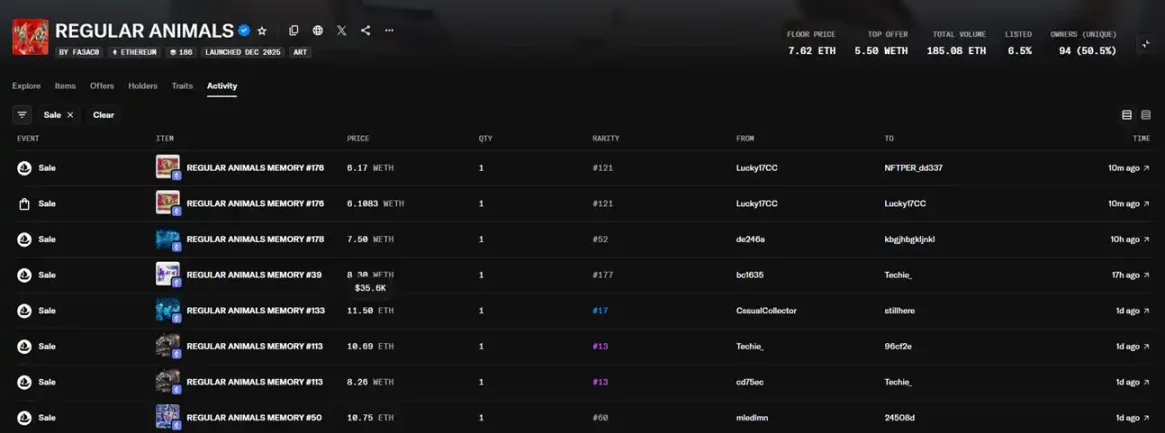
Yesterday, multiple Regular Animals were sold on OpenSea for over 10 ETH (approximately $35,000) each. These artworks were given away for free at Art Basel, with a total of 256 pieces. At this price, beeple essentially gave away nearly ten million dollars worth of NFTs at Art Basel.
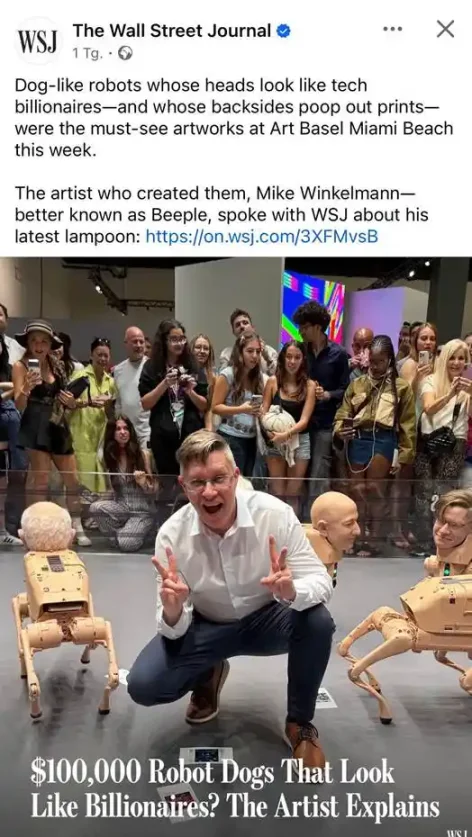
The project that beeple and his team brought to Art Basel is Regular Animals. These are robotic dogs, as shown in the image below. They look somewhat eerie because these robotic dogs have human faces, and they are faces of well-known figures such as Musk, Andy Warhol, Zuckerberg, Picasso, and even beeple himself.
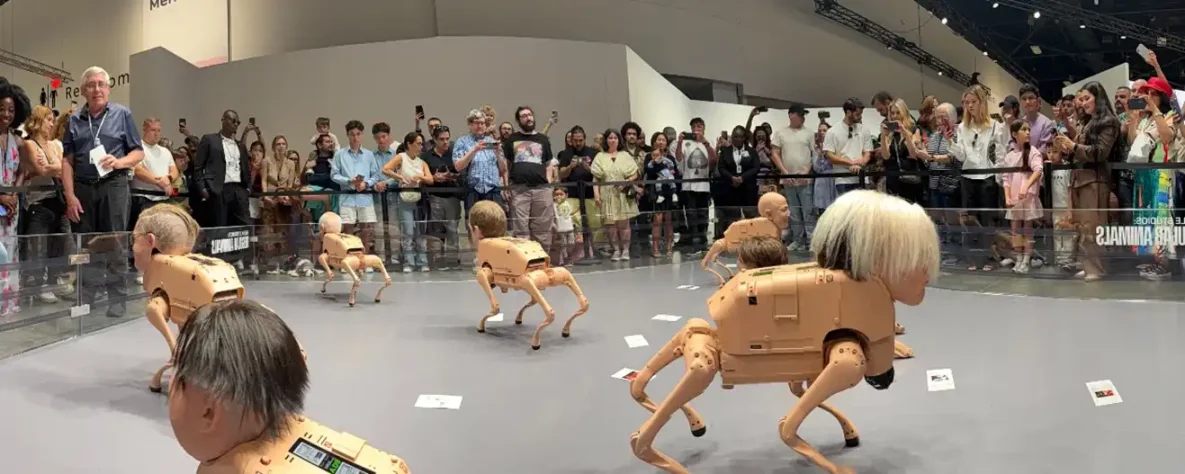
Of course, it's not just about the eerie visual effect. These robotic dogs use the cameras on their heads to observe their surroundings and employ an evolving visual algorithm to create artworks.
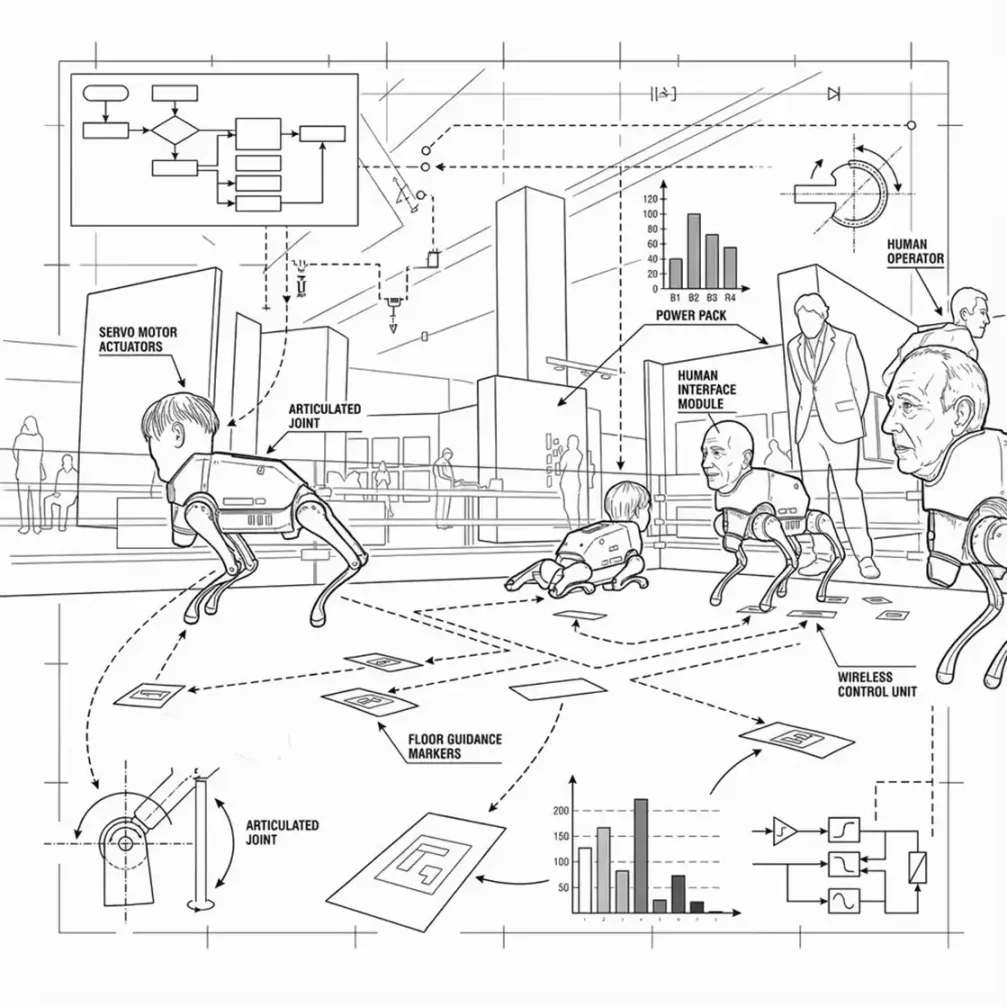
The selection of these famous figures is not arbitrary. The reason for choosing the aforementioned celebrities is that they have influenced how we view the world, whether through algorithms, art, or politics. As humans, we observe the world through these perspectives, and so do these robotic dogs. At Art Basel, these robotic dogs and humans observed each other, and each moment of observation became an artwork created by the robotic dogs. These artworks are also like autobiographies of these robotic dogs.

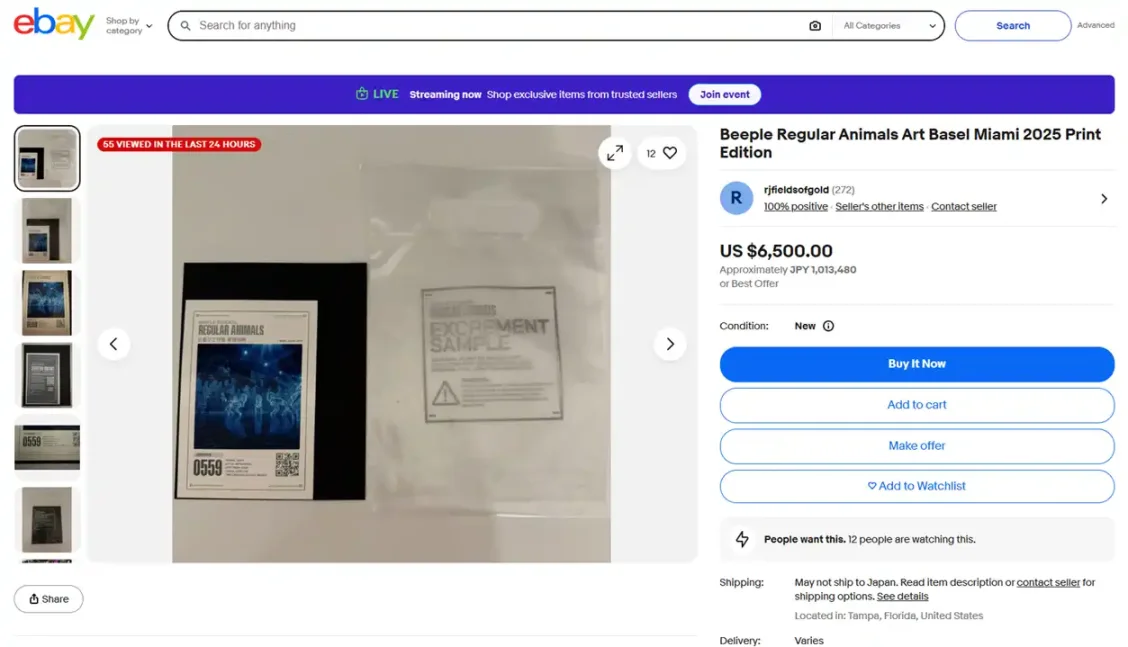
Interestingly, Regular Animals also has a physical series, with a total of 1,024 pieces. On eBay, someone has already listed one for a fixed price of $6,500. The market's valuation is that NFTs are far more valuable than physical paintings, reminiscent of Damien Hirst's "The Currency" series years ago, which forced owners to choose between physical and NFT versions.
Before achieving great success in the NFT field, beeple had been creating art every day since 2007 but had never sold anything for more than $100. After gaining fame and fortune, beeple did not squander it like some artists or crypto project teams. Instead, he acquired a studio/gallery of about 460 square meters, built a team of dozens of 3D artists, engineers, and researchers (even including a former Boeing engineer), invited Carolyn Christov-Bakargiev, the former director of the Castello di Rivoli Museum of Contemporary Art, as an advisor, and continuously exhibited at art shows around the world while creating new artworks.

This exhibition of beeple's robotic dogs has not only gained attention in the crypto circle due to its price but has also been covered by traditional media outlets like WSJ.
Domande pertinenti

QWho is Beeple and what is he known for in the NFT world?

ABeeple is an artist who gained fame for selling an NFT for $69 million, symbolizing the golden era of NFTs.

QWhat is the name of Beeple's latest NFT project featured at the Basel Art Show?

ABeeple's latest project is called 'Regular Animals,' which features robotic dogs with human faces of famous personalities.

QHow many Regular Animals NFTs were distributed for free at the Basel Art Show, and what was their estimated total value?

A256 Regular Animals NFTs were distributed for free at the Basel Art Show, with an estimated total value of nearly $9 million based on secondary market sales.

QWhat unique ability do the Regular Animals robotic dogs have?

AThe Regular Animals robotic dogs use cameras to observe their surroundings and employ an evolving visual algorithm to create artworks, which serve as their autobiographies.

QHow has Beeple's approach to his career evolved since his NFT success?

ABeeple has established a large studio, assembled a team of artists and engineers, and continues to create and exhibit artworks globally, focusing on innovation rather than extravagance.

Letture associate

Circle CEO: Stablecoins Are at the Internet's 2002 Stage, Will Reach Trillions of Dollars in the Future

Circle CEO Jeremy Allaire, in a Q2 2026 earnings AMA, discussed the current state and future of stablecoins and Circle's strategy. He compared stablecoins today to the internet in 2002, predicting they will grow from hundreds of billions to trillions of dollars. Key points include: * **Current Use Cases**: Stablecoins have achieved product-market fit in digital asset markets (for trading/settlement), as a digital dollar store of value in emerging markets, and for cross-border payments and settlement. * **Future Growth Areas**: Allaire highlighted opportunities in the AI agent economy, merchant payments (especially via QR codes and stablecoin cards), and the convergence of traditional and on-chain finance. * **Circle's Strategy**: Circle aims to grow USDC through global partnerships. Its economic engines will include reserve income, transaction fees from its on-chain payment network (CPN), and its upcoming "economic operating system," Arc. * **Arc's Vision**: Arc, launching its mainnet on September 16, is a stablecoin-native blockchain designed for seamless user and developer experience. It aims to power the future "on-chain" economy where businesses and AI agents operate. * **Global Adoption**: Allaire emphasized that stablecoin adoption is a global phenomenon, driven by regulatory clarity in regions like Europe (MiCA) and the US (GENIUS Act), and will continue regardless of specific US legislation like the CLARITY Act. * **EURC Growth**: Circle's euro stablecoin, EURC, has surpassed €400 million in circulation, benefiting from early preparation for European regulations and existing distribution networks. Allaire expressed confidence in Circle's execution, citing strong team cohesion and the adoption of AI tools, while identifying cybersecurity and global local operations as key areas for continued strengthening.

marsbit14 min fa

Circle CEO: Stablecoins Are at the Internet's 2002 Stage, Will Reach Trillions of Dollars in the Future

marsbit14 min fa

With Revenue 3.8 Billion Lower Than CXMT, Net Profit Is 8.6 Billion Higher: What Secrets Are Hidden in YMTC's IPO?

Chinese NAND flash giant Changcun Holdings has submitted its IPO prospectus to the Shanghai Stock Exchange. In Q1 2026, the company reported revenue of 47.042 billion yuan and a net profit attributable to parent company shareholders of 33.379 billion yuan. This presents a striking contrast with its competitor Changxin Technology, which had higher revenue (50.8 billion yuan) but a significantly lower net profit of 24.762 billion yuan. The key to this discrepancy lies in their ownership structures of core assets. Changcun Holdings fully owns its main operating entity, Yangtze Memory Technologies Co., Ltd., allowing nearly all group profits to flow to the parent company. In contrast, Changxin Technology controls but does not fully own its key production subsidiaries, meaning a substantial portion of its consolidated profits (approximately 8.25 billion yuan in Q1 2026) belongs to minority shareholders, reducing its reported net profit. Despite Changcun's higher net profit, its pre-IPO valuation is estimated lower than Changxin's. Analysts attribute this to differing market expectations: Changxin, focused on DRAM and the high-growth HBM market for AI servers, is seen as having greater long-term growth potential. Changcun, while dominant in NAND flash, operates in a market with inherent size constraints, making its future valuation more dependent on successfully upgrading its product mix toward higher-value segments like enterprise SSDs.

marsbit25 min fa

With Revenue 3.8 Billion Lower Than CXMT, Net Profit Is 8.6 Billion Higher: What Secrets Are Hidden in YMTC's IPO?

marsbit25 min fa

Perpetual Contract Liquidation Wave Resurges, Bitcoin $62k - $67k May Become the 'Disaster Zone'

A wave of liquidations has hit the crypto perpetual futures market, with analysts warning of continued volatility. Following Bitcoin's drop below $76,000 and subsequent rebound, over $84 million in long positions were liquidated in one hour, demonstrating the amplified impact of leverage. The U.S. CFTC's recent approval of a spot Bitcoin perpetual contract on the Kalshi exchange has opened this "previously closed" asset class to American institutions, with the platform reporting $5.5 billion in volume in its first two weeks. However, critics like Better Markets warn that perpetuals are "among the most dangerous crypto products" for retail investors due to a lack of enhanced protections. Recent price action saw a massive $529 million in hourly liquidations, predominantly longs. Analysts note that while a $3.3 billion short squeeze cleared liquidity above $80,000, a significant pool of long liquidations now sits between $62,000 and $67,000, posing a downside risk if key resistance holds. Experts caution new traders against using leverage or options, which can expire worthless, without proper experience and risk management. Despite the dangers, the demand for leveraged products persists, with some institutional players preferring on-chain platforms for their transparency and self-custody. As Kalshi expands its perpetual offerings beyond crypto, the core warning remains: leverage can lead to sudden, severe losses for unprepared investors.

marsbit25 min fa

Perpetual Contract Liquidation Wave Resurges, Bitcoin $62k - $67k May Become the 'Disaster Zone'

marsbit25 min fa

Trading

Spot
活动图片