Author: CoinFound
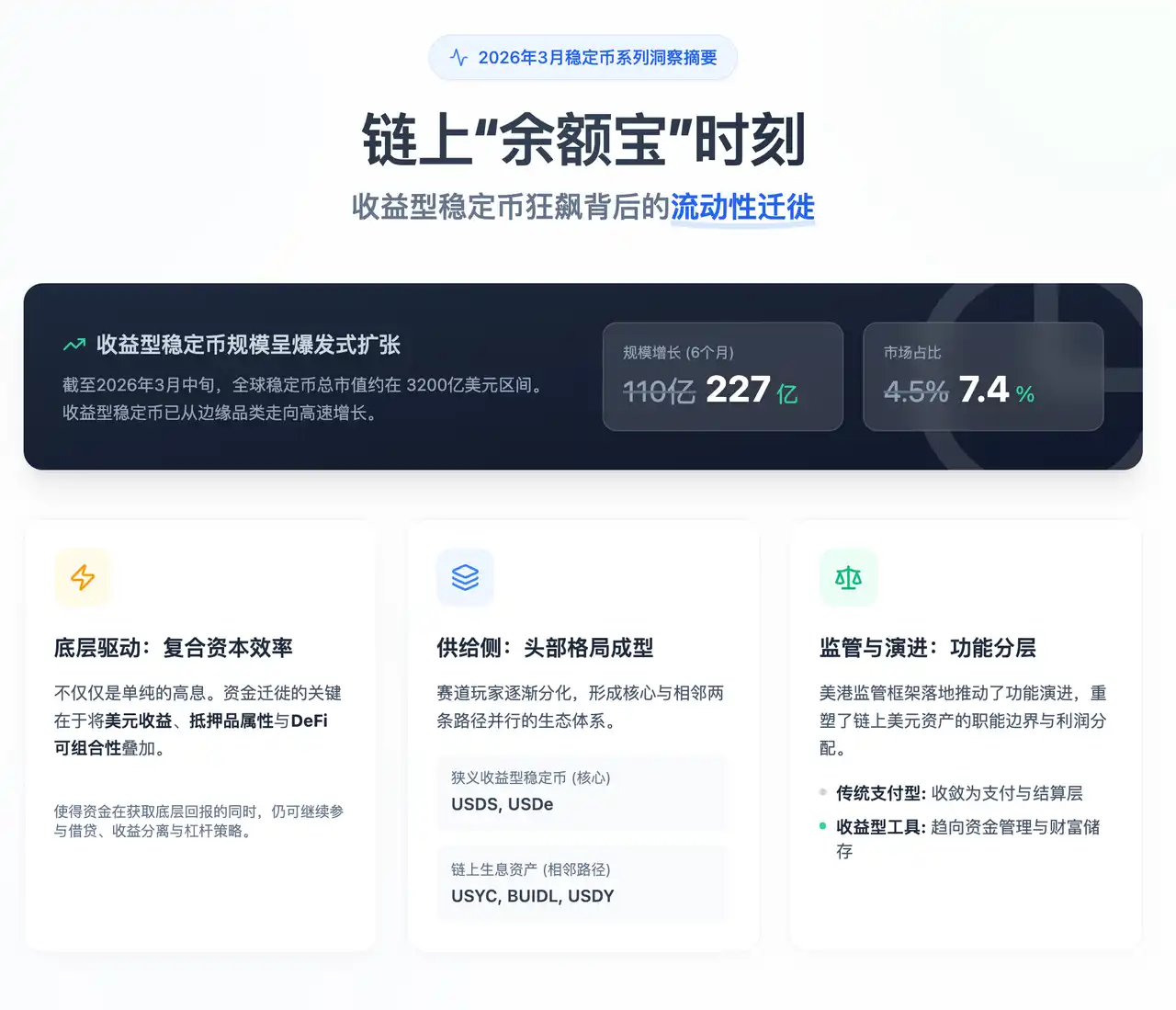
For a long time, the core role of stablecoins in the market has been more like an on-chain dollar settlement tool: it serves as a medium of exchange, a safe-haven asset, a tool for cross-border transfers, and the foundation of DeFi liquidity, making it the most important "silent infrastructure" in the crypto ecosystem. However, starting in 2026, a deeper structural shift began to emerge in this sector: an increasing amount of capital is no longer satisfied with simply "holding a dollar-pegged asset," but instead seeks to "hold an on-chain dollar asset that can continue to generate yield, be used as collateral, nested, and participate in strategic combinations."
The latest CoinFound research, "The On-Chain 'Yu'ebao' Moment: The Liquidity Migration Behind the Surge of Yield-Bearing Stablecoins," points out that yield-bearing stablecoins have moved from a niche category to rapid growth. As of mid-March 2026, the total market capitalization of global stablecoins is approximately $320 billion; the scale of yield-bearing stablecoins is about $22.7 billion, a significant increase from about $11 billion roughly six months ago. Their share of the overall stablecoin market has also risen from about **4.5%** to approximately 7.4%.
This is not an ordinary market rotation, nor is it simply a case of "high-yield products attracting short-term capital." At a deeper level, this is a major liquidity migration centered around capital efficiency, control over funds, and the logic of on-chain asset management.
Why Have Yield-Bearing Stablecoins Nearly Doubled in Six Months?
If one only looks at the surface phenomenon, many would naturally conclude: because they offer higher yields.
But this conclusion only explains the phenomenon, not the structure.
Because in the market environment of March 2026, centralized exchanges and traditional compliant platforms can also offer stablecoin yield products with not-low returns. Top platforms can even provide quite attractive APRs for assets like USDC and USDe during specific periods. For ordinary users, these products have obvious advantages: lower barriers to entry, simpler operation, no need to manage private keys, and no exposure to on-chain interaction risks, Gas costs, or smart contract risks.
If the market were purely profit-driven, then theoretically, capital should remain more within exchange wealth management products, rather than venturing into the on-chain environment to bear higher complexity and higher risks.
But the reality is恰恰相反—over $22.7 billion in capital is continuously migrating towards yield-bearing stablecoins.
This indicates that what is truly driving this round of explosion is not the surface-level yield, but a higher level of composite capital efficiency.
The Core is Not "High Interest," but "Yield + Liquidity + Composability"
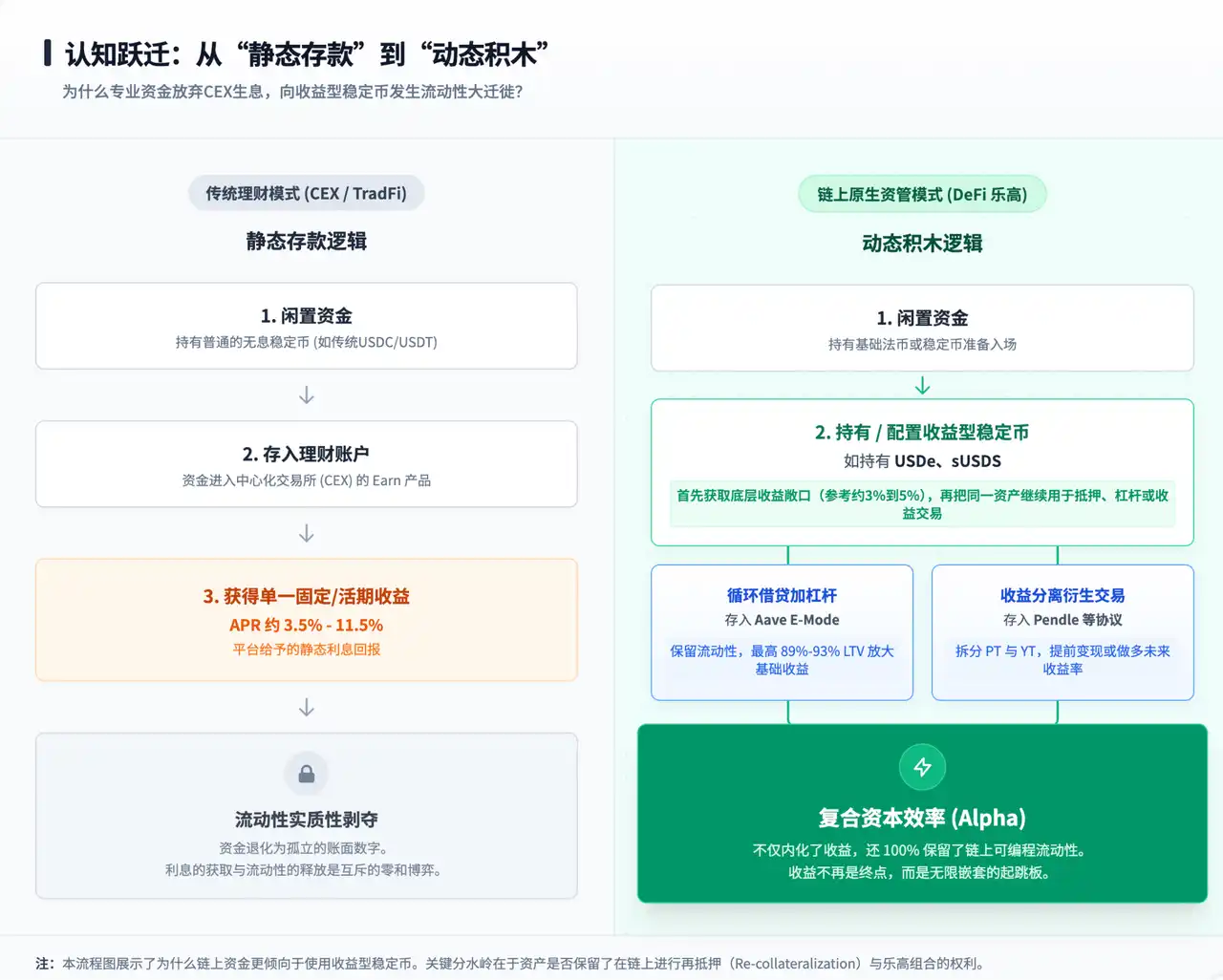
The traditional CEX yield model is essentially closer to "static deposits."
Users deposit funds and receive fixed or floating returns, but in return, they surrender the liquidity and usage rights of those funds. Funds in a wealth management state typically cannot simultaneously serve as margin to open derivative positions, continue to provide liquidity for DeFi protocols, or be repeatedly called upon in lending, yield splitting, or leverage loops.
The underlying design of yield-bearing stablecoins changes precisely this point.
It encapsulates the "right to yield" directly into the token itself, making this type of asset not just a yield-bearing vehicle, but also a "dynamic building block" on the chain that can continue to be used as collateral, nested, lent, traded, and recombined.
In other words, users hold not a static dollar amount, but an asset that can both continuously generate yield and continue to participate in on-chain capital operations.
This is the true underlying logic of this liquidity migration:
What capital values is not just the surface returns of 4%, 5%, or 8%, but rather retaining the full on-chain liquidity and strategic space while holding an asset.
This type of asset can:
-
Serve as collateral in lending protocols
-
Be split into principal and yield rights for further trading
-
Become derivative margin
-
Be embedded in protocol treasuries and DAO balance sheets
-
Amplify capital efficiency through cycles across multiple protocols
In other words, yield-bearing stablecoins are not the "end pool" for on-chain capital, but a new springboard.
The Main Force Behind This Migration is Not Ordinary Retail Investors, but Professional On-Chain Capital
Looking at the capital profile, the driving force behind the surge of yield-bearing stablecoins is not scattered retail investors, but rather two core groups:
1. Professional DeFi Players
This type of capital is extremely sensitive to "capital efficiency."
They are not satisfied with single returns but tend to use yield-bearing stablecoins as core collateral, injecting them into lending protocols or yield trading protocols to amplify their yield exposure through looping, nesting, and structured strategies.
In this system, the importance of yield-bearing stablecoins lies not just in "being able to generate yield," but also in the fact that they are both a yield-bearing base position and a fuel for callable strategies.
2. Native On-Chain Institutions and Protocol Treasuries
Institutional capital such as DAO Treasuries, protocol reserves, on-chain funds, and quantitative market makers are also accelerating their embrace of this type of asset.
The reason is simple: they need a cash management tool that can be directly held and utilized on-chain, possesses a certain level of yield generation capability, liquidity efficiency, and relative stability.
For these institutions, funds cannot be left idle long-term in non-yielding ordinary stablecoins, nor is it suitable to rely entirely on CEX wealth management products. The emergence of yield-bearing stablecoins恰好填补了 the gap for "money fund-like" assets in the on-chain world.
Who is Absorbing This Wave of Ten-Billion-Dollar Liquidity?
Looking at the current landscape, the core players in the narrow definition of yield-bearing stablecoins are primarily crypto-native systems represented by USDS / sUSDS, USDe / sUSDe; while products represented by USYC, BUIDL, USDY constitute adjacent paths for on-chain dollar yield-bearing assets.
Although both types of assets are competing for "on-chain dollar yield capital," their legal structures, compliance attributes, and product positioning are not identical.
Three Main Yield Paths: Where Does the Money Actually Come From?
This is the core question of the market.
The yield behind the $22.7 billion scale cannot be generated out of thin air. CoinFound research categorizes the current mainstream paths in the market into three types:
Path One: RWA Mapping Model
This model uses traditional financial assets such as US short-term Treasury bonds and bank overnight repos as its core underlying.
In essence, it maps the dollar interest yield from the real world onto the chain through trusts, funds, or tokenization structures.
The characteristics of this path are:
-
Relatively stronger compliance
-
Risk profile closer to traditional dollar cash management tools
-
Clear source of yield, primarily from US Treasury interest and money market returns
As shown in the first image corresponding to this section, the essence of this path is:
The money comes from real-world dollar coupons.
Path Two: Delta Neutral / Synthetic Dollar
This is the path with the strongest crypto-native color, and also the most complex and flexible path.
Its core idea is to package spot or staked assets with derivative short hedges to construct a synthetic asset that approximates a dollar peg.
Yield mainly comes from:
-
Underlying staking yield
-
Funding rate / basis yield in perpetual or futures markets
A representative of this model is the Ethena synthetic dollar system.
Its advantages lie in:
-
Extremely strong composability
-
Higher yield elasticity
-
Easier integration into the DeFi ecosystem
However, its yield is also more dependent on market structure, leverage demand, and derivative liquidity.
It performs stronger in bull markets and faces greater pressure when the market cools.
Path Three: Native On-Chain Staking派
This path directly uses the staking yield of native assets on PoS public chains as its underlying.
The issuer uses financial engineering to convert the staking returns of assets like ETH, after hedging and repackaging, into a more stable dollar-denominated yield tool.
It does not rely on US Treasury coupons, nor does it depend entirely on funding rates; instead, it更直接地来源于 the "consensus rewards" of the blockchain system itself.
A Leading格局 Has Formed, Supply Side is Concentrating
Looking at the current landscape, the格局 of leading players is already relatively clear.
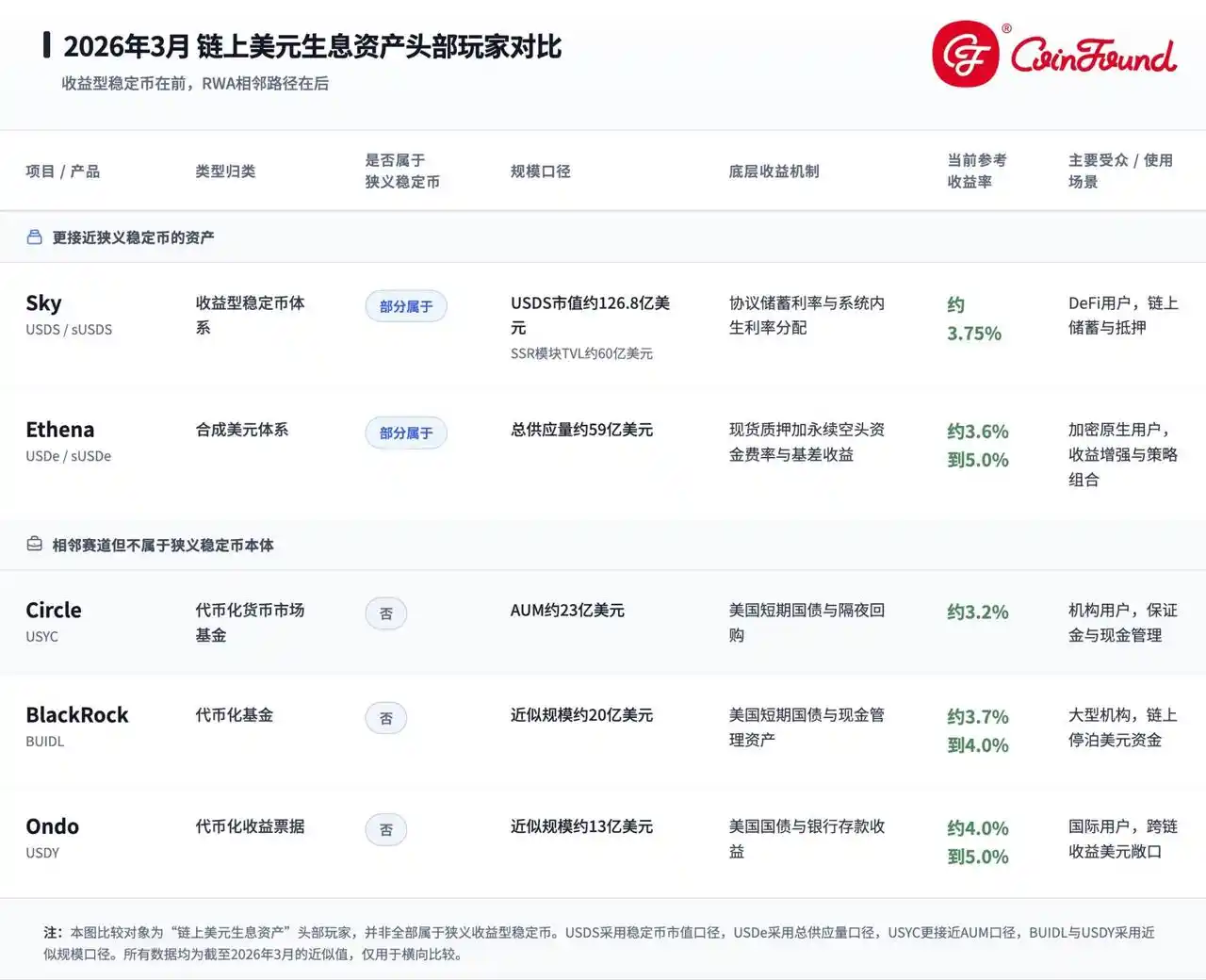
Sky (USDS / sUSDS)
Sky is one of the entities closest to a "protocol-internal bank" in the current yield-bearing stablecoin system.
Its moat is not just scale, but the integration of stablecoins, savings rates, collateral systems, and DeFi composability within the same protocol framework, creating strong systemic stickiness.
Ethena (USDe / sUSDe)
Ethena is the most representative player on the synthetic dollar path.
Its real advantage lies in its deep integration with DeFi infrastructure like Aave and Pendle, making USDe / sUSDe not just a yield product, but also a high-frequency collateral and strategic asset within the entire DeFi ecosystem.
Circle USYC
USYC is closer to an on-chain money market fund than a狭义 yield-bearing stablecoin itself.
Its strength is not in "higher yield," but in leveraging Circle's B2B channels and institutional distribution capabilities, giving it极强的穿透力 in institutional cash management and margin scenarios.
BlackRock BUIDL
BUIDL is a typical institutional on-chain fund product.
It represents the path where traditional asset management giants bring dollar cash management products on-chain. It is more suitable as an on-chain parking asset for large institutions rather than a general-purpose payment stablecoin.
Ondo USDY
USDY provides exposure to on-chain yield notes, positioning itself more towards globalization, multi-chain distribution, and the long-tail market.
It is also competing for on-chain dollar yield capital, but its legal attributes are closer to note-type assets rather than stablecoins themselves.
The Market is Structurally Differentiating: Payment Layer vs. Asset Management Layer
More值得注意的是, the rise of yield-bearing stablecoins does not mean they will completely replace USDT or USDC.
On the contrary, the market is moving towards a clearer stratification:
-
Traditional Payment Stablecoins: Further converge into the payment and settlement layer
-
Yield-Bearing On-Chain Dollar Tools: Gradually take on the capital management and wealth storage layer
This means the stablecoin market is shifting from the past model of "one asset handling all functions" to a货币层次结构 similar to the traditional financial system:
-
One category responsible for circulation
-
One category responsible for storage and appreciation
-
One category responsible for institutional cash management and yield absorption
Yield-bearing stablecoins have not eliminated traditional stablecoins,
but they are reshaping the boundaries, functions, and profit distribution methods of on-chain dollar assets.
Regulation Drives Functional Stratification, Interest Spreads Begin Redistribution
This change is not just spontaneous market evolution; regulatory factors are deeply driving it from behind.
As stablecoin regulatory frameworks in the US and Hong Kong gradually land, payment stablecoins are being more clearly restricted to the role of "payment管道."
In this regulatory environment, payment stablecoins emphasize more:
-
100% high-quality liquid asset backing
-
Redemption at par value
-
Prohibition of direct interest payments to holders
This means that the reserve interest spread long独占 by traditional stablecoin issuers is now facing new challenges.
In the past, ordinary holders bore asset and credit risks but could not share in the interest收益; with the emergence of yield-bearing on-chain dollar tools, the market is beginning to see a new mechanism for profit redistribution:
Part of the reserve收益 that originally belonged to the issuers is being重新分配给 holders and on-chain capital.
This is one of the deepest institutional significances of yield-bearing stablecoins.
Conclusion: The On-Chain 'Yu'ebao' Moment is Being Previews on the Institutional Side
Looking back from the vantage point of March 2026, the $22.7 billion leveraged by yield-bearing stablecoins over the past six months is not an isolated number.
What it represents behind the scenes is a change in capital consciousness within the crypto world: capital is no longer satisfied with holding a "static dollar," but is beginning to pursue a "dynamic dollar" that can preserve value, generate yield, and continuously participate in on-chain strategies.
This is precisely the on-chain world's "Yu'ebao moment."
It does not mean that traditional payment stablecoins will lose their地位, nor does it mean that all on-chain dollars will become yield-bearing.
But it clearly indicates that the future competition in the stablecoin world is no longer just about scale or payment network competition, but rather:
Who can承接 on-chain wealth storage, who can provide higher capital efficiency, and who can find a better balance between compliance and composability.