The On-Chain Evolution of Private Credit: From Ledgers to Investable Products

深潮Pubblicato 2025-12-18Pubblicato ultima volta 2025-12-18

Introduzione

Private credit is undergoing a significant on-chain evolution, transitioning from a ledger-based operational upgrade to a distributable, investable product. While the total value of tokenized private credit has surged to around $24 billion, only 12% of the $19.3 billion in active loans tracked on RWA.xyz are held in transferable tokenized form. The market is split between "representative" tokenization—where blockchain serves as a transparent record-keeping system for off-chain loans—and "distributable" tokenization, where loans are natively issued and held as transferable tokens on-chain. The latter is growing rapidly, offering benefits like enhanced liquidity, faster settlement, and improved transparency. Figure dominates the market with a 73% share but uses blockchain only for record-keeping. In contrast, platforms like Maple are driving the shift toward fully distributable tokenized credit. This shift could standardize and scale private credit distribution by reducing intermediation, enabling programmable compliance, and improving portability—key advancements for an asset class that represents less than 2% of the $1.6 trillion global private credit market.

Author: Prathik Desai

Compiled by: Block Unicorn
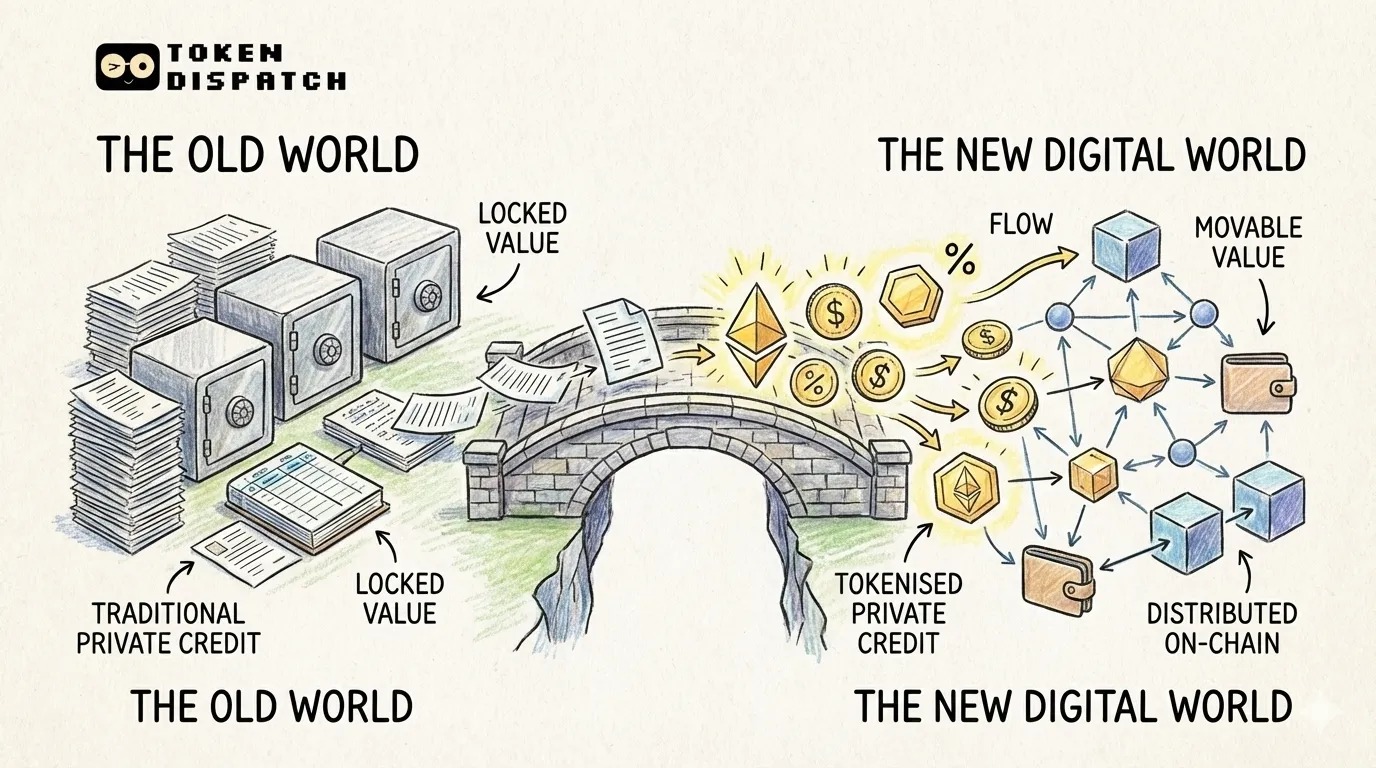
Preface

On tokenized real-world asset (RWA) platforms, private credit is at a pivotal moment. Over the past year, tokenized private credit has been the fastest-growing category, surging from less than $50,000 to approximately $2.4 billion.

If stablecoins (whose payment channels cover all on-chain activities) are excluded, tokenized private credit ranks second only to on-chain commodities. Top tokenized commodities include Tether and Paxos's gold-backed currencies, as well as Justoken's tokens backed by cotton, soybean oil, and corn. This appears to be a serious category, with real borrowers, cash flows, underwriting mechanisms, and yields—and it is less dependent on market cycles compared to commodities.

But the story only becomes complex when you dig deeper.

This $2.4 billion in outstanding tokenized private credit represents only a small fraction of the total outstanding loans. This suggests that only a portion of these assets can truly be held and transferred on-chain in tokenized form.

In today's article, I will examine the reality behind the numbers of tokenized private credit and what these numbers mean for the future of this category.

Let's dive right in.

The Dual Nature of Tokenized Private Credit

The total active loans on the RWA.xyz platform are slightly over $19.3 billion. However, only about 12% of these assets can be held and transferred in tokenized form. This highlights the dual nature of tokenized private credit.

One aspect is "representative" tokenized private credit, where the blockchain merely provides operational upgrades by establishing an on-chain ledger of outstanding loans recorded from the traditional private credit market. The other aspect is the distribution upgrade, where blockchain-driven markets coexist with traditional (or off-chain) private credit markets.

The former is used solely for recording and reconciliation, documented on a public ledger. The latter, however, can be transferred to wallets for transactions.

Once you understand this classification system, you won't ask whether private credit is on-chain. Instead, you'll pose a sharper question: How much private credit originates from the blockchain? The answer to this question might offer some insights.
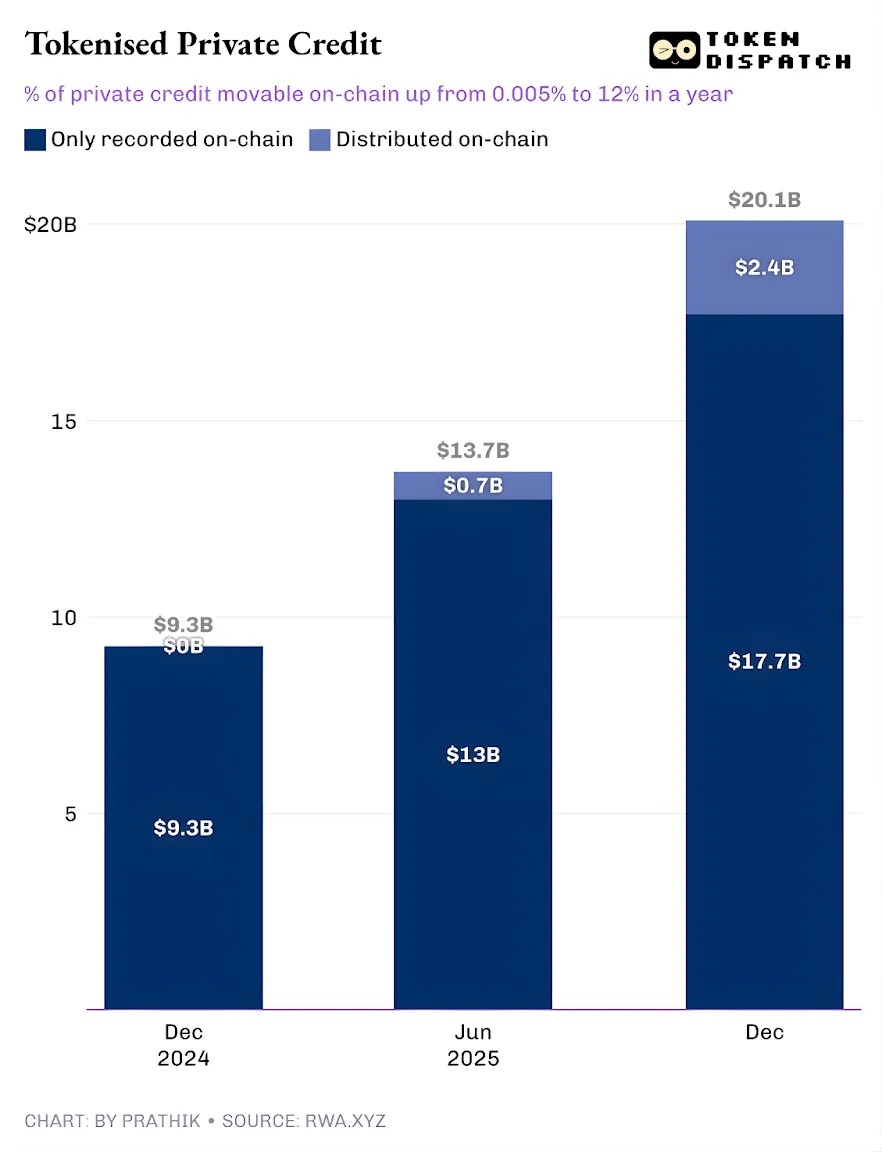
The trajectory of tokenized private credit is encouraging.

Until last year, almost all tokenized private credit was merely an operational upgrade. The loans already existed, borrowers made timely payments, platforms operated normally, and the blockchain simply recorded these activities. All tokenized private credit was only recorded on-chain and could not be transferred as tokens. Within a year, this share of on-chain transferable assets has climbed to 12% of the total trackable private credit.

It showcases the growth of tokenized private credit as a distributable on-chain product. This enables investors to hold fund shares, pool tokens, notes, or structured investment exposures in tokenized form.

If this distributed model continues to expand, private credit will no longer resemble a loan ledger but rather an investable on-chain asset class. This shift will change the benefits lenders derive from transactions. Beyond yields, lenders will gain a tool with greater operational transparency, faster settlement, and more flexible custody. Borrowers will access funding that isn't dependent on a single distribution channel, which could be highly beneficial in risk-averse environments.

But who will drive the growth of the distributable private credit market?

The Figure Effect

Currently, the majority of outstanding credit comes from a single platform, while the rest of the ecosystem forms a long tail.

Since October 2022, Figure has dominated the tokenized private credit market, but its market share has dropped from over 90% in February to 73% today.
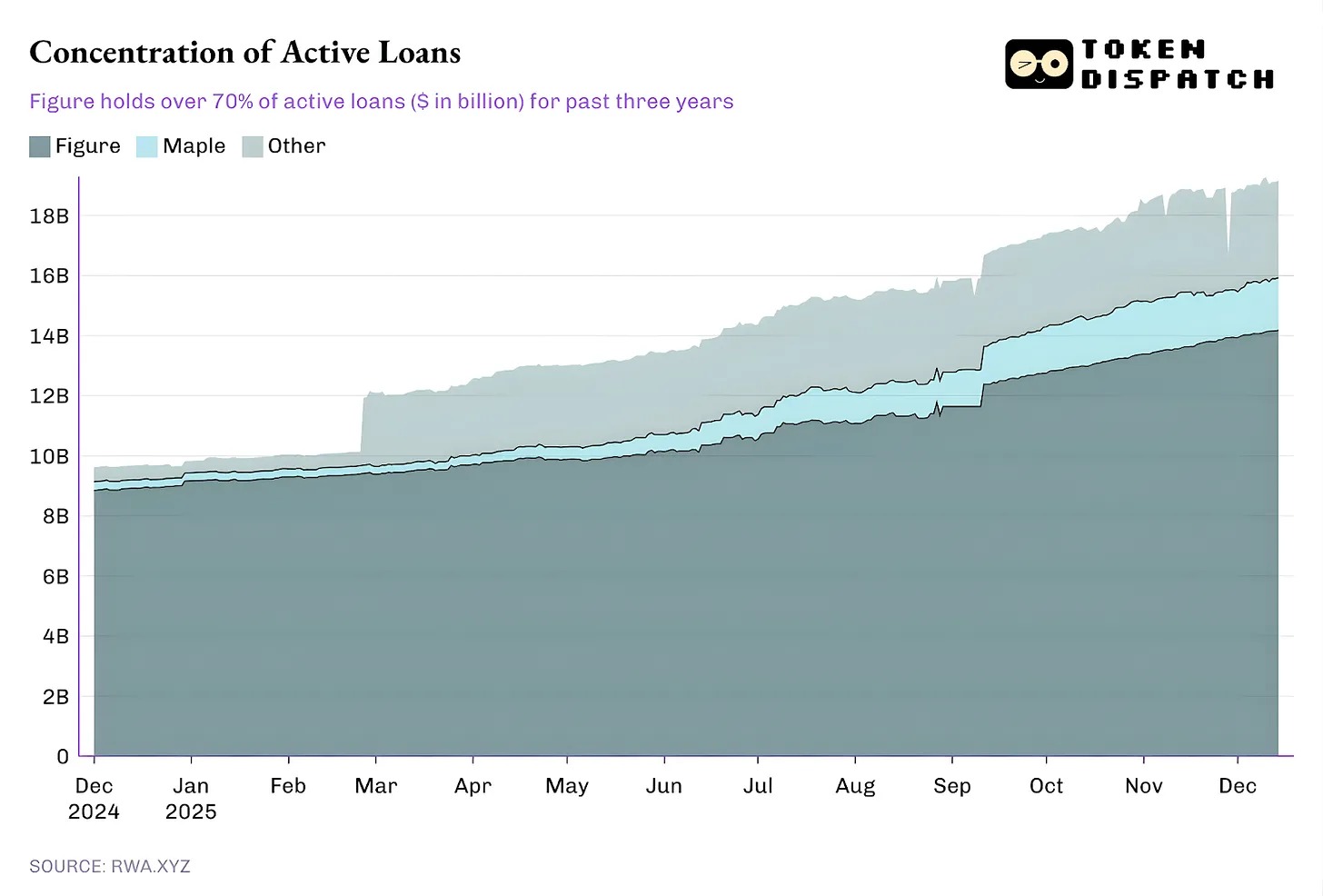
But what's more interesting is Figure's private credit model.

Although tokenized private credit now exceeds $14 billion, all the value of this industry leader is reflected in "representative" asset value, while the distributed value remains zero. This indicates that Figure's model is an operational pipeline that records loan issuance and ownership on the Provenance blockchain.

Meanwhile, some smaller players are driving the distribution of tokenized private credit.
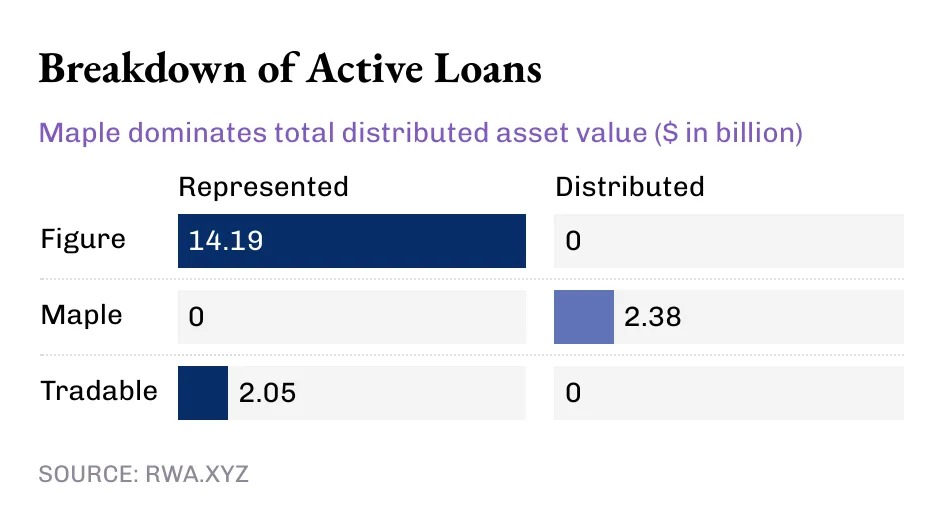
Figure and Tradable hold all their tokenized private credit as representative value, while Maple's value is entirely distributed via the blockchain.

From a macro perspective, the vast majority of the $19 billion in active on-chain loans are recorded on the blockchain. But the trend over the past few months is undeniable: more and more private credit is being distributed via blockchain. Given the immense growth potential of tokenized private credit, this trend will only intensify.

Even at $19 billion, RWAs currently account for less than 2% of the total $1.6 trillion private credit market.

But why is "movable, not just recorded" private credit important?

Movable private credit offers more than just liquidity. Gaining exposure to private credit off-platform through tokens provides portability, standardization, and faster distribution speed.

Assets acquired through traditional private credit channels trap holders within a specific platform's ecosystem. Such ecosystems have limited transfer windows and cumbersome secondary market trading processes. Additionally, secondary market negotiations are slow and primarily led by professionals. This gives existing market infrastructure far more power than asset holders.

Distributable tokens can reduce these frictions by enabling faster settlement, clearer ownership changes, and simpler custody.

More importantly, "movability" is a prerequisite for the large-scale standardized distribution of private credit, which has historically been lacking. In the traditional model, private credit appears in the form of funds, business development companies (BDCs), and collateralized loan obligations (CLOs), each adding multiple layers of intermediaries and opaque fees.

On-chain distribution offers a different path: programmable wrappers enforce compliance (whitelisting), cash flow rules, and information disclosure at the tool level, rather than through manual processes.


Domande pertinenti

QWhat is the current size of the tokenized private credit market, and how does it compare to the total outstanding private credit market?

AThe tokenized private credit market has grown to approximately $24 billion. However, this represents only a small fraction, about 1.2%, of the total $1.6 trillion private credit market.

QWhat is the key difference between 'representative' and 'distributable' tokenized private credit?

A'Representative' tokenized private credit uses the blockchain solely as an operational upgrade to record and reconcile loans from the traditional market on a public ledger. 'Distributable' tokenized private credit allows the assets to be held and transferred as tokens, enabling them to be portable and traded in a blockchain-driven market.

QWhich company is the current market leader in tokenized private credit, and what is unique about its model?

AFigure is the current market leader, holding 73% of the tokenized private credit market. Its model is unique because its entire $14+ billion in value is classified as 'representative' value, meaning the loans are recorded on the Provenance blockchain for operational purposes but are not distributable as transferable tokens.

QWhat are the potential benefits of 'distributable' tokenized private credit over traditional private credit instruments?

ADistributable tokenized private credit offers benefits such as portability, faster settlement, clearer ownership changes, simpler custody, and the potential for standardized, large-scale distribution. It reduces reliance on a single platform's ecosystem and the complex, slow processes of traditional secondary markets dominated by intermediaries.

QWhat does the growth of the distributable segment indicate for the future of private credit?

AThe growth of the distributable segment indicates a shift where private credit is evolving from being a simple on-chain ledger of loans into a true, tradable asset class. This transformation promises greater operational transparency, faster settlement, and more flexible custody options for lenders, while providing borrowers with access to capital that is not reliant on a single distribution channel.

Letture associate

From South Korea to the United States: Blue-Collar Jobs Are Becoming Increasingly Popular, Thanks to AI

AI is reshaping the labor market's value proposition. The traditional four-year college degree is losing its appeal as a guaranteed career path, while skilled blue-collar trades like electricians, welders, and plumbers are experiencing historic demand and wage premiums. This shift is driven by dual pressures: AI's displacement of certain white-collar roles and a booming need for physical infrastructure and data center construction. Data confirms the trend. In the U.S., vocational school revenue surged, and a significant portion of recent layoffs are AI-related. Surveys show a majority of Gen Z adults plan to pursue blue-collar work, citing better job security against AI automation. Vocational education interest has exploded recently. Experts cite a psychological shift as younger generations seek tangible, AI-resistant careers and avoid high student debt. In many cases, salaries for skilled trades now match or exceed those requiring a bachelor's degree. In South Korea, semiconductor vocational high schools boast near-total employment, with graduates securing high-paying roles at companies like Samsung. The shortage is structural, exacerbated by a retiring baby boomer workforce and massive infrastructure projects. Companies like JPMorgan Chase, Meta, and Lowe's are investing heavily in training programs. However, overcoming historical stigma and a "perception gap" around trade careers remains a key challenge to closing the talent gap.

marsbit35 min fa

From South Korea to the United States: Blue-Collar Jobs Are Becoming Increasingly Popular, Thanks to AI

marsbit35 min fa

Qualcomm: AI Hype Subsides, When Will Smartphones Emerge from the Gloom?

Qualcomm reported its Q3 FY2026 results (ending June 2026), with revenue of $9.95B, down 4% YoY but above expectations. Gross margin declined to 53.1%, pressured by rising costs across manufacturing and memory. Key business segments showed mixed performance: Handset revenue fell 19.6% YoY to $5.09B, dragged by an 11% decline in non-Apple Android shipments and weaker high-end mix. Conversely, Automotive revenue surged 61% to $1.59B, and IoT grew 9% to $1.83B. Core operating profit dropped 41% YoY due to margin compression and higher expenses. Management's Q4 FY2026 guidance projects revenue of $9.7B-$10.5B, in line with consensus, but Non-GAAP EPS guidance of $2.05-$2.25 fell short of expectations. Amidst persistent weakness in its core handset market, Qualcomm is pursuing growth in AI, focusing on Edge AI (smartphones, PCs, automotive) and Data Center AI. Its data center strategy includes four pillars: AI accelerators (e.g., AI200), commercial CPUs (Dragonfly C1000), custom silicon, and connectivity solutions. While these initiatives initially boosted its stock, concerns over AI capital expenditure sustainability have since erased those gains. The company targets $5B in data center revenue for FY2027 and $15B for FY2029. The report concludes that with the traditional handset business still under pressure, the data center opportunity is currently viewed as a longer-term option, and a more conservative valuation based on core operations may be warranted until AI contributions materialize.

marsbit39 min fa

Qualcomm: AI Hype Subsides, When Will Smartphones Emerge from the Gloom?

marsbit39 min fa

From TPU to Self-Evolving Agents: How Jeff Dean Predicts the Next Step in AI

At the 2026 YC Startup School, Jeff Dean outlined his vision for AI's next phase, shifting focus from simply scaling models to building intelligent, autonomous systems. He believes AI's progress is no longer just about creating smarter models, but about integrating them into systems capable of long-term, iterative work, automated experimentation, and continuous learning. This evolution moves the competition from "who has the bigger model" to "who can best organize intelligence." Dean suggests AI capabilities are now comparable to a junior engineer, enabling the automation of complex workflows. However, the true challenge and opportunity lie in managing these AI "workers" at scale. He emphasizes the importance of **context engineering**—structuring tools, memory, and feedback loops—over raw model power. For startups, this means building deep expertise in niche domains where general models currently fail (near 0-1% success rates), leveraging proprietary data, specialized tools, and domain-specific evaluators. A recurring theme is re-examining fundamental constraints. Dean's past work, like moving Google's search index to memory or creating the TPU, stemmed from questioning outdated assumptions about hardware and cost. He sees similar inflection points today, particularly in **specialized inference hardware** to drastically reduce latency and energy consumption for real-time Agent operation. Notably, he points out that in modern AI systems, the dominant cost is often not computation but **data movement**. Reliable, long-running Agents require robust system design, borrowing concepts from distributed computing like checkpointing, state management, and parallel exploration to handle failures and maintain progress over days or weeks. As AI automates execution, the scarcest human skills will shift to **defining clear specifications**, **judging what problems are worth solving** (taste), and designing effective feedback loops. Ultimately, Dean's framework prioritizes understanding the problem deeply, identifying the true bottlenecks, and systematically building closed-loop systems where AI can not only perform tasks but also improve AI itself.

marsbit39 min fa

From TPU to Self-Evolving Agents: How Jeff Dean Predicts the Next Step in AI

marsbit39 min fa

Trading

Spot
活动图片




