The New Narrative of the $5,000 Era: The 'Old King' Returns, How to Understand the Tokenization Logic of Gold?

marsbitPubblicato 2026-01-29Pubblicato ultima volta 2026-01-29

Introduzione

Amidst global macroeconomic instability and a weakening US dollar, gold has surged past $5,000 per ounce, reasserting its role as a consensus asset independent of sovereign promises. However, traditional gold ownership—either physical bullion with high storage costs and low liquidity, or paper gold/ETFs confined within centralized financial systems—fails to meet the needs of the digital age. Tokenized gold, exemplified by Tether’s XAUt, offers a solution: each token is backed 1:1 by physical gold stored in auditable vaults, combining the security of real gold with the full liquidity and composability of crypto assets. Unlike paper gold, tokenized gold operates on-chain, enabling global 24/7 transfers, fractional ownership, and integration into DeFi protocols, payments, and consumption scenarios. Platforms like imToken Web further enhance accessibility through self-custody and seamless management, allowing users to hold, trade, and even spend gold digitally. This transformation elevates gold from a static store of value to a dynamic, usable asset for the modern era—proving that true value lies in minimizing reliance on external promises.

Author: imToken

If a year ago, someone told you that gold would quickly rise to $5,000 per ounce, most people's first reaction would probably be that it was wishful thinking.

But that's exactly what happened. In just half a month, the gold market has been like a runaway horse, continuously breaking through multiple historical barriers of $4,700, $4,800, and $4,900 per ounce, and heading toward the collective market gaze of the $5,000 moment with almost no looking back.
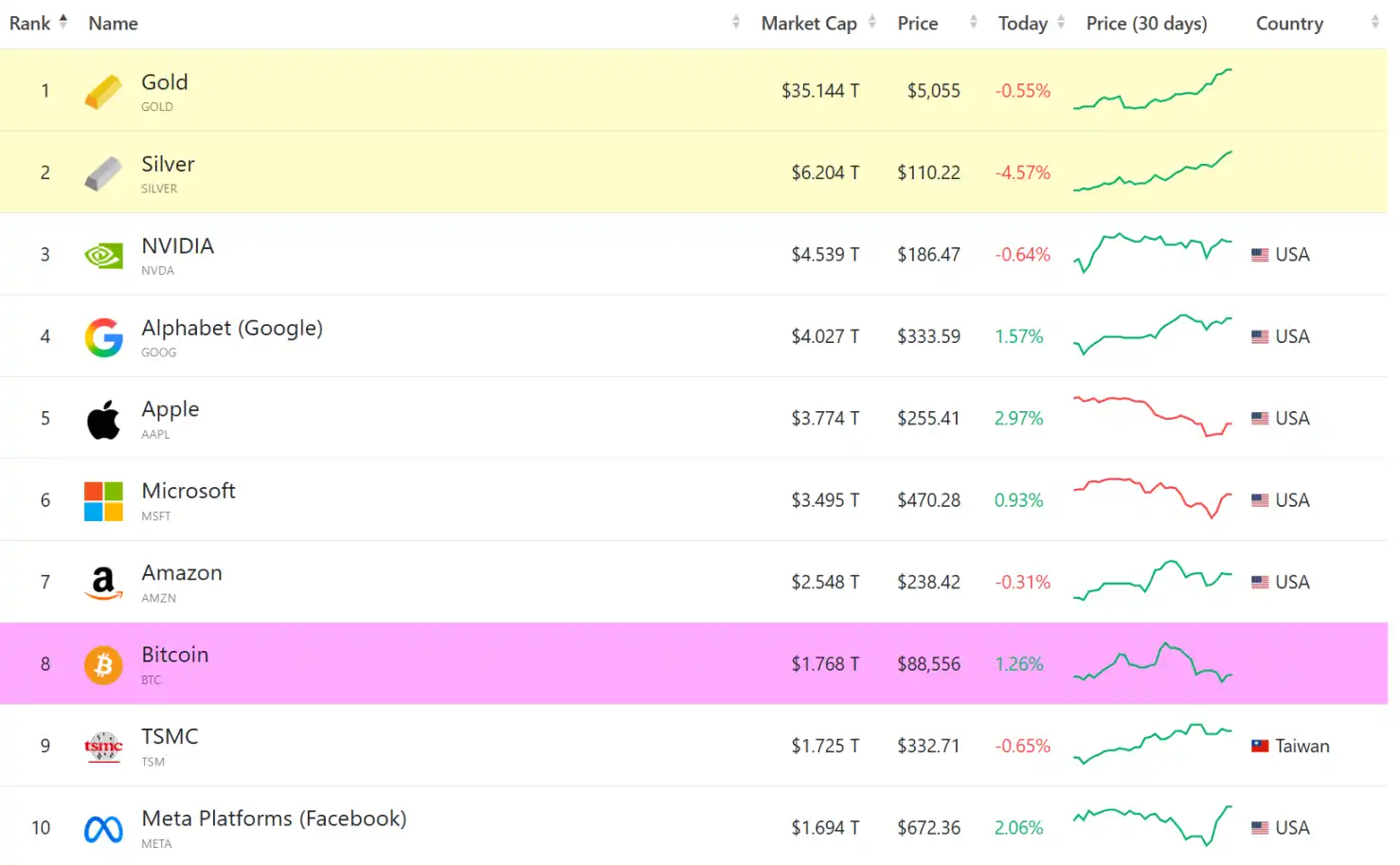
Source: companiesmarketcap.com

It can be said that after global macro uncertainties have been repeatedly verified, gold has returned to its most familiar position—as a consensus asset that does not rely on any single sovereign promise.

But at the same time, a more practical question is emerging: As the gold consensus returns, are traditional holding methods no longer able to meet the needs of the digital age?

I. The Inevitability of the Macro Cycle: The 'Old King' Returns to the Throne

From a longer macro cycle perspective, this round of gold's upward cycle is not short-term speculation but a structural return against the backdrop of macro uncertainty and a weakening U.S. dollar:

Geopolitical risks have extended from Russia-Ukraine to key resource and shipping regions such as the Middle East and Latin America; the global trade system has been repeatedly interrupted by tariffs, sanctions, and policy games; the U.S. fiscal deficit continues to expand, and the long-term stability of the U.S. dollar's credit is being discussed more frequently. In such an environment, the market will undoubtedly accelerate its search for a value anchor that does not rely on any single country's credit and does not require others' endorsement.

From this perspective, gold does not need to prove that it can generate returns; it only needs to repeatedly prove one thing: in an era of credit uncertainty, it still exists.

This also partly explains why, in this cycle, BTC, which was once expected to be 'digital gold,' has not fully assumed the same consensus role—at least in the dimension of macro hedging, the choices of funds have already provided the answer, which will not be elaborated here (extended reading: 'From Trustless BTC to Tokenized Gold: Who Is the Real 'Digital Gold'?').

However, the return of the gold consensus does not mean that all problems have been solved. After all, for a long time, investors have almost had to choose between two imperfect holding methods.

The first is physical gold, which is secure and sovereign but almost illiquid. Locking gold bars in a safe means high storage, anti-theft, and transfer costs, and it also means that it can hardly participate in real-time trading or daily use.

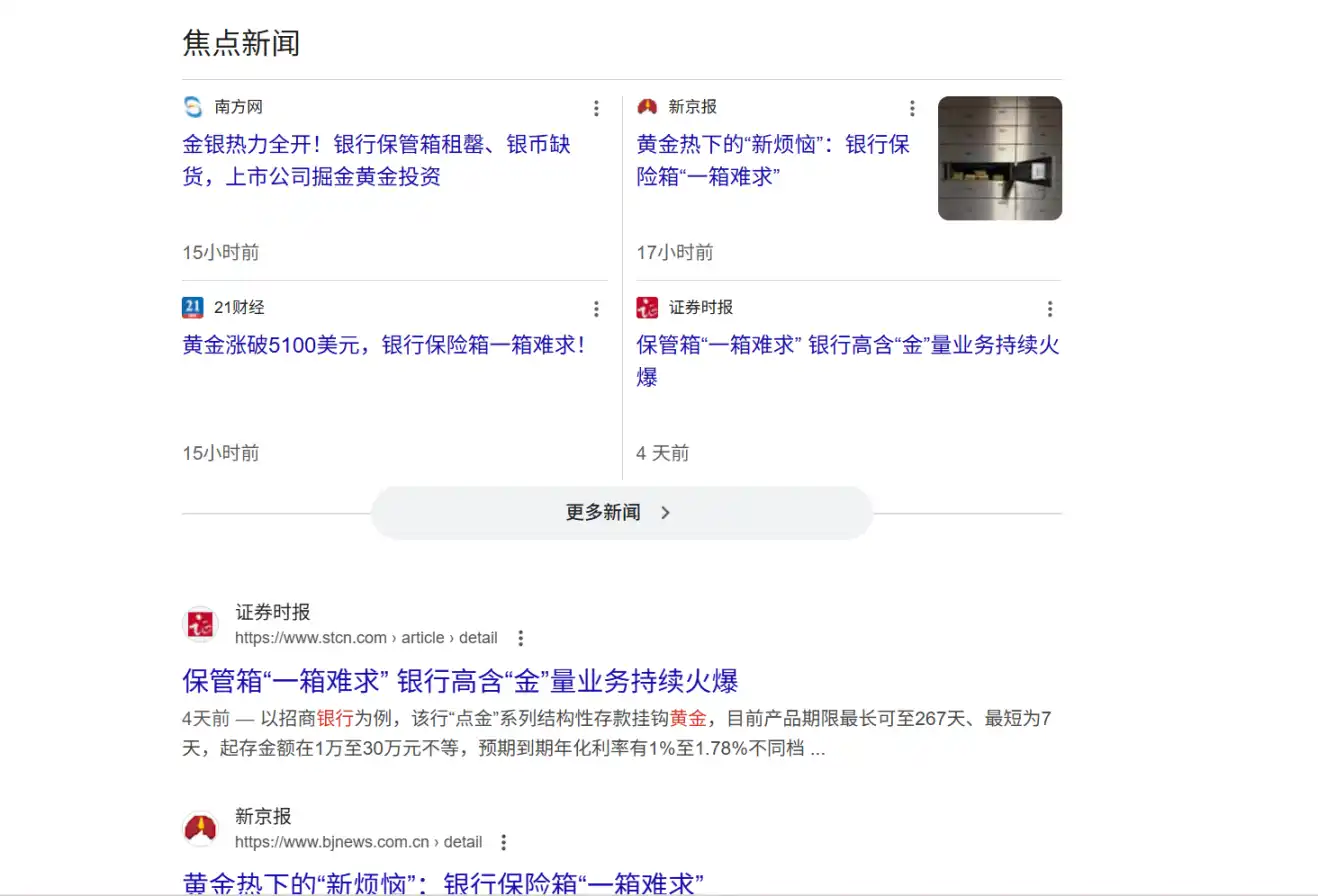
The recent phenomenon of 'one safe-deposit box is hard to find' in many banks恰恰 illustrates that this contradiction is being amplified, meaning that more and more people want to hold gold in their own hands, but现实条件并不总是配合.
The second is paper gold or gold ETFs, which to some extent make up for the physical holding threshold of physical gold, such as paper gold products issued by bank accounts or brokerage systems. These are essentially a claim on financial institutions, giving you a settlement promise backed by the account system.

But the problem is that this liquidity itself is not complete—the liquidity provided by paper gold and gold ETFs is only locked within a single financial system. It can be bought and sold within a certain bank, a certain exchange, or a certain set of clearing rules, but it cannot freely flow outside this system.

This means it cannot be split, combined, or collaborate with other assets across systems, let alone be directly used in different scenarios. It is only 'in-account liquidity,' not true asset liquidity.

For example, the first gold investment product I owned, 'Tencent Micro Gold,' was like this. From this perspective, paper gold does not truly solve the liquidity problem of gold but only temporarily replaces the physical inconvenience with counterparty credit.

In the end, security, liquidity, and sovereignty have long been in a state where it is difficult to have all three. And in a highly digitalized and cross-border era, such trade-offs are becoming increasingly unsatisfactory.

It is against this background that tokenized gold has begun to enter the视野 of more people.

II. Tokenized Gold: Returning 'Complete Liquidity' to the Asset Itself

Tokenized gold, represented by XAUt (Tether Gold) issued by Tether, attempts to solve not just the surface-level problem of 'making gold easier to hold/trade,' which paper gold can also achieve, but a more fundamental proposition:

How can gold achieve the same complete liquidity and composability as crypto assets that can flow across systems, without sacrificing the 'physical gold endorsement' of gold?

If we take XAUt as an example and拆解 its design logic, we will find that it is not radical but even quite traditional and restrained: each XAUt corresponds to 1 ounce of physical gold in a London vault, and the physical gold is stored in a professional vault, auditable and verifiable. At the same time, tokenized gold holders have the right to claim the underlying gold.

This design does not introduce complex financial engineering, nor does it attempt to amplify gold's attributes through algorithms or credit expansion. On the contrary, it deliberately maintains respect for the traditional gold logic—first ensuring that the physical gold attribute is established, and then discussing the changes brought by digitization.

In the final analysis, tokenized gold like XAUt and PAXG is not 'creating a new gold narrative' but is using blockchain to repackage the oldest asset form. In this sense, XAUt is more like a 'digital physical gold' than a speculative derivative in the crypto world.

But at the same time, the more important change is that the liquidity level of gold has fundamentally shifted. As mentioned above, in the traditional system, whether it is paper gold or gold ETFs, the so-called liquidity is essentially in-account liquidity—it exists within a certain bank, a certain brokerage, or a certain clearing system and can only be bought, sold, and settled within established boundaries.

The liquidity of XAUt is directly attached to the asset itself. Once gold is mapped as an on-chain token, it naturally possesses the basic attributes of crypto assets and can be freely transferred, split, combined, and circulated among different protocols and applications without needing permission from any centralized institution.

This means that for the first time, gold no longer relies on an 'account' to prove its liquidity but circulates freely globally 24/7 in the form of the asset itself (extended reading: 'The 'Gold Godfather' Debates CZ: Who Is the Real 'Digital Gold'? A Trust Battle Across TradFi and Crypto'). In the on-chain environment, XAUt and others are no longer just 'tradable gold tokens' but basic asset units that can be recognized, called, and combined by other protocols:

  • It can be freely exchanged with stablecoins and other assets;
  • It can be incorporated into more complex asset allocation and组合 strategies;
  • It can even be used as a value carrier to participate in consumption and payment scenarios;

This is precisely the part of 'liquidity' that paper gold has never been able to provide.

III. From 'On-Chain' to 'Usable': The True Watershed for Digital Physical Gold

For this reason, if tokenized gold only completes the step of 'going on-chain,' it is far from reaching the finish line.

The real watershed lies in whether this 'digital physical gold' can truly be easily held, managed, traded, and even used as 'currency' for consumption and payment? That is, returning to the point mentioned above, if tokenized gold remains just a string of code on the chain and is ultimately encapsulated in a centralized platform or a single entry point, then it is no different from paper gold.

Against this background, the significance of lightweight self-custody solutions like imToken Web begins to emerge. Taking imToken Web's exploration as an example, it allows users to access through a browser—like opening a webpage, instantly managing their tokenized gold and other crypto assets on any device.

Moreover, in a self-custody environment, the private key is完全 controlled by the user. Your gold does not exist on any service provider's server but is truly anchored in a blockchain address.

Additionally, thanks to the interoperability of Web3 infrastructure, XAUt is no longer a heavy metal sleeping in a safe. It can be purchased flexibly in small amounts, and when needed, its purchasing power can be released in real-time into global consumption scenarios through支付 tools like imToken Card.
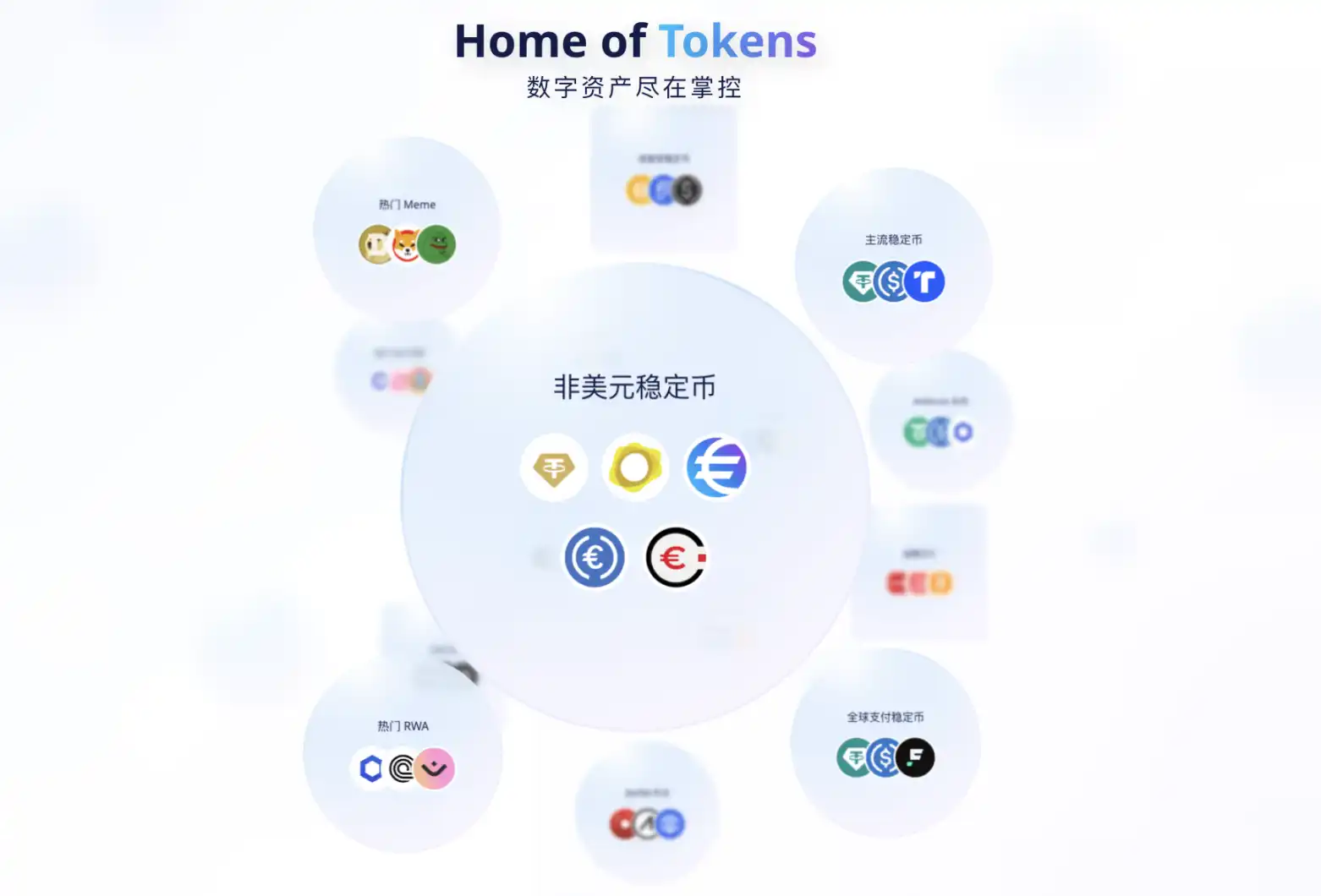
Source: imToken Web

In short, in the Web3 environment, XAUt can not only be traded but also combined with other assets, exchanged, and even connected to payment and consumption scenarios.

And when gold simultaneously possesses extremely high storage certainty and modern usage potential for the first time, it truly completes the leap from an 'old-school避险品' to a 'future currency.'

After all, gold, as a consensus that can span millennia, is not inherently陈旧; what is陈旧 is only the way it is held.

So when gold enters the chain in the form of XAUt and returns to personal control through self-custody environments like imToken Web, what it continues is not a new narrative but a logic that spans eras:

In an uncertain world, true value is to rely as little as possible on the promises of others.

Crypto di tendenza

Domande pertinenti

QWhat are the main factors driving the recent surge in gold prices to $5000 per ounce?

AThe surge is driven by global macroeconomic uncertainties, including geopolitical risks in regions like Ukraine, the Middle East, and Latin America, disruptions in global trade systems due to tariffs and sanctions, and concerns about the long-term stability of the US dollar due to expanding fiscal deficits. These factors have increased demand for gold as a consensus asset that doesn't rely on any single sovereign promise.

QWhat are the limitations of traditional gold holding methods like physical gold and paper gold/ETF?

APhysical gold offers security and sovereignty but lacks liquidity due to high storage, security, and transfer costs. Paper gold or gold ETFs provide some liquidity within specific financial systems but are essentially claims on financial institutions, limiting their use to internal account systems. They cannot be freely transferred, split, combined, or used across different platforms or scenarios, offering only 'account liquidity' rather than true asset liquidity.

QHow does tokenized gold, such as XAUt, address the limitations of traditional gold investments?

ATokenized gold like XAUt represents physical gold stored in auditable vaults, with each token backed by one ounce of gold. It combines the security of physical gold with the full liquidity and composability of crypto assets. Unlike paper gold, it can be freely transferred, split, combined, and used across different protocols and applications without relying on centralized institutions, enabling global 24/7 circulation and integration into various financial strategies and payment scenarios.

QWhat role do self-custody solutions like imToken Web play in the adoption of tokenized gold?

ASelf-custody solutions like imToken Web allow users to manage tokenized gold through lightweight, accessible interfaces (e.g., web browsers) while retaining full control of their private keys. This ensures that the gold is truly owned by the user and not held on centralized servers. It enhances usability by enabling easy trading, combination with other assets, and practical applications such as spending via tools like imToken Card, bridging the gap between storage and real-world use.

QHow does tokenized gold transform gold from a 'traditional safe-haven asset' to a 'future currency'?

ATokenized gold merges gold's historical value as a stable store of wealth with modern digital capabilities. By being on-chain, it gains full liquidity, divisibility, and interoperability with other assets and payment systems. This allows it to be used not just for investment but also in daily transactions, consumption, and complex financial strategies, effectively transitioning gold from a passive holding into an active, versatile medium of exchange in the digital economy.

Letture associate

Within Strategy's Framework, STRC's Dividend Yield Remains at 12% as Share Price Stays Below Par Value

Michael Saylor, Executive Chairman of Strategy (MSTR), confirmed that the dividend rate for its STRC perpetual preferred shares will remain at 12.00% through August 2026. The rate has increased from 9% at its July 2025 launch to the current high via a "ratchet" mechanism, which permanently raises the rate by 0.5% whenever the share price falls below $95. This mechanism is intended to push the price back toward its $100 par value and support Strategy's "at-the-market" (ATM) program for issuing new shares to fund Bitcoin purchases. However, the mechanism has not worked as intended. STRC shares closed at $89.46 on July 31, remaining about 10-11% below par value despite the record-high dividend. Competition from rival Strive's higher-yielding SATA securities has pressured demand. The persistent discount has forced Strategy to suspend new STRC issuances via its ATM program, limiting this funding channel for Bitcoin acquisitions. STRC's struggles reflect Bitcoin's own volatility, as the preferred shares historically move in tandem. Analysts have warned the ratchet structure carries long-term, one-way risk. A law firm is investigating Strategy's ability to maintain dividend payments if Bitcoin's price stays low. Retail investors own roughly 83% of outstanding STRC shares, a group seen as prone to panic selling during downturns. In response, Strategy has established financial reserves, including a liquidity cushion covering about 26 months of dividend/interest obligations, and a $2 billion share buyback program alongside a Bitcoin monetization framework, though the company emphasized it is not obligated to sell any Bitcoin.

cryptonews.ru2 min fa

Within Strategy's Framework, STRC's Dividend Yield Remains at 12% as Share Price Stays Below Par Value

cryptonews.ru2 min fa

Analyst: Bitcoin's Price Will Drop to $60k in August, Then Rebound to $70k

Financial analyst Andrey Poroshin has provided a new forecast for Bitcoin's price dynamics in August. Poroshin, an analyst at the Bitbanker exchange, expects the cryptocurrency market to experience a downturn this month, with prices retesting the $60,000 level due to a lack of supportive macroeconomic catalysts. He noted that the recent US Federal Reserve decision to hold interest rates did not significantly impact the market, while inflation remains above the 2% target. Poroshin stated that Bitcoin is ending July under pressure from moderate volatility and a lack of new macroeconomic stimuli, leading to continued market caution. According to his base scenario, Bitcoin will drop to a range of $60,000 to $62,000 before recovering to $70,000. He pointed out that even $70,000 remains below the cost of mining in the US, which has prompted some miners to shift towards AI data center operations. Poroshin cited the winding down of BitMEX's operations as a potential catalyst for a price rebound, suggesting the exit of weaker players often coincides with market reversals and reduced short-term selling pressure. He believes Bitcoin is currently less susceptible to geopolitical shocks, such as the Iran-US conflict, and does not expect significant market changes in August related to the pending CLARITY Act. Looking ahead, Poroshin forecasts that September will bring more active price fluctuations driven by potential Fed rate decisions and possible discussions or approval of the CLARITY Act.

cryptonews.ru3 min fa

Analyst: Bitcoin's Price Will Drop to $60k in August, Then Rebound to $70k

cryptonews.ru3 min fa

In Jinjiang, Fujian, a Storage Super Unicorn Lies Quiet

In Fujian's Jinjiang, a city known for sportswear, lies a quiet semiconductor giant: Fujian Jinhua Integrated Circuit Co. (JHICC). Once a promising domestic DRAM manufacturer alongside Yangtze Memory and ChangXin Memory Technologies (CXMT), its journey was derailed in 2018 when the U.S. placed it on an Entity List and filed criminal charges for alleged trade secret theft. This halted production for years. A turning point came in February 2024 when a U.S. federal court found JHICC not guilty. However, it had lost crucial time. While CXMT soared to become a top-valued A-share company in 2024, JHICC, with an estimated valuation of 80 billion RMB, was just restarting. Its current output is primarily customized DDR4 chips, not the advanced DDR5/HBM demanded for AI, but it still benefits from the broader memory chip upcycle. JHICC's story is tied to Chen Zhengkun, a veteran engineer who left Micron to lead the venture. Founded in 2016 with state-backed funding, JHICC partnered with Taiwan's UMC to develop DRAM technology. Rapid progress was cut short by the U.S. actions, which Micron initiated, partly due to its heavy reliance on the Chinese market. Post-sanctions, Chen's team worked to rebuild the production line with reduced reliance on U.S. technology. According to its records, JHICC achieved small-scale production and revenue growth under immense pressure. It now focuses on the stable "niche" DRAM market (e.g., TVs, routers) with a monthly capacity of ~40,000 wafers, aiming for 60,000 by 2026. It holds over 1,000 patents but remains on the Entity List. For Jinjiang, investing in JHICC was a bold industrial leap. The local government provided unwavering financial and logistical support during the crisis, helping the company survive. JHICC has become the anchor for a growing local semiconductor cluster. Though its scale lags behind domestic peers, JHICC's persistence symbolizes a hard-won foothold in a global market long dominated by Samsung, SK Hynix, and Micron. Having missed one boom, it seeks a place in the new AI-driven memory supercycle.

marsbit2 h fa

In Jinjiang, Fujian, a Storage Super Unicorn Lies Quiet

marsbit2 h fa

Trading

Spot

Articoli Popolari

Come comprare ERA

Benvenuto in HTX.com! Abbiamo reso l'acquisto di Caldera (ERA) semplice e conveniente. Segui la nostra guida passo passo per intraprendere il tuo viaggio nel mondo delle criptovalute.Step 1: Crea il tuo Account HTXUsa la tua email o numero di telefono per registrarti il tuo account gratuito su HTX. Vivi un'esperienza facile e sblocca tutte le funzionalità,Crea il mio accountStep 2: Vai in Acquista crypto e seleziona il tuo metodo di pagamentoCarta di credito/debito: utilizza la tua Visa o Mastercard per acquistare immediatamente CalderaERA.Bilancio: Usa i fondi dal bilancio del tuo account HTX per fare trading senza problemi.Terze parti: abbiamo aggiunto metodi di pagamento molto utilizzati come Google Pay e Apple Pay per maggiore comodità.P2P: Fai trading direttamente con altri utenti HTX.Over-the-Counter (OTC): Offriamo servizi su misura e tassi di cambio competitivi per i trader.Step 3: Conserva Caldera (ERA)Dopo aver acquistato Caldera (ERA), conserva nel tuo account HTX. In alternativa, puoi inviare tramite trasferimento blockchain o scambiare per altre criptovalute.Step 4: Scambia Caldera (ERA)Scambia facilmente Caldera (ERA) nel mercato spot di HTX. Accedi al tuo account, seleziona la tua coppia di trading, esegui le tue operazioni e monitora in tempo reale. Offriamo un'esperienza user-friendly sia per chi ha appena iniziato che per i trader più esperti.

440 Totale visualizzazioniPubblicato il 2025.07.17Aggiornato il 2026.06.02

Come comprare ERA

Discussioni

Benvenuto nella Community HTX. Qui puoi rimanere informato sugli ultimi sviluppi della piattaforma e accedere ad approfondimenti esperti sul mercato. Le opinioni degli utenti sul prezzo di ERA ERA sono presentate come di seguito.

活动图片













