The Man Who Best Promoted SOL Exits the Crypto World

marsbitPubblicato 2026-02-05Pubblicato ultima volta 2026-02-05

Introduzione

Kyle Samani, co-founder and managing partner of Multicoin Capital, has stepped down from his daily operational and management roles at the crypto-focused venture firm and transitioned to an advisory position. Known as one of the most vocal proponents of Solana, Samani was instrumental in Multicoin’s early and heavy investments in the blockchain, famously declaring “Solana is always the answer” and publicly criticizing Bitcoin and Ethereum. Under his leadership, Multicoin achieved extraordinary returns from Solana, though the fund also faced significant losses during market downturns. Despite his exit from Multicoin, Samani remains committed to the crypto space, particularly Solana, and will continue personal investments in the ecosystem. He will retain his role as chairman of Forward Industries, a digital asset treasury company heavily invested in SOL. Samani plans to redeem his Multicoin stake not in cash but in shares and warrants of Forward Industries to increase his exposure. His departure is driven by a growing interest in emerging technologies such as AI, longevity science, and robotics. Samani has indicated he will take time to explore these areas but remains a firm believer in crypto’s potential to reshape global finance.

Original | Odaily Planet Daily (@OdailyChina)

Author | Azuma (@azuma_eth)

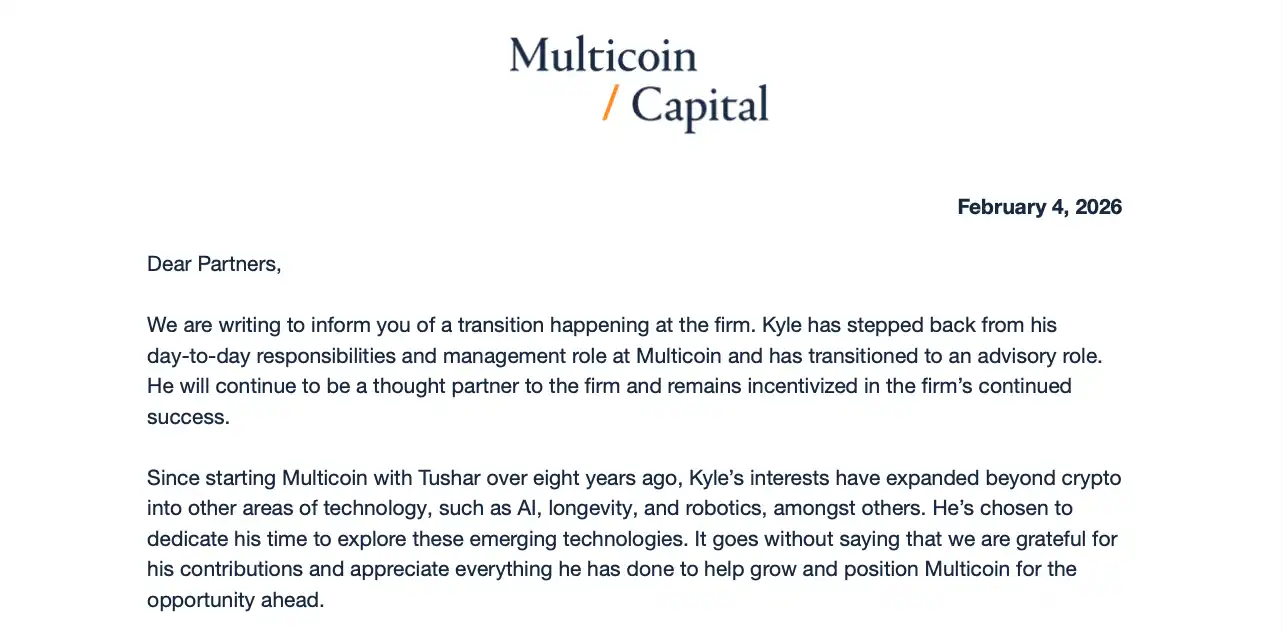
On February 4 local time, the well-known venture capital firm Multicoin Capital wrote to LPs stating that co-founder and managing partner Kyle Samani has stepped down from his daily duties and management role at Multicoin and transitioned to an advisory role.

Tushar Jain, another co-founder of Multicoin, said that Samani's interests have expanded from the cryptocurrency field to cutting-edge directions such as AI, longevity technology, and robotics, and therefore he has decided to devote more time to exploring these emerging technologies.
The Man Who Best Promoted SOL

Since co-founding Multicoin with Tushar in 2017, Samani has been one of the most active investors in the cryptocurrency field. His most classic achievement is his疯狂押注 on Solana.

Multicoin was the first venture capital firm to heavily invest in Solana. Between 2018 and 2021, Multicoin led Solana's first three rounds of financing, and Samani himself took on the role of evangelizing Solana to the crypto world. Samani is extremely adept at promoting Solana in a high-profile and provocative manner. He has publicly criticized Bitcoin for lacking practical utility, criticized Ethereum for being structurally bloated and slow to scale, emphasized that "Solana is always the answer," and firmly believed that SOL would outperform BTC and ETH in the long run.

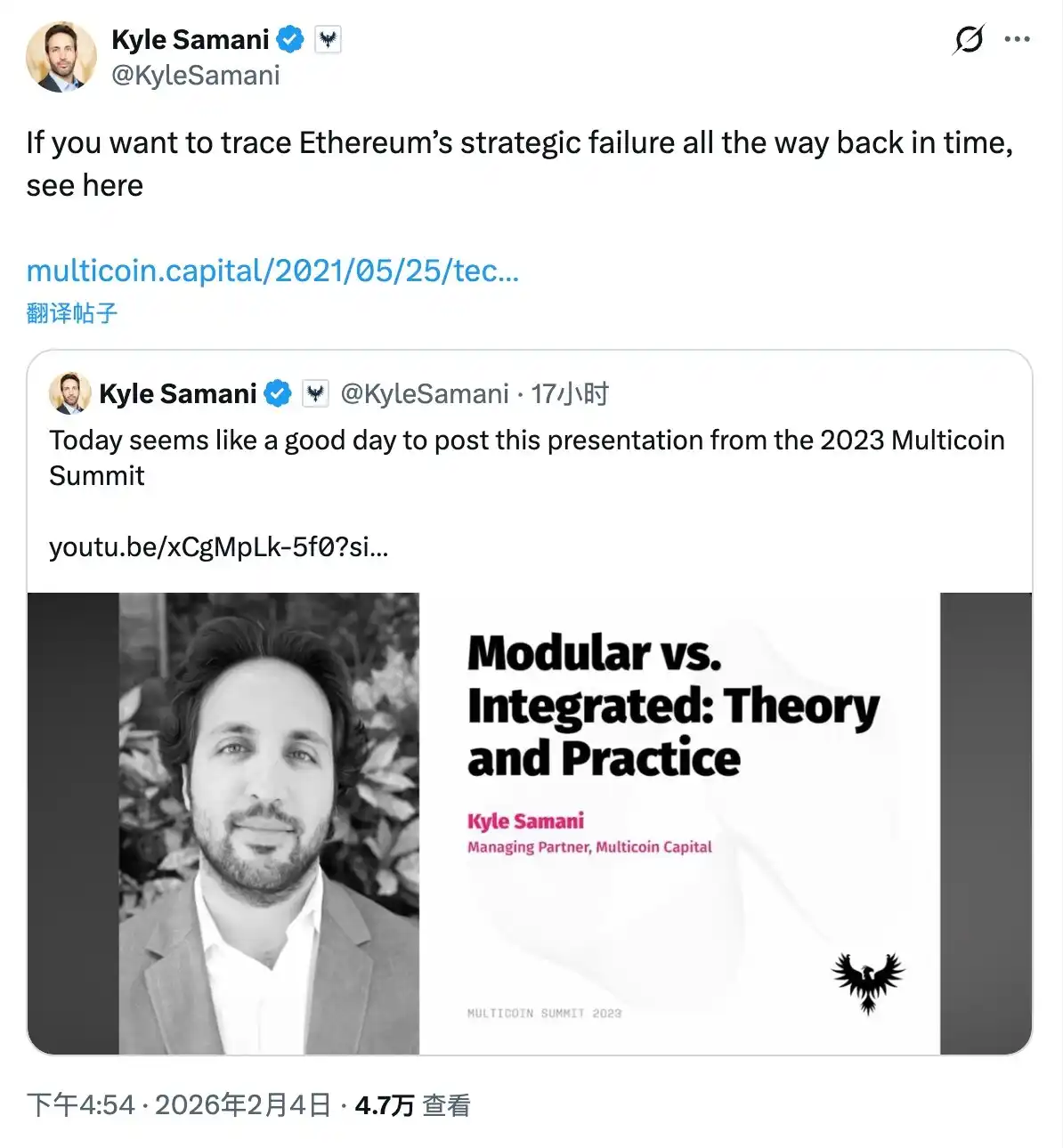
A recent example is that yesterday, Vitalik publicly admitted that Ethereum's Layer2 historical路线 had errors. Samani specifically reposted an article he wrote in 2021 comparing Ethereum and Solana's scaling paths and commented, "This is the beginning and end of Ethereum's strategic failure."
Multicoin's bet on Solana was a huge success. At the end of 2021, Samani said on The Wolf Of All Streets podcast that the firm had made an astonishing profit of 614,000% on Solana.

However, after the collapse of FTX, the entire Solana ecosystem was hit hard, and SOL一度跌至 $8, plunging the project into its darkest moment. Multicoin's profits also experienced a huge drawdown — the fund lost about 91.4% in 2022, its worst performance since inception.

But Samani and Multicoin showed an even more courageous side at this time. Instead of abandoning Solana, they continued to be driven by faith, firmly evangelizing Solana and increasing investment in Solana ecosystem projects. The final result was that Solana achieved the most amazing涅槃重生 in cryptocurrency history, and Samani and Multicoin also "regained lost ground" as SOL recovered.

After the rise of Digital Asset Treasuries (DAT) in 2025, Multicoin, together with Galaxy Digital and Jump Crypto, jointly led a $1.65 billion financing round for the DAT company Forward Industries. Forward Industries is now the largest SOL DAT on the market (holding 6.82 million SOL, worth approximately $626 million). Samani himself serves as the chairman of the board of this company.

A Madman in the Eyes of Ordinary People, the Best Investor in the Eyes of Peers

Because Samani prefers contrarian investments and his言论过于高调且极具煽动性, he is often accompanied by considerable controversy (mainly from the Ethereum ecosystem).

But in the eyes of a few VC peers, Samani is the best investor in the entire cryptocurrency field. Dragonfly Capital partner Hasseb Qureshi once said that as competitors, Dragonfly and Multicoin are always at odds, but experts recognize experts. Investment is like a sport, and Samani is the highest scorer of all time, unmatched by anyone.

Hasseb added: "This doesn't mean you have to like him. I often find him reckless and even annoying. I also often disagree with him... But Samani is a true contrarian thinker. He bets where others are unwilling to bet... Ultimately, this is the reason investors exist—to allocate capital to undervalued ideas, and Samani is one of the few non-consensus investors in our industry."

Personal Statement: Not Completely Leaving the Circle

After Multicoin's letter to LPs was announced, Samani himself also explained his job change on X.

Samani emphasized that his faith in cryptocurrency and Solana remains unchanged — "After nearly a decade of working deeply in the cryptocurrency industry, I am more convinced than ever that crypto technology will fundamentally reshape the financial system. I believe the Clarity Act will attract new participants like a tide,催生 an unprecedented wave of applications. I am still long-term bullish on the crypto field, especially the Solana ecosystem, and plan to continue making personal investments in the field while supporting companies in Multicoin's portfolio."

In addition, although he will gradually step down from Multicoin, Samani will continue to serve as chairman of the board of Forward Industries. Furthermore, Samani also mentioned that he intends to submit a redemption request to the Multicoin main fund on March 31, 2026, but will not request cash. Instead, he will redeem in kind with Forward Industries shares and warrants, to significantly increase his personal exposure to Forward Industries.

Future Direction Exploration

Multicoin's letter to LPs mentioned several new directions Samani is interested in — AI, longevity technology, and robotics.

Although it is not yet clear which specific directions Samani has identified (Samani said he will take a break for now), yesterday he reposted an article by Shayon, another partner at Multicoin, about AI titled "Disrupting the Human-AI Relationship." The core idea of the article is that instead of苦苦思索 "what AI can assist humans with," a more economically efficient direction is "how humans should assist AI," and what new investment opportunities will emerge around this shift in thinking.

Interested readers can read the original article, which may serve as a window into Samani's future thinking.


Domande pertinenti

QWho is Kyle Samani and what is his role change at Multicoin Capital?

AKyle Samani is the co-founder and managing partner of Multicoin Capital. He has stepped down from his day-to-day duties and management role at Multicoin and transitioned into an advisory role.

QWhat was Kyle Samani's most notable investment success in the crypto space?

AKyle Samani's most notable investment success was Multicoin Capital's heavy investment in Solana (SOL), which yielded a profit of 614,000% by late 2021.

QWhy did Kyle Samani decide to reduce his role at Multicoin Capital?

AKyle Samani decided to reduce his role because his interests have expanded beyond cryptocurrency to include emerging technologies such as AI, longevity tech, and robotics.

QWhat is Forward Industries, and what is Kyle Samani's involvement with it?

AForward Industries is a Digital Asset Treasury (DAT) company with significant holdings in SOL. Kyle Samani serves as the Chairman of the Board for Forward Industries and plans to increase his personal exposure to the company through in-kind redemptions from Multicoin's main fund.

QDespite stepping back, what does Kyle Samani plan to continue in the crypto space?

AKyle Samani plans to continue his personal investments in the crypto space, particularly in the Solana ecosystem, and will continue to support companies in Multicoin's investment portfolio.

Letture associate

Can Generative Models Finally Be Trained End-to-End? The Core Is a For Loop

This article introduces a novel training paradigm for generative models called Explorative Modeling (XM), which enables true end-to-end training. Traditionally, powerful generative models like autoregressive and diffusion models are not trained end-to-end. They are trained to predict a single small step but require iterative multi-step sampling for inference. This "exposure bias" leads to error accumulation and limits performance. The core challenge XM addresses is "mode blurring." In generative tasks, a single input (e.g., "generate a dog") corresponds to many valid outputs (multiple modes). Standard training objectives like reconstruction loss force the model to average these modes, producing unrealistic, blurry outputs. To avoid this, existing models break generation into many small, almost deterministic steps, sacrificing end-to-end training. XM tackles this by restructuring the training loop itself. Its key insight is to amplify "generative expressivity." For each training input, instead of generating one sample, the model generates K candidate outputs. Only the candidate closest to the real data is used for computing the loss and updating the model via backpropagation. This simple "best-of-K" mechanism is implemented as a short for-loop. By exploring multiple possibilities, the model learns to distribute its guesses across different modes rather than collapsing to their uninformative average. The paper demonstrates that "exploration" acts as a new, powerful scaling axis. Gains from XM increase with model size, data scale, and compute. Experiments show improvements in FID scores for image generation and significant efficiency gains, sometimes outperforming larger models without exploration. When pushed to the limit, XM enables fully single-step, end-to-end generative models. In robotics tasks, an "Explorative Policy" matched the performance of a 100-step Diffusion Policy with a single forward pass, drastically improving inference speed. While the best-of-K concept is not entirely new, the authors' contribution lies in formally understanding it as a direct method to boost generative expressivity without fragmenting the generation process. This work suggests that as models scale, enhancing exploration during training may become crucial for overcoming fundamental performance bottlenecks.

marsbit46 min fa

Can Generative Models Finally Be Trained End-to-End? The Core Is a For Loop

marsbit46 min fa

Annual Salary of Millions Competing for Electricians, Meta Rushes to Open Its Own Technical School

The AI boom is facing an unexpected bottleneck: a severe shortage of skilled construction workers and electricians. As tech giants like Meta, OpenAI, and Alphabet race to build massive data centers—such as OpenAI's $16 billion "Stargate" project—they are hitting a critical labor wall. The U.S. needs an estimated 130,000 more electricians, 240,000 construction workers, and 150,000 supervisors by 2030 for AI infrastructure alone, but tens of thousands of electrician jobs go unfilled each year. While AI companies offer high premiums, with electricians earning up to $280,000 annually, worker scarcity still causes massive losses—delays on a single project can cost $14.2 million per month. The complexity of building AI data centers, which require immense power (equivalent to powering hundreds of thousands of homes), sophisticated electrical systems, and advanced liquid cooling solutions, demands highly skilled technicians who are in short supply. To combat this, companies are investing heavily in training. Meta has committed $115 million to a free training school offering tuition, housing, and stipends, targeting 5,000 new workers. OpenAI is partnering with unions to secure skilled labor. These efforts are paying off, with a significant rise in Gen Z interest in trade schools over college. However, the power demands are staggering. AI data centers are driving a rapid surge in electricity consumption, projected to account for up to 12% of U.S. power use by 2028 and raising costs for consumers. Furthermore, the construction boom is project-based, leading to a potential future glut of trained workers once building peaks, which could depress wages industry-wide. The race for AI supremacy now depends as much on skilled hands as on advanced chips.

marsbit2 h fa

Annual Salary of Millions Competing for Electricians, Meta Rushes to Open Its Own Technical School

marsbit2 h fa

Trading

Spot
活动图片




