The Illusion of Zero Fees: How Lighter Extracts Costs Through High Latency

marsbitPubblicato 2025-12-12Pubblicato ultima volta 2025-12-12

Introduzione

"The Illusion of 'Zero Fees': How Lighter Uses High Latency to Hide Costs Lighter DEX promotes 'zero-fee' trading for retail traders, but this comes with a hidden cost: high latency. The platform offers two account types—standard (0% fee) and premium (low fee)—with the standard account imposing a 200–300ms delay on transactions. In crypto markets, where prices move rapidly, this delay allows faster traders to exploit price movements and trade against slower users. Academic research suggests the actual cost due to adverse selection and slippage ranges from 6–12 basis points per trade for standard accounts, compared to just 0.2–2 basis points for premium accounts. This makes the 'free' account effectively 5–10 times more expensive. The model resembles payment for order flow practices seen in traditional finance, where platforms like Robinhood profit by routing orders to market makers. While Lighter discloses latency data, it emphasizes 'zero fees' in marketing while burying latency details, knowing most users won’t understand the implications. For all traders—especially small retail investors—the premium account is unequivocally the better choice."

There's a fundamental truth in business: if a product is free, you are the product.

Lighter DEX is promoting "zero fees" to retail traders. It sounds too good to be true—and it is.

What Lighter doesn't highlight in bold letters is the latency structure behind these "free" trades.
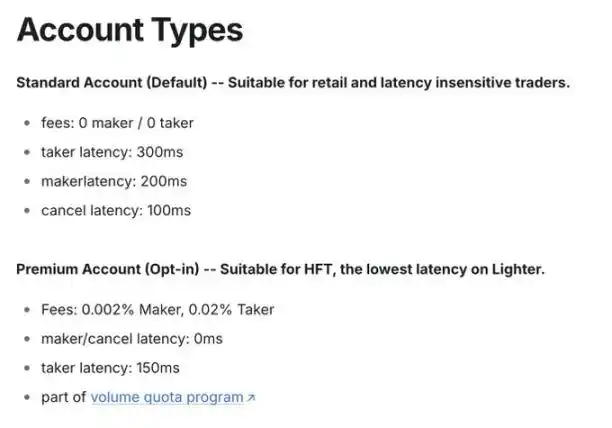
Lighter offers two account types: once you understand how latency works, you realize that the 0% fee tier is actually the most expensive option on the platform.

That 200–300 milliseconds of latency is the entire foundation of their business model.

What Does 300 Milliseconds Really Mean?
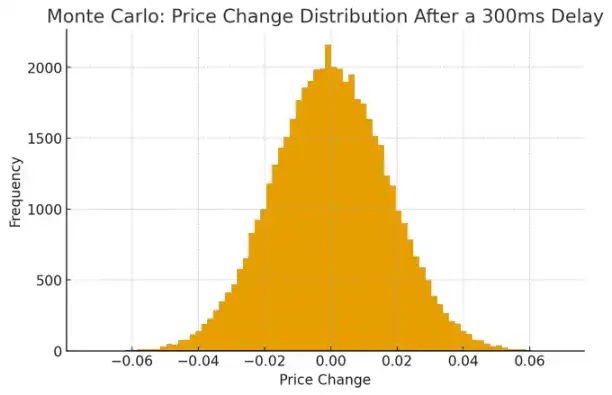
The average human blink takes 100–150 milliseconds. In the time it takes you to blink twice, faster traders have already captured price movements, adjusted their positions, and traded against you.

Crypto markets are highly volatile. At typical volatility levels (50–80% annualized), prices move roughly 0.5 to 1 basis point per second.

This means that within 300 milliseconds, random market fluctuations alone cause prices to move by an average of 0.15–0.30 basis points.

The True Cost of "Free"

If we quantify it:

Academic research on adverse selection costs (Glosten & Milgrom, Kyle's Lambda, etc.) suggests that informed traders typically have an advantage of 2–5 times the magnitude of random price fluctuations.

If the slippage due to randomness over 300 milliseconds is about 0.2 basis points, adverse selection would add an additional 0.4–1.0 basis points.

For active traders and market makers, the actual cost looks something like this:
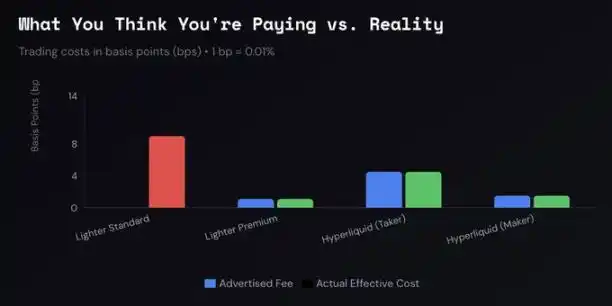
· Standard Account Actual Cost: 6–12 basis points per trade (0.06%–0.12%)

· Premium Account Actual Cost: 0.2–2 basis points per trade (0.002%–0.02%)

The "free" account is 5–10 times more expensive than the paid account.

Zero fees are just a marketing number—the real cost is hidden in the latency.

The Premium Account Is Clearly the Better Deal

Under no circumstances is the Standard Account (0% fee) the better choice.

Not for small retail traders, not for large traders, not for scalpers, swing traders, or even passive investors. Especially not for market makers. Not for anyone.

"I'm just a small retail trader; I don't need a premium setup."

Wrong.

Small retail traders can afford slippage even less. If you trade $1,000 and lose 10 basis points per trade, that's $1 gone each time. After 50 trades, 5% of your account has silently disappeared.

"I don't trade frequently; latency doesn't affect me."

Also wrong.

If you trade infrequently, the fee for a Premium Account is negligible anyway.

But even in those few trades, you're still getting worse execution. Why accept any disadvantage when the cost to avoid it is almost zero?

Just upgrade to the Premium Account.

This Model Isn't New

Traditional financial markets have seen this before—it's called payment for order flow.

@RobinhoodApp popularized this model by attracting retail traders with "free trades," then routing their orders to market makers who profited by trading against the uninformed retail flow.
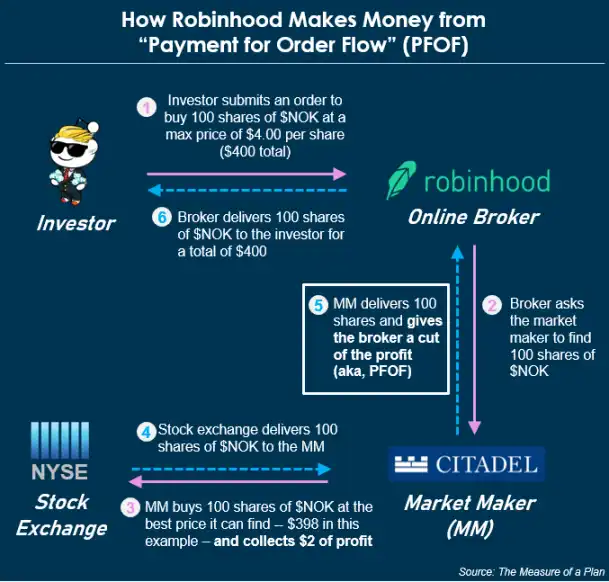
Lighter's model is structurally similar. Standard Account users aren't getting free trades—they're getting slower trades. That latency is being monetized by faster participants.

The exchange doesn't need to charge you a fee because you're paying with execution quality.

What Lighter Is Doing Right and Wrong

Lighter isn't hiding the latency data—it's in the documentation.

But transparency isn't the same as clarity.

Highlighting "0% fees" in headlines while burying "300ms latency" in the fine print is a strategy that prioritizes sign-up conversions over user understanding.

Most retail traders don't understand what latency means, what adverse selection is, or how to calculate the equivalent real cost.

And Lighter knows it.

The Premium Account is a better deal in every way than the "zero-fee" Standard Account—no argument needed.


Crypto di tendenza

Domande pertinenti

QWhat is the main hidden cost associated with Lighter's 'zero-fee' trading accounts?

AThe main hidden cost is the high latency of 200-300 milliseconds, which allows faster traders to exploit price movements and results in worse execution prices for standard account users.

QHow does the actual cost of Lighter's standard 'zero-fee' account compare to its premium account?

AThe standard account's actual cost (6-12 basis points per trade) is 5-10 times higher than the premium account's cost (0.2-2 basis points per trade.

QWhat traditional market practice is Lighter's business model similar to?

AIt is similar to Payment for Order Flow (PFOF), popularized by Robinhood, where 'free' trades are facilitated by routing orders to market makers who profit from the spread.

QWhy is the premium account a better option even for infrequent traders according to the article?

ABecause the few trades an infrequent trader makes will still get worse execution prices with the standard account, and the cost to avoid this (via the premium account) is negligible.

QWhat does the article claim is the real reason Lighter prominently advertises '0% fees' but buries the latency details?

AIt is a marketing strategy aimed at increasing user sign-up conversions, relying on the fact that most retail traders don't understand the financial impact of latency and adverse selection.

Letture associate

Ray Dalio's Latest Macro Analysis Full Text: Buy More Gold, Add Some Bitcoin

In his latest macro analysis, Ray Dalio applies his framework from "How Countries Go Broke: The Big Cycle" to the current global debt environment. He highlights recent events like Japan selling U.S. Treasuries and rising U.S. long-term yields as signs of an unsustainable debt dynamic. Dalio explains that excessive government debt leads to either unacceptably high interest rates, severe economic downturns, or significant currency debasement through central bank money printing. He summarizes the U.S. fiscal situation: with $5.5 trillion in revenue, $7.5 trillion in spending, a $2 trillion deficit, and total debt at six times annual revenue, debt servicing costs are immense. Without correction, U.S. debt could reach $55-$60 trillion in a decade. Dalio proposes a "3% Three-Way" solution: reducing the budget deficit to 3% of GDP through balanced spending cuts, tax increases, and interest rate reductions to avoid a traumatic adjustment. In response to FAQs, he argues that the risk of a U.S. debt crisis is high and could materialize within a few years if the current path continues. He dismisses the notion that the dollar's reserve status makes the U.S. immune, citing historical precedents of reserve currency declines. He is also unconvinced by Japan's high-debt stability, noting poor returns for yen-denominated assets. For investors, Dalio recommends diversifying globally, underweighting bonds, and overweighting assets like gold and a small allocation to Bitcoin (around 10-15% to gold) to hedge against currency debasement and poor debt returns.

marsbit28 min fa

Ray Dalio's Latest Macro Analysis Full Text: Buy More Gold, Add Some Bitcoin

marsbit28 min fa

Stripe’s 16-Year Chronicle: From 7 Lines of Code to a $100 Billion Valuation

Stripe's 16-year journey began with a simple promise: "7 lines of code to accept payments." Founded by Patrick and John Collison, the company started by hiding the complexity of bank integrations and merchant accounts behind a clean API, initially targeting developers at startups. This early focus on user experience and technical simplicity fueled rapid adoption. A key early milestone was establishing vital bank partnerships, a challenge overcome by hiring Billy Alvarado, who brought crucial institutional relationship skills. From this foundation, Stripe systematically expanded its product boundaries. It launched Connect for platform payments, Atlas for company formation, Radar for fraud prevention, and Billing for subscriptions. This transformed Stripe from a payment processor into a broader financial infrastructure suite for internet businesses. The COVID-19 pandemic accelerated growth but also led to over-hiring. A 14% layoff in 2022 marked a period of organizational correction. Subsequently, Stripe shifted its growth strategy towards strategic acquisitions to enter new domains quickly. It acquired Bridge (stablecoin infrastructure), Privy (wallet infrastructure), Metronome (usage-based billing), and agreed to buy OpenRouter (AI model routing). These moves signal Stripe's ambition to build a "programmable money system" for the emerging AI and agent-based economy, managing not just currency flows but also the measurement and pricing of computational resources like AI tokens. Internally, Stripe leverages AI agents (like "Minions") to boost engineering productivity. Despite scaling to nearly 8,000 employees and processing $1.9 trillion in payment volume annually, the company remains private. A recent employee tender offer valued it at $159 billion. The core question for Stripe's future is whether it can successfully integrate its expanding product matrix—spanning payments, crypto, and AI infrastructure—into a cohesive platform, positioning itself as the foundational economic layer for autonomous software agents.

marsbit57 min fa

Stripe’s 16-Year Chronicle: From 7 Lines of Code to a $100 Billion Valuation

marsbit57 min fa

Treasury Secretary's Move to Suppress Treasury Yields Ignites 'Currency Debasement Trade'! Gold Hits Three-Month High, Bitcoin Surges Over 25% in a Single Week

US Treasury Secretary Besant's efforts to lower long-term Treasury yields by announcing expanded buybacks had only a brief market impact. However, this move fueled a "currency devaluation trade," weakening the US dollar while boosting both gold (to a three-month high) and Bitcoin (up over 25% for the week). Analysts attribute this reaction to deepening market concerns over the massive US fiscal deficit and structural pressures keeping long-term rates elevated, including fierce competition for capital from global government borrowing and massive AI sector financing. Despite the Treasury's actions, fundamental forces like growth, inflation, and capital demand are seen as limiting its ability to sustainably suppress yields. Bitcoin's strong positive correlation with gold has reinforced its narrative as a hedge against devaluation. While equity markets have shown resilience, some strategists warn that Treasury yields nearing 5% increase pressure on the dollar and high-leverage assets. Figures like Ray Dalio have advised reducing bond exposure in favor of gold and some Bitcoin, citing US debt risks. Market opinions are divided on the sustainability of the devaluation trade, with some noting the lack of a near-term catalyst for its next leg higher. The underlying tension between the Treasury's desire for lower borrowing costs and the Federal Reserve's focus on inflation and reducing market intervention remains a key theme. Upcoming events like Nvidia's earnings and the Jackson Hole symposium will test whether AI profits can continue supporting stocks and if the Fed aligns more with Washington's preference for easier financial conditions.

华尔街日报3 h fa

Treasury Secretary's Move to Suppress Treasury Yields Ignites 'Currency Debasement Trade'! Gold Hits Three-Month High, Bitcoin Surges Over 25% in a Single Week

华尔街日报3 h fa

Alexander Shokhin: Business Needs an Interest Rate Below 10% and the Dollar at 90-95 Rubles

Alexander Shokhin, head of the Russian Union of Industrialists and Entrepreneurs (RSPP), has advocated for potentially using "non-market" tools to keep the ruble within a target exchange rate corridor. This, he argues on August 21, would help avoid excessive volatility, though he called the topic a separate discussion. Shokhin had previously raised the idea of a currency corridor in late May, noting the ruble's current exchange rate is not fully market-driven due to a limited currency segment and reduced foreign currency demand. He stated that many business community colleagues propose fixing a corridor, even through non-market methods, to ensure predictability. The business community's key targets, as outlined by Shokhin in late December 2025, are a Central Bank key rate of 12%, inflation of 4–5%, and a US dollar exchange rate of 90–95 rubles by the end of 2026. A turning point for investment, he said, would be lowering the rate to 12% with 6% inflation, though truly comfortable business conditions would require a rate below 10%. He stressed the critical importance of currency predictability for corporate investment decisions. From a data analysis perspective, the idea of a ruble corridor is not new. A similar mechanism was used in Russia from 1995 to 1998, where the central bank held the dollar within fixed boundaries through regular interventions. This regime lasted three years before ending abruptly during the 1998 default, illustrating the fragility of rigid targets under external shocks. The macro-economic link is clear: stricter corridors require more reserves to defend against currency pressure. The key unresolved technical aspect is the specific sources and volume of such interventions given the current market's limited liquidity. Whether this discussion remains theoretical or leads to concrete corridor parameters will be seen in the coming months.

cryptonews.ru4 h fa

Alexander Shokhin: Business Needs an Interest Rate Below 10% and the Dollar at 90-95 Rubles

cryptonews.ru4 h fa

Trading

Spot

Articoli Popolari

Come comprare SKDD

Benvenuto in HTX.com! Abbiamo reso l'acquisto di GraniteShares 2x Short SK Hynix Daily ETF (SKDD) semplice e conveniente. Segui la nostra guida passo passo per intraprendere il tuo viaggio nel mondo delle criptovalute.Step 1: Crea il tuo Account HTXUsa la tua email o numero di telefono per registrarti il tuo account gratuito su HTX. Vivi un'esperienza facile e sblocca tutte le funzionalità,Crea il mio accountStep 2: Vai in Acquista crypto e seleziona il tuo metodo di pagamentoCarta di credito/debito: utilizza la tua Visa o Mastercard per acquistare immediatamente GraniteShares 2x Short SK Hynix Daily ETFSKDD.Bilancio: Usa i fondi dal bilancio del tuo account HTX per fare trading senza problemi.Terze parti: abbiamo aggiunto metodi di pagamento molto utilizzati come Google Pay e Apple Pay per maggiore comodità.P2P: Fai trading direttamente con altri utenti HTX.Over-the-Counter (OTC): Offriamo servizi su misura e tassi di cambio competitivi per i trader.Step 3: Conserva GraniteShares 2x Short SK Hynix Daily ETF (SKDD)Dopo aver acquistato GraniteShares 2x Short SK Hynix Daily ETF (SKDD), conserva nel tuo account HTX. In alternativa, puoi inviare tramite trasferimento blockchain o scambiare per altre criptovalute.Step 4: Scambia GraniteShares 2x Short SK Hynix Daily ETF (SKDD)Scambia facilmente GraniteShares 2x Short SK Hynix Daily ETF (SKDD) nel mercato spot di HTX. Accedi al tuo account, seleziona la tua coppia di trading, esegui le tue operazioni e monitora in tempo reale. Offriamo un'esperienza user-friendly sia per chi ha appena iniziato che per i trader più esperti.

68 Totale visualizzazioniPubblicato il 2026.08.19Aggiornato il 2026.08.19

Come comprare SKDD

Cosa è SKUU

Progettato per fornire il doppio dei rendimenti giornalieri con leva delle azioni SK Hynix, questo è un ETF a leva long a giornata unica sotto GraniteShares. È adatto per investitori con una visione ottimistica a breve termine su SK Hynix per allocazione tattica.

89 Totale visualizzazioniPubblicato il 2026.08.19Aggiornato il 2026.08.19

Cosa è SKUU

Come comprare SKUU

Benvenuto in HTX.com! Abbiamo reso l'acquisto di GraniteShares 2x Long SK Hynix Daily ETF (SKUU) semplice e conveniente. Segui la nostra guida passo passo per intraprendere il tuo viaggio nel mondo delle criptovalute.Step 1: Crea il tuo Account HTXUsa la tua email o numero di telefono per registrarti il tuo account gratuito su HTX. Vivi un'esperienza facile e sblocca tutte le funzionalità,Crea il mio accountStep 2: Vai in Acquista crypto e seleziona il tuo metodo di pagamentoCarta di credito/debito: utilizza la tua Visa o Mastercard per acquistare immediatamente GraniteShares 2x Long SK Hynix Daily ETFSKUU.Bilancio: Usa i fondi dal bilancio del tuo account HTX per fare trading senza problemi.Terze parti: abbiamo aggiunto metodi di pagamento molto utilizzati come Google Pay e Apple Pay per maggiore comodità.P2P: Fai trading direttamente con altri utenti HTX.Over-the-Counter (OTC): Offriamo servizi su misura e tassi di cambio competitivi per i trader.Step 3: Conserva GraniteShares 2x Long SK Hynix Daily ETF (SKUU)Dopo aver acquistato GraniteShares 2x Long SK Hynix Daily ETF (SKUU), conserva nel tuo account HTX. In alternativa, puoi inviare tramite trasferimento blockchain o scambiare per altre criptovalute.Step 4: Scambia GraniteShares 2x Long SK Hynix Daily ETF (SKUU)Scambia facilmente GraniteShares 2x Long SK Hynix Daily ETF (SKUU) nel mercato spot di HTX. Accedi al tuo account, seleziona la tua coppia di trading, esegui le tue operazioni e monitora in tempo reale. Offriamo un'esperienza user-friendly sia per chi ha appena iniziato che per i trader più esperti.

79 Totale visualizzazioniPubblicato il 2026.08.19Aggiornato il 2026.08.19

Come comprare SKUU

Discussioni

Benvenuto nella Community HTX. Qui puoi rimanere informato sugli ultimi sviluppi della piattaforma e accedere ad approfondimenti esperti sul mercato. Le opinioni degli utenti sul prezzo di A A sono presentate come di seguito.

活动图片