The Hidden Realities and Concerns Behind Web3 Unicorn Phantom

marsbitPubblicato 2025-12-23Pubblicato ultima volta 2025-12-23

Introduzione

The Web3 unicorn Phantom, valued at $3 billion, has navigated a challenging 2025 in the crypto wallet market. While its user base grew to nearly 20 million monthly active users and assets under custody surpassed $25 billion, its market share in embedded swaps plummeted from 10% to just 0.5%, as users migrated to exchange-linked wallets offering lower fees and stronger incentives. Phantom, which started on Solana and expanded multi-chain, remains heavily dependent on the Solana ecosystem, with 97% of its swap transactions occurring there. This has posed risks as Solana's TVL declined over 34% from its peak. In response, Phantom has aggressively pursued new product lines to diversify revenue and usage. Key launches include its native stablecoin CASH, which surpassed $100 million in supply; a Phantom-branded debit card for spending crypto in the U.S.; the acquisition of trading tools like Solsniper; integration of a prediction market with Kalshi; and the release of a free SDK, Phantom Connect, for easier dApp onboarding. CEO Brandon Millman emphasizes focusing on product over token launches or an IPO, aiming to make crypto a tool for everyday payments. However, the path is competitive, with MetaMask having already launched a similar card in more regions. The success of Phantom's debit card and the sustainability of its stablecoin remain to be proven as it battles to define the future of independent non-custodial wallets.

Author: zhou, ChainCatcher

The cryptocurrency wallet market in 2025 is witnessing a fierce battle for market share.

As the meme coin frenzy subsides, high-frequency trading users are increasingly migrating to exchange-affiliated wallets that offer lower fees and stronger incentives. In the face of the closed-loop ecosystems of exchanges, the survival space for independent players is continuously shrinking.

Against this backdrop, Phantom's performance has drawn attention. Earlier this year, it raised $150 million in funding, pushing its valuation to $3 billion. Since the fourth quarter, the project has successively launched its own stablecoin CASH, a prediction market platform, and a crypto debit card, attempting to find new growth points beyond trading business.

$3 Billion Valuation: From Solana Origins to Multi-Chain Expansion

Looking back at Phantom's development history, in 2021, the Solana ecosystem had just exploded, and on-chain infrastructure was still incomplete. Traditional crypto wallets like MetaMask primarily supported Ethereum-based chains, with insufficient compatibility for other chains, resulting in certain user experience shortcomings.

Typically, when creating a wallet, users must manually write down a 12 or 24-word seed phrase. If the key is lost, assets become permanently irrecoverable, which many potential users find cumbersome and risky.

The three founders of Phantom had previously worked for years at 0x Labs (an Ethereum DeFi infrastructure project). They seized this opportunity, choosing to start with Solana to create a wallet with a simple interface and intuitive operation. Their core innovation lies in optimizing the backup process: providing various simple methods such as email login, biometric recognition, and encrypted cloud backup to assist and replace manual copying of seed phrases, significantly lowering the entry barrier for beginners.

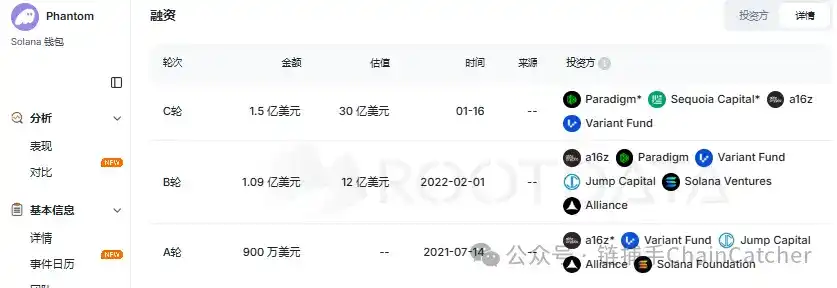
In April 2021, the Phantom browser extension was launched, and within months, its user base exceeded one million, becoming the preferred choice for Solana users. According to RootData, in July of the same year, Phantom, still in its testing phase, received a $9 million Series A funding round led by a16z; in January 2022, Paradigm led a $109 million Series B round, valuing it at $1.2 billion; until early 2025, Paradigm and Sequoia again led a $150 million funding round, pushing its valuation to $3 billion.
As it scaled, Phantom subsequently began expanding its multi-chain footprint, supporting multiple public chains including Ethereum, Polygon, Bitcoin, Base, and Sui, attempting to shed the label of "Solana-specific wallet." However, Phantom still does not natively support BNB Chain, and previously, users have complained that Phantom supports ETH but not BNB Chain, causing issues with claiming airdrops.

Highs and Lows of 2025

2025 has been a year of extremes for Phantom: on one hand, rapid breakthroughs in user and product aspects; on the other, trading volume share being significantly eroded by exchange-affiliated wallets.

Specifically, user growth is a bright spot. Phantom's monthly active users grew from 15 million at the beginning of the year to nearly 20 million by year-end, ranking among the fastest-growing independent wallets, especially with significant user increases in emerging markets like India and Nigeria.

Meanwhile, Phantom's custodial assets under management exceeded $25 billion. At its peak, it generated $44 million in weekly revenue, and its annual revenue once surpassed that of MetaMask. Currently, Phantom's cumulative revenue is close to $570 million.

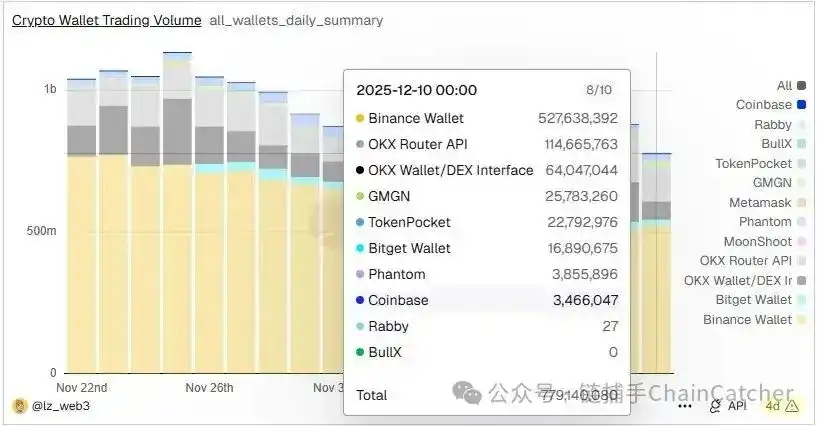
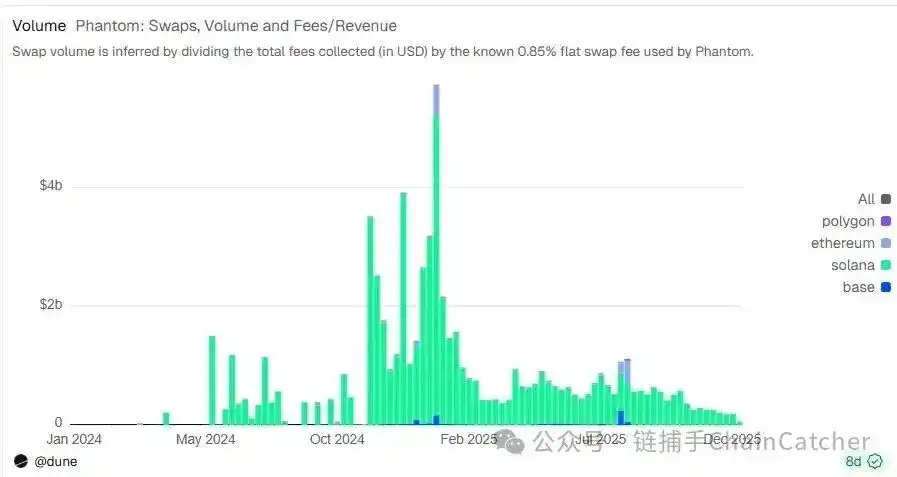
However, concerns on the trading volume side are equally prominent. According to Dune Analytics data, Phantom's share in the global embedded swap market dropped from nearly 10% at the beginning of the year to 2.3% in May, and further shrank to only 0.5% by year-end. Exchange-affiliated wallets, leveraging fee advantages, faster listing speeds, and high airdrop subsidies, have attracted a large number of high-frequency trading users. Currently, Binance Wallet holds nearly 70%, while OKX (wallet + routing API) combined holds over 20%.
A greater market concern for Phantom lies in its deep binding with Solana. Data shows that 97% of Phantom's swap transactions occur on Solana, while Solana's Total Value Locked (TVL) has fallen more than 34% from its peak of $13.22 billion on September 14, now down to a six-month low of $8.67 billion. This directly drags down Phantom's core trading metrics.
Facing these pressures, Phantom is betting resources on new products, attempting to open up a second growth curve.

In terms of product dimensions, Phantom has launched a series of differentiated features:

  • In July, integrated Hyperliquid perpetual contracts, driving approximately $1.8 billion in trading volume in just about 16 days after launch, generating nearly $930,000 in revenue through rebate mechanisms (builder codes);
  • In August, acquired meme coin monitoring tool Solsniper and NFT data platform SimpleHash, further consolidating coverage of niche trading needs.
  • The native stablecoin CASH, launched at the end of September, quickly saw its supply exceed $100 million, with a November peak of over 160,000 transactions. Its core competitiveness lies in fee-free P2P transfers and accompanying lending rewards;
  • The Phantom Cash debit card, first launched in the US in December, allows users to directly spend on-chain stablecoins with the card, and is compatible with mainstream mobile payments like Apple Pay and Google Pay;
  • On December 12, announced the launch of a prediction market platform, integrating the Kalshi prediction market within the wallet, currently open to eligible users;
  • Simultaneously launched the free SDK "Phantom Connect," allowing users to seamlessly access different web3 applications with the same account, further lowering the onboarding barriers for developers and users.

Among these, the debit card and CASH stablecoin are the most watched. Phantom is attempting to use them to solve the "last mile" problem of spending crypto assets.

Phantom CEO Brandon Millman has publicly stated that in the short term, there will be no token issuance, no IPO, and no building of their own chain. All efforts are focused on refining the product to turn the wallet into a financial tool usable by ordinary people. He believes that the endgame of the wallet race is not about who has the largest trading volume, but about who first brings crypto into daily payments.

However, the path to the "last mile" of cryptocurrency payments is not easy, and Phantom is not the first independent non-custodial wallet to launch a debit card.

Prior to this, MetaMask had already partnered with Mastercard, Baanx, and CompoSecure in Q2 2025 to launch the MetaMask Card, supporting real-time conversion of cryptocurrency to fiat for spending, and rolling out in multiple regions including the EU, UK, and Latin America. MetaMask's card has broader coverage and an earlier start, but is limited by the Ethereum and Linea networks, with higher fees and slower speeds, leading to user feedback that it is "convenient but rarely used."

In comparison, Phantom's debit card started later, currently only available in limited quantities in the US, and its actual adoption remains to be seen. Theoretically, leveraging Solana's low-fee advantage, it might be more competitive in fee-sensitive emerging markets, but it still has a clear gap compared to MetaMask Card in terms of global coverage and merchant acceptance.

Regarding stablecoins, if CASH cannot form a sustained network effect, it may follow the path of other wallet-native stablecoins that started high but fell quickly, such as MetaMask's native stablecoin mUSD, whose supply quickly surpassed the $100 million mark after launch but dropped to about $25 million in less than two months.

Conclusion

As the meme frenzy recedes, trading volume is no longer a reliable moat, and independent wallets must return to the essence of financial services.

Overall, Phantom integrates Hyperliquid perpetual contracts and the Kalshi prediction market on the trading end to retain advanced users; on the consumption end, it bets on the CASH stablecoin and debit card, attempting to truly bring on-chain assets into daily life.

This dual-drive strategy of "trading derivatives + consumption payments" is Phantom's self-redemption under the挤压 (squeeze) of the Matthew effect in the wallet赛道 (race). It is not only searching for a second growth curve but also defining the endgame for independent wallets.

Domande pertinenti

QWhat are the main challenges Phantom is facing in the 2025 crypto wallet market?

APhantom faces challenges including market share in embedded swap transactions (dropping to 0.5% by year-end), intense competition from exchange-linked wallets like Binance Wallet and OKX, and its heavy reliance on the Solana ecosystem, which has seen a significant TVL decline.

QHow did Phantom initially differentiate itself from traditional crypto wallets like MetaMask?

APhantom differentiated itself by simplifying the user experience, offering email login, biometric authentication, and encrypted cloud backups to replace manual seed phrase recording, lowering the entry barrier for new users.

QWhat new products has Phantom launched to diversify beyond its core wallet business?

APhantom launched its native stablecoin CASH, a prediction market platform with Kalshi, an encrypted debit card for spending crypto assets, and acquired tools like Solsniper and SimpleHash. It also integrated Hyperliquid for perpetual contracts and released the Phantom Connect SDK.

QWhy is Phantom's deep integration with Solana considered a potential risk?

A97% of Phantom's swap transactions occur on Solana, and Solana's TVL has dropped over 34% from its peak to a six-month low, directly impacting Phantom's core transaction metrics and exposing it to ecosystem-specific volatility.

QHow does Phantom's approach to crypto payments compare with MetaMask's efforts?

APhantom's debit card, launched later and currently limited to the US, leverages Solana's low fees but has less global coverage than MetaMask Card. MetaMask's card, available in multiple regions, suffers from higher fees and slower speeds due to its Ethereum/Linea foundation.

Letture associate

Stuck Polymarket: The Real Test After Riding the Traffic Boom Has Arrived

Polymarket, a leading prediction market platform, is facing significant technical challenges as its growth outpaces its current infrastructure on Polygon. Users are experiencing laggy transactions, unresponsive orders, and delayed confirmations, severely impacting the trading experience. In response, DeFi Engineering VP Josh Stevens outlined a comprehensive engineering overhaul. The plan includes reducing on-chain data delays, fixing order cancellation issues, rebuilding the central limit order book (CLOB), improving website performance, and developing a unified SDK and API. A major revelation was the ongoing "chain migration," indicating a potential move away from Polygon. The core issue is that Polymarket has evolved from a simple prediction market into a high-frequency trading platform, making Polygon's limitations—such as block space, gas fees, and block time—a ceiling for further growth. The migration is not just a simple chain switch but a fundamental rebuild of its trading system to support more complex products like perpetual contracts (Perps). This announcement has sparked competition among chains like Solana, Sui, and Algorand, all vying to host Polymarket. For Polygon, losing this key application, which contributes significantly to its gas fee revenue, would be a major setback. The real test for Polymarket is no longer attracting users but proving it can provide a stable, reliable trading environment that retains them.

Odaily星球日报8 min fa

Stuck Polymarket: The Real Test After Riding the Traffic Boom Has Arrived

Odaily星球日报8 min fa

Lowering Expectations for BTC's Next Bull Market

The author, Alex Xu, explains his decision to significantly reduce his Bitcoin holdings (from full to ~30% of his portfolio) during the current bull cycle, citing a lowered long-term outlook for BTC's price appreciation in the next cycle. He outlines six key reasons for this reduced expectation: 1. **Diminished Growth Drivers:** The narrative of exponential user adoption has largely played out with institutional ETF adoption. The next major growth phase—adoption by sovereign national reserves or central banks—seems unlikely in the near future. 2. **Personal Opportunity Cost:** More attractive investment opportunities have emerged in other assets, such as undervalued companies. 3. **Industry-Wide Contraction:** The broader crypto industry is struggling, with most Web3 business models (SocialFi, GameFi, DePIN) failing. This overall萧条 (depression) reduces the fundamental demand and consensus for Bitcoin. 4. **Strain on Major Buyer:** MicroStrategy, a major corporate buyer of BTC, faces rising financing expenses for its debt, which could slow its purchasing rate and create significant marginal pressure on the market. 5. **Increased Competition from Gold:** The emergence of "tokenized gold" has closed the functional gap (portability, divisibility) between physical gold and Bitcoin, offering a strong competitor in the non-sovereign store-of-value space. 6. **Security Budget Concerns:** The block reward halving continues to exacerbate the long-standing issue of funding Bitcoin's network security, with new fee source explorations like Ordinals and L2s largely failing. The author's decision to hold a significant (though reduced) position reflects a cautious, not bearish, outlook. He remains open to increasing his exposure if the fundamental reasons for his skepticism change or if new positive catalysts emerge.

marsbit47 min fa

Lowering Expectations for BTC's Next Bull Market

marsbit47 min fa

Can Iran 'Control' the Strait of Hormuz?

Iran has announced a comprehensive plan to assert control over the strategic Strait of Hormuz, a critical global oil shipping chokepoint. The proposed measures include requiring all vessels to obtain Iranian permission for passage, imposing fees for security, environmental protection, and navigation management—preferably paid in Iranian rials—and absolutely banning Israeli ships. Vessels from countries deemed hostile by Iran’s top security bodies may also be barred. Analysts suggest Iran’s motives are multifaceted: increasing pressure on the U.S. and Israel by leveraging control over oil transit to influence global prices and inflation; creating a new revenue stream, potentially exceeding $7.7 billion annually, to counter Western sanctions and support postwar reconstruction; and using transit permissions as bargaining chips in future negotiations, notably with the U.S. However, the plan faces significant practical and diplomatic challenges. Enforcing comprehensive interception and fee collection in the busy waterway, patrolled by international military forces, would be difficult. The U.S. has already countering with a blockade of Iranian ports and threats to intercept any ship paying fees, potentially strangling Iran’s oil exports and fee revenue. Broad international opposition, led by European and Gulf states, and legal controversies further complicate implementation. The proposal may ultimately serve more as a negotiating tactic than a feasible policy, with its execution remaining highly uncertain.

marsbit1 h fa

Can Iran 'Control' the Strait of Hormuz?

marsbit1 h fa

Trading

Spot
Futures
活动图片

