The First Step to Becoming an On-Chain Bank: Polymarket Launches Native Stablecoin

marsbitPubblicato 2026-04-07Pubblicato ultima volta 2026-04-07

Introduzione

Polymarket, a leading prediction market platform, has announced a major upgrade involving the replacement of its current collateral, USDC.e, with its own native stablecoin, Polymarket USD (pegged 1:1 to USDC). This transition, expected within 2-3 weeks, is designed to be seamless for most users. The introduction of its own stablecoin allows Polymarket to consolidate user funds within its own ecosystem, transforming from merely facilitating trades to holding and managing the underlying capital. This shift enables the platform to potentially generate significant revenue from the yield on the reserve assets (USDC), estimated to be tens of millions annually from its current ~$400M in open interest. This moves its business model beyond transaction fees, which recently surpassed $1M daily, towards earning "interest" on deposited funds. Furthermore, controlling a large pool of stablecoins grants Polymarket greater leverage in its relationship with Circle (issuer of USDC) and could pave the way for future financial services. This strategic upgrade signifies Polymarket's evolution from a prediction market ("casino logic") into a more comprehensive financial entity with banking-like capabilities ("bank logic"), significantly deepening its competitive moat.

Original | Odaily Planet Daily (@OdailyChina)

Author | Golem (@web3_golem)
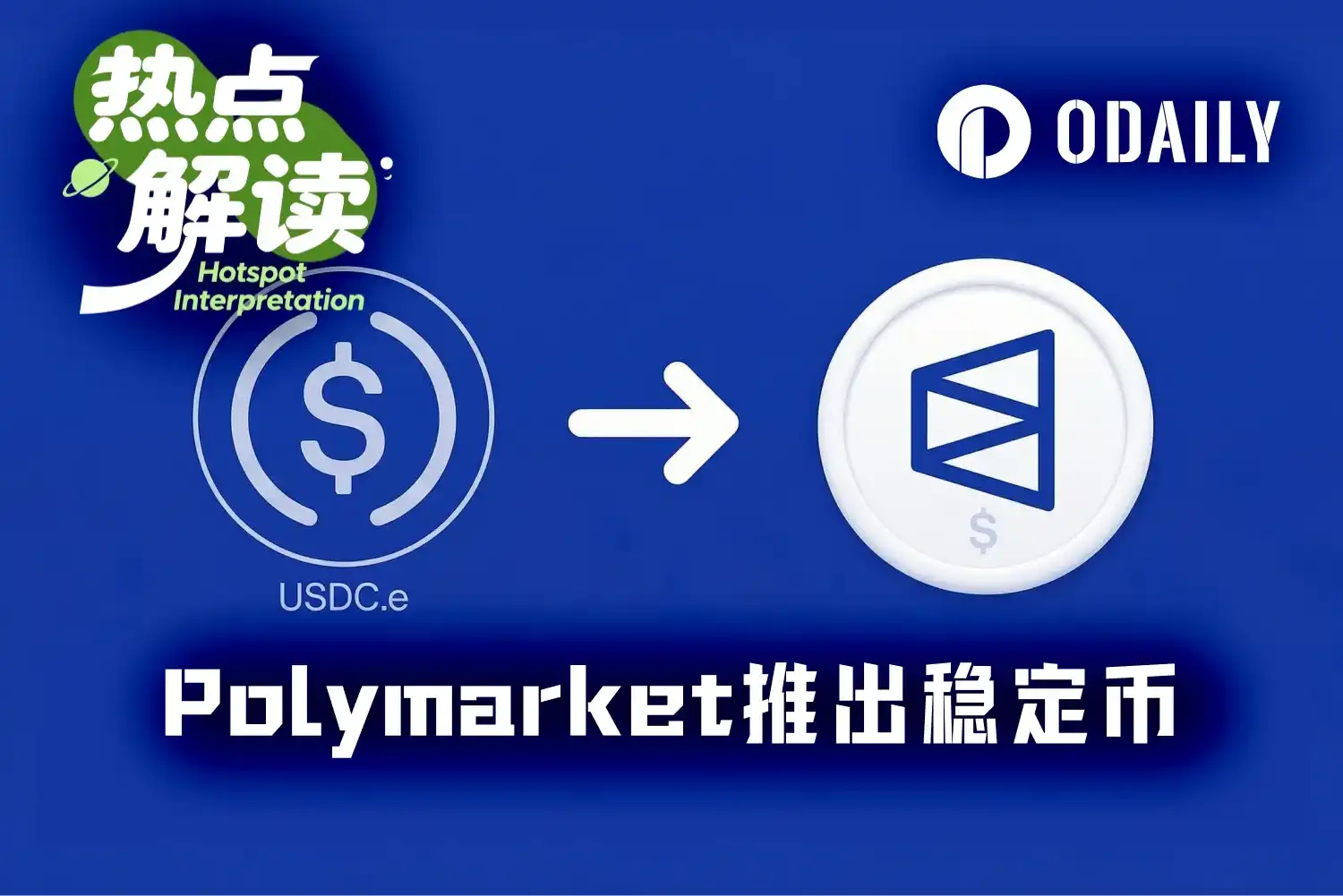
On April 6, Polymarket announced a major upgrade to the platform in the next 2 to 3 weeks, including upgrading both CTF and CLOB to V2, and replacing the platform collateral from USDC.e to the native stablecoin Polymarket USD.

According to the official introduction, Polymarket USD is 1:1 backed by USDC. For most users, the transition from USDC.e to Polymarket USD is seamless, with the frontend handling it automatically—users only need to confirm once. For advanced users and API-only traders, the transition process might be a bit more complex but still not difficult; they need to wrap their USDC or USDC.e into Polymarket USD through the wrap() function of the collateral access contract.

On the surface, it seems like Polymarket is just changing the trading collateral in the backend. As the platform grows, continuing to use USDC.e is indeed a potential risk. Back in February, Circle and Polymarket had already announced plans to migrate from bridged USDC.e to native USDC, and this is just a normal progression of that cooperation.

However, Polymarket did not choose to directly introduce native USDC to replace USDC.e; instead, it added an extra layer, aiming to pool USDC into its own fund pool. This layer is called Polymarket USD. Therefore, the emergence of Polymarket USD is definitely a "One more thing"(Odaily Note: "One more thing" is a classic tradition of Apple keynotes, now symbolizing a company's finale, industry-disrupting moves, etc.).

Polymarket Gains the Right to Mint Currency

The first layer of significance is that Polymarket can pool user funds.

Previously, the money users deposited into Polymarket would be converted into USDC.e. You can think of it as Polymarket being a huge trading venue—it only handles matching, pricing, and清算; the money flows through it, but the money itself does not belong to its system. Polymarket is not a treasury.

But that's about to change. When USDC.e is replaced with Polymarket USD, Polymarket can reach out to that money which was merely "passing through." As Polymarket officially stated, the daily user experience is unaffected, but the actual on-chain settlement path behind the scenes has been altered. This transformation is no less significant than an exchange transitioning from relying on third-party清算机构 to building its own清算 center.

Polymarket USD is 1:1 backed by USDC, meaning that in the future, for every Polymarket USD in the market, there will be a corresponding USDC in Polymarket's fund pool. Currently, every Yes/No share pair on Polymarket is backed by USDC.e. When players place bets or settle, USDC.e also moves on-chain. But after switching to Polymarket USD, although it will also flow on-chain with user operations, the USDC in Polymarket's fund pool won't move accordingly. Therefore, as long as users don't come to redeem, this money is essentially Polymarket's.

Polymarket has transformed from a use case for stablecoins to an entity that holds the on-chain minting right. Polymarket USD diverts user assets from the "open sea" to Polymarket's "internal lake." Once funds begin to pool, Polymarket is no longer just a prediction trading platform, and its business model no longer relies solely on trading fees, because it can start playing the oldest "money makes money" game in the financial markets.

Increasing Polymarket's Revenue Channels

The second layer of significance is the expansion of Polymarket's business.

The current business model of prediction markets is simple: charging transaction fees. After Polymarket adjusted its fee mechanism on March 30(Odaily Note: Expanding the taker fee scope to include Finance, Politics, Economics, Culture, Weather, and other market categories, in addition to the original Crypto and Sports categories), its daily fee income has exceeded $1 million.
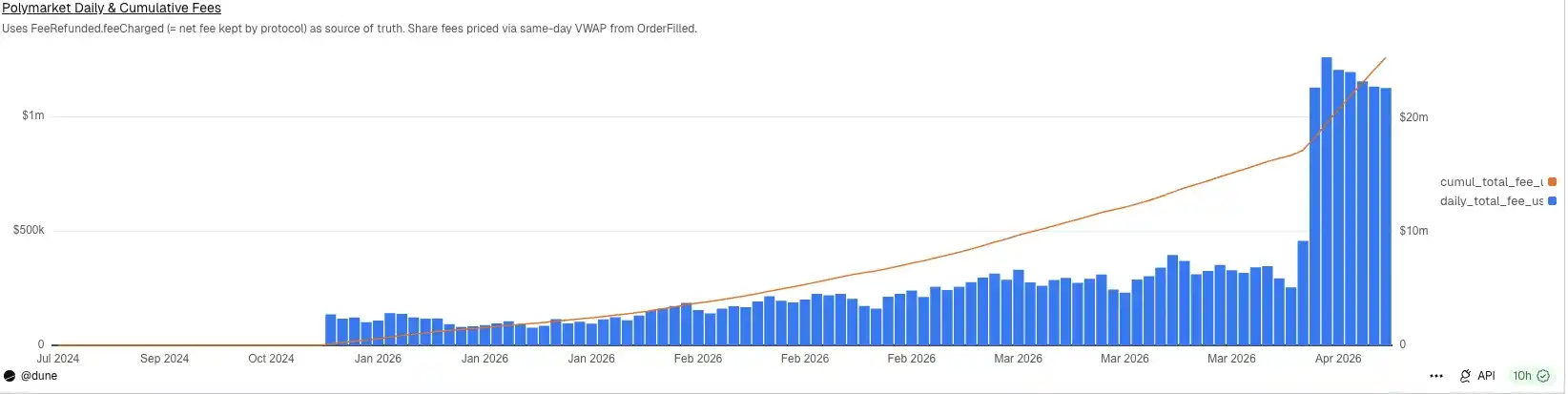
Polymarket's Daily Fee Income

Although impressive, it's not enough to satisfy Polymarket's ambitions. Prediction markets are currently the most sought-after赛道, but the business model ceiling isn't very high, the project's moat is relatively单一 (regulatory approval), and user stickiness isn't exceptionally strong. In the current landscape where everyone is doing prediction markets, how can Polymarket ensure it won't be surpassed by competitors in the future?

The answer it gives now is: I don't just match trades; I can also put players' money to work.

From a business essence perspective, the most attractive aspect of stablecoins over the years has never been fast payments and transfers, but the低调 yet highly profitable money-printing machine behind them—reserve asset yield. In 2025, the vast majority of Circle's income still came from reserve income. Polymarket understood this model, hence it launched Polymarket USD.

According to Dune data, the value of open interest on the Polymarket platform has exceeded $400 million. If all this money is converted into Polymarket USD, Polymarket simply needs to deposit the underlying collateral USDC into Circle's institutional account or place it in a U.S. Treasury protocol. At a risk-free rate of 4%-5%, it could earn tens of millions of dollars in "interest tax" annually just by sitting back.

Defillama founder 0xngmi even directly stated that Polymarket user wallets hold approximately $1.25 billion. If they keep this interest income, at current rates, they would gain an additional $54 million in annual revenue. Polymarket could even participate in DeFi wealth management with higher APYs, turning the idle funds on the prediction platform into active leverage and returning the到期收益 to users, effectively providing a hedge for users.
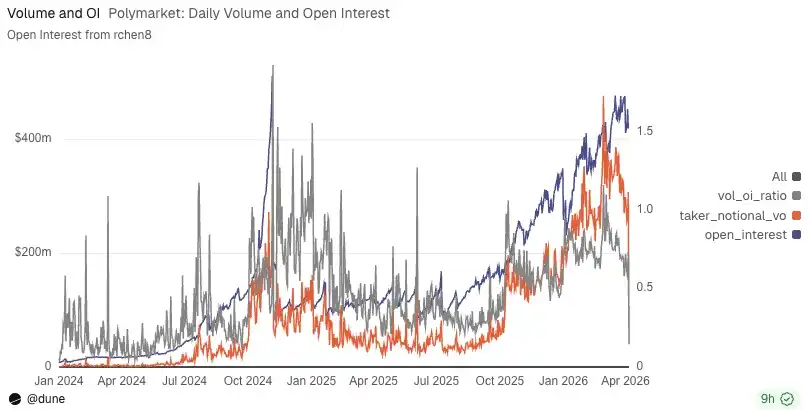
Polymarket's Daily OI and Trading Volume Curve

Prediction markets naturally have two characteristics: fund滞留 and high-frequency reallocation driven by events. Users' money doesn't truly enter and exit instantly like in a casino; it's either already in positions or sitting in accounts waiting for the next event, the next odds change. This type of money is most suitable for financial reprocessing, and for users, there's also a beautiful excuse: improving capital efficiency.

Of course, Polymarket hasn't publicly stated yet that it will definitely engage in yield extraction or on-chain wealth management after launching the stablecoin. But this path is almost a natural next step. As long as the scale of Polymarket USD grows larger in the future, it naturally gains the space to manage yields, expand collateral, and create financial combinations within the platform.

Some time ago, the《CLARITY Act》faced resistance for potentially prohibiting crypto companies from offering interest on stablecoins to users. If the outcome of the dispute remains a prohibition, all the above演绎 of Polymarket USD's potential would come to naught. But on April 6, according to U.S. media reports, the core disagreement between the U.S. crypto industry and banking over stablecoin yield mechanisms may be nearing resolution. Although details have not been disclosed, overall expectations are optimistic, and the《CLARITY Act》may enter the deliberation stage in committee in late April.

So, don't think Polymarket is far from this.

Polymarket Gains USDC Distribution Rights

The launch of the stablecoin by Polymarket has a third layer of significance: gaining USDC distribution rights.

As of today, Polymarket is still a major distribution scenario within the USDC ecosystem. Circle provides native USDC, Polymarket distributes USDC, and both sides are harmonious. Polymarket is currently experiencing strong growth momentum. Undoubtedly, the amount of USDC reserves沉淀 within its platform will grow larger in the future, potentially even becoming a distribution channel as important as Coinbase. When that time truly comes, the relationship between Polymarket and Circle might also change.

A reality in the stablecoin world is that distribution rights are as important as issuance rights, which is why Coinbase can take away over half of Circle's reserve income. Therefore, in the future, when Polymarket becomes a significant distributor of USDC, it will inevitably also gain bargaining power and be entitled to a large share of the reserve income. Furthermore, when Polymarket USD matures sufficiently, it could even explore multi-collateral backed stablecoins, not just relying solely on USDC.

This is also why I believe Polymarket USD is not an ordinary upgrade for Polymarket, but an identity update. Polymarket will evolve from "a platform collecting fees based on event volatility" to one that also兼具 "a platform organizing and清算 around the dollar".

The former is casino logic, while the latter is bank logic.

Polymarket's moat has thus gained another layer. It still maintains the beautiful narrative of information as the market and pricing facts early. But in terms of its business model, it is quietly moving itself to a more important position—no longer satisfied with being surface-level market traffic, no longer satisfied with仅仅 attracting users with odds, and no longer satisfied with continuing to cede the fattest part of the industry chain (asset reserve income) to others.


Domande pertinenti

QWhat is the primary reason Polymarket is introducing its native stablecoin, Polymarket USD?

APolymarket is introducing Polymarket USD to transition from using USDC.e as collateral to a native stablecoin that is 1:1 backed by USDC. This allows Polymarket to settle user funds within its own ecosystem, effectively enabling it to hold and potentially generate revenue from the underlying USDC reserves.

QHow does the introduction of Polymarket USD change the platform's business model beyond transaction fees?

ABeyond transaction fees, Polymarket USD enables Polymarket to generate revenue from the idle USDC reserves backing the stablecoin. By investing these reserves in low-risk assets like U.S. Treasury bonds or Circle's institutional accounts, Polymarket could earn significant interest income, estimated at tens of millions of dollars annually.

QWhat are the potential benefits for users in the transition to Polymarket USD, according to the article?

AFor most users, the transition to Polymarket USD is seamless and requires only a single confirmation on the front end. The change also opens the possibility for Polymarket to improve capital efficiency for users by leveraging idle funds for yield-generating activities, potentially offering returns that act as a hedge.

QHow does the article describe the strategic shift in Polymarket's role within the stablecoin ecosystem?

AThe article describes the shift as Polymarket evolving from a prediction market platform that relies on external stablecoins to one that controls the issuance and distribution of its own stablecoin. This grants Polymarket greater negotiating power with partners like Circle and positions it as a key distributor of USDC, similar to Coinbase.

QWhat regulatory consideration is mentioned regarding Polymarket's ability to generate yield from stablecoin reserves?

AThe article mentions the U.S. CLARITY Act, which initially proposed banning crypto companies from offering interest on stablecoin holdings. However, recent reports suggest that disagreements between crypto and banking sectors are nearing resolution, with expectations leaning towards allowing such practices, which would enable Polymarket to pursue yield generation.

Letture associate

In-Depth Report on the On-Chain Lending Market: When Off-Chain Credit Meets On-Chain Liquidation

The on-chain lending market has evolved from a peripheral DeFi niche into core financial infrastructure. As of early 2026, total value locked (TVL) in on-chain lending protocols has reached $64.3 billion, accounting for 53.54% of total DeFi TVL, making it the largest and most mature vertical within decentralized finance. Aave dominates the sector with approximately $32.9 billion in TVL, commanding nearly half of the market—a leadership position that is unlikely to be challenged in the foreseeable future. However, the path of on-chain lending forward is not without risk. Liquidation cascades, credit defaults, and cross-chain vulnerabilities remain systemic threats hanging over the industry. At the same time, a deeper structural transformation is underway: on-chain lending is shifting from a “leverage tool for crypto-native users” to a “compliant gateway for institutional capital”. The scale of RWA (Real World Asset) lending has surpassed $18.5 billion, with U.S. Treasuries and government securities increasingly serving as core collateral. Institutional capital inflows are reshaping both the user base and risk appetite of the sector. This report systematically analyzes the evolution of on-chain lending definitions, competitive dynamics, core risks, and future trends, providing a comprehensive industry outlook for investors and trade practitioners. Key findings suggest that the “one dominant player with several strong challengers” structure will persist in the short term, while fixed-rate lending, compliant collateral, and institutional credit underwriting will define the next phase of competition. For investors focused on DeFi infrastructure, three key opportunity tracks stand out, namely, the Aave ecosystem (Morpho, Spark), RWA lending protocols (Ondo, Maple) and fixed-rate innovation (Notional, Pendle).

HTX Learn1 h fa

In-Depth Report on the On-Chain Lending Market: When Off-Chain Credit Meets On-Chain Liquidation

HTX Learn1 h fa

Fu Peng's First Public Speech in 2026: What Exactly Are Crypto Assets? Why Did I Join the Crypto Asset Industry?

Fu Peng, a renowned macroeconomist and now Chief Economist at New火 Group, delivered his first public speech of 2026 at the Hong Kong Web3 Festival. He explained his perspective on crypto assets and why he joined the industry, framing it within the context of macroeconomic trends and financial evolution. Fu emphasized that crypto assets are transitioning from an early, belief-driven phase to a mature, institutionally integrated asset class. He drew parallels to the 1970s-80s, when technological advances (like computing) revolutionized traditional finance, leading to the rise of FICC (Fixed Income, Currencies, and Commodities). Similarly, current advancements in AI, data, and blockchain are reshaping finance, with crypto assets becoming part of a new "FICC + C" (C for Crypto) framework. He noted that institutional capital, including traditional hedge funds, avoided early crypto due to its speculative nature but are now engaging as regulatory clarity emerges (e.g., stablecoin laws, CFTC classifying crypto as a commodity). Fu predicted that 2025-2026 marks a turning point where crypto becomes a standardized, financially viable asset for diversified portfolios, akin to commodities or derivatives in traditional finance. Fu defined Bitcoin not as "digital gold" in a simplistic sense but as a value-preserving, financially tradable asset. He highlighted that crypto's future lies in regulated, institutional adoption, moving away from retail-dominated trading. His entry into crypto signals this maturation, where traditional finance integrates crypto into mainstream asset management.

marsbit2 h fa

Fu Peng's First Public Speech in 2026: What Exactly Are Crypto Assets? Why Did I Join the Crypto Asset Industry?

marsbit2 h fa

Justin Sun Sues Trump Family: What $75 Million Bought Was Only a Blacklist

Justin Sun, founder of Tron, has filed a lawsuit in federal court against World Liberty Financial (WLF), alleging he was made the "primary target of a fraudulent scheme" after investing $75 million. Sun claims the investment secured him an advisor title and WLFI tokens, which were later frozen by WLF, causing "hundreds of millions in losses." The dispute began in late 2024 when Sun's investment helped revive WLF's struggling token sale, which ultimately raised $550 million. Shortly after, the SEC dropped its lawsuit against Sun following Donald Trump's inauguration. However, relations soured when Sun refused WLF's demands for additional funding. In August 2025, WLF added a "blacklist" function to its smart contract, allowing it to unilaterally freeze tokens. Sun's holdings, worth approximately $107 million, were frozen, and he was threatened with token destruction. The lawsuit highlights WLF's structure, which directs 75% of token sale profits to the Trump family, who had earned $1 billion by December 2025. WLF's CEO is Zach Witkoff, son of U.S. Middle East envoy Steve Witkoff. The project faces scrutiny for opaque operations, including a controversial loan arrangement on the Dolomite platform, co-founded by a WLF advisor. Despite Sun's history with the SEC, the case underscores centralization risks within DeFi, as WLF controls governance and holds powers to freeze assets arbitrarily. Sun's tokens remain frozen as legal proceedings begin.

marsbit2 h fa

Justin Sun Sues Trump Family: What $75 Million Bought Was Only a Blacklist

marsbit2 h fa

Trading

Spot
Futures

Articoli Popolari

Cosa è $BANK

Banca AI: Un Passo Rivoluzionario nel Futuro della Banca Introduzione In un'era caratterizzata da rapidi progressi tecnologici, Banca AI si trova all'incrocio tra intelligenza artificiale (AI) e servizi bancari. Questo progetto innovativo mira a ridefinire il panorama finanziario, migliorando l'efficienza operativa, le misure di sicurezza e le esperienze dei clienti attraverso il potere dell'AI. Mentre ci impegniamo in questa esplorazione di Banca AI, esamineremo cosa comporta il progetto, le sue dinamiche operative, il suo contesto storico e i traguardi significativi. Cos'è Banca AI? Alla sua essenza, Banca AI rappresenta un'iniziativa trasformativa volta a integrare l'intelligenza artificiale in varie operazioni bancarie. Questo progetto sfrutta le capacità dell'AI per automatizzare processi, migliorare i protocolli di gestione del rischio e potenziare l'interazione con i clienti attraverso servizi personalizzati. Gli obiettivi principali di Banca AI includono: Automazione delle Funzioni Bancarie: Sfruttando le tecnologie AI, Banca AI mira ad automatizzare compiti di routine, riducendo il carico sulle risorse umane e aumentando l'efficienza. Miglioramento della Gestione del Rischio: Il progetto utilizza algoritmi AI per prevedere e identificare i rischi, rafforzando così le misure di sicurezza contro le frodi e altre minacce. Personalizzazione dei Servizi Bancari: Banca AI si concentra sull'offrire prodotti e servizi finanziari su misura analizzando i dati e i comportamenti dei clienti. Miglioramento dell'Esperienza del Cliente: L'implementazione di soluzioni guidate dall'AI, come chatbot e assistenti virtuali, mira a fornire agli utenti interazioni più umane, rivoluzionando il modo in cui i clienti si relazionano con le banche. Con questi obiettivi, Banca AI si posiziona come un attore cruciale nel rendere la banca più efficiente, sicura e centrata sull'utente. Chi è il Creatore di Banca AI? I dettagli riguardanti il creatore di Banca AI rimangono sconosciuti. Pertanto, non è stata identificata alcuna persona o organizzazione specifica nelle informazioni disponibili. L'anonimato che circonda la nascita del progetto solleva domande, ma non sminuisce la sua ambiziosa visione e obiettivi. Chi sono gli Investitori di Banca AI? Simile al creatore del progetto, informazioni specifiche riguardo gli investitori o le organizzazioni di supporto di Banca AI non sono state divulgate. Senza queste informazioni, è difficile delineare il sostegno finanziario e istituzionale che potrebbe spingere il progetto in avanti. Tuttavia, l'importanza di avere una solida base di investimento è fondamentale per sostenere lo sviluppo in un campo così innovativo. Come Funziona Banca AI? Banca AI opera su più fronti innovativi, concentrandosi su fattori unici che la differenziano dai framework bancari tradizionali. Di seguito sono riportate le caratteristiche operative chiave: Automazione: Applicando algoritmi di machine learning, Banca AI automatizza vari processi manuali all'interno delle banche. Ciò si traduce in una riduzione dei costi operativi e consente ai lavoratori umani di reindirizzare i propri sforzi verso attività più strategiche. Gestione Avanzata del Rischio: L'integrazione dell'AI nelle pratiche di gestione del rischio fornisce alle banche strumenti per prevedere con precisione potenziali minacce come le frodi, garantendo che le informazioni e i beni dei clienti rimangano al sicuro. Raccomandazioni Finanziarie Personalizzate: Attraverso l'apprendimento continuo dalle interazioni con i clienti, i sistemi AI sviluppano una comprensione sfumata delle esigenze degli utenti, consentendo loro di offrire consigli su misura per le decisioni finanziarie. Interazioni Migliorate con i Clienti: Utilizzando chatbot e assistenti virtuali alimentati dall'AI, Banca AI consente un'esperienza cliente più coinvolgente, permettendo agli utenti di risolvere rapidamente le loro richieste, riducendo così i tempi di attesa e migliorando i livelli di soddisfazione. Tutte queste caratteristiche operative posizionano Banca AI come un pioniere nel settore bancario, stabilendo nuovi standard per la fornitura di servizi e l'eccellenza operativa. Timeline di Banca AI Comprendere la traiettoria di Banca AI richiede uno sguardo al suo contesto storico. Di seguito è riportata una timeline che evidenzia traguardi e sviluppi importanti: Inizio 2010: La concettualizzazione dell'integrazione dell'AI nei servizi bancari ha cominciato a guadagnare attenzione mentre le istituzioni bancarie riconoscevano i potenziali benefici. 2018: Si è verificato un aumento significativo nell'implementazione delle tecnologie AI quando le banche hanno iniziato a utilizzare strumenti AI come i chatbot per servizi clienti di base e sistemi di gestione del rischio per migliorare la sicurezza. 2023: La sofisticazione dell'AI ha continuato ad avanzare, con l'introduzione dell'AI generativa per compiti più complessi come l'elaborazione di documenti e l'analisi degli investimenti in tempo reale. Quest'anno ha segnato un significativo salto nelle capacità offerte alle banche dalla tecnologia AI. 2024-Stato Attuale: A partire da quest'anno, Banca AI è su una traiettoria ascendente, con ricerche e sviluppi in corso pronti a migliorare ulteriormente le capacità nelle operazioni bancarie. L'esplorazione continua delle applicazioni AI suggerisce sviluppi entusiasmanti in arrivo. Punti Chiave su Banca AI Integrazione dell'AI nella Banca: Banca AI si concentra sull'adozione dell'intelligenza artificiale per snellire i processi bancari e migliorare le esperienze degli utenti. Focus su Automazione e Gestione del Rischio: Il progetto enfatizza fortemente queste aree, mirando a spostare il carico di compiti di routine mentre migliora le strutture di sicurezza attraverso analisi predittive. Soluzioni Bancarie Personalizzate: Sfruttando i dati dei clienti, Banca AI consente servizi bancari su misura che si adattano alle esigenze individuali degli utenti. Impegno per lo Sviluppo: Banca AI rimane impegnata in sforzi di ricerca e sviluppo continuativi, garantendo la sua adattabilità e rilevanza continua man mano che la tecnologia continua a evolversi. Conclusione In sintesi, Banca AI rappresenta un passo cruciale in avanti nell'industria bancaria, sfruttando l'intelligenza artificiale per rimodellare i paradigmi operativi, migliorare la sicurezza e promuovere la soddisfazione del cliente. Nonostante le lacune nelle informazioni riguardo il creatore e gli investitori, gli obiettivi chiari e i meccanismi funzionali di Banca AI forniscono una solida base per la sua continua evoluzione. Mentre la tecnologia AI continua ad avanzare e fondersi con il settore bancario, Banca AI è ben posizionata per avere un impatto significativo sul futuro dei servizi finanziari, migliorando il modo in cui comprendiamo e interagiamo con la banca.

107 Totale visualizzazioniPubblicato il 2024.04.06Aggiornato il 2024.12.03

Cosa è $BANK

Come comprare BANK

Benvenuto in HTX.com! Abbiamo reso l'acquisto di Lorenzo Protocol (BANK) semplice e conveniente. Segui la nostra guida passo passo per intraprendere il tuo viaggio nel mondo delle criptovalute.Step 1: Crea il tuo Account HTXUsa la tua email o numero di telefono per registrarti il tuo account gratuito su HTX. Vivi un'esperienza facile e sblocca tutte le funzionalità,Crea il mio accountStep 2: Vai in Acquista crypto e seleziona il tuo metodo di pagamentoCarta di credito/debito: utilizza la tua Visa o Mastercard per acquistare immediatamente Lorenzo ProtocolBANK.Bilancio: Usa i fondi dal bilancio del tuo account HTX per fare trading senza problemi.Terze parti: abbiamo aggiunto metodi di pagamento molto utilizzati come Google Pay e Apple Pay per maggiore comodità.P2P: Fai trading direttamente con altri utenti HTX.Over-the-Counter (OTC): Offriamo servizi su misura e tassi di cambio competitivi per i trader.Step 3: Conserva Lorenzo Protocol (BANK)Dopo aver acquistato Lorenzo Protocol (BANK), conserva nel tuo account HTX. In alternativa, puoi inviare tramite trasferimento blockchain o scambiare per altre criptovalute.Step 4: Scambia Lorenzo Protocol (BANK)Scambia facilmente Lorenzo Protocol (BANK) nel mercato spot di HTX. Accedi al tuo account, seleziona la tua coppia di trading, esegui le tue operazioni e monitora in tempo reale. Offriamo un'esperienza user-friendly sia per chi ha appena iniziato che per i trader più esperti.

669 Totale visualizzazioniPubblicato il 2025.05.09Aggiornato il 2025.05.09

Come comprare BANK

Discussioni

Benvenuto nella Community HTX. Qui puoi rimanere informato sugli ultimi sviluppi della piattaforma e accedere ad approfondimenti esperti sul mercato. Le opinioni degli utenti sul prezzo di BANK BANK sono presentate come di seguito.

活动图片