The First Prediction Market Stock Has Emerged!

marsbitPubblicato 2026-06-15Pubblicato ultima volta 2026-06-15

Introduzione

"Prediction Market Unicorn Emerges!" While the World Cup drives record trading volumes in prediction markets, the industry leader Kalshi faces a new threat from a former key ally. In March 2025, Kalshi partnered with online broker Robinhood to offer prediction market services, allowing users to bet on events. This deal was mutually beneficial: Kalshi gained access to Robinhood's massive retail user base, with an estimated 25-35% of its volume coming through this channel, while Robinhood earned significant fees, reporting a 320% year-over-year increase in "other transaction revenue" to $147 million in Q1 2026, largely fueled by prediction markets. However, Robinhood's ambitions have grown. Recognizing that its user base and distribution power are the scarcest resources, it initiated a plan to bring operations in-house. In late 2025, Robinhood partnered with Susquehanna to acquire CFTC-regulated exchange MIAXdx, renaming it Rothera Exchange. By June 2026, Robinhood launched its own prediction market product on Rothera, strategically using the World Cup as a launchpad. Initial data shows Rothera processing tens of millions of contracts within days, directly siphoning volume away from Kalshi. This shift marks a pivotal moment: control is moving from the market infrastructure provider (Kalshi) to the entity controlling user distribution (Robinhood). The story illustrates a recurring internet era dynamic: "He who controls distribution controls everything." As more platforms with...

Author | Azuma (@Azuma_eth)

The flames of the World Cup have ignited, and the total global trading volume of prediction markets continues to hit new highs. However, as the industry leader, Kalshi may not be in the best mood at the moment.

The reason is not a fluctuation in Kalshi's own business data, but because Kalshi now "suddenly" faces another formidable rival after Polymarket, and this opponent was once its most important ally.
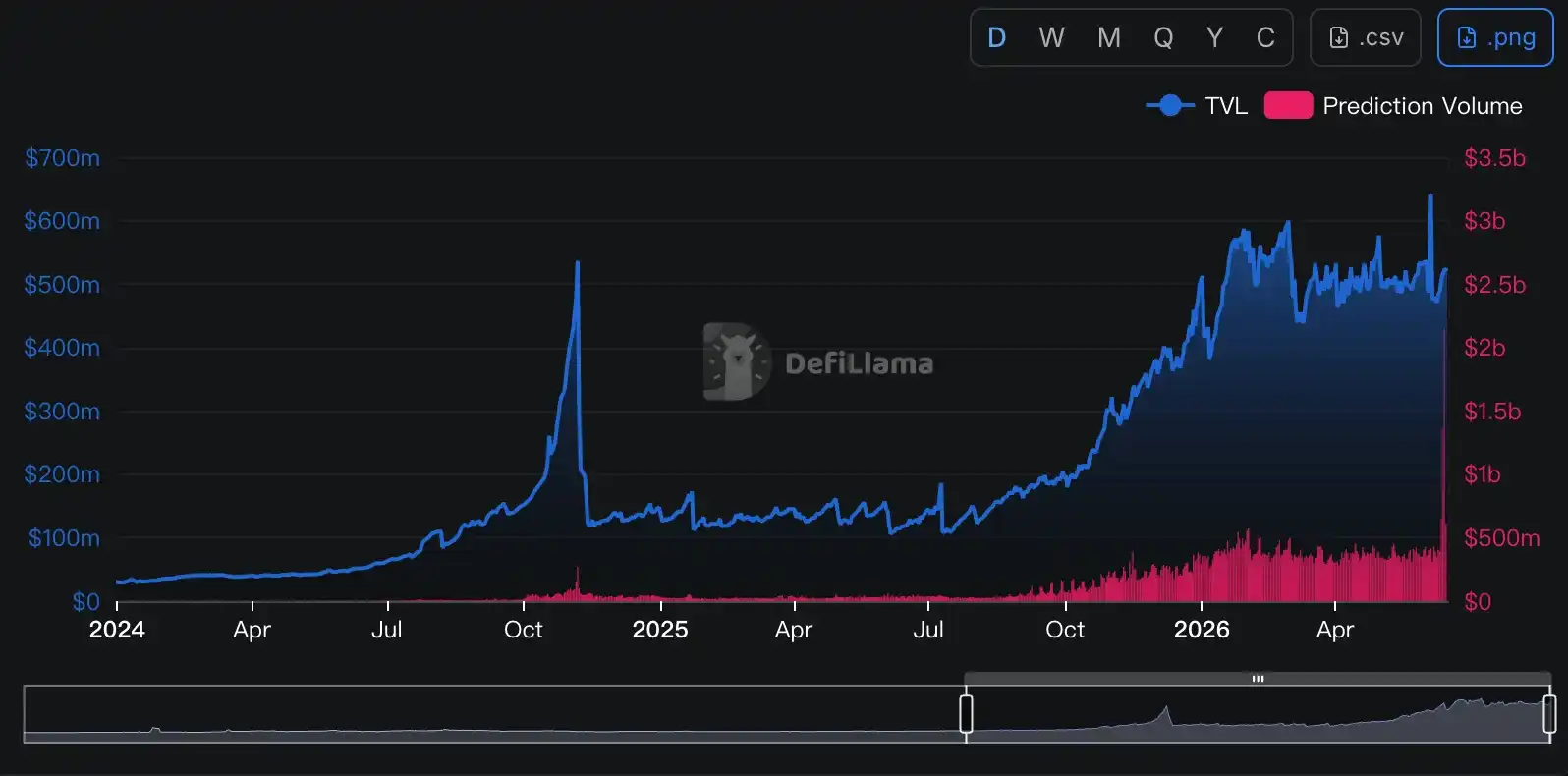
  • Odaily Note: Data sourced from Defillama.

Kalshi's Most Important Traffic Channel — Robinhood

Rewind to March 2025. At that time, Kalshi announced a partnership with the US online brokerage Robinhood. The latter would use Kalshi's services to provide its users with prediction market trading, allowing users to place bets on political, economic, sports, and other events.

From a business model perspective, this was a classic case of "mutual benefit" — Robinhood, responsible for user access and order flow distribution, could directly utilize Kalshi's mature product; Kalshi, responsible for the underlying market, matching, clearing, and regulatory compliance systems, could access Robinhood's massive pool of retail traffic.

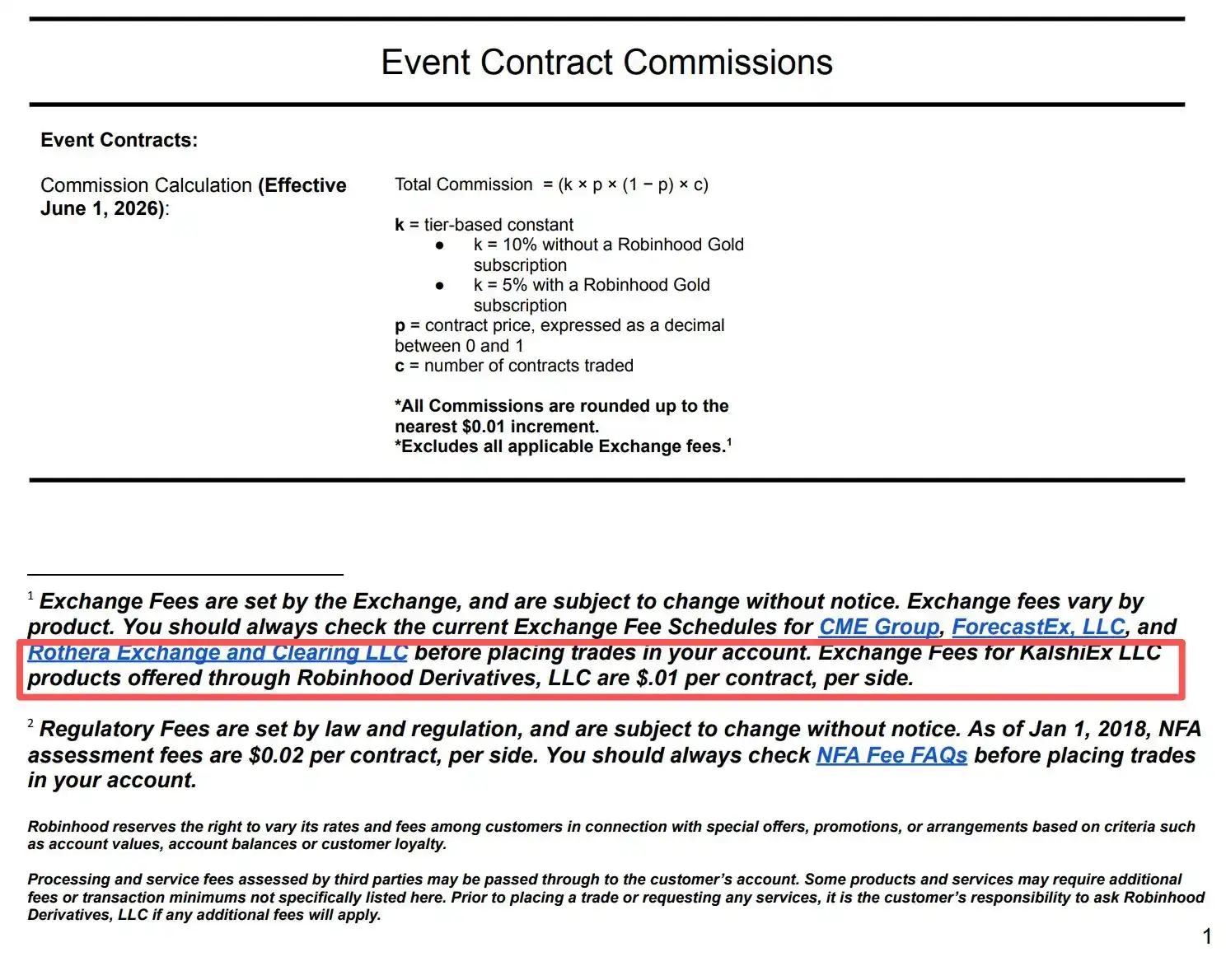
The subsequent story proved the "win-win" outcome of this collaboration. Through Robinhood's channel distribution, Kalshi indirectly gained a massive amount of users and transaction volume. Piper Sandler analysts once estimated that "transactions completed through the Robinhood channel accounted for about 25%-35% of Kalshi's total trading volume." These orders ultimately translated into revenue for both parties — Robinhood charges an independent fee for all Kalshi event contracts traded through this channel, $0.01 per contract per side, and then shares the revenue with Kalshi (the specific split was not disclosed).
The Q1 financial report released at the end of April this year showed that Robinhood achieved trading of 8.8 billion event contracts in Q1, driving "other transaction revenue" to grow 320% year-over-year, reaching $147 million. Prediction markets have become the most eye-catching new growth engine in Robinhood's product line.

But recently, this relationship has undergone some subtle changes.

Robinhood's Ambition: Reclaiming the Cake Shared with Kalshi

As countless episodes in internet history have proven, when a channel gains sufficient influence, it is no longer content with just being a channel. Robinhood is no exception.

Although the cooperation with Kalshi also brought Robinhood considerable revenue, with prediction markets becoming one of the fastest-growing new businesses on the platform, Robinhood was no longer satisfied with the current revenue-sharing arrangement.

In their partnership model, Kalshi provided the market and infrastructure, while Robinhood provided the users and order flow. However, as the cooperation deepened, Robinhood gradually realized that what was truly scarce might not be the market itself, but the user access point it firmly controlled. After all, for most Robinhood users, they don't care whether their orders are ultimately executed on Kalshi or another platform — users only see a trading entry point within the Robinhood app, not the underlying infrastructure provider.

In other words, Robinhood always controlled one of the most critical resources in prediction markets — distribution power. If the users belong to Robinhood, why should the orders flow to someone else?

In fact, while Robinhood was quickly validating the demand for prediction markets with Kalshi, another Plan B was launched shortly after.

In November 2025, Robinhood announced the establishment of a joint venture with Wall Street quantitative trading giant Susquehanna, planning to acquire the CFTC-regulated derivatives exchange MIAXdx. According to the official statement, the joint venture would operate an independent futures and derivatives exchange and clearing agency in the future, with prediction markets being one of its key focuses. At the time, the outside world mostly viewed this as an infrastructure investment. However, with subsequent information disclosures, people gradually realized that Robinhood's goal was far beyond just finding a new partner for prediction markets.

In January 2026, the deal was officially completed. Robinhood and Susquehanna gained 90% control of MIAXdx, simultaneously acquiring a complete CFTC regulatory framework, including Designated Contract Market (DCM) and Derivatives Clearing Organization (DCO) qualifications. Subsequently, MIAXdx was renamed Rothera Exchange, and its clearing agency was renamed Rothera Clearing.

Thus, Robinhood now possessed the core elements needed to independently operate a prediction market. The only thing lacking was a mature product comparable to Kalshi's, but for Robinhood, with its rich experience in internet product development, this was clearly not a difficult task.

Rothera's Opportunity: The World Cup

In June 2026, after about six months of accelerated development, the Rothera product took shape, and Robinhood finally made the move that was almost destined to happen — gradually shifting orders that originally flowed to Kalshi into its own controlled system.

Robinhood specifically chose an excellent launch battleground for Rothera — the World Cup. For prediction markets, the World Cup is undoubtedly one of the most traffic-generating trading themes. Whether it's match outcomes, qualification results, or the ultimate champion, related markets can attract a large number of new users to trade in a short period. For Rothera's nascent platform, there is no better scenario for a cold start than the World Cup.

According to Robinhood's official disclosure, during this World Cup, which comprises a total of 104 matches, part of the event contracts will be directed to Rothera for matching and clearing, including markets for single World Cup match results, the ultimate World Cup champion, total goals in a single match, etc. Compared to the previous model that completely relied on Kalshi, this marks the first time Robinhood has directed prediction market orders into its own trading system on a large scale.
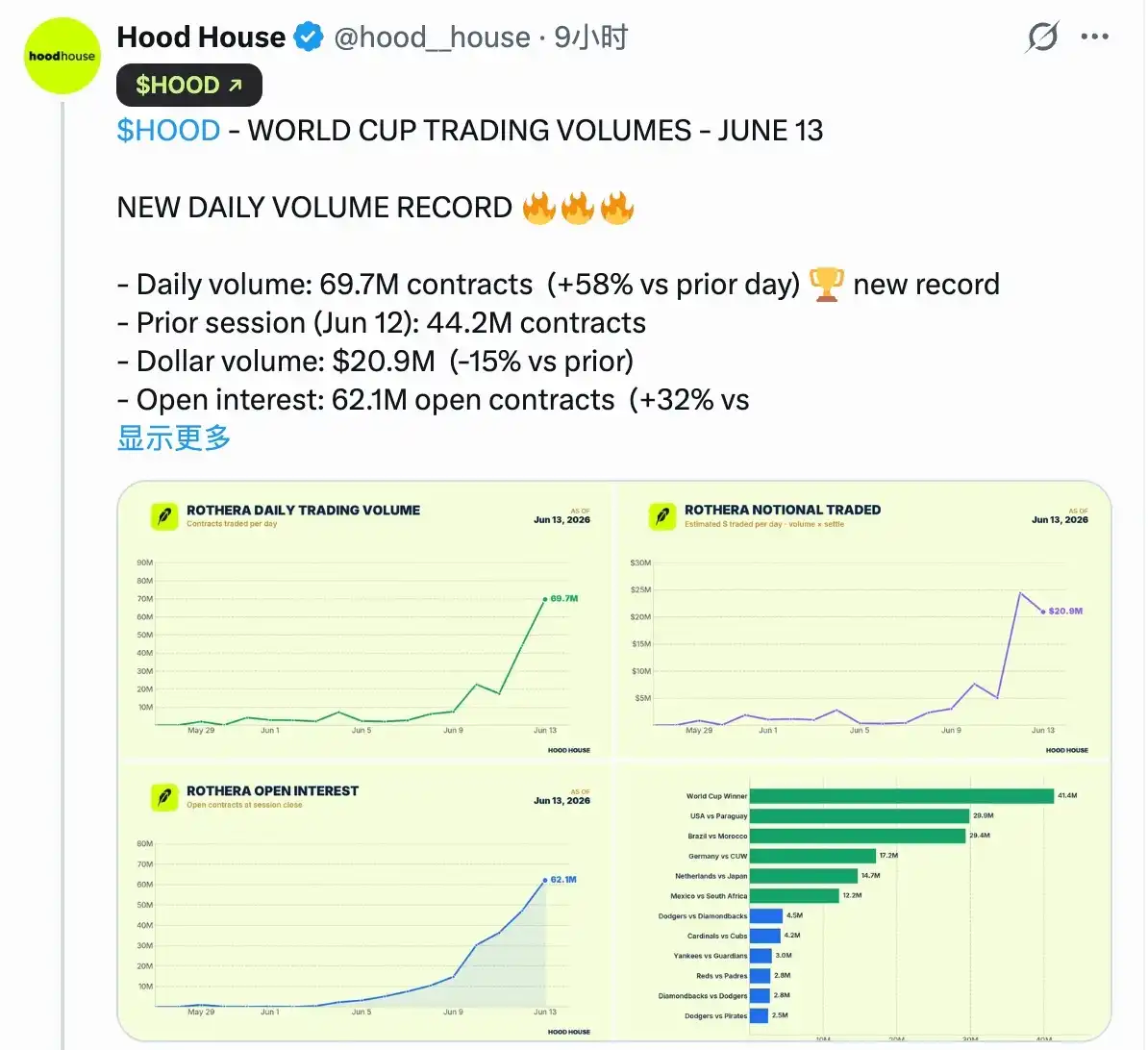
Judging by the results, Rothera clearly seized this opportunity. According to data disclosed by Hood House, a research-focused自媒体 tracking Robinhood's activities, on June 12th, Rothera completed 44.2 million contract trades, corresponding to approximately $24.4 million in dollar trading volume; on June 13th, Rothera completed 69.7 million contract trades, corresponding to approximately $20.9 million in dollar trading volume... Although these figures still lag behind Kalshi's popular markets, which often see hundreds of millions or even billions of dollars in volume, considering that Rothera has literally just launched a few days ago, this performance is sufficiently successful.

For both Robinhood and Kalshi, this means the balance of cooperation between them has begun to tilt. From Robinhood's perspective, the transaction fee revenue that previously had to be shared with Kalshi can now be retained more within its own ecosystem; from Kalshi's perspective, this means that one of its former most important growth engines has begun to show signs of weakening.

And the World Cup is clearly just the beginning of Rothera's encroachment on Kalshi. Looking further into the future, Robinhood will inevitably expand Rothera's coverage to more sports events, as well as economic and political themes. Those orders that originally flowed to Kalshi will then be intercepted one by one by Rothera.

Since Robinhood and Kalshi have never publicly disclosed their revenue-sharing ratio, we cannot know the exact value of this interception. However, considering that Robinhood alone generated $147 million in prediction market-related revenue in Q1, and with the World Cup in Q2 and the midterm elections later expected to bring even larger-scale trading activities, the annual value of this interception could reach billions of dollars.

Who Controls Distribution, Controls Everything

The drama of Robinhood and Kalshi moving from allies to rivals once again illustrates a logic repeatedly verified in the internet market — products are easy to build, traffic is hard to find; whoever controls distribution controls everything.

Over the past few years, the market generally believed that Kalshi's core moat came from regulatory licenses, exchange qualifications, and clearing capabilities. Therefore, whether it was brokerages like Robinhood or various media outlets, communities, and traffic platforms, they were essentially just Kalshi's channels and traffic inlets. However, the emergence of Rothera proves one thing: in today's market where products are highly homogenized, the product itself might not be the most important element. What remains truly scarce is always the users.

Where the users are, the liquidity is; where the liquidity is, the market will be. When Robinhood controls the access point to tens of millions of retail users, it has the full ability to direct these users to any trading venue. For users, they don't care whether their orders are ultimately executed on Kalshi or Rothera. As long as the experience isn't significantly different, it doesn't matter who is behind the matching and clearing.

If the theme of the prediction market industry in the past few years was the market competition between Polymarket and Kalshi, then the theme for the coming years might become a channel war. Robinhood incubating Rothera is, in essence, a reverse integration launched by the channel side towards the market layer. As more and more platforms with traffic inlets begin to recognize the strategic value of prediction markets, similar stories are likely to continue. Whether they are exchanges, brokerages, social platforms, or media platforms, all could become new gateways to prediction markets.

And when inlets begin to control markets, and channels begin to possess pricing power, the ultimate winner in the prediction market industry might no longer be the platform responsible for matching orders, but the one closest to the users, the one that best controls distribution.

It was true in the internet era, and it was true in the mobile internet era. This time, there are no exceptions either.


Domande pertinenti

QWhy is the article titled 'The First Stock of the Prediction Market Concept Has Appeared!'?

AThe title refers to the financial markets potentially viewing 'Robinhood' (HOOD), a publicly traded brokerage platform, as a stock heavily exposed to and benefiting from the growth of the prediction market industry. The article details how Robinhood, initially a distributor for Kalshi, has now built its own prediction market infrastructure (Rothera), positioning itself as a major player and capturing more value from this high-growth segment.

QWhat was the nature of the initial partnership between Robinhood and Kalshi, and why did it break down?

AThe initial partnership (March 2025) was symbiotic: Kalshi provided the regulated prediction market platform (licenses, matching, clearing), while Robinhood provided its massive retail user base and distribution. It broke down because Robinhood realized the scarcity and strategic value of its user access point. As prediction markets became a key growth driver, Robinhood wanted to capture more of the revenue by bringing the trading infrastructure in-house, leading it to develop its own platform, Rothera.

QHow did Robinhood build its own prediction market platform, Rothera?

ARobinhood built Rothera through a strategic acquisition. In November 2025, it announced a joint venture with Susquehanna to acquire MIAXdx, a CFTC-regulated derivatives exchange. The deal closed in January 2026, giving them a Designated Contract Market (DCM) and Derivatives Clearing Organization (DCO) license. MIAXdx was renamed Rothera Exchange/Rothera Clearing, providing Robinhood with the core regulated infrastructure to independently operate a prediction market.

QWhy did Robinhood choose the 2026 FIFA World Cup to launch Rothera?

ARobinhood chose the 2026 FIFA World Cup as the launchpad for Rothera because it is a premier, high-traffic event for prediction markets. Sports events, especially the World Cup, naturally attract a large volume of speculative trading on outcomes like match winners and champions. This provided Rothera with a perfect 'cold start' scenario to attract a surge of new users and generate immediate trading volume, proving the viability of their new platform.

QWhat is the core argument the article makes about the future of the prediction market industry?

AThe article argues that the future competitive landscape of prediction markets will shift from a 'market war' (between platforms like Polymarket and Kalshi) to a 'channel war.' The core thesis is that 'who controls distribution, controls everything.' The ultimate winners may not be the companies that build the trading engines (like Kalshi), but rather the entities (like Robinhood) that own the user interface, the customer relationships, and the primary access points, as they hold the power to direct traffic and capture value.

Letture associate

How to Do Research Well: Deliberately Practice the Real Skills That Matter

No one truly teaches you how to do research. You're often given a desk, a pre-selected problem, and vague instructions to "create something new." Consequently, many people reverse-engineer the job based on visible outputs—papers, posts, announcements—learning only how to *appear* like a researcher rather than how to *become* one. True research capability is built from stacking small, trainable skills, nearly all of which can be developed through deliberate practice. **Pick Your Own Problem:** Most researchers absorb problems from advisors or trends, lacking the underlying reasoning. Choosing a problem you genuinely care about, as John Schulman advises, leads to original work. Develop "taste" like a muscle: predict experiment outcomes, guess paper results from methods, and track which findings remain important over time. **Upgrade Your Inputs:** Relying on shared reading lists (arXiv hot lists, filtered group chats) leads to unoriginal conclusions. Undervalued old literature often holds crucial insights (e.g., MoE, LSTM, backpropagation). Richard Sutton's "The Bitter Lesson" or Claude Shannon's 1952 talk on creative thinking are more predictive than lengthy modern surveys. Breadth matters as much as depth: draw from neuroscience, mechanism design, hardware knowledge, and honest statistics. Read papers directly, especially appendices and limitations sections. **Write Everything Down:** As Paul Graham noted, writing exposes flaws in seemingly mature ideas. Writing is the cheapest defense against self-deception. Following Feynman's principle, Darwin programmatically wrote down facts contradicting his theory to combat memory bias. Maintain a detailed log of hypotheses, setups, predictions, results, and updated understandings. Reviewing past logs fosters essential humility.

marsbit35 min fa

How to Do Research Well: Deliberately Practice the Real Skills That Matter

marsbit35 min fa

Following US Ban on Fable 5, Zhipu AI's Stock Soars 47%

On June 15th, shares of Zhipu AI surged dramatically on the Hong Kong stock market, peaking at a 47.6% gain before closing 32.82% higher. This sharp increase was directly triggered by two recent industry events. On June 12th, Anthropic announced it was suspending global access to its latest flagship models, Claude Fable 5 and Claude Mythos 5, to comply with a U.S. government export control order. The next day, Zhipu AI announced it would open access to its latest open-source flagship model, GLM-5.2, under the permissive MIT license. The Anthropic incident highlighted a critical issue beyond raw model capability: the risk of sudden, unpredictable loss of access to advanced AI models, especially for developers and enterprises deeply integrated with them. This has shifted industry and market focus toward factors like stability, sustainable access, and controllability. Zhipu's move, promoting "frontier intelligence for all," positions its openly available model as a reliable and accessible alternative. The GLM-5.2 model emphasizes "Long Horizon Task" capabilities with a 1M context window, targeting complex, multi-step coding and engineering workflows where maintaining context is crucial. Analysts note this event exposes the risk of dependency on closed-source models subject to single jurisdictional controls, potentially accelerating a shift toward domestic base models and localized deployments. The market's reaction signals a new valuation dimension in AI: providers who can offer stable, long-term, and sustainably accessible AI capabilities are gaining strategic importance.

marsbit59 min fa

Following US Ban on Fable 5, Zhipu AI's Stock Soars 47%

marsbit59 min fa

Fully Entering the AI Era: Alipay Bets on Conversation, WeChat Holds Fast to Social

In May 2026, Alipay announced over 300 million AI payment transactions. Shortly after, WeChat opened its mini-programs for AI integration, sparking controversy by requiring developer source code access. This highlights their diverging approaches to AI integration. Alipay is testing "Project Treasure," an optional AI-native interface replacing traditional app grids with a conversational window. Users can command complex tasks (e.g., "book a ride and order coffee") handled end-to-end by AI. This shift follows an abandoned standalone AI app, focusing instead on enhancing its existing user base. For unmodified mini-programs, Alipay's AI uses "screen-reading" to simulate user interactions, bypassing the need for developer overhaul. It also introduced "Token Pay" for micro-transactions and "AI Wallets" for autonomous agent spending. WeChat, prioritizing its core social function, is taking an embedded approach. Its AI agent will operate within existing contexts like group chats and official accounts, assisting without a separate interface. To enable this, WeChat offers developers two paths: granting source code access for direct AI control ("Automatic Mode") or manually encapsulating services into standardized "Skills." Both place significant burden on developers. Key differences emerge in handling legacy services: WeChat demands developer cooperation (code or labor), while Alipay's screen-reading offers immediate, if potentially less stable, compatibility. Alipay's 3 billion AI transactions demonstrate user acceptance of AI-driven commercial actions. The divergent strategies may reshape mini-program ecosystems—Alipay passively "AI-fying" services, WeChat potentially favoring resource-rich developers—and set competing technical standards. Ultimately, the competition centers on where users entrust the command to "help me get things done."

marsbit1 h fa

Fully Entering the AI Era: Alipay Bets on Conversation, WeChat Holds Fast to Social

marsbit1 h fa

Trading

Spot
Futures

Articoli Popolari

Come comprare T

Benvenuto in HTX.com! Abbiamo reso l'acquisto di Threshold Network Token (T) semplice e conveniente. Segui la nostra guida passo passo per intraprendere il tuo viaggio nel mondo delle criptovalute.Step 1: Crea il tuo Account HTXUsa la tua email o numero di telefono per registrarti il tuo account gratuito su HTX. Vivi un'esperienza facile e sblocca tutte le funzionalità,Crea il mio accountStep 2: Vai in Acquista crypto e seleziona il tuo metodo di pagamentoCarta di credito/debito: utilizza la tua Visa o Mastercard per acquistare immediatamente Threshold Network TokenT.Bilancio: Usa i fondi dal bilancio del tuo account HTX per fare trading senza problemi.Terze parti: abbiamo aggiunto metodi di pagamento molto utilizzati come Google Pay e Apple Pay per maggiore comodità.P2P: Fai trading direttamente con altri utenti HTX.Over-the-Counter (OTC): Offriamo servizi su misura e tassi di cambio competitivi per i trader.Step 3: Conserva Threshold Network Token (T)Dopo aver acquistato Threshold Network Token (T), conserva nel tuo account HTX. In alternativa, puoi inviare tramite trasferimento blockchain o scambiare per altre criptovalute.Step 4: Scambia Threshold Network Token (T)Scambia facilmente Threshold Network Token (T) nel mercato spot di HTX. Accedi al tuo account, seleziona la tua coppia di trading, esegui le tue operazioni e monitora in tempo reale. Offriamo un'esperienza user-friendly sia per chi ha appena iniziato che per i trader più esperti.

414 Totale visualizzazioniPubblicato il 2024.12.10Aggiornato il 2026.06.02

Come comprare T

Discussioni

Benvenuto nella Community HTX. Qui puoi rimanere informato sugli ultimi sviluppi della piattaforma e accedere ad approfondimenti esperti sul mercato. Le opinioni degli utenti sul prezzo di T T sono presentate come di seguito.

活动图片