The First Fed Chair with Crypto Holdings? Kevin Warsh Discloses at Least 20 Crypto Investments Including Solana and dYdX

marsbitPubblicato 2026-04-15Pubblicato ultima volta 2026-04-15

Introduzione

Kevin Warsh, a former Federal Reserve governor and nominee for Fed Chair, has disclosed at least 20 cryptocurrency-related investments in a 69-page financial filing submitted to the U.S. Office of Government Ethics. The disclosure, required ahead of his Senate confirmation hearing, reveals indirect holdings in major crypto projects including Solana, dYdX, Optimism, Polychain Capital, Dapper Labs, and Lightning Network, among others. These investments are held through various venture funds and special purpose vehicles. Warsh and his wife, Jane Lauder, have a combined net worth of at least $192 million. While the crypto holdings are described as small, risk-focused positions, they span multiple sectors: L1 and L2 blockchains, DeFi protocols, NFT platforms, payment systems, and AI-integrated chains. Warsh has publicly endorsed Bitcoin in the past, calling it “a very good police for policy” and “the new gold for those under 40.” If confirmed, he would become the first Fed Chair with direct exposure to crypto venture investments. His confirmation hearing is scheduled for April 21, though political opposition remains a potential hurdle.

Author: Claude, Deep Tide TechFlow

Deep Tide Guide: Kevin Warsh, nominated by Trump for Fed Chair, submitted a 69-page financial disclosure revealing combined assets with his wife of at least $192 million, including indirect investments in at least 20 crypto-related entities such as Solana, dYdX, Polychain Capital, Optimism, and Dapper Labs. If confirmed, he would become the first Fed Chair with exposure to crypto venture capital. The confirmation hearing is scheduled for April 21st, but Republican Senator Tillis still threatens to vote no due to the Powell investigation stalemate.
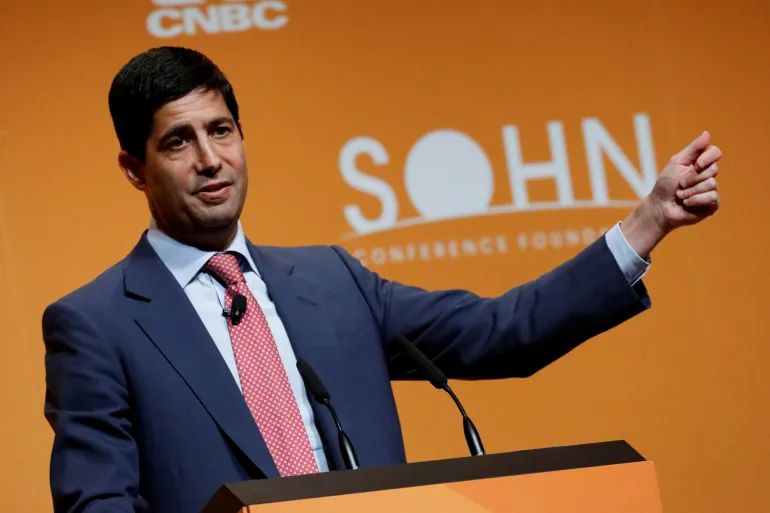
Warsh's crypto holdings list emerged through a 69-page government ethics document.

Fed Chair nominee Kevin Warsh submitted his financial disclosure to the U.S. Office of Government Ethics (OGE) on April 14th, the final procedural step before the Senate confirmation hearing. The document shows that Warsh and his wife Jane Lauder have combined assets of approximately $192 million, potentially more. But what truly captured the crypto industry's attention were the over twenty crypto and Web3-related holdings buried deep within the file.
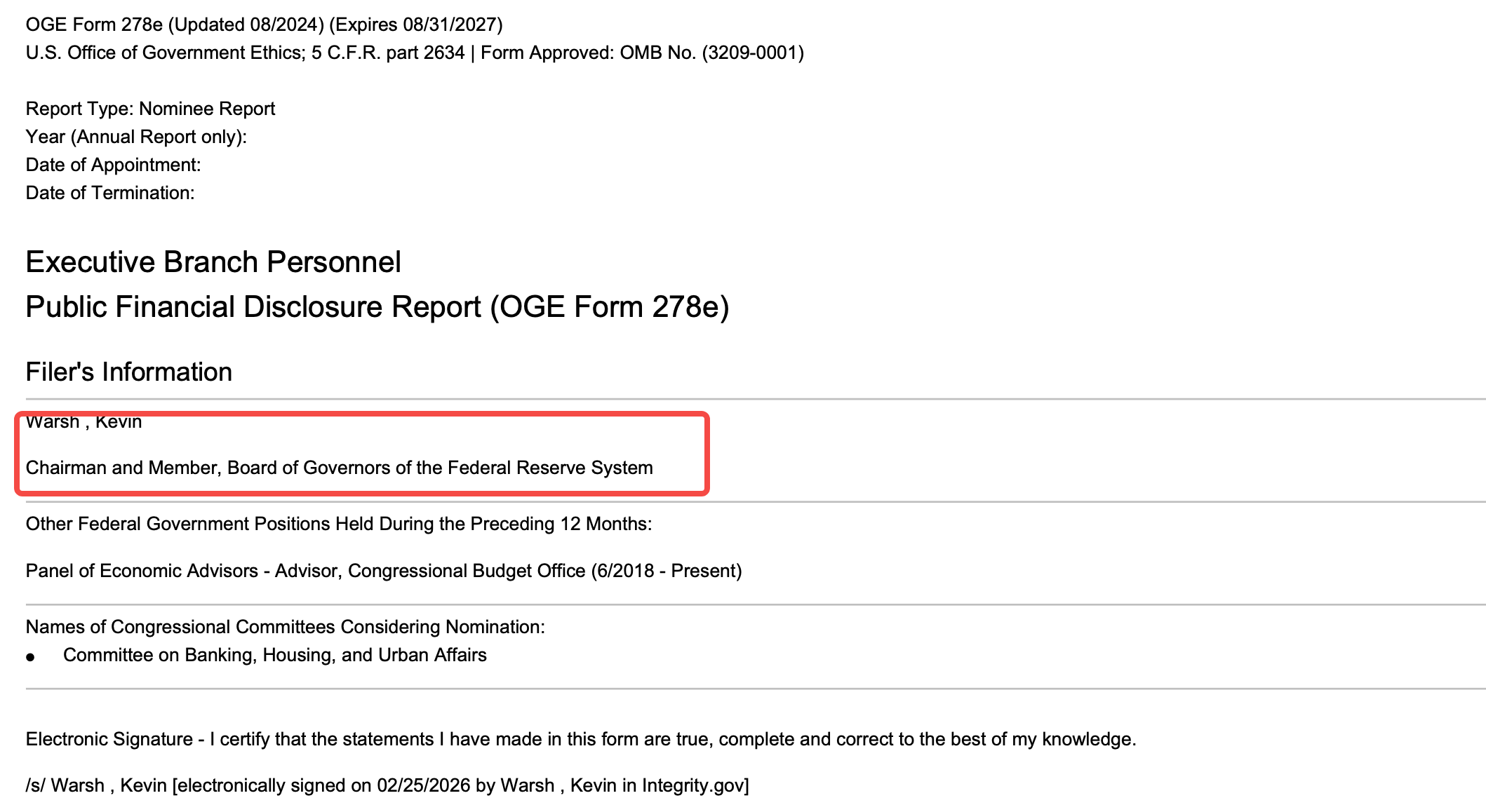
Warsh had previously stated clearly in a public interview at the Hoover Institution: Bitcoin doesn't make him uncomfortable; he considers it an important asset that can help policymakers judge whether their decisions are correct. Now, the disclosure proves he's gone beyond mere words—his money is indeed on this track.

At Least 20 Crypto Entities: Nearly Full Coverage from L1 Public Chains to DeFi Protocols

Warsh's crypto exposure is distributed across multiple venture capital fund structures. Through the AVGF I fund, he indirectly holds interests in Solana, Optimism, and the Lightning Network; through DCM Investments 10 LLC, he holds stakes in dYdX and Polychain Capital, with the same vehicle also including dozens of fintech and Web3 projects like Compound, Lighter, Lemon Cash, and Blast (an Ethereum L2 protocol).

Under the AVF series of funds, crypto-related holdings also appear including Dapper Labs, Deso, Eulith, Onjuno, Ridian, Friends With Benefits, and Zero Gravity (an L2 AI blockchain platform). Warsh also directly holds shares worth $1,001 to $15,000 in Web3 company Metatheory Inc. through Founder Bets Master SPV LLC.
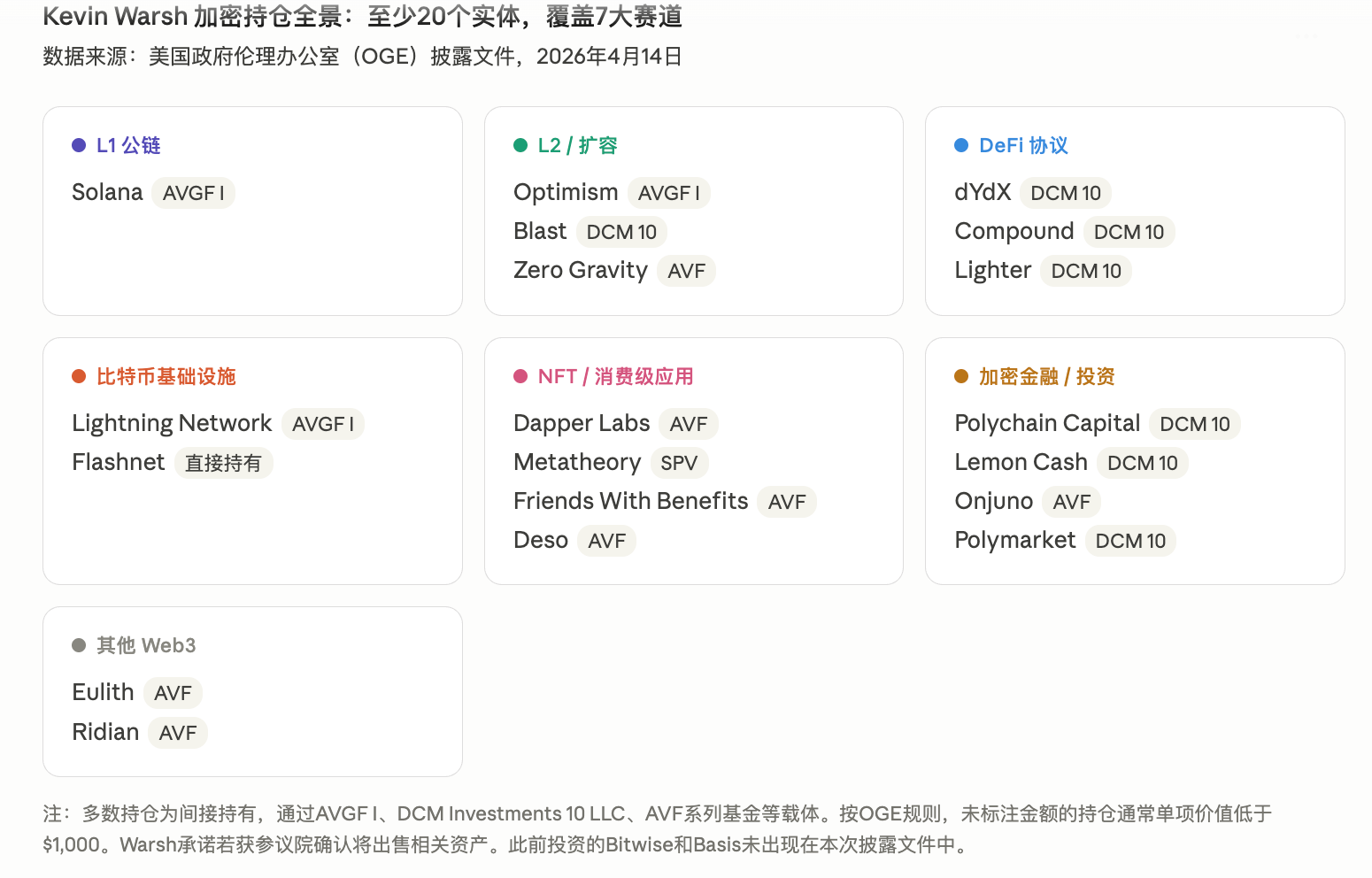
Furthermore, according to Bitcoin Magazine, Warsh also holds equity in Bitcoin payments startup Flashnet, a company positioned as a Bitcoin merchant payment system similar to the Lightning Network. Warsh had previously invested in crypto index management company Bitwise and algorithmic stablecoin project Basis, although these investments did not appear in this disclosure.

In terms of coverage, this holdings list touches nearly every major sector of the crypto industry: L1 public chains (Solana), L2 scaling (Optimism, Blast), DeFi protocols (dYdX, Compound), NFT infrastructure (Dapper Labs), prediction markets (Polymarket), Bitcoin payments (Flashnet, Lightning Network), and even social tokens (Friends With Benefits) and AI blockchain (Zero Gravity).

However, according to OGE rules, holdings without specified amounts typically mean the individual item is valued below $1,000, indicating these crypto positions are mostly small risk bets rather than concentrated positions.

Full Picture of $192 Million in Assets: Druckenmiller Advisory Fees, Juggernaut Fund & Opaque Holdings

Crypto holdings are just one corner of Warsh's vast asset portfolio.

The two largest investments in the file are two positions in the Juggernaut Fund LP, each marked as "over $50 million," but the underlying assets are not disclosed due to confidentiality agreements. Warsh has committed to selling all of these if confirmed. Additionally, about twenty-plus THSDFS LLC series holdings, with individual amounts up to $5 million, also have undisclosed underlying assets due to confidentiality clauses.

Regarding income, Warsh received a $10.2 million advisory fee from the Duquesne Family Office of Wall Street legend Stanley Druckenmiller. He also received $1.55 million from GoldenTree Asset Management, $750,000 from Cerberus Capital Management in advisory fees, and a $750,000 speaking fee from Brevan Howard—all institutions with digital asset trading businesses.

OGE certifying official Heather Jones noted in the review opinion that once Warsh completes the promised asset sales, he will meet the compliance requirements of the Ethics in Government Act.

Warsh's wife, Jane Lauder, is the granddaughter of Estée Lauder's founder, with Forbes estimating her personal net worth at approximately $1.9 billion.

Once Called Bitcoin a "Good Police for Policy," Now His Holdings Confirm His Judgment

Warsh's attitude toward Bitcoin is unique among past and current senior Fed officials.

As early as 2011, Warsh saw the Bitcoin whitepaper from Marc Andreessen at a dinner. In 2018, he wrote in The Wall Street Journal that Bitcoin could become a "sustainable store of value" similar to gold. In 2021, he stated on CNBC that for people under 40, Bitcoin is their new gold.

In 2025, in a Hoover Institution interview, he gave his most complete statement to date: Bitcoin is not a substitute for the dollar, but it can be a very good police for policy. He also characterized software development in the crypto industry as part of U.S. economic competitiveness.

For the crypto industry, Warsh's disclosure is a double-edged signal. On one hand, a Fed Chair with firsthand venture capital exposure to DeFi and blockchain infrastructure may understand the nuances of this technology better than his predecessors; on the other hand, forced sales and recusal obligations may limit his ability to translate these sympathetic attitudes into concrete actions early in his tenure.


Domande pertinenti

QWho is Kevin Warsh and what significant financial disclosure did he make?

AKevin Warsh is a nominee for the position of Federal Reserve Chair. He submitted a 69-page financial disclosure to the U.S. Office of Government Ethics, revealing a combined net worth of at least $192 million with his wife and indirect investments in at least 20 crypto-related entities.

QWhat are some of the major crypto projects and companies that Kevin Warsh has indirect investments in?

AHis disclosed crypto investments include Solana, dYdX, Polychain Capital, Optimism, Dapper Labs, Compound, Lightning Network, Blast, and Flashnet, covering sectors like L1 blockchains, L2 scaling, DeFi, NFTs, and Bitcoin payments.

QWhat is the significance of Kevin Warsh potentially becoming the Federal Reserve Chair with these crypto holdings?

AIf confirmed, Kevin Warsh would be the first Federal Reserve Chair to have a venture capital exposure to the cryptocurrency market, indicating a potential for a more nuanced understanding of the technology within the highest levels of U.S. monetary policy.

QWhat was Kevin Warsh's previous public stance on Bitcoin and cryptocurrency?

AWarsh has publicly stated that Bitcoin does not make him uneasy, views it as an important asset that can act as a 'good police' for policy makers to judge their decisions, and has referred to it as 'new gold' for people under 40.

QWhat are the two largest investments in Warsh's portfolio and what is the plan for them if he is confirmed?

AThe two largest investments are two positions in the Juggernaut Fund LP, each valued at 'over $50 million'. Warsh has committed to divest these holdings, along with other specified assets, if his nomination is confirmed to comply with government ethics rules.

Letture associate

From Theft to Re-entry: How Was $292 Million "Laundered"?

A sophisticated crypto laundering operation was executed following the $292 million hack of Kelp DAO on April 18. The attack, attributed to the North Korean Lazarus group, began with anonymous infrastructure preparation using Tornado Cash to fund wallets untraceably. The hacker exploited a vulnerability in Kelp’s cross-chain bridge, stealing 116,500 rsETH. To avoid crashing the market, the attacker used Aave and Compound as laundering tools—depositing the stolen rsETH as collateral to borrow $190 million in clean, liquid ETH. This move triggered a bank run on Aave, causing an $8 billion drop in TVL. After consolidating funds, the attacker fragmented them across hundreds of wallets to evade detection. A major breakpoint was THORChain, where over $460 million in volume—30 times its usual activity—was processed in 24 hours, converting ETH into Bitcoin. This shift to Bitcoin’s UTXO model exponentially increased tracing complexity by shattering funds into countless untraceable fragments. The final destination was Tron-based USDT, the primary channel for illicit crypto flows. From there, funds were cashed out via OTC brokers in China and Southeast Asia, using unlicensed underground banks and UnionPay networks outside Western sanctions scope. Ultimately, the laundered money supports North Korea’s weapons programs, which rely heavily on crypto hacking for foreign currency. The incident underscores structural challenges in DeFi: its openness, composability, and lack of central control make such laundering not just possible, but inherently difficult to prevent.

marsbit6 min fa

From Theft to Re-entry: How Was $292 Million "Laundered"?

marsbit6 min fa

Google and Amazon Simultaneously Invest Heavily in a Competitor: The Most Absurd Business Logic of the AI Era Is Becoming Reality

In a span of four days, Amazon announced an additional $25 billion investment, and Google pledged up to $40 billion—both direct competitors pouring over $65 billion into the same AI startup, Anthropic. Rather than a typical venture capital move, this signals the latest escalation in the cloud wars. The core of the deal is not equity but compute pre-orders: Anthropic must spend the majority of these funds on AWS and Google Cloud services and chips, effectively locking in massive future compute consumption. This reflects a shift in cloud market dynamics—enterprises now choose cloud providers based on which hosts the best AI models, not just price or stability. With OpenAI deeply tied to Microsoft, Anthropic’s Claude has become the only viable strategic asset for Google and Amazon to remain competitive. Anthropic’s annualized revenue has surged to $30 billion, and it is expanding into verticals like biotech, positioning itself as a cross-industry AI infrastructure layer. However, this funding comes with constraints: Anthropic’s independence is challenged as it balances two rival investors, its safety-first narrative faces pressure from regulatory scrutiny, and its path to IPO introduces new financial pressures. Globally, this accelerates a "tri-polar" closed-loop structure in AI infrastructure, with Microsoft-OpenAI, Google-Anthropic, and Amazon-Anthropic forming exclusive model-cloud alliances. In contrast, China’s landscape differs—investments like Alibaba and Tencent backing open-source model firm DeepSeek reflect a more decoupled approach, though closed-source models from major cloud providers still dominate. The $65 billion bet is ultimately about securing a seat at the table in an AI-defined future—where missing the model layer means losing the cloud war.

marsbit6 h fa

Google and Amazon Simultaneously Invest Heavily in a Competitor: The Most Absurd Business Logic of the AI Era Is Becoming Reality

marsbit6 h fa

Computing Power Constrained, Why Did DeepSeek-V4 Open Source?

DeepSeek-V4 has been released as a preview open-source model, featuring 1 million tokens of context length as a baseline capability—previously a premium feature locked behind enterprise paywalls by major overseas AI firms. The official announcement, however, openly acknowledges computational constraints, particularly limited service throughput for the high-end DeepSeek-V4-Pro version due to restricted high-end computing power. Rather than competing on pure scale, DeepSeek adopts a pragmatic approach that balances algorithmic innovation with hardware realities in China’s AI ecosystem. The V4-Pro model uses a highly sparse architecture with 1.6T total parameters but only activates 49B during inference. It performs strongly in agentic coding, knowledge-intensive tasks, and STEM reasoning, competing closely with top-tier closed models like Gemini Pro 3.1 and Claude Opus 4.6 in certain scenarios. A key strategic product is the Flash edition, with 284B total parameters but only 13B activated—making it cost-effective and accessible for mid- and low-tier hardware, including domestic AI chips from Huawei (Ascend), Cambricon, and Hygon. This design supports broader adoption across developers and SMEs while stimulating China's domestic semiconductor ecosystem. Despite facing talent outflow and intense competition in user traffic—with rivals like Doubao and Qianwen leading in monthly active users—DeepSeek has maintained technical momentum. The release also comes amid reports of a new funding round targeting a valuation exceeding $10 billion, potentially setting a new record in China’s LLM sector. Ultimately, DeepSeek-V4 represents a shift toward open yet realistic infrastructure development in the constrained compute landscape of Chinese AI, emphasizing engineering efficiency and domestic hardware compatibility over pure model scale.

marsbit6 h fa

Computing Power Constrained, Why Did DeepSeek-V4 Open Source?

marsbit6 h fa

Trading

Spot
Futures

Articoli Popolari

Come comprare DYDX

Benvenuto in HTX.com! Abbiamo reso l'acquisto di dYdX (DYDX) semplice e conveniente. Segui la nostra guida passo passo per intraprendere il tuo viaggio nel mondo delle criptovalute.Step 1: Crea il tuo Account HTXUsa la tua email o numero di telefono per registrarti il tuo account gratuito su HTX. Vivi un'esperienza facile e sblocca tutte le funzionalità,Crea il mio accountStep 2: Vai in Acquista crypto e seleziona il tuo metodo di pagamentoCarta di credito/debito: utilizza la tua Visa o Mastercard per acquistare immediatamente dYdXDYDX.Bilancio: Usa i fondi dal bilancio del tuo account HTX per fare trading senza problemi.Terze parti: abbiamo aggiunto metodi di pagamento molto utilizzati come Google Pay e Apple Pay per maggiore comodità.P2P: Fai trading direttamente con altri utenti HTX.Over-the-Counter (OTC): Offriamo servizi su misura e tassi di cambio competitivi per i trader.Step 3: Conserva dYdX (DYDX)Dopo aver acquistato dYdX (DYDX), conserva nel tuo account HTX. In alternativa, puoi inviare tramite trasferimento blockchain o scambiare per altre criptovalute.Step 4: Scambia dYdX (DYDX)Scambia facilmente dYdX (DYDX) nel mercato spot di HTX. Accedi al tuo account, seleziona la tua coppia di trading, esegui le tue operazioni e monitora in tempo reale. Offriamo un'esperienza user-friendly sia per chi ha appena iniziato che per i trader più esperti.

133 Totale visualizzazioniPubblicato il 2024.12.13Aggiornato il 2025.03.21

Come comprare DYDX

Discussioni

Benvenuto nella Community HTX. Qui puoi rimanere informato sugli ultimi sviluppi della piattaforma e accedere ad approfondimenti esperti sul mercato. Le opinioni degli utenti sul prezzo di DYDX DYDX sono presentate come di seguito.

活动图片












