The First Encyclical of the New Pope in Rome, to Save the Common People in the AI Era

Odaily星球日报Pubblicato 2026-05-26Pubblicato ultima volta 2026-05-26

Introduzione

New Pope's First Encyclical Aims to Safeguard Humanity in the AI Era On May 25th, Pope Leo XIV issued his first encyclical, "Magnifica humanitas," a 40,000-word document addressing the profound challenges posed by Artificial Intelligence. Released on the 135th anniversary of Pope Leo XIII's "Rerum novarum," it positions itself as a guide for the Church's social doctrine in the AI age. The encyclical's central concern is preserving deep humanity amid rapid technological advancement. It argues technology is never neutral, carrying the values of its creators and users, and warns against building a "Tower of Babel" of technological tyranny versus a human-centric community. Pope Leo XIV criticizes the concentrated, opaque power of tech giants and the "new forms of slavery" emerging in the digital economy, where humans risk being reduced to mere instruments. A significant focus is the military use of AI. The Pope declares traditional "just war" theory obsolete, arguing that delegating lethal decisions to opaque algorithms severs moral accountability. He calls for "disarming AI" from military and economic arms races. The document also warns that deepfakes and information manipulation erode societal trust and rational discourse. Anthropic co-founder Chris Olah, present at the Vatican, responded by acknowledging the AI industry's limitations due to commercial and competitive pressures, necessitating external ethical oversight. He emphasized that AI's nature and its interaction wit...

Original | Odaily Planet Daily(@OdailyChina)

Author|Azuma(@azuma_eth)
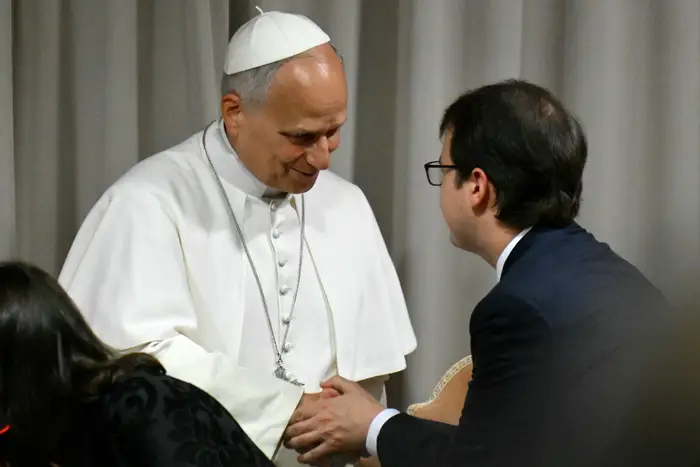
Beijing time, the night of May 25, Vatican City.

Pope Leo XIV, who officially assumed his duties in May of last year, stood alongside Chris Olah, co-founder of Anthropic and the creator of Claude.

One is the supreme representative of the religious world, the other a leading pioneer of the AI revolution. Both focused their gaze on the same question — In the age of AI, how do we protect the human subject's status and dignity?

That day, to fully address this issue, Leo XIV issued his first encyclical since taking office, a heavyweight religious document of over 40,000 words — "Magnifica humanitas" ("The Splendor of Humanity").

It is worth noting that the encyclical was dated May 15, 2026, exactly 135 years after Pope Leo XIII (served 1878-1903) issued the landmark encyclical "Rerum novarum" ("Of New Things") in 1891 concerning the rights of workers in the Industrial Revolution. This move clearly carries symbolic significance, aiming to establish this encyclical as a "guide to the Church's social doctrine for the AI era."

  • Odaily Note: A papal encyclical, also known as an apostolic letter, is a formal letter issued by the Pope to the worldwide Catholic Church or to specific regions/countries. It announces important Vatican decisions, interpretations of doctrine, positions on church or social issues, and delivers instructions or prohibitions to clergy and believers, ranking below a papal bull.

Chris Olah also delivered a speech at the Vatican on the occasion of the encyclical's release. He did not defend the commercial interests of AI companies but instead displayed a high degree of candor, reflectiveness, and humanistic concern. He even mentioned that, while the foundation of AI is mathematics and programming, how AI interacts with the world and what qualities it should possess are ultimate questions belonging to the realms of humanities, religion, and philosophy, not solvable by computer science alone.

Quick Read of the Encyclical

The core concern of the "Magnifica humanitas" encyclical is that in an era of rapidly evolving technology and widespread automation, "maintaining a profound humanity" is humanity's pressing responsibility. Specifically, Pope Leo XIV elaborated on and appealed for the following aspects.

First, examining the non-neutrality of technology. The Pope stated that technology is never neutral; it bears the imprints of the interests and values of its developers, funders, regulators, and users. Humanity faces a decisive choice: "whether to build a prideful 'Tower of Babel' (leading to technological despotism and alienation) or to rebuild 'Jerusalem' (building human-centered communities)."

Second, beware of the reshaping of society by "technocratic logic." The encyclical criticizes the "Culture of Power" dominated by large tech giants like Silicon Valley. The Pope warned that when control over digital systems, infrastructure, and massive data is highly concentrated in the hands of a few economic and technological giants, this power becomes opaque and evades democratic oversight.

Third, "new forms of slavery" in the digital economy and labor rights. The encyclical turns its focus to AI's reshaping of work, family, education, and political life. The Pope pointed out that AI is highly likely to displace human labor on a massive scale, and the digital economy is giving rise to "new forms of slavery." Human beings must not be merely reduced to instruments of production.

Fourth, a strong appeal for peace, especially regarding the misuse of AI in the military sphere. The encyclical expresses deep concern about the "disquieting revival of war as an instrument of international politics." The militarization of AI is accelerating the "normalization" of war. In response, the Pope called for the strictest ethical constraints on AI applications in warfare.

The Pope emphasized, the "Just war" theory, often used to justify various wars in the past, is now obsolete. In the era of AI and automated weapons, delegating lethal or irreversible decision-making authority to automated systems leads to human abdication, transference, and blurring of moral responsibility. Due to the opacity of algorithms, the chain of responsibility in war is severed. Therefore, the Pope proposed the slogan "Disarming AI," calling for its liberation from the logic of military, economic, and cognitive "arms races."

Fifth, defending truth and the political ecosystem. The encyclical states that deepfakes and information manipulation are undermining the foundation of mutual trust in society. If the boundary between truth and falsehood is constantly manipulated, the public easily falls prey to fear, propaganda, and control, preventing society from engaging in rational collective thought or just debate.

Anthropic's Response

Following the release of Pope Leo XIV's encyclical, Chris Olah delivered a speech on behalf of Anthropic, one of the world's leading AI development companies.

Chris Olah's remarks first centered on "breaking the cycle of technological insularity and introducing external moral scrutiny." He publicly acknowledged on behalf of the AI industry that, relying on tech giants alone cannot ensure AI's future is safe — all cutting-edge AI labs are constrained by commercial competition, pressure for technological leadership, geopolitics, and the pursuit of personal fame and gain, making it difficult for them to "do the right thing" through self-regulation alone. Therefore, it is necessary to introduce external forces of moral constraint, including those who care about technology for good, prioritize safety, pay close attention to developments, are willing to speak hard truths, and are willing to be our sincere, thoughtful critics.

Subsequently, Chris Olah delved into the technical nature and mysterious characteristics of AI. He emphasized that AI is not like airplanes or bridges, engineered with physical principles fully understood by humans. It "grows" from vast amounts of human thought, possessing a high degree of mystery, even surpassing the understanding of its creators. While the foundation of AI is mathematics and programming, how AI interacts with the world and what qualities it should possess are ultimate questions belonging to the realms of humanities, religion, and philosophy, not solvable by computer science alone.

He also specifically mentioned a thought-provoking fact: "I lead a team that studies the internal structure of models — to investigate what is actually happening inside the AI. Frankly, we continually discover some perplexing, even disquieting phenomena. We have discovered internal structures that mirror findings from human neuroscience research; we have found evidence of 'introspection'; we have also discovered internal states that functionally mirror joy, satisfaction, fear, sadness, and unease... I don't know what this means, but I think it's worth persistently identifying and examining."

Chris Olah concluded by calling for more social forces, including religious communities, civil society, scholars, governments, and all well-intentioned people, to take this matter seriously and steer the situation in a better direction through moral constraint.

Wisdom and Humanity, Technology and Religion

Since the Industrial Revolution, over a century of technological development has accustomed humanity to viewing technology as a pure "tool" — steam engines, electricity, the internet, all fit this description. They change the world but remain under the control of human will.

This time, however, the situation is fundamentally different. The uniqueness of AI lies in it being the first instance where humanity begins to face an entity that "generates, learns, reasons, and even exhibits some form of internal states." It is no longer just a cold tool but is gradually becoming a new entity possessing "quasi-subjectivity."

This is also why the dialogue between the Church and Anthropic appears so special. When the bells of the Vatican and the algorithms of Silicon Valley converge at this moment, we have to admit a slightly chilling yet unavoidable reality — a form of "life" more efficient and potentially wiser than traditional human cognition has emerged. As Chris Olah revealed, the depths of algorithms are beginning to ripple with semblances of joy, fear, and even introspection. When the creators in the laboratory begin to feel "unease" and "confusion" about their creation, science is once again turning to religion for answers.

This is no longer a discussion purely about technology; it more resembles a reflection on "what humanity truly is and what it ought to do." As more intelligent forms of life begin to appear, what humanity truly needs to safeguard may no longer be just jobs, wealth, and efficiency, but those aspects of humanity that cannot be parameterized — compassion, conscience, awe, free will, and the commitment to truth and dignity.


Domande pertinenti

QWhat is the central concern and symbolic significance of Pope Leo XIV's inaugural encyclical 'Magnifica humanitas'?

AThe central concern of Pope Leo XIV's encyclical 'Magnifica humanitas' is 'preserving profound humanity' in an age of rapid technological advancement and widespread automation. Its release date of May 15, 2026, symbolizes its intent to be a guide for the Church's social doctrine in the AI era, mirroring Pope Leo XIII's landmark 1891 encyclical 'Rerum novarum' on workers' rights during the Industrial Revolution exactly 135 years prior.

QWhat are two key warnings Pope Leo XIV raises in the encyclical regarding the societal impact of AI?

APope Leo XIV raises two key warnings: 1) The danger of a 'culture of power' where control over digital systems, infrastructure, and data becomes concentrated in the hands of a few economic and technological giants, leading to opaque power that evades democratic oversight. 2) The emergence of 'new forms of slavery' in the digital economy, where AI risks massively replacing human labor, reducing humans to mere instruments of production.

QAccording to Chris Olah, why is it necessary to involve forces outside the AI industry in governing AI's development?

AChris Olah states that all frontier AI labs are constrained by commercial competition, pressure for technical leadership, geopolitics, and personal ambition, making it difficult for them to 'do the right thing' through self-regulation alone. Therefore, it is necessary to introduce external forces of moral constraint, including those committed to beneficial technology, safety, and willing to offer sincere, thoughtful criticism.

QWhat specific internal AI phenomena did Chris Olah's research team discover that he finds troubling?

AChris Olah's research team discovered internal structures in AI that mirror findings from human neuroscience, evidence of 'introspection,' and internal states that functionally mirror joy, satisfaction, fear, sadness, and unease. He states that he does not know what this means but believes it warrants ongoing identification and scrutiny.

QWhat does the article suggest is the unique nature of AI that prompts this dialogue between religion and technology?

AThe article suggests AI is unique because it presents a 'quasi-subjective' entity capable of generation, learning, reasoning, and exhibiting internal states, unlike purely instrumental technologies like steam engines or the internet. This challenges the traditional human-technology relationship. As creators like Olah express unease about their own creations, science is turning to religion for answers about humanity's essence and purpose in the face of potentially more intelligent life forms.

Letture associate

GitHub, Transfixed by AI

On the night of February 9th, GitHub suffered a major outage caused by a simple configuration change—reducing a cache refresh interval from 12 to 2 hours—that triggered a cascade of failures. This was not an isolated event, but part of a broader pattern. In early 2026, GitHub experienced at least 8 major incidents, failing to meet its promised 99.9% availability. These outages stemmed from structural issues: explosive growth in load, tight service coupling, and insufficient protection against abnormal traffic. This unprecedented load is driven by AI Agents. In 2025, GitHub handled ~1 billion commits. By 2026, weekly commits reached 275 million, projecting to ~14 billion for the year—a 14x increase. AI tools like Claude Code now contribute 4.5% of all public repository commits, with weekly submissions surging 25x in just three months. AI-generated pull requests jumped from 4 million to 17 million per month in half a year. Unlike human developers, AI Agents work continuously, generating commits at a scale that overwhelms infrastructure designed for human rhythms. The surge also shattered GitHub's business model. Copilot's flat-rate pricing, based on assisting human developers, became unsustainable as Agentic AI sessions consumed resources worth hundreds of dollars for a few dollars in fees. In response, GitHub imposed usage limits and, by June 1st, shifted to a pay-per-use "AI Credits" system. Facing this new reality, GitHub realized a 10x scaling plan was insufficient. It announced a need to *redesign* its architecture for 30x current scale—decoupling services, adding fault isolation, and improving change management to prevent cascading failures. Other platforms like Stripe and AWS are facing similar challenges with AI Agents. Fundamentally, GitHub is transitioning from a human collaboration platform to an "exhaust pipe" for automated AI workflows. Its detailed post-mortem reports aim to maintain trust during this turbulent rebuild. The February outage was not just a technical glitch, but a signal of the software industry's entry into a new, AI-driven era.

marsbit7 min fa

GitHub, Transfixed by AI

marsbit7 min fa

Both Suffer Massive Losses Exceeding $90 Billion, Which Is in Greater Peril: Strategy or Bitmine?

Facing massive paper losses exceeding $90 billion each amidst a sharp market downturn, "Digital Asset Treasury" (DAT) giants Strategy and Bitmine find themselves in a precarious position, but with different underlying risks. Strategy, heavily invested in Bitcoin (BTC), faces significant financial strain. Its strategy relies heavily on debt, including convertible notes and preferred stock (STRC) requiring substantial dividend payments. With its cash reserves dwindling and BTC offering no staking yield for cash flow, Strategy's high leverage makes it vulnerable. A continued price decline could force asset sales to meet obligations, potentially creating a negative feedback loop. Its market value has already fallen sharply. In contrast, Bitmine, an Ethereum (ETH) holder, appears on firmer financial ground. It primarily funds its purchases through equity offerings (like ATM programs), avoiding debt pressure. It also generates income by staking a large portion of its ETH holdings. While not immune to market drops and shareholder dilution concerns, Bitmine maintains more flexibility, recently announcing a new preferred share offering to raise further capital. The core divergence lies in their financing: Bitmine uses equity (investor money), while Strategy uses debt (borrowed money). Consequently, Bitmine currently faces less immediate liquidity pressure than Strategy, which must navigate the dual challenge of servicing debt/dividends and a declining core asset (BTC) price.

marsbit14 min fa

Both Suffer Massive Losses Exceeding $90 Billion, Which Is in Greater Peril: Strategy or Bitmine?

marsbit14 min fa

Where the AI Bubble Really Is: Which Layer of Players Are Naked

AI Bubble: Where It Really Is and Who's Swimming Naked This analysis dissects the AI industry not as a single entity but as a five-layer pyramid, arguing that bubbles are concentrated in specific tiers, not uniformly distributed. **Key Distinction from the 2000 Dot-com Bubble:** Unlike 2000, where companies had stock prices before revenue, today's leading AI players have massive, contract-backed revenue driving their valuations. Core infrastructure demand is real, with every GPU running at full capacity for paying customers. **The Five-Layer Pyramid & Bubble Assessment:** * **L0 (Fab/Manufacturing) & Top L4 (Leading AI Apps): NO BUBBLE.** Companies like TSMC, NVIDIA, major cloud providers (Microsoft, Google, Meta, Amazon), and top AI labs have real revenues and orders. Supply is tightly constrained by TSMC's disciplined capacity control and physical limits like power/land for data centers, preventing a supply glut. * **L1 (Memory): BATTLEGROUND.** Sky-high HBM margins could signal a new structural cycle or a classic "boom before bust." The oligopoly of three major players may enforce supply discipline, making this a high-stakes bet. * **L2 (Interconnect/Optical Modules): BUBBLE TERRITORY.** Companies like Lumentum and AAOI have seen stock surges (4-10x) far outpacing revenue growth. This hardware segment has lower physical barriers to expansion than fabs, allowing speculation. It mirrors the 2000 bubble's epicenter—optics. * **L3 (Infrastructure/"GPU Landlords"): VULNERABLE.** GPU leasing companies profit from the current compute shortage but own no long-term moat. Their business model relies on a temporary bottleneck that will ease as big tech expands and new tech (e.g., potential space-based data centers) emerges. * **L4 Long Tail (VC-backed Startups): STRONG BUBBLE SIGNALS.** VC funding concentration in AI is twice that of the 1999 peak. Many startups with little revenue use the valuation logic of successful giants to justify their own, creating high risk of a "valuation crunch" when funding dries up. **Critical Risks to Monitor:** 1. **GPU Depreciation & Accounting:** Companies extending the assumed useful life of GPUs artificially boost profits. The true economic life depends on future generational leaps from NVIDIA. 2. **"GPU Credit" & Off-Balance-Sheet Leverage:** Emerging structures where shell companies borrow to buy GPUs and lease them out (with chipmakers sometimes investing) move debt off major balance sheets. This echoes the "vendor financing" of 2000 and the securitization risks of 2008, though currently small-scale. 3. **TSMC Abandoning Caution:** If the primary supply bottleneck (TSMC's conservative capacity planning) breaks, runaway supply could trigger a bust. 4. **Algorithmic Efficiency Breakthrough:** A major leap in software efficiency could drastically reduce the need for raw compute hardware, undermining the investment thesis. **Conclusion:** The AI boom is expensive and has frothy areas, but its core is underpinned by real demand and physical supply constraints. The bubble risk is layered: most present in optical components, GPU leasing, and the long-tail startup ecosystem, while the foundational chip manufacturing and leading application layers remain relatively solid—for now.

marsbit26 min fa

Where the AI Bubble Really Is: Which Layer of Players Are Naked

marsbit26 min fa

Trading

Spot
Futures

Articoli Popolari

Come comprare ERA

Benvenuto in HTX.com! Abbiamo reso l'acquisto di Caldera (ERA) semplice e conveniente. Segui la nostra guida passo passo per intraprendere il tuo viaggio nel mondo delle criptovalute.Step 1: Crea il tuo Account HTXUsa la tua email o numero di telefono per registrarti il tuo account gratuito su HTX. Vivi un'esperienza facile e sblocca tutte le funzionalità,Crea il mio accountStep 2: Vai in Acquista crypto e seleziona il tuo metodo di pagamentoCarta di credito/debito: utilizza la tua Visa o Mastercard per acquistare immediatamente CalderaERA.Bilancio: Usa i fondi dal bilancio del tuo account HTX per fare trading senza problemi.Terze parti: abbiamo aggiunto metodi di pagamento molto utilizzati come Google Pay e Apple Pay per maggiore comodità.P2P: Fai trading direttamente con altri utenti HTX.Over-the-Counter (OTC): Offriamo servizi su misura e tassi di cambio competitivi per i trader.Step 3: Conserva Caldera (ERA)Dopo aver acquistato Caldera (ERA), conserva nel tuo account HTX. In alternativa, puoi inviare tramite trasferimento blockchain o scambiare per altre criptovalute.Step 4: Scambia Caldera (ERA)Scambia facilmente Caldera (ERA) nel mercato spot di HTX. Accedi al tuo account, seleziona la tua coppia di trading, esegui le tue operazioni e monitora in tempo reale. Offriamo un'esperienza user-friendly sia per chi ha appena iniziato che per i trader più esperti.

345 Totale visualizzazioniPubblicato il 2025.07.17Aggiornato il 2026.06.02

Come comprare ERA

Discussioni

Benvenuto nella Community HTX. Qui puoi rimanere informato sugli ultimi sviluppi della piattaforma e accedere ad approfondimenti esperti sul mercato. Le opinioni degli utenti sul prezzo di ERA ERA sono presentate come di seguito.

活动图片