The First Cut of the New Year! Who is Secretly Harvesting Your 'Red Envelope'? Understand These 4 Signals to Avoid It!

marsbitPubblicato 2026-01-04Pubblicato ultima volta 2026-01-04

Introduzione

The crypto market has seen significant outflows from Bitcoin and Ethereum ETFs at the start of the new year, with institutions potentially taking profits and rotating capital into altcoins like Solana and XRP. This shift suggests a tactical move rather than a bearish turn, as macroeconomic factors such as potential Fed rate cuts and growing crypto adoption create both opportunities and volatility. Key strategies include holding core long-term positions in major cryptocurrencies, cautiously exploring altcoins with institutional inflows, and avoiding emotional reactions to short-term news or price fluctuations. Technical analysis indicates a tug-of-war between bullish and bearish forces near key resistance levels, emphasizing the need for patience and disciplined risk management. Overall, the focus should be on preserving capital, leveraging market inefficiencies, and making informed decisions based on broader trends rather than speculative hype.

Happy New Year, sisters! Qinglan's Crypto Class is starting. I'm Sister Qinglan!

Just after New Year's Day, are you, like me, hoping for a 'bountiful harvest' for your wallet in the new year? But have you noticed that despite all the positive news—expectations of Fed rate cuts, accelerated cryptocurrency adoption... our Bitcoin and Ethereum are actually seeing net outflows?

If you only look at the K-line charts and listen to the news, the 'New Year's red envelope' you just tucked into your pocket might quietly shrink by more than half in the blink of an eye!

Today, Sister Qinglan will cut through the fog for you and see who is behind this 'first cut' of the year. We not only need to avoid pitfalls but also learn to 'simmer' our wealth steadily amidst the waves and fluctuations, just like making soup!

One: ETF Funds 'Flowing Openly but Diverting Secretly': Don't Take the Big Players' Portfolio Adjustments Seriously. Data doesn't lie: At the start of the new year, Bitcoin spot ETFs saw a single-day net outflow of $348 million, Ethereum ETFs also saw an outflow of $72.05 million, and even giants like BlackRock are selling.

On the surface, it looks bearish, but behind it is 'expectation gap harvesting'.

Institutions don't celebrate the Spring Festival. They take advantage of the thin holiday trading and relaxed vigilance of retail investors to do two things:

Lock in profits: After such a big rise, taking profits is the way to go.

Create panic: Use large outflows to scare the market, making inexperienced sisters think 'the bull market is over, run!'.

But did they really run? No. Coinbase is still shouting 'accelerated crypto adoption in 2026'. This is suppressing the price while giving you a candy. Institutions are playing 'feint in the east, attack in the west'—quietly shifting profitable funds from mainstream coins to more promising directions.

Your mistake: Selling the moment you see outflows, only for the price to rise after you sell; chasing the rally as soon as you hear good news, only to get trapped.

Sister Qinglan's advice for you:

Hold your long-term positions (Bitcoin, Ethereum) steady. As long as the fundamentals haven't changed, ignore short-term fluctuations.

Don't rush to chase with short-term funds. Appropriately reduce positions that have risen too much, keep cash, and wait for the market to stabilize or for mistaken selling opportunities before entering the market in batches. This is the steady way of 'long-term foundation + swing trading for extra returns'.

Two: Altcoins 'Undercurrents Surging': Institutions Have Quietly Changed Battlefields. Just as funds were flowing out of Bitcoin and Ethereum, another signal lit up: ETFs for Solana and XRP are being bought by big money! Franklin Templeton's XRP ETF holdings have doubled in market value, and the Solana ETF assets have also broken through $950 million.

This is clearly an open secret of 'asset rotation'! Institutions know that the short-term explosive power of mainstream coins is weakening, so they take profits and switch to埋伏 (ambush) altcoins with stronger narratives and relatively lower positions. When market heat returns,配合 (coordinating with) news to pump the price, it's another perfect harvest.

Your mistake: Only staring at Bitcoin's rises and falls, chasing altcoins only after the rise is over,结果套在山顶 (resulting in being trapped at the top); or completely ignoring fund flows, missing swing opportunities.

Sister Qinglan's advice for you:

Keep holding long-term mainstream coins.

For short-term, you can pay small-position attention to altcoins with institutional inflows and positive expectations (like SOL, XRP). But remember: Altcoins are highly volatile,务必轻仓试探 (must use light positions to test), enter in batches, and run after making a profit—absolutely do not greedily linger in the battle!

Three: Macro Policy 'Simultaneous Ice and Fire': Don't Let News Lead You by the Nose. The macro picture is like a roller coaster:

On one side, Moody's predicts the Fed may aggressively cut rates three times in the first half of 2026 (bullish).

On the other side, market data shows a high probability of maintaining rates unchanged in January and March (reality).

At the same time, many countries are advancing crypto legalization, with Iran even accepting cryptocurrency payments.

This is a typical 'expectation gap game'. Rate cut predictions might just be a 'smokescreen' for institutions to boost market sentiment; when the actual rate cuts land, it might instead be 'buy the rumor, sell the news'. Regulatory legalization is a long-term positive, but it's often used to cover up distribution in the short term.

Your mistake: Hearing about rate cuts and thinking the bull market is confirmed, going All in; treating long-term positives as short-term暴涨 (surging) signals, resulting in being washed out repeatedly.

Sister Qinglan's advice for you:

Be bullish on the industry's future long-term, don't be disturbed by short-term noise.

Use the expectation gap for swing trading (buy low, sell high) short-term, but always set stop-profit and stop-loss, without greed or fear. Remember: Policy is the foundation, but not a guarantee of short-term surges.

Four: The K-line Chart is 'Lying': Bull-Bear Tug-of-War, the Calm Win. The technicals are interesting:

The daily and 1-hour trends are weakly downward.

But the 4-hour chart is strongly upward. The price is stuck near $88,000, with the $90,000关口 (gateway/level) close at hand.
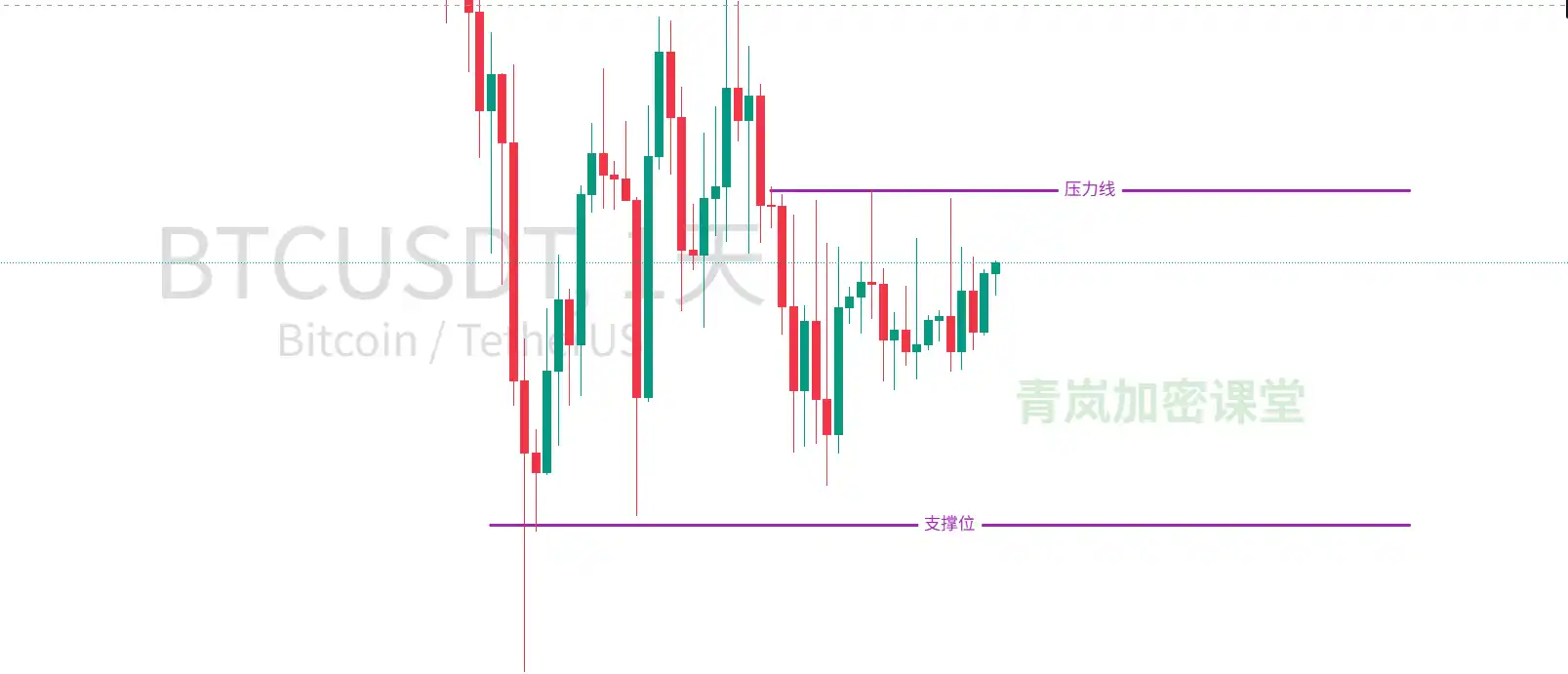
This is precisely a microcosm of the bull-bear psychological game: The weak trend shows bears are still applying pressure, possibly wanting to smash the price to accumulate; The strong rebound shows bulls are also gathering strength, wanting to use the opportunity to break through. Many sisters waver here, thinking the bull market is back when it rises, and thinking it will crash immediately when it falls.

Your mistake: Being confused by short-term fluctuations, trading frequently, losing all the money to fees, and容易在关键点位冲动决策 (easily making impulsive decisions at key points).

Sister Qinglan's advice for you:

Look at the major trend. Before the daily chart stabilizes, treat rebounds as 'dead cat bounces'.

If you want to speculate short-term, only试探 (test) with small positions at key support levels (like near $87,000), and must use a stop-loss.

The真正安全的加仓点 (truly safe point to add positions) is after a volume breakout above $90,000 and holding steady. Before that, hold cash and wait patiently.

Summary: For the Start of 2026, Do This to Protect Your Red Envelope and Grow Steadily. See through fund flows: ETF outflows don't mean the bull market is over; it could be institutional repositioning. Stabilize your long-term core holdings.

Follow the smart money: Pay attention to altcoins where funds are flowing,布局 (position) with small sizes, quick in and out.

Be rational about macro: Long-term positive ≠ short-term surge, use the expectation gap, but don't迷信 (superstitiously believe) news.

Respect the technicals: Look at the trend combining multiple timeframes, don't act impulsively at key points, wait for clear signals.

The crypto circle is like a江湖 (river lake - meaning a complex world), deep waters and rough waves. Don't just focus on how much others have earned; think more about how you can step on fewer pitfalls and survive more cycles. In 2026, let's together, with patience and strategy, simmer our wealth out steadily!

I am Sister Qinglan, accompanying you through bull and bear markets, earning money within our understanding clearly. See you next time!


Domande pertinenti

QAccording to the article, what is the main reason for the net outflow of funds from Bitcoin and Ethereum ETFs at the beginning of the new year?

AThe main reason is that institutions are locking in profits and creating panic to manipulate the market, while secretly shifting funds to more promising areas like certain altcoins.

QWhat strategy does Qinglan suggest for dealing with the short-term volatility of mainstream cryptocurrencies like Bitcoin and Ethereum?

AQinglan suggests holding long-term positions steady and not reacting to short-term fluctuations, while using short-term funds to reduce positions in overvalued assets, retain cash, and wait for market stabilization or opportunities to buy in batches.

QWhich altcoins are mentioned as receiving significant institutional investment inflows despite the outflow from major cryptocurrencies?

ASolana and XRP are mentioned as altcoins that are being bought by large funds, with Franklin Templeton's XRP ETF holdings doubling and Solana ETF assets exceeding $950 million.

QHow does the article advise interpreting macroeconomic policy signals like interest rate cuts and crypto legalization?

AThe article advises viewing interest rate cut predictions as potential 'smoke screens' to boost market sentiment and recognizing that long-term regulatory benefits are not guarantees of short-term price surges. It recommends using expectation disparities for trading but not relying solely on news.

QWhat technical analysis insight does Qinglan provide regarding the current price action of Bitcoin near the $88,000 to $90,000 range?

AQinglan notes that daily and 1-hour charts show weak downward trends, while the 4-hour chart shows a strong upward trend, indicating a tug-of-war between bulls and bears. She advises treating rebounds as potential 'dead cat bounces' until the daily trend stabilizes, and only cautiously testing key support levels with small positions and stop-losses.

Letture associate

Breaking: OpenAI Undergoes Major Reorganization, President Brockman Assumes Command

OpenAI has announced a major internal reorganization just months before its anticipated IPO. The company is merging its three flagship product lines—ChatGPT, Codex, and the API platform—into a single, unified product organization. The most significant leadership change involves co-founder and President Greg Brockman moving from a background technical role to take full, permanent control over all product strategy. This follows the indefinite medical leave of AGI Deployment CEO Fidji Simo. Additionally, ChatGPT's longtime lead, Nick Turley, has been reassigned to enterprise products, with former Instagram executive Ashley Alexander taking over consumer offerings. The consolidation, internally framed as a strategic move towards an "Agentic Future," aims to break down internal silos and create a cohesive "Super App." This planned desktop application would integrate ChatGPT's conversational abilities, Codex's coding power, and a rumored internal web browser named "Atlas" to autonomously perform complex user tasks. The reorganization occurs amid significant internal and external pressures. OpenAI has recently seen a wave of high-profile departures, including Sora co-lead Bill Peebles and other senior technical leaders, leading to concerns about a thinning executive bench. Externally, rival Anthropic recently secured funding at a staggering $900 billion valuation, surpassing OpenAI's own. Google's upcoming I/O developer conference also poses a competitive threat. Analysts suggest the dramatic restructure is a pre-IPO move to present a clearer, more focused narrative to Wall Street—streamlining operations and demonstrating decisive leadership under Brockman to counter internal turbulence and intense market competition.

marsbit3 h fa

Breaking: OpenAI Undergoes Major Reorganization, President Brockman Assumes Command

marsbit3 h fa

Two Survival Structures of Market Makers and Arbitrageurs

Market makers and arbitrageurs represent two distinct survival structures in high-frequency trading. Market makers primarily use limit orders (makers) to profit from the bid-ask spread, enjoying high capital efficiency (nominally 100%) but bearing inventory risk. This "inventory risk" arises from passive, fragmented, and discontinuous order fills in the limit order book (LOB). This risk, while a potential cost, can also contribute to excess profit if managed within control boundaries, allowing for mean reversion. Market makers essentially sell "time" (uncertainty over execution timing) to the market for price control and low fees. In contrast, cross-exchange arbitrageurs typically use market orders (takers) to exploit price differences or funding rates, resulting in lower nominal capital efficiency (requiring capital on both exchanges) and higher transaction costs. Their risk exposure stems from asymmetries in exchange rules (e.g., minimum order sizes), execution latency, and infrastructure risks (e.g., ADL, oracle drift). These exposures are active, exogenous gaps that primarily erode profits rather than contribute to them. Arbitrageurs essentially sell "space" (capital sunk across venues) for localized, immediate certainty. Both strategies engage in a trade-off between execution friction and residual risk. Optimal systems allow for temporary, controlled risk exposure rather than enforcing zero exposure at all costs. Their evolution converges towards hybrid models: arbitrageurs may use maker orders to reduce costs, while market makers may use taker orders or hedges for risk management. Ultimately, both use different forms of risk exposure—market makers exposing inventory, arbitrageurs immobilizing capital—to extract marginal, hard-won certainty from the market.

链捕手3 h fa

Two Survival Structures of Market Makers and Arbitrageurs

链捕手3 h fa

Who Will Define the Rules of the AI Era? Anthropic Discusses the 2028 US-China AI Landscape

This article, based on Anthropic's analysis, outlines the intensifying systemic competition between the U.S./allies and China for AI leadership by 2028. It argues that access to advanced computing power ("compute") is the critical bottleneck, where the U.S. currently holds a significant advantage through chip export controls and allied innovation. However, China's AI labs remain competitive by exploiting policy loopholes—via chip smuggling, overseas data center access, and "model distillation" attacks to copy U.S. model capabilities—keeping them close to the frontier. The piece presents two contrasting scenarios for 2028. In the first, decisive U.S. action to tighten compute controls and curb distillation locks in a 12-24 month AI capability lead, cementing democratic influence over global AI norms, security, and economic infrastructure. In the second, policy inaction allows China to achieve near-parity through continued access to U.S. technology, enabling Beijing to promote its AI stack globally and integrate advanced AI into its military and governance systems, altering the strategic balance. Anthropic contends that maintaining a decisive U.S. lead is essential for shaping safe AI development and governance. The core recommendation is for U.S. policymakers to urgently close compute and model access loopholes while promoting global adoption of the U.S. AI technology stack to secure a lasting strategic advantage.

marsbit5 h fa

Who Will Define the Rules of the AI Era? Anthropic Discusses the 2028 US-China AI Landscape

marsbit5 h fa

Trading

Spot
Futures

Articoli Popolari

Come comprare RED

Benvenuto in HTX.com! Abbiamo reso l'acquisto di RedStone (RED) semplice e conveniente. Segui la nostra guida passo passo per intraprendere il tuo viaggio nel mondo delle criptovalute.Step 1: Crea il tuo Account HTXUsa la tua email o numero di telefono per registrarti il tuo account gratuito su HTX. Vivi un'esperienza facile e sblocca tutte le funzionalità,Crea il mio accountStep 2: Vai in Acquista crypto e seleziona il tuo metodo di pagamentoCarta di credito/debito: utilizza la tua Visa o Mastercard per acquistare immediatamente RedStoneRED.Bilancio: Usa i fondi dal bilancio del tuo account HTX per fare trading senza problemi.Terze parti: abbiamo aggiunto metodi di pagamento molto utilizzati come Google Pay e Apple Pay per maggiore comodità.P2P: Fai trading direttamente con altri utenti HTX.Over-the-Counter (OTC): Offriamo servizi su misura e tassi di cambio competitivi per i trader.Step 3: Conserva RedStone (RED)Dopo aver acquistato RedStone (RED), conserva nel tuo account HTX. In alternativa, puoi inviare tramite trasferimento blockchain o scambiare per altre criptovalute.Step 4: Scambia RedStone (RED)Scambia facilmente RedStone (RED) nel mercato spot di HTX. Accedi al tuo account, seleziona la tua coppia di trading, esegui le tue operazioni e monitora in tempo reale. Offriamo un'esperienza user-friendly sia per chi ha appena iniziato che per i trader più esperti.

396 Totale visualizzazioniPubblicato il 2025.03.05Aggiornato il 2025.03.21

Come comprare RED

Discussioni

Benvenuto nella Community HTX. Qui puoi rimanere informato sugli ultimi sviluppi della piattaforma e accedere ad approfondimenti esperti sul mercato. Le opinioni degli utenti sul prezzo di RED RED sono presentate come di seguito.

活动图片












