The Financial Circle is Embracing Knowledge Payment

marsbitPubblicato 2026-01-13Pubblicato ultima volta 2026-01-13

Introduzione

Financial professionals in China are increasingly turning to knowledge monetization platforms. Notable figures like Hong Hao and Li Bei are achieving significant revenue: Hong Hao's knowledge community generated over 12.5 million RMB in two months after raising its annual fee to 1499 RMB, while Li Bei sold 200 spots for a 12,888 RMB course in just two days, earning 2.57 million RMB. This trend reflects a strategic use of "leverage"—a concept emphasizing scalable, near-zero marginal cost products like media content—to complement traditional labor and capital leverage. Both individuals leverage their macroeconomic expertise and personal branding to attract broad audiences, blending analysis with engaging content like predictions and personal anecdotes. However, their approaches differ: Hong Hao uses his platform to bolster his investment credibility amid uncertain fund performance, while Li Bei employs courses to retain clients and stabilize her asset management firm amid competitive pressures. Ultimately, this shift addresses dual needs: investors seek reliable information and emotional reassurance in noisy markets, while managers aim to cultivate loyal clients directly. As generating alpha becomes harder, selling the "map"—through subscriptions and courses—is emerging as a lucrative alternative.

Author: Shen Hui, Yuanchuan Investment Review

Hong Hao's knowledge planet officially announced a price increase, tagged at 1499 yuan/year, equivalent to a bottle of Moutai.

Before the price hike, the annual fee was 899 yuan. Based on 14,000 recharges, in just two months, Hong Hao's GMV on the knowledge planet reached 12.586 million yuan.

Similarly, Hong Hao's friend Li Bei also ventured into knowledge payment. A course worth 12,888 yuan, with 200 spots, sold out in two days. That is to say, in just two days, Li Bei's course sales revenue reached 2.57 million yuan.

As is well known, media is a notoriously bad business. This conclusion is easily drawn from the media sector's consistently poor performance among the 31 primary sectors of Shenwan. However, in this sunset industry, private domains and selling courses stand out as exceptions, attracting countless financial professionals to bend their backs.

Former Guohai Fixed Income Chief Jin Yi's Douyin account "Bai Nian Talks Politics and Economics" gained 1.6 million followers in three months, with membership for one-on-one consulting services from Chief Jin priced at 4,283 yuan per month; Tan Jun is about to launch the "Industry Decision-Maker Internal Reference Circle," limited to 30 seats, priced at 159,880 yuan; the more upscale-sounding "Bull Bear Beast Club" offers paid members not only access to Fu Peng's financial intelligence courses but also the opportunity to ski with him in Changbai Mountain.

Compared to their American counterparts, who show a stronger willingness to pay, financial consumers in the U.S. are different. The big short seller Michael Burry simply closed his hedge fund and switched to launching an electronic newsletter on Substack priced at $379 per year, attracting 187,000 subscribers in just two months—shorting Nvidia isn't as easy as making money.

Suddenly, financial big shots are jumping in, not competing on who has more investment ideas, but on who has more subscribers. Is investing too hard to make money, or is the business of headcounts too easy?

Three Types of Leverage

Silicon Valley investor Naval Ravikant mentioned that to achieve financial freedom, one needs to use three types of leverage:

  • The first is labor leverage, which means being the boss and having others work for you;
  • The second is capital leverage, like Warren Buffett using capital leverage to expand influence and make money with money;
  • The third, which he considers the most important leverage, is "products with zero marginal cost of reproduction," mainly including code and media.

In Naval's view, the wealth of the new generation of millionaires is created through code and media.

Joe Rogan relies on podcasts to earn $50-100 million annually [1]. Using this new type of leverage, simply by increasing paid memberships and online course sales, one can amplify the results of their labor hundreds or thousands of times. Its advantage is that the cost of reproduction is almost zero, and anyone with a computer and internet access can easily earn passive income.

And Hong Hao and Li Bei恰恰同时拥有这三种杠杆。

Li Bei founded Banxia in 2017, and by 2022, its scale had exceeded 10 billion yuan. She had already achieved financial freedom through labor and capital leverage. As she herself said, she doesn't lack the tens of millions of yuan generated annually from knowledge payment. But it cannot be denied that these tens of millions are far more certain in the short term than waiting for a reversal in China's real estate market.

Compared to Li Bei's colorful业余生活 of baking, gardening, and playing tennis, Hong Hao's recent experiences have been more turbulent.

Earlier, Hong Hao was the Chief Global Strategist at CICC and had worked at Citigroup and Morgan Stanley. In 2022, after leaving Bank of Communications International, he switched between buy-side and sell-side roles,先后 joining Srui Group and Huafu International. He is now the Managing Partner and Chief Investment Officer of Lianhua Capital.

However, Hong Hao's performance has always been a mystery.

In August 2023, he launched the Lotus-AAA fund with Srui and Lianhua Capital. Except for a single-month surge of 8.98% in September 2024, its performance had been lukewarm before. Perhaps because the fund's operation time was too short, when展示业绩, backtested simulated historical performance dating back to September 2002 was also included. At least the chart shows that Hong Hao似乎真有20年累计高达718.77%的投资收益。
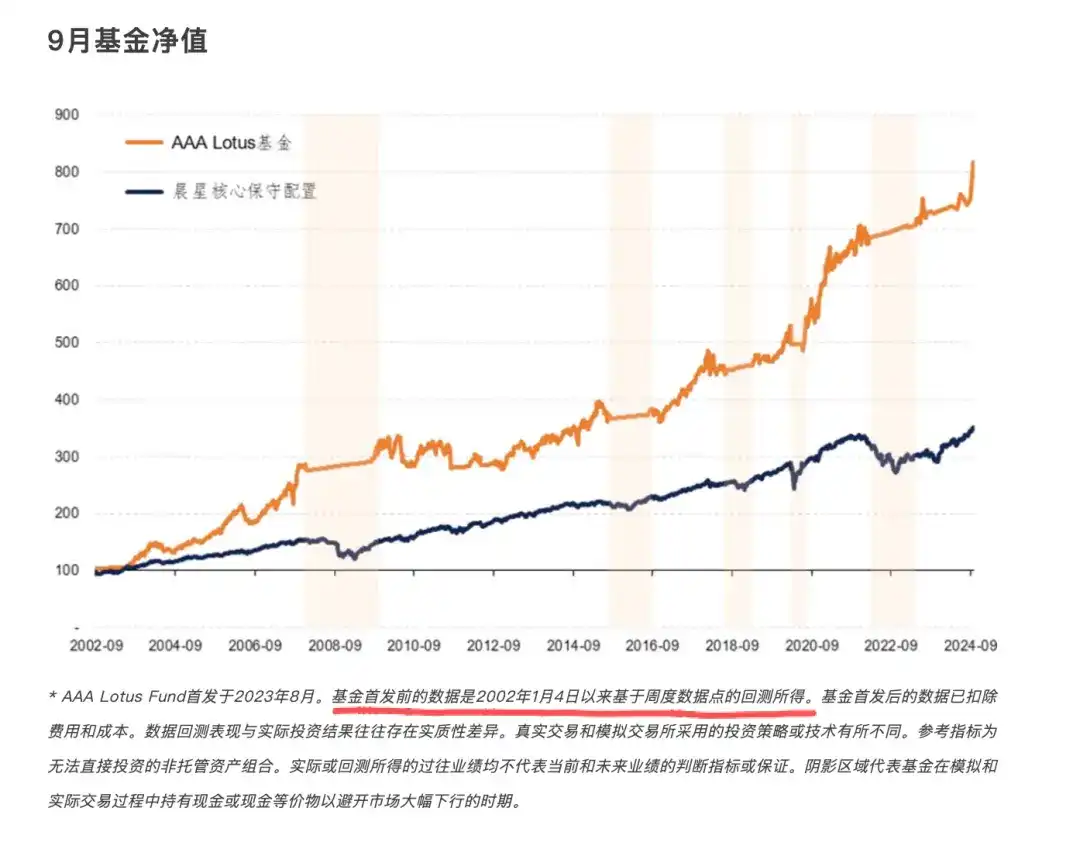
You can question Hong Hao's actual performance, but you cannot question his chart-making ability

Hong Hao and Li Bei are skilled at building IPs and generating traffic. Their熟练运用 of the third type of leverage gives them stronger money-making abilities than their peers in knowledge payment.

In terms of赛道选择, the macro sector where Hong Hao and Li Bei operate naturally reaches a wider audience. Not everyone cares about what Nvidia's open-sourced VLA model is called, but everyone cares whether gold will continue to rise in the future and whether the stock market in the Year of the Red Horse and Red Goat will have the Nine Purple Fire luck.

In terms of表达方式, compared to being lulled to sleep by the ambiguous views of economic grandmasters at roundtable forums, people prefer to listen with wide-eyed interest to Hong Hao predicting the fifth wave of the bull market and Li Bei analyzing the escape from the micro-cap fire. Even if they are evasive, they might意外收获 "MaiMaiMai" (BuyBuyBuy/SellSellSell)的艺术表达—after all, if they win, it's buy buy buy; if they lose, it's sell sell sell.

In terms of写作文体开发, Hong Hao is good at mixing classical Chinese and obscure characters into macro analysis, mysteriously citing various sources, giving people a reading experience that is hard to understand yet greatly震撼. Hong Hao once explained that the best article sounds like废话 but has some unexpected consequences [2]. Li Bei, on the other hand, can skillfully combine her emotional journey with macro analysis, occasionally posting相亲贴 (matchmaking posts), providing some low-participation-threshold topics.

Precisely because people love macro literature掺杂 with "fortune-telling" and "gossip," Hong Hao and Li Bei have captured the huge流量 in the financial circle, also creating a broader entry point for their transition into knowledge payment.

It's All Business

Fund managers are usually cautious about using the third type of leverage.

Because once a fund manager starts writing articles or selling courses, they are seen as not focusing on their main job, diverting time that should be devoted to investment research. Moreover, transitioning to media won't gain more professional recognition, just as people always criticize financial influencers—if their investment ability is strong enough, why would they take time out to teach others how to make money?

Whether it's Hong Hao creating a星球 (knowledge planet) or Li Bei selling courses, their purpose in涉足知识付费 is not simply to transition into self-media.

Compared to Li Bei, Hong Hao transitioned to investment relatively late, and he can't even show a three-year continuous net value curve. Therefore, he更需要 to constantly market the accuracy of his predictions on social media to背书 his investment ability.

On November 28 last year, Business Weekly brought Hong Hao, Li Bei, and Fu Peng together at a roundtable. When the three discussed gold, Fu Peng's views were ambiguous, Li Bei was clearing positions and bearish,只有洪灏公布了详细的卖点—selling all when the gold price reaches $4500/ounce.

This led to质疑, because the price of the main Comex gold futures contract had never reached $4500/ounce at that time. Non-main contracts had briefly reached it, but it was almost impossible for large institutional funds like Hong Hao's to exit at the peak in such low-liquidity contracts.

Hong Hao did not公开详细的黄金交易平仓单, but instead marketed on his星球 "Ten Thousand Witness the Miracle of Predicting Silver." He publicly predicted:

Silver hasn't finished its run; how deep the cup is, how high the target is. If 4500 is a fair price for gold, then for others, we need to use our imagination. New highs are for buying; those who fear heights are destined for hardship.

As written in "The Crowd," he who掌握了影响群众想象力的艺术, also掌握了统治他们的艺术.
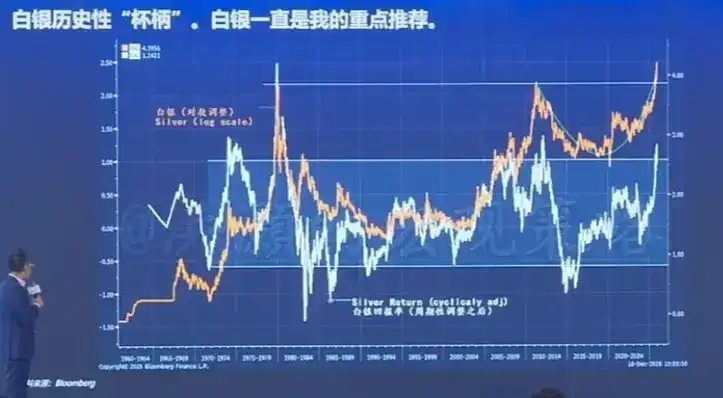
Hong Hao believes silver has formed a giant 60-year "cup and handle" pattern

Ultimately, Lianhua Capital is still not well-known. Posting粉丝的好评 (fan praise) on the星球, creating涨价预期 (price increase expectations) for the星球, and selling more "星球茅台" (Planet Moutai) can孵化 more future私募客户 (private fund clients). Compared to collecting management fees and performance fees, it has higher short-term economic benefits.

After all, outputting a "bullish on silver" view is easy—like the two sides of a coin, you can brag if it goes up—while "heavily betting on silver" involves multi-dimensional博弈 with the market, human nature, rules, and scale.

Compared to Hong Hao, Li Bei faces a different situation. After Banxia crossed the 10-billion-yuan threshold, its performance growth weakened, and it dropped out of the camp of billion-yuan私募 early this year. In an environment where Bridgewater China remains strong and quantitative macro opponents are formidable, the urgent task is to stabilize old clients and avoid redemptions.

Li Bei's approach is to免费赠送 online courses to all Banxia investors and offline courses to investors who have held the fund for more than 2 years or invested more than 5 million yuan. Thus, before the course starts on January 24th, investors wanting to redeem get a赎回冷静期 (redemption cooling-off period).

In November, Minghong's macro product sold out upon launch; in December, Two Sigma's "CTA + Index Enhanced"复合策略 product, with a 2 billion yuan quota, was instantly snapped up across three major channels. This type of multi-strategy product from quantitative私募无形之中 forms a substitute for Li Bei's macro strategy.

Moreover, subjective私募 are gradually declining on the distribution side, and mainstream channels are somewhat avoiding them. In the future, subjective managers will inevitably need to invest more energy in direct sales.

A clever way is to first筛出 (screen out) the customer base with payment ability from fans with a price of 12,888 yuan, and then use slogans like "easily achieving long-term annualized returns of over 10% by taking the course" to锁定 (lock in) those customers who are dissatisfied with wealth management returns and渴望致富 (eager to get rich).

Fans with purchasing power and purchasing desire, after attending Li Bei's offline classes for答疑解惑 (Q&A), can naturally be converted into私募 clients with极少的 time cost and极高的 conversion rate.

Astute managers not only skillfully use the third type of leverage but also善于叠加 use all three types of leverage.

Epilogue

When discussing knowledge payment becoming a trend in the asset management industry, many people think of two aspects:

  • First, the pressure from salary cuts in the financial industry prompts practitioners to seek other sources of income;
  • Second, switching from investment to media is like降维打击 (attacking from a higher dimension). Precisely because of this, financial self-media is the首选副业 (preferred side job) for most financial practitioners.

But looking deeper, this actually stems from the bidirectional需求 of investors and managers—investors need reliable sources of information, and managers need loyal clients.

It's like Jensen Huang gave a speech at CES, and the next day there were dozens of interpretations利好 (beneficial) to which market sectors. It seems information is equalized, but in reality, it adds countless噪音 (noises). The advancement of AI allows more noise to be produced at low cost. For both investors and managers, attention and trust are the scarcest resources.

Who wouldn't want to spend some money to buy a professional fund manager's knowledge planet to gain an information edge, or even follow their operations? Many people know that Hong Hao's predictions will eventually翻车 (fail), but what they are buying is not a 100% win rate, but rather, in the chaotic market, through his repeated analysis and confirmation, they can obtain an emotional anchor and comfort.

Some subjective fund managers are also gradually realizing that they are no longer the first choice for institutions, distribution channels, or high-net-worth clients. So they can only work harder to reach more precise clients through私域 (private domains) and courses. Some skilled subjective私募 have even screened their clients into executives or industry experts of invested companies—making money for clients while also obtaining the most前沿 (cutting-edge) industry information差 (information gap) from them.

I asked him why he doesn't ask sell-side analysts. He replied that sell-side can only be bullish on their own industry and mislead him, while invested clients can tell him the most real and objective views on the industry.

When gold becomes harder to dig and shovels are in excess, having a矿藏地图 (mineral deposit map) is the important thing, and the person selling the map becomes the one who makes the most money.


Domande pertinenti

QWhat are the three types of leverage mentioned in the article for achieving wealth freedom, and which one is considered the most important?

AThe three types of leverage are: 1) Labor leverage (having people work for you), 2) Capital leverage (using money to make more money, like Warren Buffett), and 3) 'Products with zero marginal cost of replication,' which includes code and media. The third type is considered the most important.

QHow much revenue did Hong Hao generate from his knowledge planet in two months before the price increase?

AHong Hao generated 12.586 million RMB in GMV from his knowledge planet in two months before the price increase, based on 14,000 subscribers at the previous annual fee of 899 RMB.

QWhat is the primary business reason suggested for why financial figures like Hong Hao and Li Bei are turning to knowledge付费?

AThe primary business reason is to leverage their influence (the third type of leverage) to generate significant revenue with low marginal effort, while also using it as a tool for client acquisition, credibility building, and stabilizing their core asset management businesses in a challenging market.

QAccording to the article, what is the underlying need from both investors and managers that knowledge付费 addresses?

AThe underlying need is a two-way demand: investors need reliable sources of information to cut through market noise, and asset managers need loyal, long-term clients in an environment where they are no longer the default choice for many institutions and distributors.

QWhat specific tactic does the article mention Li Bei using to potentially discourage investor redemptions from her fund?

ALi Bei offered free online courses to all her fund's investors and free offline courses to those who had held the fund for over 2 years or invested more than 5 million RMB, creating a 'cooling-off period' for redemption decisions before the course started.

Letture associate

Trading

Spot
Futures

Articoli Popolari

Cosa è $S$

Comprendere SPERO: Una Panoramica Completa Introduzione a SPERO Mentre il panorama dell'innovazione continua a evolversi, l'emergere delle tecnologie web3 e dei progetti di criptovaluta gioca un ruolo fondamentale nel plasmare il futuro digitale. Un progetto che ha attirato l'attenzione in questo campo dinamico è SPERO, denotato come SPERO,$$s$. Questo articolo mira a raccogliere e presentare informazioni dettagliate su SPERO, per aiutare gli appassionati e gli investitori a comprendere le sue basi, obiettivi e innovazioni nei domini web3 e crypto. Che cos'è SPERO,$$s$? SPERO,$$s$ è un progetto unico all'interno dello spazio crypto che cerca di sfruttare i principi della decentralizzazione e della tecnologia blockchain per creare un ecosistema che promuove l'impegno, l'utilità e l'inclusione finanziaria. Il progetto è progettato per facilitare interazioni peer-to-peer in modi nuovi, fornendo agli utenti soluzioni e servizi finanziari innovativi. Al suo interno, SPERO,$$s$ mira a responsabilizzare gli individui fornendo strumenti e piattaforme che migliorano l'esperienza dell'utente nello spazio delle criptovalute. Questo include la possibilità di metodi di transazione più flessibili, la promozione di iniziative guidate dalla comunità e la creazione di percorsi per opportunità finanziarie attraverso applicazioni decentralizzate (dApps). La visione sottostante di SPERO,$$s$ ruota attorno all'inclusività, cercando di colmare le lacune all'interno della finanza tradizionale mentre sfrutta i vantaggi della tecnologia blockchain. Chi è il Creatore di SPERO,$$s$? L'identità del creatore di SPERO,$$s$ rimane piuttosto oscura, poiché ci sono risorse pubblicamente disponibili limitate che forniscono informazioni dettagliate sul suo fondatore o fondatori. Questa mancanza di trasparenza può derivare dall'impegno del progetto per la decentralizzazione—un ethos che molti progetti web3 condividono, dando priorità ai contributi collettivi rispetto al riconoscimento individuale. Centrando le discussioni attorno alla comunità e ai suoi obiettivi collettivi, SPERO,$$s$ incarna l'essenza dell'empowerment senza mettere in evidenza individui specifici. Pertanto, comprendere l'etica e la missione di SPERO rimane più importante che identificare un creatore singolo. Chi sono gli Investitori di SPERO,$$s$? SPERO,$$s$ è supportato da una varietà di investitori che vanno dai capitalisti di rischio agli investitori angelici dedicati a promuovere l'innovazione nel settore crypto. Il focus di questi investitori generalmente si allinea con la missione di SPERO—dando priorità a progetti che promettono avanzamenti tecnologici sociali, inclusività finanziaria e governance decentralizzata. Queste fondazioni di investitori sono tipicamente interessate a progetti che non solo offrono prodotti innovativi, ma contribuiscono anche positivamente alla comunità blockchain e ai suoi ecosistemi. Il supporto di questi investitori rafforza SPERO,$$s$ come un concorrente degno di nota nel dominio in rapida evoluzione dei progetti crypto. Come Funziona SPERO,$$s$? SPERO,$$s$ impiega un framework multifunzionale che lo distingue dai progetti di criptovaluta convenzionali. Ecco alcune delle caratteristiche chiave che sottolineano la sua unicità e innovazione: Governance Decentralizzata: SPERO,$$s$ integra modelli di governance decentralizzati, responsabilizzando gli utenti a partecipare attivamente ai processi decisionali riguardanti il futuro del progetto. Questo approccio favorisce un senso di proprietà e responsabilità tra i membri della comunità. Utilità del Token: SPERO,$$s$ utilizza il proprio token di criptovaluta, progettato per servire varie funzioni all'interno dell'ecosistema. Questi token abilitano transazioni, premi e la facilitazione dei servizi offerti sulla piattaforma, migliorando l'impegno e l'utilità complessivi. Architettura Stratificata: L'architettura tecnica di SPERO,$$s$ supporta la modularità e la scalabilità, consentendo un'integrazione fluida di funzionalità e applicazioni aggiuntive man mano che il progetto evolve. Questa adattabilità è fondamentale per mantenere la rilevanza nel panorama crypto in continua evoluzione. Coinvolgimento della Comunità: Il progetto enfatizza iniziative guidate dalla comunità, impiegando meccanismi che incentivano la collaborazione e il feedback. Nutrendo una comunità forte, SPERO,$$s$ può affrontare meglio le esigenze degli utenti e adattarsi alle tendenze di mercato. Focus sull'Inclusione: Offrendo basse commissioni di transazione e interfacce user-friendly, SPERO,$$s$ mira ad attrarre una base utenti diversificata, inclusi individui che potrebbero non aver precedentemente interagito nello spazio crypto. Questo impegno per l'inclusione si allinea con la sua missione generale di empowerment attraverso l'accessibilità. Cronologia di SPERO,$$s$ Comprendere la storia di un progetto fornisce preziose intuizioni sulla sua traiettoria di sviluppo e sui traguardi. Di seguito è riportata una cronologia suggerita che mappa eventi significativi nell'evoluzione di SPERO,$$s$: Fase di Concettualizzazione e Ideazione: Le idee iniziali che formano la base di SPERO,$$s$ sono state concepite, allineandosi strettamente con i principi di decentralizzazione e focus sulla comunità all'interno dell'industria blockchain. Lancio del Whitepaper del Progetto: Dopo la fase concettuale, è stato rilasciato un whitepaper completo che dettaglia la visione, gli obiettivi e l'infrastruttura tecnologica di SPERO,$$s$ per suscitare interesse e feedback dalla comunità. Costruzione della Comunità e Prime Interazioni: Sono stati effettuati sforzi attivi di outreach per costruire una comunità di early adopters e potenziali investitori, facilitando discussioni attorno agli obiettivi del progetto e ottenendo supporto. Evento di Generazione del Token: SPERO,$$s$ ha condotto un evento di generazione del token (TGE) per distribuire i propri token nativi ai primi sostenitori e stabilire una liquidità iniziale all'interno dell'ecosistema. Lancio della Prima dApp: La prima applicazione decentralizzata (dApp) associata a SPERO,$$s$ è stata attivata, consentendo agli utenti di interagire con le funzionalità principali della piattaforma. Sviluppo Continuo e Partnership: Aggiornamenti e miglioramenti continui alle offerte del progetto, inclusi partnership strategiche con altri attori nello spazio blockchain, hanno plasmato SPERO,$$s$ in un concorrente competitivo e in evoluzione nel mercato crypto. Conclusione SPERO,$$s$ rappresenta una testimonianza del potenziale del web3 e delle criptovalute di rivoluzionare i sistemi finanziari e responsabilizzare gli individui. Con un impegno per la governance decentralizzata, il coinvolgimento della comunità e funzionalità progettate in modo innovativo, apre la strada verso un panorama finanziario più inclusivo. Come per qualsiasi investimento nello spazio crypto in rapida evoluzione, si incoraggiano potenziali investitori e utenti a ricercare approfonditamente e a impegnarsi in modo riflessivo con gli sviluppi in corso all'interno di SPERO,$$s$. Il progetto mostra lo spirito innovativo dell'industria crypto, invitando a ulteriori esplorazioni delle sue innumerevoli possibilità. Mentre il percorso di SPERO,$$s$ è ancora in fase di sviluppo, i suoi principi fondamentali potrebbero effettivamente influenzare il futuro di come interagiamo con la tecnologia, la finanza e tra di noi in ecosistemi digitali interconnessi.

75 Totale visualizzazioniPubblicato il 2024.12.17Aggiornato il 2024.12.17

Cosa è $S$

Cosa è AGENT S

Agent S: Il Futuro dell'Interazione Autonoma in Web3 Introduzione Nel panorama in continua evoluzione di Web3 e criptovalute, le innovazioni stanno costantemente ridefinendo il modo in cui gli individui interagiscono con le piattaforme digitali. Uno di questi progetti pionieristici, Agent S, promette di rivoluzionare l'interazione uomo-computer attraverso il suo framework agentico aperto. Aprendo la strada a interazioni autonome, Agent S mira a semplificare compiti complessi, offrendo applicazioni trasformative nell'intelligenza artificiale (AI). Questa esplorazione dettagliata approfondirà le complessità del progetto, le sue caratteristiche uniche e le implicazioni per il dominio delle criptovalute. Cos'è Agent S? Agent S si presenta come un innovativo framework agentico aperto, progettato specificamente per affrontare tre sfide fondamentali nell'automazione dei compiti informatici: Acquisizione di Conoscenze Specifiche del Dominio: Il framework apprende in modo intelligente da varie fonti di conoscenza esterne ed esperienze interne. Questo approccio duale gli consente di costruire un ricco repository di conoscenze specifiche del dominio, migliorando le sue prestazioni nell'esecuzione dei compiti. Pianificazione su Lungo Orizzonte di Compiti: Agent S impiega una pianificazione gerarchica potenziata dall'esperienza, un approccio strategico che facilita la suddivisione e l'esecuzione efficiente di compiti complessi. Questa caratteristica migliora significativamente la sua capacità di gestire più sottocompiti in modo efficiente ed efficace. Gestione di Interfacce Dinamiche e Non Uniformi: Il progetto introduce l'Interfaccia Agente-Computer (ACI), una soluzione innovativa che migliora l'interazione tra agenti e utenti. Utilizzando Modelli Linguistici Multimodali di Grandi Dimensioni (MLLM), Agent S può navigare e manipolare senza sforzo diverse interfacce grafiche utente. Attraverso queste caratteristiche pionieristiche, Agent S fornisce un framework robusto che affronta le complessità coinvolte nell'automazione dell'interazione umana con le macchine, preparando il terreno per innumerevoli applicazioni nell'AI e oltre. Chi è il Creatore di Agent S? Sebbene il concetto di Agent S sia fondamentalmente innovativo, informazioni specifiche sul suo creatore rimangono elusive. Il creatore è attualmente sconosciuto, il che evidenzia sia la fase embrionale del progetto sia la scelta strategica di mantenere i membri fondatori sotto anonimato. Indipendentemente dall'anonimato, l'attenzione rimane sulle capacità e sul potenziale del framework. Chi sono gli Investitori di Agent S? Poiché Agent S è relativamente nuovo nell'ecosistema crittografico, informazioni dettagliate riguardanti i suoi investitori e sostenitori finanziari non sono documentate esplicitamente. La mancanza di approfondimenti pubblicamente disponibili sulle fondazioni di investimento o sulle organizzazioni che supportano il progetto solleva interrogativi sulla sua struttura di finanziamento e sulla roadmap di sviluppo. Comprendere il supporto è cruciale per valutare la sostenibilità del progetto e il suo potenziale impatto sul mercato. Come Funziona Agent S? Al centro di Agent S si trova una tecnologia all'avanguardia che gli consente di funzionare efficacemente in contesti diversi. Il suo modello operativo è costruito attorno a diverse caratteristiche chiave: Interazione Uomo-Computer Simile a Quella Umana: Il framework offre una pianificazione AI avanzata, cercando di rendere le interazioni con i computer più intuitive. Mimando il comportamento umano nell'esecuzione dei compiti, promette di elevare le esperienze degli utenti. Memoria Narrativa: Utilizzata per sfruttare esperienze di alto livello, Agent S utilizza la memoria narrativa per tenere traccia delle storie dei compiti, migliorando così i suoi processi decisionali. Memoria Episodica: Questa caratteristica fornisce agli utenti una guida passo-passo, consentendo al framework di offrire supporto contestuale mentre i compiti si sviluppano. Supporto per OpenACI: Con la capacità di funzionare localmente, Agent S consente agli utenti di mantenere il controllo sulle proprie interazioni e flussi di lavoro, allineandosi con l'etica decentralizzata di Web3. Facile Integrazione con API Esterne: La sua versatilità e compatibilità con varie piattaforme AI garantiscono che Agent S possa adattarsi senza problemi agli ecosistemi tecnologici esistenti, rendendolo una scelta attraente per sviluppatori e organizzazioni. Queste funzionalità contribuiscono collettivamente alla posizione unica di Agent S all'interno dello spazio crittografico, poiché automatizza compiti complessi e multi-fase con un intervento umano minimo. Man mano che il progetto evolve, le sue potenziali applicazioni in Web3 potrebbero ridefinire il modo in cui si svolgono le interazioni digitali. Cronologia di Agent S Lo sviluppo e le tappe di Agent S possono essere riassunti in una cronologia che evidenzia i suoi eventi significativi: 27 Settembre 2024: Il concetto di Agent S è stato lanciato in un documento di ricerca completo intitolato “Un Framework Agentico Aperto che Usa i Computer Come un Umano”, mostrando le basi per il progetto. 10 Ottobre 2024: Il documento di ricerca è stato reso pubblicamente disponibile su arXiv, offrendo un'esplorazione approfondita del framework e della sua valutazione delle prestazioni basata sul benchmark OSWorld. 12 Ottobre 2024: È stata rilasciata una presentazione video, fornendo un'idea visiva delle capacità e delle caratteristiche di Agent S, coinvolgendo ulteriormente potenziali utenti e investitori. Questi indicatori nella cronologia non solo illustrano i progressi di Agent S, ma indicano anche il suo impegno per la trasparenza e il coinvolgimento della comunità. Punti Chiave su Agent S Man mano che il framework Agent S continua a evolversi, diversi attributi chiave si distinguono, sottolineando la sua natura innovativa e il potenziale: Framework Innovativo: Progettato per fornire un uso intuitivo dei computer simile all'interazione umana, Agent S porta un approccio nuovo all'automazione dei compiti. Interazione Autonoma: La capacità di interagire autonomamente con i computer attraverso GUI segna un passo avanti verso soluzioni informatiche più intelligenti ed efficienti. Automazione di Compiti Complessi: Con la sua metodologia robusta, può automatizzare compiti complessi e multi-fase, rendendo i processi più veloci e meno soggetti a errori. Miglioramento Continuo: I meccanismi di apprendimento consentono ad Agent S di migliorare dalle esperienze passate, migliorando continuamente le sue prestazioni e la sua efficacia. Versatilità: La sua adattabilità attraverso diversi ambienti operativi come OSWorld e WindowsAgentArena garantisce che possa servire un'ampia gamma di applicazioni. Man mano che Agent S si posiziona nel panorama di Web3 e delle criptovalute, il suo potenziale per migliorare le capacità di interazione e automatizzare i processi segna un significativo avanzamento nelle tecnologie AI. Attraverso il suo framework innovativo, Agent S esemplifica il futuro delle interazioni digitali, promettendo un'esperienza più fluida ed efficiente per gli utenti in vari settori. Conclusione Agent S rappresenta un audace passo avanti nell'unione tra AI e Web3, con la capacità di ridefinire il modo in cui interagiamo con la tecnologia. Sebbene sia ancora nelle sue fasi iniziali, le possibilità per la sua applicazione sono vaste e coinvolgenti. Attraverso il suo framework completo che affronta sfide critiche, Agent S mira a portare le interazioni autonome al centro dell'esperienza digitale. Man mano che ci addentriamo nei regni delle criptovalute e della decentralizzazione, progetti come Agent S giocheranno senza dubbio un ruolo cruciale nel plasmare il futuro della tecnologia e della collaborazione uomo-computer.

430 Totale visualizzazioniPubblicato il 2025.01.14Aggiornato il 2025.01.14

Cosa è AGENT S

Come comprare S

Benvenuto in HTX.com! Abbiamo reso l'acquisto di Sonic (S) semplice e conveniente. Segui la nostra guida passo passo per intraprendere il tuo viaggio nel mondo delle criptovalute.Step 1: Crea il tuo Account HTXUsa la tua email o numero di telefono per registrarti il tuo account gratuito su HTX. Vivi un'esperienza facile e sblocca tutte le funzionalità,Crea il mio accountStep 2: Vai in Acquista crypto e seleziona il tuo metodo di pagamentoCarta di credito/debito: utilizza la tua Visa o Mastercard per acquistare immediatamente SonicS.Bilancio: Usa i fondi dal bilancio del tuo account HTX per fare trading senza problemi.Terze parti: abbiamo aggiunto metodi di pagamento molto utilizzati come Google Pay e Apple Pay per maggiore comodità.P2P: Fai trading direttamente con altri utenti HTX.Over-the-Counter (OTC): Offriamo servizi su misura e tassi di cambio competitivi per i trader.Step 3: Conserva Sonic (S)Dopo aver acquistato Sonic (S), conserva nel tuo account HTX. In alternativa, puoi inviare tramite trasferimento blockchain o scambiare per altre criptovalute.Step 4: Scambia Sonic (S)Scambia facilmente Sonic (S) nel mercato spot di HTX. Accedi al tuo account, seleziona la tua coppia di trading, esegui le tue operazioni e monitora in tempo reale. Offriamo un'esperienza user-friendly sia per chi ha appena iniziato che per i trader più esperti.

848 Totale visualizzazioniPubblicato il 2025.01.15Aggiornato il 2025.03.21

Come comprare S

Discussioni

Benvenuto nella Community HTX. Qui puoi rimanere informato sugli ultimi sviluppi della piattaforma e accedere ad approfondimenti esperti sul mercato. Le opinioni degli utenti sul prezzo di S S sono presentate come di seguito.

活动图片