The Fall of the $70 Million Myth: How NFTs Went from Auction House to Walmart Shelves

比推Pubblicato 2026-01-06Pubblicato ultima volta 2026-01-06

Introduzione

The NFT market has experienced a dramatic decline from its peak, marked by the cancellation of NFT Paris 2025 and a significant drop in market value. Total NFT supply surged by 35% in 2025, while sales fell 37% to $5.63 billion, and the market capitalization plummeted 86% from its 2022 high. Average sale prices dropped to $96, down 75% from the bull market. Even blue-chip NFTs like CryptoPunks and Bored Ape Yacht Club saw floor prices fall by 78% and 83%, respectively. Major platforms like OpenSea are pivoting away from pure NFT trading, with some shutting down entirely. Amid the downturn, Pudgy Penguins emerged as a success story by leveraging its IP for physical consumer products, generating an estimated $50 million annually through retail partnerships with Walmart and others. Its brand-focused strategy, including high-profile advertising, boosted secondary market activity. Meanwhile, NFTs are finding utility in real-world applications, such as tokenized physical assets (e.g., Courtyard’s Pokémon cards) and functional use cases like FIFA’s anti-scalping tickets for the 2026 World Cup. The speculative frenzy around NFTs as standalone financial assets has ended, but the technology persists as a practical tool for verification, ownership, and integration into broader ecosystems—signaling a shift from hype to utility.

Author: Sanqing, Foresight News

Original Title: From the $70 Million Myth to $9 Dolls, Are NFTs Really "Dead"?


On January 5, the NFT Paris developer conference, originally scheduled for February, was suddenly canceled. The banks of the Seine, once alive with all-night parties, are now left with only a cold official tweet: "The market crash has hit us hard. Even with aggressive cost-cutting measures, we are still unable to sustain it."

Five years ago, digital artist Beeple's work "Everydays: The First 5000 Days" sold for a staggering $69.3 million at Christie's auction house. This was followed by CryptoPunks fetching tens of millions and countless digital collectibles backed by mainstream institutions—it was the golden age of NFTs.

From a record-breaking auction sale to a forced industry conference cancellation, NFTs have completed a full cycle from frenzy to reckoning in just five years.

Image – Everydays: The First 5000 Days NFT

Imbalance in NFT Market Supply and Demand

Supply Explosion. According to CryptoSlam data, the supply in 2025 increased by 35% compared to 1 billion in 2024. Over the past four years, the total number of NFTs has skyrocketed from 38 million to 1.34 billion, a growth of approximately 3,400%.

Sales Shrinkage. According to CryptoSlam data, the total NFT sales in 2025 were approximately $5.63 billion, a 37% decrease from $8.9 billion in 2024. According to CoinGecko data, the total NFT market capitalization fell from a peak of about $17 billion in April 2022 to about $2.4 billion by the end of 2025, a drop of about 86%. In 2025 alone, the total NFT market capitalization shrank from about $9.2 billion in January to its year-end size, a staggering 68% drop for the year.

Liquidity Dilution. As the barrier to minting lowered, the market entered a "high-frequency, low-price" mode. According to CryptoSlam data, the average transaction price has fallen from $124 in 2024 to $96 by the end of 2025. Compared to the average transaction price of over $400 during the peak of the 2021-2022 bubble, it has lost three-quarters of its value.
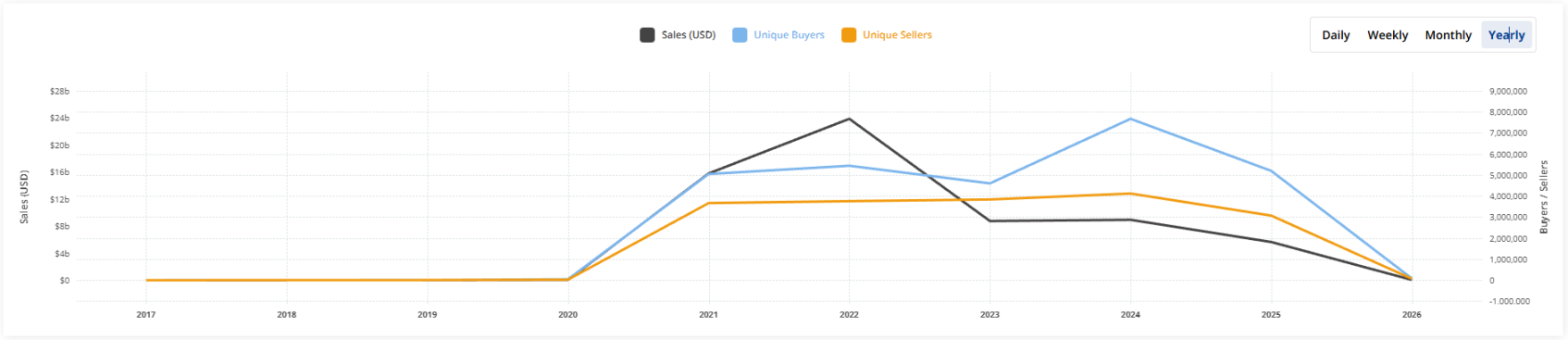
Image Source: CryptoSlam

Even former top-tier NFT projects and blue-chip NFTs couldn't escape the downturn. Taking CryptoPunks as an example, the floor price has fallen to about 30 ETH, down 78% from its peak of 125 ETH in 2021; Bored Ape Yacht Club (BAYC) fell 83% from about 30 ETH to about 5 ETH; Azuki dropped 93% from about 12 ETH to 0.8 ETH.

Collective "Flight" and Evolution of Platforms

The moves of industry leaders signal the end of this cycle.

OpenSea, once the undisputed leader in the NFT marketplace, saw its platform revenue drop from $50-120 million per month during the NFT golden age to less than one million.

Consequently, OpenSea announced a pivot, transforming from a pure "NFT marketplace" to a universal on-chain trading center for "Trade Everything," encompassing physical collectibles and digital assets like tokens, and confirmed it will issue a token.

Blur, which debuted at its peak, has seen its TVL continuously hit new lows, and its token price is down 99% from its high.

Then there's Magic Eden, which rose to prominence on the Solana chain. After a year of operation, it issued a token. Affected by the NFT market sentiment and the realization of airdrop expectations, platform trading volume began to shrink, and its token price also fell over 98% from its high.

Even projects that couldn't keep up with the changing times, like the older NFT marketplace X2Y2, have been eliminated, ceasing operations entirely, with the team shifting to the AI field.

From "Token" to "Brand"

Amid the widespread gloom, Pudgy Penguins has successfully bucked the trend, becoming an outlier in the industry. Its success does not rely on complex innovations in token technology or short-term speculative hype, but rather on transforming digital IP into physical consumer goods, gradually building a sustainable brand ecosystem that bridges Web3 and traditional retail.

Through the dual revenue model implemented by CEO Luca Netz, Pudgy Penguins deeply integrates IP licensing with physical goods. Its physical toys are now available in over 10,000 retail channels globally, including Walmart, Target, and Walgreens. According to an AInvest report, this transformation has brought the project approximately $50 million in annual revenue, effectively offsetting the impact of the overall crypto market contraction.
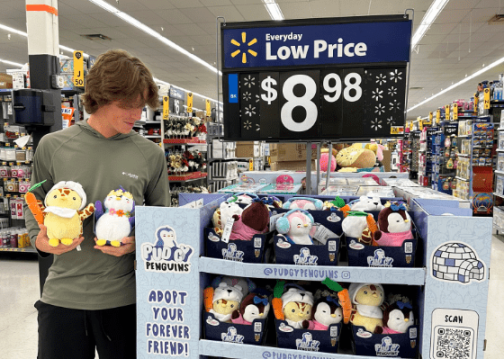
Image – Pudgy Penguins toy shelf in a US Walmart

During the 2025 Christmas season, Pudgy Penguins spent approximately $500,000 to project a giant animation on the Las Vegas landmark Sphere.

Image – Pudgy Penguins形象 on the Sphere

This advertisement, seen by millions of tourists, avoided crypto jargon and the term NFT, presenting only a family-friendly IP image. This brand exposure, in turn, stimulated liquidity in the secondary market. Over the past 14 days, the floor price of this NFT has risen 25%, and trading volume has increased by about 33%.

This shift from speculation to cultural operation seems to be becoming a consensus among industry survivors. Last May, Yuga Labs, the publisher of Bored Ape Yacht Club (BAYC), transferred the IP rights of the top NFT project CryptoPunks to the non-profit Infinite Node Foundation, aiming to strip it of its speculative, price-volatile nature and seek longer-term artistic preservation and cultural operation.

Physical Backing and Functional Return

Beyond IP branding, NFTs are becoming the underlying tool for connecting real-world assets (RWA).

Physical Card Trading. The platform Courtyard.io is changing the game. They deposit real Pokémon cards into certified vaults and tokenize them as NFTs. In the 30 days leading up to the end of 2025, the platform processed over 230,000 transactions, generating approximately $12.7 million in sales, demonstrating strong market appetite for this type of highly liquid, physically-backed asset.

Functional Tickets. FIFA (Fédération Internationale de Football Association) has also joined this trend, introducing "Priority Purchase Right" NFTs for ticket sales for the 2026 World Cup. These NFTs are not for speculation but serve as a verification tool to prevent scalper premiums and price gouging in the secondary market.

What Died in NFTs, and What Remains

NFTs are not "completely dead," but they have indeed died once.

What died is the fantasy of viewing NFTs as a financial asset that could be endlessly minted and traded based solely on narrative, detached from real-world value. In the face of infinite supply and limited demand, this path was destined to be unsustainable.

What remains is NFT's role as a "credential layer." It is no longer expected to create value alone but is embedded within IP brands, physical assets, and functional scenarios,承担ing the basic functions of rights confirmation, transfer, participation, and verification.

From Pudgy Penguins' toy shelves, to the on-chain flow of physical cards, to the anti-scalping mechanisms for World Cup tickets, NFTs are stepping down from the speculative stage and returning to the toolbox.

For the NFT speculative market, this is undoubtedly a winter. But for NFTs themselves, this is more like a rebirth after disenchantment.


Twitter:https://twitter.com/BitpushNewsCN

Bitpush TG Discussion Group:https://t.me/BitPushCommunity

Bitpush TG Subscription: https://t.me/bitpush

Original link:https://www.bitpush.news/articles/7600451

Crypto di tendenza

Domande pertinenti

QWhat was the peak auction price of Beeple's NFT 'Everydays: The First 5000 Days' and what does its current market state symbolize?

ABeeple's NFT 'Everydays: The First 5000 Days' was sold for $69.3 million at Christie's auction house. The current state of the NFT market, including the cancellation of events like NFT Paris, symbolizes the complete cycle from狂热 (frenzy) to清算 (liquidation) over a five-year period.

QAccording to data from CryptoSlam, how did the supply and sales volume of NFTs change in 2025 compared to previous years?

AIn 2025, the supply of NFTs increased by 35% compared to 2024's 1 billion, while the total sales volume dropped by 37% from $8.9 billion to approximately $5.63 billion. The total market capitalization also fell by about 86% from its peak in April 2022.

QHow did major NFT platforms like OpenSea and Blur perform in the declining market, and what changes did they make?

AOpenSea's monthly revenue dropped from $50-120 million during the NFT golden age to less than $1 million, leading it to转型 (transform) into a general on-chain trading center for all types of assets. Blur's TVL hit new lows, and its token price fell by 99% from its peak.

QWhat strategy did Pudgy Penguins use to achieve success despite the overall market downturn?

APudgy Penguins succeeded by transforming its digital IP into physical consumer goods, adopting a dual revenue model that combines IP licensing with physical products. Its toys are now sold in over 10,000 retail stores globally, generating an estimated $50 million in annual revenue.

QWhat new practical applications for NFT technology are emerging, as mentioned in the article?

ANew practical applications include platforms like Courtyard.io, which tokenizes physical assets like Pokémon cards as NFTs for high-liquidity trading, and FIFA's use of NFTs as 'priority purchase right' tickets for the 2026 World Cup to prevent scalping and price fraud in the secondary market.

Letture associate

Agent Race Ends, Super Workbench Takes Over

The era of fragmented AI agents is ending. Over the past month, China's tech giants—Tencent, Alibaba, and ByteDance—have simultaneously shifted strategy: instead of launching new, standalone AI agents, they are consolidating their various agent projects into unified "super workbenches." Tencent integrated its QClaw teams into WorkBuddy, a strategic product hailed as a potential third flagship after QQ and WeChat. Alibaba is merging its QoderWork, Wukong, and MuleRun agents into a new "Qianwen Office" platform under DingTalk's leadership. ByteDance rebranded its TRAE SOLO coding agent to TRAE Work, signaling a broader focus on workflow collaboration. This convergence marks a pivotal industry consensus. The initial exploration phase, where companies rapidly built numerous overlapping agents for different scenarios, proved costly and inefficient. With open-source tools eroding technical barriers, competition has shifted from agent creation to resource consolidation and cost control. Historically, platform wars are won not by creating more products, but by simplifying them—as seen with browsers unifying web access and super-apps consolidating services. Now, the "super workbench" aims to become the unified AI entry point for work. This reflects a deeper market realization: the primary audience for AI is no longer just programmers (a market in the tens of millions) but all knowledge workers (a market of billions). The real opportunity lies in augmenting everyday tasks—managing emails, documents, data, and meetings—across the entire workday. The core battleground is becoming control over the primary AI entry point that employees use daily. Tencent's WorkBuddy leverages WeChat and Tencent Docs; Alibaba's Qianwen Office taps into DingTalk's organizational data; ByteDance's TRAE Work integrates with Feishu's workflows. Whoever owns this "super workbench" gains strategic control over orchestrating enterprise data and APIs. This shift is redefining enterprise software. Traditional SaaS applications, valued for their user interfaces, will recede into the background. Their core functionalities will be exposed as standardized "Skills" or APIs for the super workbench's agents to invoke. Software value will shift from selling user seats to charging based on API calls and outcomes delivered. The evolution of agents is moving through clear stages: first as novel standalone products, then as consolidated primary work entry points, and finally as pervasive, invisible capabilities embedded into the digital fabric. The recent moves by major tech firms signal the transition from the first stage into the second, accelerating toward the third. In the end, the most successful agent technology may become invisible—like electricity or the HTTP protocol—a fundamental, unnamed infrastructure powering work itself.

marsbit17 min fa

Agent Race Ends, Super Workbench Takes Over

marsbit17 min fa

Michael Saylor: 110 Reasons to Oppose BIP-110

Michael Saylor presents 110 arguments against Bitcoin Improvement Proposal (BIP) 110, a soft fork aimed at restricting certain non-monetary data storage uses (like inscriptions) on the Bitcoin blockchain. He acknowledges the proponents' valid concerns—such as node costs, fee pressure, and preserving Bitcoin's monetary focus—but fundamentally disagrees with the proposed solution. Saylor argues that BIP 110 represents a dangerous precedent of using consensus rules to enforce value judgments on transaction validity, moving away from Bitcoin's core principles of neutrality and permissionless innovation. His key objections are organized into eleven categories: 1) It violates neutrality and hard consensus by banning currently valid transactions. 2) It fails to meet the high burden of proof required for a consensus change, lacking concrete data on the alleged crisis. 3) Its seven bundled technical restrictions are overly broad, targeting generic script functionalities and blocking future upgrade paths. 4) It sacrifices compatibility and future optionality by closing off designed upgrade hooks. 5) Its temporary rules add significant complexity (grandfathering, expiry states) without sufficient justification. 6) The economic and security impacts, particularly on miner revenue and fee markets, are uncertain and unmodeled. 7) Superior, market-based tools (fee markets, relay/mining policies) already exist to manage blockchain load. 8) It stifles innovation by creating a chilling effect for developers. 9) Its modified activation mechanism (55% threshold, forced signaling) is aggressive and risks network splits. 10) The precedent it sets—using consensus to suppress disliked but legal uses—is more dangerous than the problem it aims to solve. 11) A better path exists: improving measurements, refining resource-based policies, and allowing market forces to work. Saylor concludes that Bitcoin's strength lies in its neutral rules, open markets, and hard consensus. Changing these foundational elements to target specific use cases is an unnecessary and risky "iatrogenic" intervention. He advocates for guarding Bitcoin's neutrality rather than acting as its redeemer.

marsbit33 min fa

Michael Saylor: 110 Reasons to Oppose BIP-110

marsbit33 min fa

Trading

Spot

Articoli Popolari

Come comprare HOUSE

Benvenuto in HTX.com! Abbiamo reso l'acquisto di Housecoin (HOUSE) semplice e conveniente. Segui la nostra guida passo passo per intraprendere il tuo viaggio nel mondo delle criptovalute.Step 1: Crea il tuo Account HTXUsa la tua email o numero di telefono per registrarti il tuo account gratuito su HTX. Vivi un'esperienza facile e sblocca tutte le funzionalità,Crea il mio accountStep 2: Vai in Acquista crypto e seleziona il tuo metodo di pagamentoCarta di credito/debito: utilizza la tua Visa o Mastercard per acquistare immediatamente HousecoinHOUSE.Bilancio: Usa i fondi dal bilancio del tuo account HTX per fare trading senza problemi.Terze parti: abbiamo aggiunto metodi di pagamento molto utilizzati come Google Pay e Apple Pay per maggiore comodità.P2P: Fai trading direttamente con altri utenti HTX.Over-the-Counter (OTC): Offriamo servizi su misura e tassi di cambio competitivi per i trader.Step 3: Conserva Housecoin (HOUSE)Dopo aver acquistato Housecoin (HOUSE), conserva nel tuo account HTX. In alternativa, puoi inviare tramite trasferimento blockchain o scambiare per altre criptovalute.Step 4: Scambia Housecoin (HOUSE)Scambia facilmente Housecoin (HOUSE) nel mercato spot di HTX. Accedi al tuo account, seleziona la tua coppia di trading, esegui le tue operazioni e monitora in tempo reale. Offriamo un'esperienza user-friendly sia per chi ha appena iniziato che per i trader più esperti.

333 Totale visualizzazioniPubblicato il 2025.04.27Aggiornato il 2026.06.02

Come comprare HOUSE

Discussioni

Benvenuto nella Community HTX. Qui puoi rimanere informato sugli ultimi sviluppi della piattaforma e accedere ad approfondimenti esperti sul mercato. Le opinioni degli utenti sul prezzo di HOUSE HOUSE sono presentate come di seguito.

活动图片