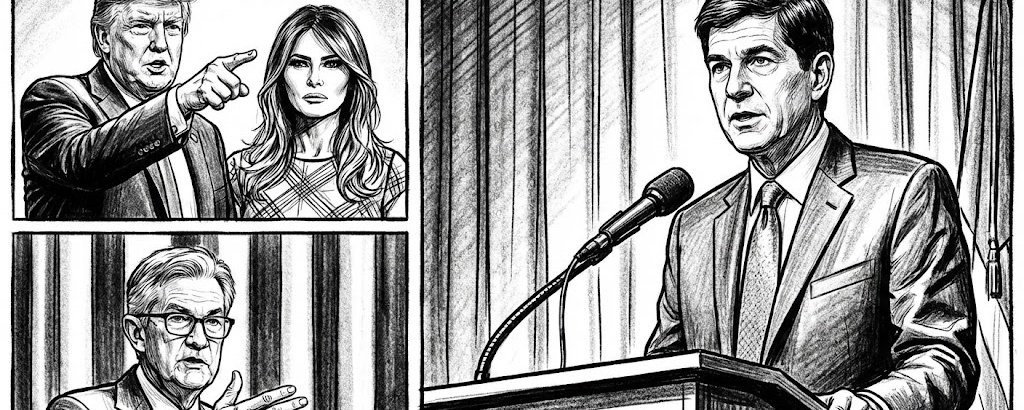
The Era Without Good Answers: Understanding Warsh, Trump, and the Next Four Years of a New Era

marsbitPubblicato 2026-02-02Pubblicato ultima volta 2026-02-02

Introduzione

The article "An Era Without Good Answers: Understanding Warsh, Trump, and the Next Four Years" analyzes the potential implications of Kevin Warsh becoming the next Federal Reserve Chair under a Trump administration. It argues that Warsh represents not just a shift from dovish to hawkish policy, but a fundamental redefinition of the Fed's role. His appointment signals a move away from the Fed acting as a perpetual backstop for markets and government debt—a role perfected by Chair Powell during crises like the pandemic. Instead, Warsh advocates for monetary and fiscal discipline, opposing unconditional quantitative easing and emphasizing market rules over intervention. However, the US economy's reality—characterized by massive debt, deficit spending, and market dependence on low rates—severely limits any radical change. Warsh's proposed policies of raising rates and reducing the Fed's balance sheet risk triggering market volatility, higher borrowing costs, and political backlash, likely forcing a retreat to familiar stimulus measures. From Trump’s perspective, Warsh is a "controllable reformer" who can publicly push for fiscal restraint, forcing Congress to address unsustainable spending—while also serving as a convenient scapegoat if reforms fail. Ultimately, the core constraint remains America’s debt-dominated economy, which eliminates any possibility of a definitive solution. The coming years will involve managing, not solving, these problems through a painful and iterat...

Author: Iron Pillar Brother in CRYPTO

Many years from now, facing the newly appointed Kevin Warsh and the continuous public pressure from Trump, Powell might recall the morning he first walked into the Federal Reserve Chairman's office.

It was an era where everything still seemed controllable, even though the world's rightward turn was already inevitable.

At the time, the 64-year-old Powell did not know that he was about to become the longest-serving Fed Chair in history to operate in an abnormal state: he would face the pandemic, unprecedented fiscal expansion, runaway inflation, asset bubbles, and geopolitical fractures. He would also be forced, time and again during crises, to push the Fed into the spotlight.

I. Redefining the Fed: Farewell to Backstopping—Dovish or Hawkish?

For a long time, the Fed was no longer just a central bank. It became the buyer of last resort for markets, a shadow ally of fiscal policy, the lender of last resort for banks, and the ultimate backstop.

And Powell, gradually, was shaped by circumstances from a technocrat known for his steadiness and skill in managing expectations into the guardian of this vast and bloated system.
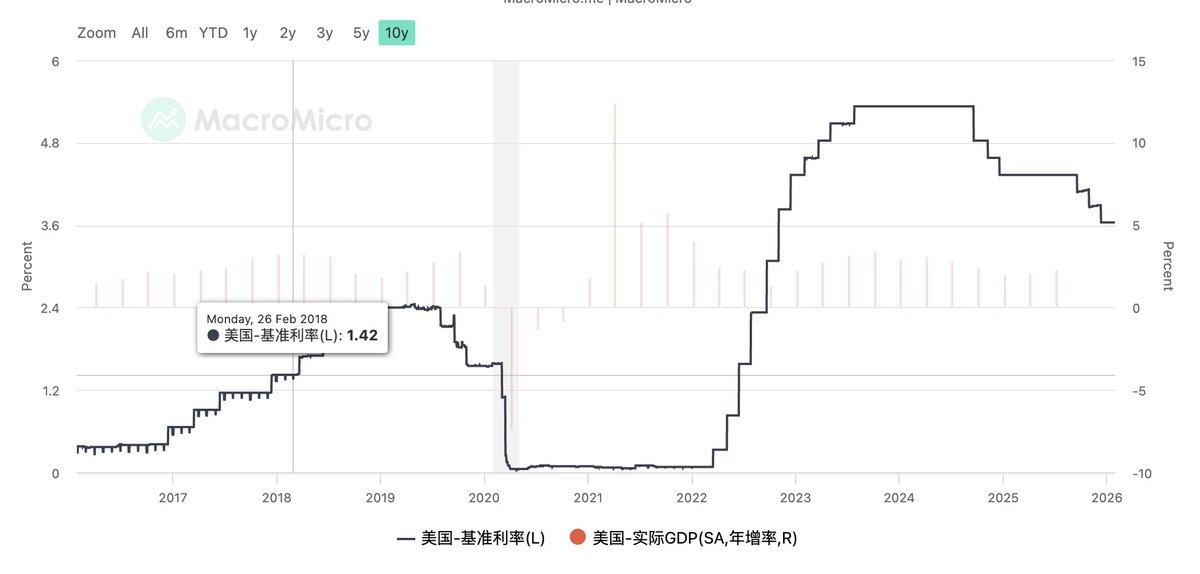
The起伏 (fluctuations) of interest rates during Powell's 8-year tenure

Until today.

As Kevin Warsh's name emerges as the next Fed Chair, what is truly changing is not merely a label of hawk or dove, but a redefinition of the Fed's role for a new era.

Warsh is not a traditional hawk obsessed with balance sheet reduction, nor a dove who only knows how to cut rates to nurture markets, nor simply an anti-establishment figure.

What he truly represents is an answer that the Fed of the new era must provide against a backdrop of growing market skepticism about the sustainability of the massive national debt: should the Fed continue to bear the responsibility of backstopping all debt problems?

In Warsh's proposals, he repeatedly mentions thorough reform—not just changes in the rate path or adjustments to the balance sheet size, but a systematic reflection on the logic of monetary policy over the past fifteen years. This extreme form of distorted Keynesianism is coming to an end.

The history centered on demand management, using asset price prosperity to mask productivity stagnation, has reached a dead end.

For Trump, Warsh is a controllable reformer: willing to cut rates, understanding debt realities, and unlike Hassett, not carrying strong political baggage, thus maintaining the necessary independence and dignity of the central bank.

For Wall Street, Warsh is a rule-abider: emphasizing monetary and fiscal discipline, opposing unconditional QE, and preferring institutional adjustments over monetary policy interventions to manage markets.

As mentioned previously in a shared space, perhaps the Fed Put will cease to exist in the next four years. It may be replaced by a more restrained central bank, clearer boundaries of responsibility, and more frequent, yet more genuine, market fluctuations. This will bring an uncomfortable adjustment period for all market participants.

II. The Gravitational Field of Reality: How Long Until a True Return, and Is It Even Possible?

Before Warsh takes office, the prevailing mood is pessimistic. After all, according to Warsh's philosophy, there should be significant balance sheet reduction and a strong fight against inflation.
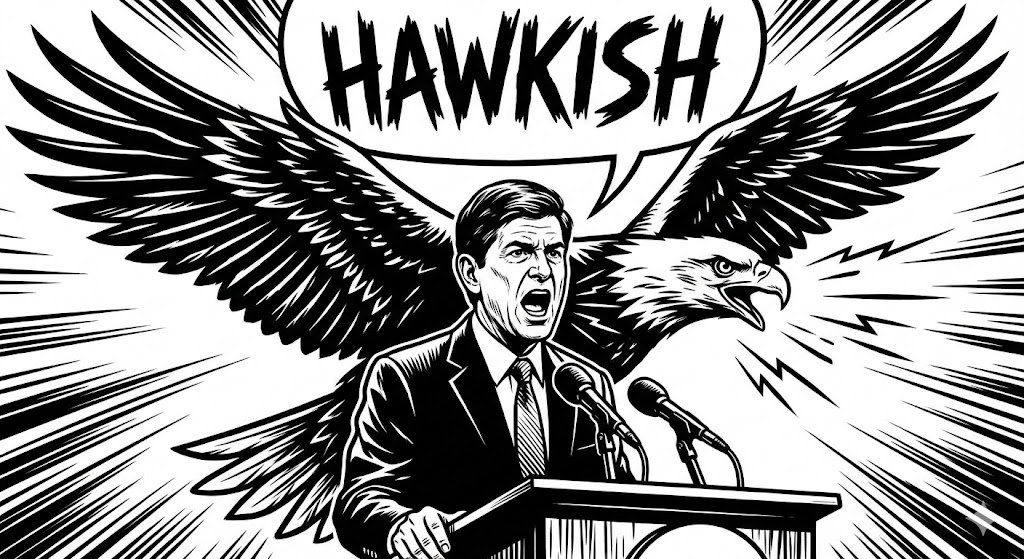
However, the current U.S. economy is in a state of fragility yet极度依赖 (heavily reliant on) a stable narrative: fiscal deficits are high, debt interest payments are nearing the brink of失控 (being out of control), real estate and medium-to-long-term financing are highly dependent on long-term rates, and capital markets are accustomed to policy backstopping.

What Warsh advocates—rate cuts + balance sheet reduction + a smaller central bank—means: it requires fiscal policy to重新面对成本 (face costs again) and exercise discipline; it requires markets to独自承担风险 (bear risks alone); and it requires the Fed to relinquish the backstopping power accumulated over the past fifteen years.

This path is not impossible; it makes logical sense and aligns with common sense. But realistically, the margin for error left for Warsh is not large, and it highly tests his control over the pace.

If balance sheet reduction pushes up term premiums, raising medium-to-long-term rates, thereby suppressing housing, investment, and employment;

If markets experience剧烈波动 (violent fluctuations) during the process of the central bank no longer backstopping;

If voters feel the real costs brought by this so-called return to discipline.

Political pressure on the Fed will quickly revert to the familiar direction: stop balance sheet reduction, slow down reforms, prioritize stabilizing growth.

Over the years, both voters and capital markets have developed a strong path dependency through repeated crises. This inertia cannot be彻底打破 (completely broken) by a single personnel change.

A more realistic assessment is: Warsh may push for a change in direction, but a true return is unlikely to happen in one step.

III. From Trump's Perspective: Another Solution Behind Warsh's Appointment

As is well known, Trump has always needed low interest rates.

But at the same time, early in his term, he flamboyantly adopted Musk-style efficiency reforms, attempting to drastically cut government spending and reshape fiscal discipline. These two goals—low rates and spending cuts—are inherently conflicting within the traditional framework.

Thus, a more interesting question arises: if Trump is unwilling to fully rely on a dovish central bank backstop, yet is aware that fiscal conditions are nearing失控边缘 (the edge of being out of control), then is choosing Warsh itself a non-traditional solution?

At this stage, the U.S. fiscal deficit rate and debt scale are approaching a critical inflection point. Continuing down the dovish path of the past fifteen years—more aggressive rate cuts, more direct central bank intervention, blurrier monetary and fiscal boundaries—might seem to buy短暂稳定 (brief stability), but in reality, it continuously透支 (overdraws) dollar credibility and exacerbates inflation problems.

The political comfort period for this path is very short, and the probability of failure is extremely high. Once inflation rebounds and long-term rates spiral out of control, the responsibility will almost certainly fall back on the White House itself.

We must always understand: Trump is, from start to finish, a master of passing the buck. And Warsh's value lies precisely not in his apparent difficulty to use, but in the ability to use Warsh's hand to pressure Congress.

If the Fed, under Warsh's leadership, clearly refuses to continue backstopping fiscal policy and refuses to unconditionally suppress term premiums, then rising interest rates, exposed financing costs, and显性化 (becoming apparent) fiscal pressure will no longer be the direct consequence of political decisions, but the natural outcome of market discipline.

What would this lead to? For Congress, continuing unconstrained spending expansion would quickly become unsustainable; for the fiscal system, cutting welfare and compressing deep budgets would, for the first time, have a被迫发生的 (forced)现实基础 (realistic basis); instead of relying on Musk-style plugging of leaks.

Even if this path fails, even if market reactions are excessive and the reform pace is forced to slow, Warsh remains a perfect scapegoat.

Or, Warsh doesn't even need the reform to succeed; he just needs to fully expose the problems to change the current state of博弈 (game theory) between Trump, Congress, and the Democrats.

This, perhaps, is the most realistic, and also most brutal, political significance of Warsh's appointment.

IV. Facing the Future of Debt: Buying Time, No One-Size-Fits-All Solution

Pulling the perspective even higher, one finds that both Warsh's reform vision and Trump's political布局 (layout) cannot escape the same现实约束 (realistic constraint): the U.S. has entered a debt-dominated era.
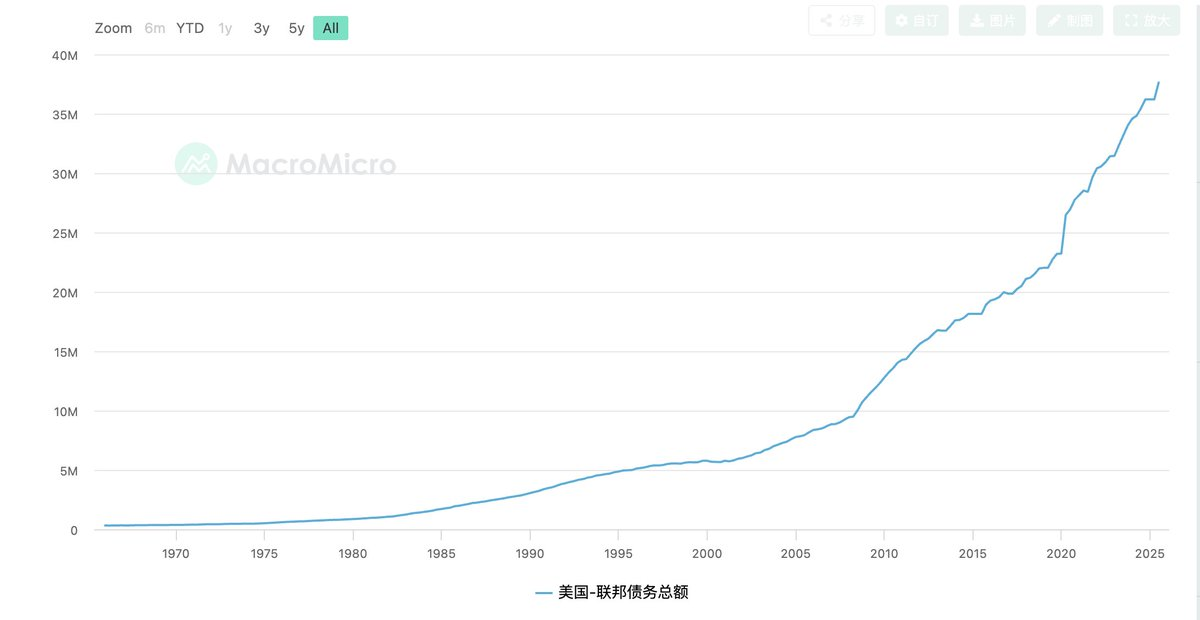
The scale of debt dictates a brutal fact: the U.S. no longer has the policy freedom for thorough correction,只剩下 (only left with) choices of how to delay and how to转移 (transfer/shift).

This is why buying time has become the only feasible, yet least dignified, path. Rate cuts use future inflation risk to alleviate current interest pressure; balance sheet reduction attempts to use institutional discipline to修复 (repair) central bank credibility; fiscal reform uses political conflict and electoral costs to temporarily smooth the debt curve.

But these choices conflict with and constrain each other; none can form a complete闭环 (closed loop) independently.

What Warsh truly faces is not the question of whether to reform, but:

In a highly financialized, politically polarized, debt-inflated system, how much real cost can reform bear (withstand)?

From this angle, no matter who comes up, they cannot provide a one-size-fits-all solution.

This also means that in the next four years, what markets need to adapt to is not a single policy shift, but a longer-term, more反复的 (repetitive/volatile) state. Interest rates will not return to the zero comfort zone, but也难以长期维持高位 (will also find it difficult to maintain high levels long-term); the central bank will not backstop unconditionally, but也不可能真正放手不管 (cannot truly let go completely either; crises will not be彻底避免 (completely avoided), only postponed and拆分 (broken down).

In such a world, macroeconomic policy no longer solves problems; it only manages them.

And this, perhaps, is the final point for understanding Kevin Warsh and Trump's布局 (layout): they are not competing for a better answer, but in an era without good answers, fighting over who decides how the costs of the past are allocated now.

This is not a story about prosperity.

It is merely the beginning of an era where reality, debt, and supply constraints become apparent again.


Domande pertinenti

QWhat is the main theme of the article regarding the Federal Reserve's role under potential new leadership?

AThe article argues that the main theme is a fundamental redefinition of the Federal Reserve's role, moving away from being the ultimate backstop for markets and government debt. It suggests that Kevin Warsh represents a shift towards a more rules-based, disciplined central bank that will no longer unconditionally underwrite fiscal spending, leading to greater market volatility and a painful adjustment period.

QAccording to the author, what is the key constraint facing any U.S. economic policy, including those proposed by Trump or Warsh?

AThe author identifies the overwhelming scale of U.S. national debt as the key and brutal constraint. This debt level means the U.S. has lost the policy freedom for a complete correction and is left only with choices about how to delay problems or transfer costs, making 'time for space' the only viable, albeit ungraceful, path.

QHow does the article interpret Donald Trump's potential motivation for selecting a figure like Kevin Warsh as Fed Chair?

AThe article suggests Trump's selection of Warsh is a 'non-traditional solution.' It posits that Trump, a 'master of blame-shifting,' could use Warsh's discipline to force Congress's hand on fiscal reform by exposing the true cost of debt. If the market reacts poorly, Warsh also serves as a perfect scapegoat, allowing Trump to avoid direct blame.

QWhat does the phrase 'Fed Put' refer to in the context of the article, and what is its predicted future?

AThe 'Fed Put' refers to the market's long-held belief that the Federal Reserve would intervene to support asset prices and backstop markets during downturns. The article predicts that under Kevin Warsh, the 'Fed Put' will cease to exist, replaced by a more restrained central bank that allows for more frequent and genuine market volatility.

QWhat is the author's overall conclusion about the possibility of finding a definitive solution to the current economic challenges?

AThe author concludes that there is no definitive, one-size-fits-all solution ('no good answers'). Macro policy will not solve the underlying problems but will only manage them. The political struggle is not about creating prosperity but about deciding how the costs of past decisions will be distributed in a new era of reality, debt, and resurgent supply constraints.

Letture associate

South Korean Exchanges 'Battle' Regulators, Challenging the Boundaries of Enforcement and Legislation

South Korea's cryptocurrency industry is engaged in a rare, direct confrontation with regulators. The Financial Intelligence Unit (FIU), the primary anti-money laundering (AML) watchdog, has recently imposed heavy penalties on major exchanges like Upbit and Bithumb for alleged violations involving unregistered overseas VASPs and AML procedures. However, exchanges are now actively challenging these actions in court and through industry associations. In a significant shift, the Seoul Administrative Court ruled in favor of Upbit's operator, Dunamu, overturning part of an FIU-ordered business suspension. The court found the FIU's penalty criteria and justification insufficiently clear. Similarly, the court suspended the enforcement of a six-month business suspension against Bithumb pending a final ruling, citing potential irreversible harm to the exchange. Beyond legal battles, the industry is contesting proposed legislative amendments. The Digital Asset eXchange Alliance (DAXA) strongly opposes a draft rule that would mandate Suspicious Transaction Reports (STRs) for all crypto transfers over 10 million KRW (~$6,800). DAXA argues this "poison pill" clause violates legal principles and would overwhelm the STR system, increasing reports from 63,000 to an estimated 5.45 million annually for major exchanges, thereby crippling effective AML monitoring. This conflict highlights a structural tension in South Korea's crypto governance: comprehensive digital asset laws are still developing, while regulators rely heavily on AML enforcement. The industry's move from passive compliance to active legal and legislative challenges signifies a new phase, pressing for clearer rules and more proportionate enforcement. While short-term disputes may intensify, this clash could ultimately lead to a more mature and sustainable regulatory framework for South Korea's vibrant crypto market.

marsbit42 min fa

South Korean Exchanges 'Battle' Regulators, Challenging the Boundaries of Enforcement and Legislation

marsbit42 min fa

After 50x Storage Surge, Justin Sun Always Looks to the Next Decade

Sun Yuchen, known for his controversial stunts like a $30 million lunch with Warren Buffett (canceled due to a kidney stone) and eating a $6.2 million duct-taped banana, is often overshadowed by a significant fact: his decade-long track record of spotting major investment trends. In 2016, he famously advised young people to invest in Bitcoin, Nvidia, Tesla, and Tencent instead of buying property. A hypothetical $20,000 investment in Nvidia and Tesla from that list would now be worth over 50 million RMB. His latest major call was on November 6, 2025, predicting a "50x storage opportunity" tied to the AI boom, which materialized with Sandisk's stock surging nearly 50-fold by 2026. Looking ahead, Sun now focuses on the next frontier: Physical AI. He identifies four key areas: 1. **Embodied AI/Robotics**: He sees this reaching its "iPhone moment," with companies like UBTech and Galaxy General leading in commercialization. 2. **Drones**: Viewed as the first commercially viable form of Physical AI, revolutionizing sectors from warfare (e.g., AeroVironment's Switchblade) to logistics. 3. **Spatial Computing**: Beyond VR, it's about AI understanding physical space, a foundational technology for robotics and autonomous systems, exemplified by Apple's Vision Pro. 4. **Space Exploration**: After a 2025 suborbital flight with Blue Origin, Sun advocates for space as the ultimate frontier, discussing blockchain's potential role in space asset management and data transactions. His investment philosophy involves betting on entire, inevitable trends rather than single companies. For robotics, he sees Tesla (the body/manufacturer) and Nvidia (the brain/AI platform) as complementary plays. In defense drones, he highlights companies making tanks obsolete (AeroVironment) and those augmenting fighter jets (Kratos). For space, he participated in Blue Origin's flight and anticipates SpaceX's potential IPO to redefine the sector's valuation. Sun Yuchen's vision frames the next two decades not as a revolution in information flow (like the internet), but in the fundamental operation of the physical world through AI-powered robots, autonomous systems, and spatial intelligence, ultimately extending human and AI activity into space. While many still focus on conventional assets, he continues to look toward the next technological horizon.

marsbit1 h fa

After 50x Storage Surge, Justin Sun Always Looks to the Next Decade

marsbit1 h fa

The Billionaires Behind the Most Expensive Midterm Election in History

"The Most Expensive Midterm Elections and Their Billionaire Backers" This analysis details the unprecedented scale of spending in the 2026 midterm elections, highlighting the key billionaire donors shaping the political landscape. Jeff Yass, founder of Susquehanna International Group, has contributed over $81 million, ranking third among individual donors behind George Soros ($102.6M) and Elon Musk ($84.8M). Yass is a major donor to Trump's MAGA Inc. and supports school choice and various candidates. Overall, federal committees have raised over $4.7 billion this cycle, with political ad spending projected to reach $10.8 billion. Republican-aligned groups are significantly out-raising their Democratic counterparts. "Dark money" from undisclosed sources continues to grow. The core stakes involve control of Congress and policy direction for Trump's final term. Donors are also motivated by specific issues: Sergey Brin and Chris Larsen are funding opposition to a proposed California wealth tax and supporting crypto-friendly policies. Other top donors include OpenAI's Greg Brockman and his wife Anna ($50M total to MAGA Inc. and an AI-focused PAC), Richard Uihlein ($45.3M to conservative causes), venture capitalists Marc Andreessen and Ben Horowitz (each over $44M to crypto/AI PACs and MAGA Inc.), Miriam Adelson ($42.6M to GOP leadership PACs), Paul Singer ($33.9M), and Diane Hendricks ($25.8M to MAGA Inc.). The article notes that the peak fundraising period is still ahead, with major primaries approaching.

marsbit1 h fa

The Billionaires Behind the Most Expensive Midterm Election in History

marsbit1 h fa

The Largest IPO in History Is Approaching, Surpassing SpaceX, 28 Years of AI Self-Iteration, Countdown to Intelligence Explosion

"Anthropic Nears Trillion-Dollar IPO, Fueled by Explosive Growth and 2028 'Intelligence Explosion' Warning Anthropic is considering a deal valuing the AI company near $1 trillion, potentially leading to one of the largest IPOs ever and surpassing SpaceX. Its revenue has skyrocketed, with Annual Recurring Revenue (ARR) reaching $45 billion in May 2026—a 500% increase in just five months. This vertical growth curve is attributed to its key products, Claude Code and Cowork, dominating AI coding and enterprise collaboration. Beyond commercial success, co-founder Jack Clark issued a pivotal warning in an interview: there is a greater than 50% chance that by the end of 2028, AI systems will achieve recursive self-improvement—the ability to autonomously build a 'better version' of themselves, initiating an 'intelligence explosion.' This prophecy underpins the company's astronomical valuation, as the market prices in the potential for transformative and disruptive AI. Further signaling its ambition, Anthropic formed a $1.5 billion joint venture with Goldman Sachs and Blackstone, aiming to disrupt traditional consulting firms like McKinsey by deploying Claude AI for complex strategic work. This move tests AI's capacity to replace high-level cognitive labor, a precursor to its predicted autonomous evolution. The narrative presents a dual future: unprecedented economic opportunity alongside significant risks like economic restructuring and security threats. Anthropic's meteoric rise and Clark's 2028 prediction frame the coming years as a countdown to a potential technological singularity."

marsbit1 h fa

The Largest IPO in History Is Approaching, Surpassing SpaceX, 28 Years of AI Self-Iteration, Countdown to Intelligence Explosion

marsbit1 h fa

Trading

Spot
Futures

Articoli Popolari

Come comprare ERA

Benvenuto in HTX.com! Abbiamo reso l'acquisto di Caldera (ERA) semplice e conveniente. Segui la nostra guida passo passo per intraprendere il tuo viaggio nel mondo delle criptovalute.Step 1: Crea il tuo Account HTXUsa la tua email o numero di telefono per registrarti il tuo account gratuito su HTX. Vivi un'esperienza facile e sblocca tutte le funzionalità,Crea il mio accountStep 2: Vai in Acquista crypto e seleziona il tuo metodo di pagamentoCarta di credito/debito: utilizza la tua Visa o Mastercard per acquistare immediatamente CalderaERA.Bilancio: Usa i fondi dal bilancio del tuo account HTX per fare trading senza problemi.Terze parti: abbiamo aggiunto metodi di pagamento molto utilizzati come Google Pay e Apple Pay per maggiore comodità.P2P: Fai trading direttamente con altri utenti HTX.Over-the-Counter (OTC): Offriamo servizi su misura e tassi di cambio competitivi per i trader.Step 3: Conserva Caldera (ERA)Dopo aver acquistato Caldera (ERA), conserva nel tuo account HTX. In alternativa, puoi inviare tramite trasferimento blockchain o scambiare per altre criptovalute.Step 4: Scambia Caldera (ERA)Scambia facilmente Caldera (ERA) nel mercato spot di HTX. Accedi al tuo account, seleziona la tua coppia di trading, esegui le tue operazioni e monitora in tempo reale. Offriamo un'esperienza user-friendly sia per chi ha appena iniziato che per i trader più esperti.

330 Totale visualizzazioniPubblicato il 2025.07.17Aggiornato il 2025.07.17

Come comprare ERA

Discussioni

Benvenuto nella Community HTX. Qui puoi rimanere informato sugli ultimi sviluppi della piattaforma e accedere ad approfondimenti esperti sul mercato. Le opinioni degli utenti sul prezzo di ERA ERA sono presentate come di seguito.

活动图片












