The Era of On-Chain Voting Is Here: Do Your Stocks Truly 'Belong' to You?

marsbitPubblicato 2026-04-10Pubblicato ultima volta 2026-04-10

Introduzione

The era of on-chain shareholder voting is approaching, as Galaxy Digital (GLXY) pioneers the first-ever on-chain voting for a public company, scheduled for its 2026 annual meeting. This initiative, developed in partnership with fintech firm Broadridge on the Avalanche blockchain, aims to transform tokenized stocks from mere "digital IOUs" into full-fledged equity with complete voting and dividend rights. The move addresses a critical flaw in traditional finance exposed during the 2021 GameStop saga: the disconnect between nominal ownership and actual shareholder rights due to multi-layered intermediation. Broadridge’s solution enables direct, transparent, and immutable voting via digital wallets, eliminating inefficiencies and opacity in the current proxy system. Key features include multi-chain auditability, a streamlined voting interface, and real-time transparency, which could empower retail and institutional investors alike. While this innovation promises greater shareholder engagement and governance transparency, the IMF warns of potential risks, such as accelerated crisis propagation due to blockchain’s settlement speed. Widespread adoption still faces hurdles, including regulatory uncertainty, resistance from traditional financial intermediaries, and technical barriers for users. However, with major players like Nasdaq and Blackrock advancing tokenization efforts, on-chain voting could mark a significant step toward authentic ownership and shareholder-centric cap...

Remember the轰轰烈烈的"GameStop (GME) retail investors versus Wall Street" battle in 2021? At that time, countless retail investors bought GME through platforms like Robinhood, aiming to counter short-selling institutions. But a dramatic scene unfolded: multiple brokerages temporarily restricted buying, allowing only selling. Many angry investors questioned: I paid for these stocks, why can't I decide how to trade them? This exposed the rights gap between retail investors as "nominal holders" and "actual beneficiaries" in the traditional financial system.

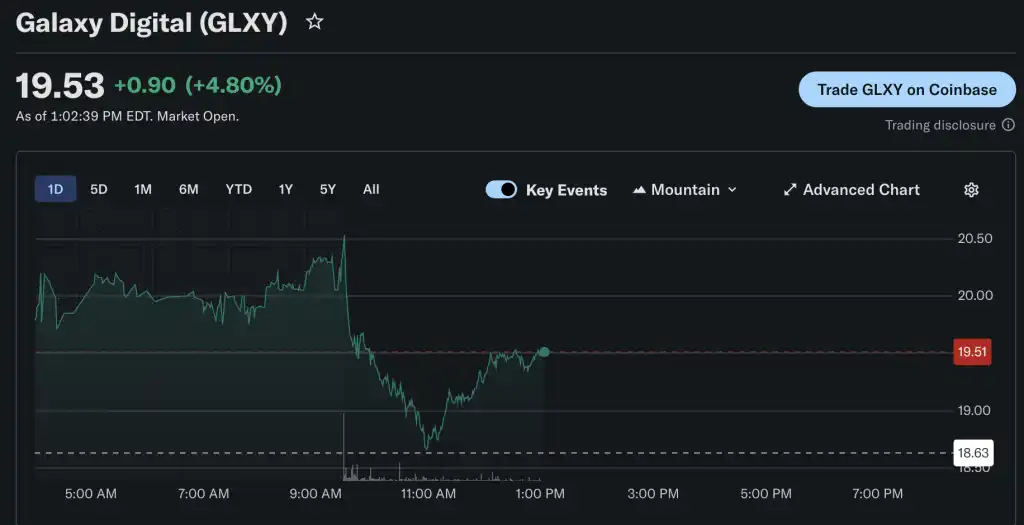
Today, a deeper transformation is taking place, one that could fundamentally solve this problem. Recently, led by cryptocurrency investment bank Galaxy Digital (GLXY), the world's first on-chain shareholder voting for a publicly traded company is set to occur at its annual meeting in May 2026. This is not just a technical experiment; it signifies that tokenized stocks are evolving from "digital replicas" into "true equity" with full shareholder rights, potentially reshaping the corporate governance landscape for decades to come.
From "Digital IOU" to "True Equity": The Coming of Age for Tokenized Assets

Over the past few years, we have witnessed the evolution of tokenized real-world assets (RWA) from concept to infrastructure. From U.S. Treasury bonds to real estate funds, various assets have been "moved" onto the blockchain. But tokenized stocks have long had an awkward "original sin": many were more like "digital IOUs" tracking stock prices or synthetic derivatives, with holders not enjoying core shareholder rights such as voting rights and dividend rights.

This might be unimportant for retail investors seeking stable returns, but for institutional investors bound by fiduciary duties (such as pension funds, mutual funds), it is a fatal flaw. They cannot invest client funds into a "pseudo-equity" without a voice. Therefore, tokenized stocks have long remained in niche trading scenarios, struggling to gain favor from mainstream institutions.

Galaxy Digital's collaboration with fintech giant Broadridge aims to pierce through this layer. Through a dedicated platform built on the Avalanche blockchain, holders of tokenized GLXY stock will be able to receive meeting materials and submit votes directly from their digital wallets. As Galaxy CEO and Wall Street legend Mike Novogratz stated: "Proxy voting is a core function of equity ownership. Enabling on-chain proxy voting for public companies is no longer a theoretical discussion."

This reminds me of my experience investing in certain Stock Connect (Hong Kong) targets. As a mainland investor, the process for participating in shareholder meeting votes was so cumbersome that it made one give up. The directness, transparency, and immutability brought by on-chain voting are the perfect remedy for such pain points.

Dissecting the "On-Chain Voting" Engine: How Transparency Defeats the "Black Box"?

Broadridge's solution is crucial because it directly addresses the core chronic problems of the traditional proxy voting system: opacity and inefficiency.

Under the current "street name" holding system centered around the Depository Trust Company (DTC), your stock may pass through multiple intermediaries like brokers, custodian banks, and clearinghouses before being registered. Your voting instruction is like a letter needing to be forwarded through multiple post offices; delays or losses at any point could prevent your voice from being heard at the shareholder meeting. Historically, cases of "vote reconciliation failure" due to this are not uncommon.

Broadridge's on-chain platform does three smart things:

  1. Direct Wallet Voting: Voting materials go directly to your digital wallet, and the voting action is completed on-chain. The path is the shortest, with no intermediaries to "cause trouble".
  2. Multi-Chain Auditing: Voting records are not stored on a single chain but are distributed across multiple chains for auditing. This is like storing meeting minutes simultaneously in a bank vault, a court archive, and the cloud. Anyone can trace and verify, greatly enhancing credibility.
  3. Unified Interface: Regardless of whether your stock is held via direct registration, through a broker, or in tokenized form, all voting data is aggregated in one interface. This solves the problem of rights fragmentation due to different holding methods.

According to data disclosed by Broadridge, its platform currently handles a monthly volume of tokenized assets reaching $8 trillion, processing over 70 billion investor communications annually. This is no longer a "small-scale test" but financial-grade infrastructure tested by massive transaction volumes. Its CEO Tim Gokey views precise and low-cost governance tools as a prerequisite for the large-scale institutional adoption of tokenized stocks, not an afterthought.

Opportunities and Undercurrents: When Corporate Governance Enters the "Live Broadcast Era"

The proliferation of on-chain voting will push corporate governance from "black box meetings" towards "transparent live broadcasts." Imagine the voting process for all major resolutions (like board elections, M&A deals, executive compensation) being real-time queryable and immutable. This would greatly reduce the information asymmetry that currently exists between registered shareholders and beneficial owners.

For active investors and activist shareholders, this is undoubtedly good news. They can more precisely aggregate voting power to drive strategic changes in companies. For listed companies, this is also a spur, forcing management to pay more attention to communication with all shareholders (especially small shareholders).

However, the International Monetary Fund (IMF) issued a sober warning in a recent report. It pointed out that tokenized finance could amplify financial crises by accelerating the transmission of market stress, as blockchain settlement speeds could outpace regulators' response times. This risk channel becomes more relevant when both governance and settlement functions migrate to shared blockchain infrastructure.

This is not alarmist. If a company's controversial resolution is quickly passed and executed via on-chain voting, market panic and selling could also spread at the speed of light. Therefore, programmable regulation (such as setting voting cooling-off periods, delayed settlement for large transactions) must develop in sync with technological innovation.

Future Outlook: Who Will Follow? What Are the Obstacles?

Galaxy Digital fired the first shot, but who is next? This is key to determining whether this transformation will be a "solo performance" or a "grand chorus."

Broadridge's platform is designed from the outset to support multiple issuers; it's not tailor-made for Galaxy. Nasdaq has received SEC approval to pilot a tokenized securities trading program, and the New York Stock Exchange is also partnering with Securitize to prepare for launching a digital trading platform. The infrastructure is falling into place.

But widespread adoption still faces obstacles:

  • Regulatory Clarity: Despite pilots, a comprehensive regulatory framework for on-chain securities issuance, trading, and governance is still under construction.
  • Traditional Interest Structures: The existing proxy voting, clearing, and settlement systems involve vast networks of interests, and change will inevitably meet resistance.
  • Technical Threshold and Security: Ordinary investors still need to learn to manage private keys and use wallets; security risks like smart contract vulnerabilities and wallet theft cannot be ignored.

From my personal market observation, since 2024, the scale of tokenized funds issued by asset management giants like BlackRock and Fidelity has continued to grow, indicating institutional capital is quietly entering the market in the form of "asset tokenization." This paves the way for "equity tokenization." Once a few benchmark tech or financial companies follow Galaxy's lead, creating a cluster effect, a tipping point could arrive quickly.

Conclusion: Your Investment, Your Rights

Ultimately, Galaxy Digital's on-chain voting experiment is about a most fundamental principle: the authenticity of ownership. In the digital age, what we invest in is not just a string of price codes, but should also be a clear, complete, and executable certificate of rights.

This transformation will not happen overnight; it will advance amidst applause, controversy, and磨合. But for every investor, it means that in the future, we might truly be able to participate more directly in the fate of the companies we invest in, as "owners." When every vote you cast is clearly recorded on-chain like an inscription, the capital market will have taken a major step towards the ideal of "shareholder primacy." Of course, while embracing new technology, we must also remain清醒 about the new risks that come with it—this is always the unerring rule of investing.


Domande pertinenti

QWhat is the core issue exposed by the GameStop (GME) event in 2021 regarding retail investors?

AThe event exposed the rights gap between retail investors as 'nominal holders' and 'beneficial owners' in the traditional financial system, where their ability to trade was restricted despite owning the shares.

QWhat significant milestone is Galaxy Digital (GLXY) achieving in 2026, and why is it important?

AGalaxy Digital is conducting the world's first on-chain shareholder voting for a public company in May 2026. This is important because it evolves tokenized stocks from mere 'digital replicas' into 'true equity' with full shareholder rights, potentially reshaping corporate governance.

QHow does Broadridge's on-chain voting platform address the problems of traditional proxy voting systems?

AIt addresses opacity and inefficiency by enabling direct voting from digital wallets (shortest path, no intermediaries), distributing voting records across multiple chains for auditability, and providing a unified interface to aggregate votes from different holding methods.

QWhat potential downside or risk does the IMF report highlight regarding tokenized finance and on-chain governance?

AThe IMF warns that tokenized finance could amplify financial crises by accelerating the transmission of market stress, as blockchain settlement speeds may outpace regulatory responses, especially when governance and settlement functions share the same infrastructure.

QWhat are some key obstacles to the widespread adoption of on-chain voting and tokenized securities?

AKey obstacles include the need for clearer comprehensive regulatory frameworks, resistance from existing traditional financial利益格局 (interest networks), and challenges like technical barriers for investors (e.g., managing private keys) and security risks (e.g., smart contract vulnerabilities).

Letture associate

Breaking: OpenAI Undergoes Major Reorganization, President Brockman Assumes Command

OpenAI has announced a major internal reorganization just months before its anticipated IPO. The company is merging its three flagship product lines—ChatGPT, Codex, and the API platform—into a single, unified product organization. The most significant leadership change involves co-founder and President Greg Brockman moving from a background technical role to take full, permanent control over all product strategy. This follows the indefinite medical leave of AGI Deployment CEO Fidji Simo. Additionally, ChatGPT's longtime lead, Nick Turley, has been reassigned to enterprise products, with former Instagram executive Ashley Alexander taking over consumer offerings. The consolidation, internally framed as a strategic move towards an "Agentic Future," aims to break down internal silos and create a cohesive "Super App." This planned desktop application would integrate ChatGPT's conversational abilities, Codex's coding power, and a rumored internal web browser named "Atlas" to autonomously perform complex user tasks. The reorganization occurs amid significant internal and external pressures. OpenAI has recently seen a wave of high-profile departures, including Sora co-lead Bill Peebles and other senior technical leaders, leading to concerns about a thinning executive bench. Externally, rival Anthropic recently secured funding at a staggering $900 billion valuation, surpassing OpenAI's own. Google's upcoming I/O developer conference also poses a competitive threat. Analysts suggest the dramatic restructure is a pre-IPO move to present a clearer, more focused narrative to Wall Street—streamlining operations and demonstrating decisive leadership under Brockman to counter internal turbulence and intense market competition.

marsbit3 h fa

Breaking: OpenAI Undergoes Major Reorganization, President Brockman Assumes Command

marsbit3 h fa

Two Survival Structures of Market Makers and Arbitrageurs

Market makers and arbitrageurs represent two distinct survival structures in high-frequency trading. Market makers primarily use limit orders (makers) to profit from the bid-ask spread, enjoying high capital efficiency (nominally 100%) but bearing inventory risk. This "inventory risk" arises from passive, fragmented, and discontinuous order fills in the limit order book (LOB). This risk, while a potential cost, can also contribute to excess profit if managed within control boundaries, allowing for mean reversion. Market makers essentially sell "time" (uncertainty over execution timing) to the market for price control and low fees. In contrast, cross-exchange arbitrageurs typically use market orders (takers) to exploit price differences or funding rates, resulting in lower nominal capital efficiency (requiring capital on both exchanges) and higher transaction costs. Their risk exposure stems from asymmetries in exchange rules (e.g., minimum order sizes), execution latency, and infrastructure risks (e.g., ADL, oracle drift). These exposures are active, exogenous gaps that primarily erode profits rather than contribute to them. Arbitrageurs essentially sell "space" (capital sunk across venues) for localized, immediate certainty. Both strategies engage in a trade-off between execution friction and residual risk. Optimal systems allow for temporary, controlled risk exposure rather than enforcing zero exposure at all costs. Their evolution converges towards hybrid models: arbitrageurs may use maker orders to reduce costs, while market makers may use taker orders or hedges for risk management. Ultimately, both use different forms of risk exposure—market makers exposing inventory, arbitrageurs immobilizing capital—to extract marginal, hard-won certainty from the market.

链捕手3 h fa

Two Survival Structures of Market Makers and Arbitrageurs

链捕手3 h fa

Who Will Define the Rules of the AI Era? Anthropic Discusses the 2028 US-China AI Landscape

This article, based on Anthropic's analysis, outlines the intensifying systemic competition between the U.S./allies and China for AI leadership by 2028. It argues that access to advanced computing power ("compute") is the critical bottleneck, where the U.S. currently holds a significant advantage through chip export controls and allied innovation. However, China's AI labs remain competitive by exploiting policy loopholes—via chip smuggling, overseas data center access, and "model distillation" attacks to copy U.S. model capabilities—keeping them close to the frontier. The piece presents two contrasting scenarios for 2028. In the first, decisive U.S. action to tighten compute controls and curb distillation locks in a 12-24 month AI capability lead, cementing democratic influence over global AI norms, security, and economic infrastructure. In the second, policy inaction allows China to achieve near-parity through continued access to U.S. technology, enabling Beijing to promote its AI stack globally and integrate advanced AI into its military and governance systems, altering the strategic balance. Anthropic contends that maintaining a decisive U.S. lead is essential for shaping safe AI development and governance. The core recommendation is for U.S. policymakers to urgently close compute and model access loopholes while promoting global adoption of the U.S. AI technology stack to secure a lasting strategic advantage.

marsbit5 h fa

Who Will Define the Rules of the AI Era? Anthropic Discusses the 2028 US-China AI Landscape

marsbit5 h fa

Trading

Spot
Futures

Articoli Popolari

Come comprare ERA

Benvenuto in HTX.com! Abbiamo reso l'acquisto di Caldera (ERA) semplice e conveniente. Segui la nostra guida passo passo per intraprendere il tuo viaggio nel mondo delle criptovalute.Step 1: Crea il tuo Account HTXUsa la tua email o numero di telefono per registrarti il tuo account gratuito su HTX. Vivi un'esperienza facile e sblocca tutte le funzionalità,Crea il mio accountStep 2: Vai in Acquista crypto e seleziona il tuo metodo di pagamentoCarta di credito/debito: utilizza la tua Visa o Mastercard per acquistare immediatamente CalderaERA.Bilancio: Usa i fondi dal bilancio del tuo account HTX per fare trading senza problemi.Terze parti: abbiamo aggiunto metodi di pagamento molto utilizzati come Google Pay e Apple Pay per maggiore comodità.P2P: Fai trading direttamente con altri utenti HTX.Over-the-Counter (OTC): Offriamo servizi su misura e tassi di cambio competitivi per i trader.Step 3: Conserva Caldera (ERA)Dopo aver acquistato Caldera (ERA), conserva nel tuo account HTX. In alternativa, puoi inviare tramite trasferimento blockchain o scambiare per altre criptovalute.Step 4: Scambia Caldera (ERA)Scambia facilmente Caldera (ERA) nel mercato spot di HTX. Accedi al tuo account, seleziona la tua coppia di trading, esegui le tue operazioni e monitora in tempo reale. Offriamo un'esperienza user-friendly sia per chi ha appena iniziato che per i trader più esperti.

333 Totale visualizzazioniPubblicato il 2025.07.17Aggiornato il 2025.07.17

Come comprare ERA

Discussioni

Benvenuto nella Community HTX. Qui puoi rimanere informato sugli ultimi sviluppi della piattaforma e accedere ad approfondimenti esperti sul mercato. Le opinioni degli utenti sul prezzo di ERA ERA sono presentate come di seguito.

活动图片












