The Era of Encryption: The Boundary Between Payment and Investment Is Disappearing

marsbitPubblicato 2026-04-02Pubblicato ultima volta 2026-04-02

Introduzione

The boundaries between payments and investment are dissolving in the age of programmable money. While payments represent a $2.5 trillion revenue stream driven by essential, daily transactions, investment management generates $850–900 billion from a much smaller, more passive user base. Payments are a universal financial behavior, whereas investing remains a luxury activity for a minority. Historically, these systems operated separately—with distinct infrastructure, products, and user experiences. However, blockchain technology now enables a unified account model: the same balance in a single application can simultaneously serve both payment and investment functions. This means funds can be used for transactions while also earning yield or participating in DeFi protocols, all within the same interface. This convergence allows users to benefit from both high-frequency, low-value payment activity and capital appreciation from investments without transferring between separate systems—a significant shift from traditional finance.

Written by: Jack Simison

Compiled by: Chopper, Foresight News

Payments and investments collectively generate $3 trillion in annual revenue, surpassing the total market capitalization of cryptocurrencies. They rely on entirely different user behaviors, completely different underlying infrastructures, and until today, they correspond to entirely different product systems. Here, I want to directly compare these two worlds.
One sector earns money that everyone must pay—payment is a necessity for survival, a rigid demand. The other sector earns money that the majority of people will never choose to invest—investment is a luxury behavior.

Payment and investment management are the two largest revenue-generating areas in financial services. They have long operated within independent systems: different products, different accounts, different regulatory frameworks, and different interfaces. This is both a legacy of historical system architecture and because there was no practical need to integrate payments and investments in the past.

Programmable money is breaking down this barrier. The same balance, stored in the same wallet, blockchain, or application, can now participate in both revenue streams. The two worlds are converging in the form of unified accounts.

To understand why this is important, one must see the huge differences in their underlying behavioral logic.
Payment: A Universal Behavior

Payment is the only necessary financial behavior for participating in daily economic life. Buying food, paying rent, settling utility bills... without payment, one cannot survive.

In 2025, about two-thirds of adults globally made or received digital payments. In the United States, consumers complete about 48 payments per month; in India, UPI has over 500 million unique users; in Brazil, Pix has increased the average annual transactions per person to about 193; in parts of sub-Saharan Africa, mobile payments are no longer just a convenient payment method but a core component of the financial system.

Payment is not an optional financial activity for a minority of active people but a daily behavior for the masses. It is instant, high-frequency, with low psychological burden, and the cost is usually negligible. Consumers do not consciously calculate fees at the checkout counter. Compared to cash, digital payments reduce the pain of payment, further increasing usage frequency. The lower the friction, the higher the transaction volume.

This behavioral foundation brings enormous business coverage. According to McKinsey data, the global payment system processes about 3.4–3.6 trillion transactions annually, with an annual fund flow scale of about $1.8–2.0 quadrillion. Salary payments, merchant payments, cross-border remittances, bill payments, subscription services, personal transfers... at every step, intermediaries can take a cut.

Every layer of the payment chain is profiting from it.

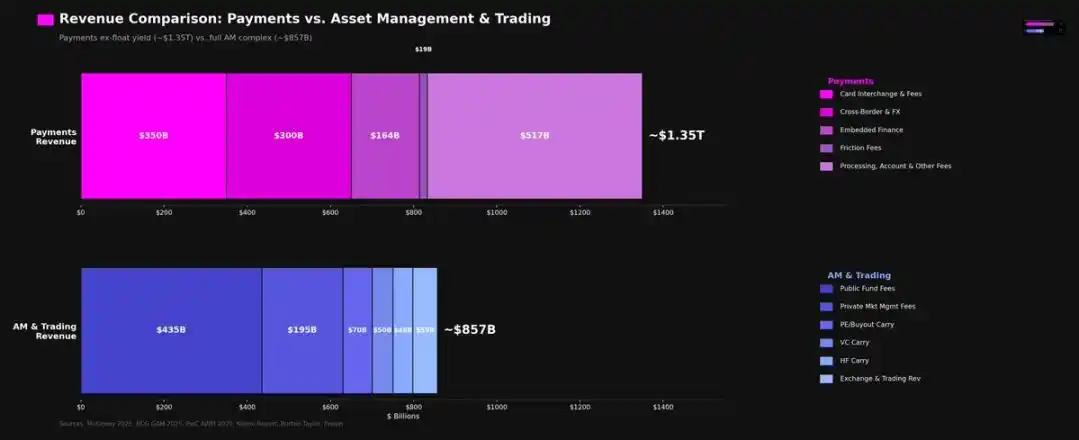
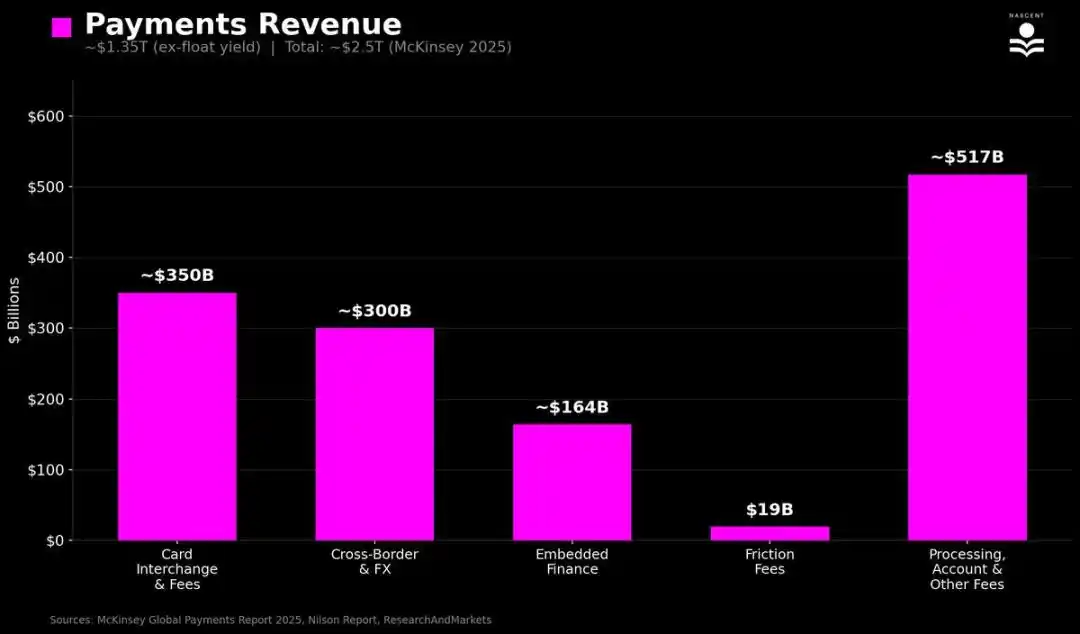
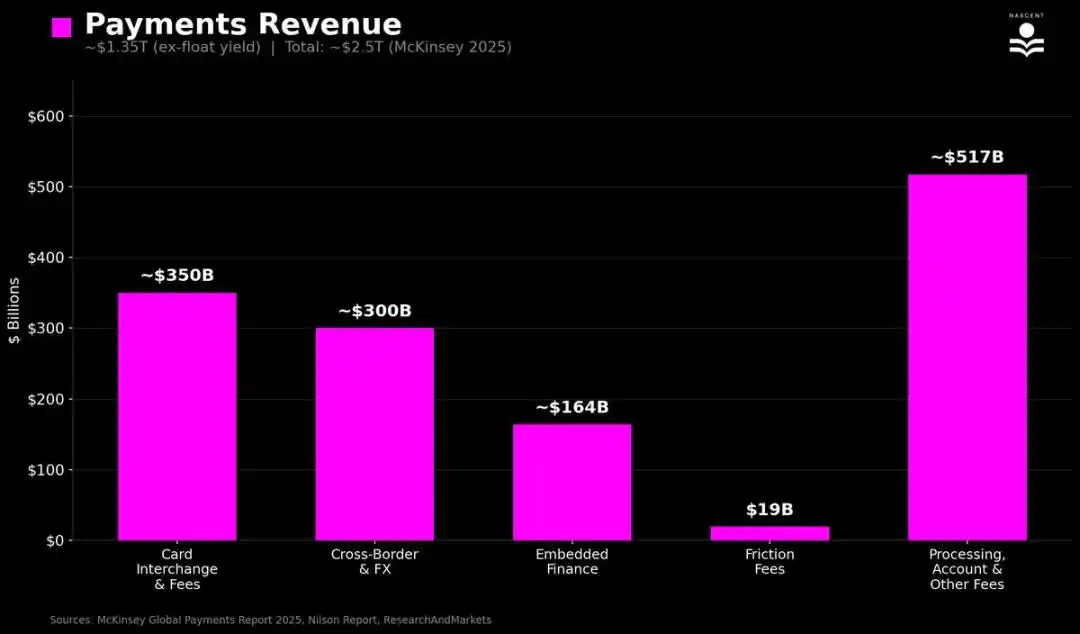
McKinsey's "2025 Global Payments Report" shows that global payment revenue is about $2.5 trillion. But nearly half of that (about $1.15 trillion) is net interest income: the earnings from idle funds in bank and payment accounts during transaction intervals. This is more like idle fund earnings rather than pure payment fees. Excluding this part, the core payment revenue from fund transfers, interchange fees, processing fees, embedded finance (Shopify, installment payments, Stripe), and friction charges (ATMs, overdrafts, on-chain fees) still amounts to about $1.35 trillion.
Investment: A Luxury Behavior

In contrast, investment is a financial behavior that no one is forced to undertake. A person can go through their entire economic life without buying stocks, opening a brokerage account, or consulting a financial advisor. Most people do just that. Active individual traders are statistically a minority.

Unlike payments, investment directly confronts loss aversion and carries a heavy cognitive burden. People instinctively avoid trading, so the funds of ordinary investors mostly lie in pension accounts, investment portfolios, ETFs, and index funds, bought and then held long-term without further action. Among those who participate in investment through pension accounts, 94% do not adjust their plans once joined and almost never trade.

The result is: the behavioral foundation of investment is narrow, passive, but extremely sticky.

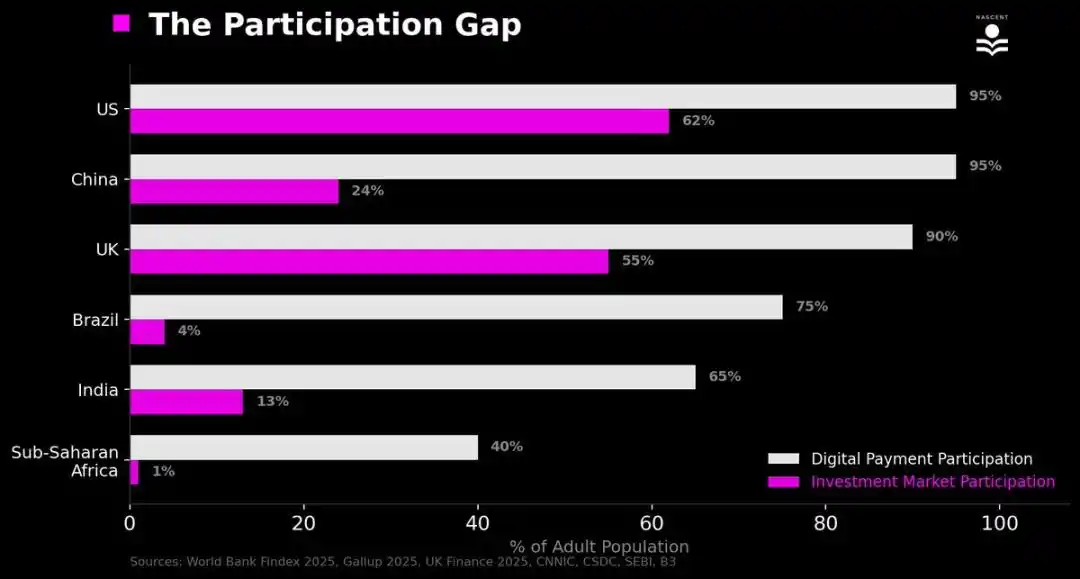
The participation rate comparison is telling: even in countries with the highest investment penetration, only about half the population participates in the investment market in some form, while digital payment penetration is as high as 95%.

  • United States: About 62% of adults hold some investment, mostly in rarely touched pension accounts
  • United Kingdom: Follows closely, about 55%
  • China: About 24% of adults have securities accounts
  • India: About 13%
  • Brazil: 4%
  • Sub-Saharan Africa: Only about 1%

Even having an account does not mean active operation.

This leads to a global asset management scale of about $147 trillion managed by professional intermediaries, including ETFs, mutual funds, pensions, and private market funds, accounting for 43% of global household financial wealth (about $305 trillion). The vast majority of this is passive index funds with extremely low fees: stock ETFs average only 14 basis points, bond ETFs 10 basis points. Even so, the global fund industry, managing about $135 trillion in assets, still has annual revenue of about $435 billion.

A minority of assets managed by private equity, venture capital, real estate, and hedge funds (about $13 trillion) charge 1%–2% management fees + 12.5%–20% performance fees, with annual revenue of about $363 billion.

Combining private market advisory fees, hedge fund performance fees, PE/VC carry, securities lending, trading commissions, etc., the total annual revenue of the investment industry is about $850–900 billion.
The overall revenue of the payment industry is still higher than that of investment, but the per capita revenue in the investment industry is much higher than in payments.

The Collapse of the Boundary

This asymmetric pattern has been stable for decades because the two fields have long operated in separate systems with independent infrastructures.

Payment business is scattered among banks, card networks, and payment processors. Asset management business is scattered among fund companies, wealth advisors, and pension platforms, while trading business is handled by brokerage firms.

Even if the same bank offers both checking accounts and investment services, they are packaged and operated as independent products, including separate customer registration, compliance processes, and user experience. The behavioral barrier between "spending money" and "investing" is further reinforced by the system.

The real change is that blockchain infrastructure allows modern payment applications to offer real investment services, and investment applications can offer real payment services, all using the same underlying system.

Investment balances can be directly used for payments without transferring through independent systems. The traditional brokerage process is: deposit funds → buy → sell → transfer to bank → spend. Crypto infrastructure compresses this into one step.

Wallets, neobanks, trading applications, or any programmable balance can allow the same dollar to complete cross-border transfer settlement while earning yield in a lending protocol, or be exchanged for other assets in the same interface, within the same operating session. Account holders can profit from both investment and payment ends simultaneously.

For the first time in history, the same balance, the same interface, can earn returns from both tracks at the same time.


Domande pertinenti

QWhat is the main argument of the article regarding the relationship between payments and investments in the crypto era?

AThe article argues that the boundary between payments and investments is disappearing due to programmable money and blockchain infrastructure, allowing the same balance in a unified account to simultaneously participate in both payment and investment activities, generating revenue from both sectors.

QAccording to the article, what are the key behavioral differences between payments and investments?

APayments are a universal, daily necessity for economic survival, characterized by high frequency, low psychological burden, and low cost. Investments, in contrast, are a luxury behavior that is not mandatory, with low participation rate, high cognitive burden, and passive, long-term holding patterns.

QHow does the revenue of the global payment industry compare to the investment management industry, as cited in the article?

AThe global payment industry generates approximately $2.5 trillion in annual revenue, with a core revenue of about $1.35 trillion after removing net interest income. The investment management industry has an annual revenue of about $850-900 billion, meaning the overall payment industry revenue is higher, but investment revenue per participant is much higher.

QWhat role does blockchain infrastructure play in merging payments and investments?

ABlockchain infrastructure enables modern payment applications to offer real investment services and vice versa, using the same underlying system. It allows an investment balance to be used directly for payments without transfers between independent systems, compressing multiple traditional steps into a single action within a unified interface.

QWhat does the article cite as the traditional reason for the separation between payment and investment systems?

AThe separation was a legacy of historical system architecture, with different products, accounts, regulatory frameworks, and interfaces for each. There was previously no practical need to integrate payments and investments, and the behavioral barrier between 'spending' and 'investing' was further reinforced by institutional structures.

Letture associate

Anthropic Starts Poaching Scientists? $27K Weekly Onsite Stipend to Fix Claude's Expert-Level Errors

Anthropic has launched a new STEM Fellow program, offering $3,800 per week for a three-month, in-person residency in San Francisco. The role targets experts from science, technology, engineering, and mathematics (STEM) fields—machine learning experience is helpful but not required. Instead, Anthropic values scientific judgment and a willingness to learn quickly. Fellows will work with Claude models and internal tools under the guidance of an Anthropic researcher. Example projects include a materials scientist identifying errors in Claude’s reasoning or a climate scientist integrating atmospheric modeling software with Claude. The goal is to have experts "tell Claude where it's wrong" and improve its scientific capabilities. This initiative is part of Anthropic’s broader strategy to strengthen its scientific ecosystem, following earlier programs like the AI Safety Fellows and AI for Science programs. The company acknowledges that current AI models, while powerful, still produce high-confidence errors and lack end-to-end research autonomy. The program aims to embed domain expertise directly into model development, turning scientists into "high-level reviewers" for AI. Anthropic CEO Dario Amodei has previously emphasized AI’s potential to accelerate scientific breakthroughs, particularly in biology and healthcare. The company believes that the next phase of AI competition will depend not on scaling parameters, but on integrating human expertise to refine model accuracy and reliability.

marsbit29 min fa

Anthropic Starts Poaching Scientists? $27K Weekly Onsite Stipend to Fix Claude's Expert-Level Errors

marsbit29 min fa

On the Eve of X Money's Launch, Musk Dismantles the Referee First

"X Money Launches After Dismantling Regulator: Musk's 9-Day Power Play" In February 2025, a team from the "Department of Government Efficiency" (DOGE), led by Elon Musk, entered the Consumer Financial Protection Bureau (CFPB) headquarters. Shortly after, the CFPB was effectively dismantled—its funding frozen, activities suspended, and nearly 90% of staff laid off. This move came just nine days after X announced a partnership with Visa and as X Money prepared to launch. The article contrasts this with the decade-long regulatory battles faced by companies like Coinbase and PayPal. Coinbase spent over $75 million in political contributions and endured a major SEC lawsuit to operate legally. PayPal complied with strict state and federal rules for its stablecoin PYUSD, including 100% reserve requirements and monthly audits. However, Musk’s approach was different. After the CFPB introduced a rule placing large digital payment apps under federal oversight, Musk tweeted "Delete CFPB." Within months, the rule was revoked by Congress. Meanwhile, DOGE operatives gained "god-tier" access to CFPB databases, potentially obtaining sensitive competitive information from rivals like Apple, Google, and PayPal. The article also highlights a "suspicious exemption clause" in the GENIUS Act, which allows private companies like X to issue stablecoins with fewer restrictions. Senator Elizabeth Warren questioned whether Musk, who was a senior presidential advisor during the Act’s drafting, influenced this clause. X Money offers a 6% APY on deposits, despite FDIC warnings that stablecoin users are not insured. As X Money launches to 600 million monthly users, the article questions the fairness of a system where Musk can bypass regulations that others spent years and millions to comply with. The dismantling of the CFPB and the alleged regulatory advantages raise concerns about the future of equitable rule-making in the U.S. financial system.

marsbit37 min fa

On the Eve of X Money's Launch, Musk Dismantles the Referee First

marsbit37 min fa

Trading

Spot
Futures

Articoli Popolari

Come comprare ERA

Benvenuto in HTX.com! Abbiamo reso l'acquisto di Caldera (ERA) semplice e conveniente. Segui la nostra guida passo passo per intraprendere il tuo viaggio nel mondo delle criptovalute.Step 1: Crea il tuo Account HTXUsa la tua email o numero di telefono per registrarti il tuo account gratuito su HTX. Vivi un'esperienza facile e sblocca tutte le funzionalità,Crea il mio accountStep 2: Vai in Acquista crypto e seleziona il tuo metodo di pagamentoCarta di credito/debito: utilizza la tua Visa o Mastercard per acquistare immediatamente CalderaERA.Bilancio: Usa i fondi dal bilancio del tuo account HTX per fare trading senza problemi.Terze parti: abbiamo aggiunto metodi di pagamento molto utilizzati come Google Pay e Apple Pay per maggiore comodità.P2P: Fai trading direttamente con altri utenti HTX.Over-the-Counter (OTC): Offriamo servizi su misura e tassi di cambio competitivi per i trader.Step 3: Conserva Caldera (ERA)Dopo aver acquistato Caldera (ERA), conserva nel tuo account HTX. In alternativa, puoi inviare tramite trasferimento blockchain o scambiare per altre criptovalute.Step 4: Scambia Caldera (ERA)Scambia facilmente Caldera (ERA) nel mercato spot di HTX. Accedi al tuo account, seleziona la tua coppia di trading, esegui le tue operazioni e monitora in tempo reale. Offriamo un'esperienza user-friendly sia per chi ha appena iniziato che per i trader più esperti.

314 Totale visualizzazioniPubblicato il 2025.07.17Aggiornato il 2025.07.17

Come comprare ERA

Discussioni

Benvenuto nella Community HTX. Qui puoi rimanere informato sugli ultimi sviluppi della piattaforma e accedere ad approfondimenti esperti sul mercato. Le opinioni degli utenti sul prezzo di ERA ERA sono presentate come di seguito.

活动图片