The End of DeFi Lego: Vaults Are Left with Nothing but Deposits

marsbitPubblicato 2026-01-29Pubblicato ultima volta 2026-01-29

Introduzione

This article argues that the era of "DeFi Lego" – the complex, interlocking composability of decentralized finance protocols – is ending. The primary user behavior has collapsed into a single action: depositing stablecoins into yield-bearing vaults for a return. Major exchanges like Binance, OKX, and HTX are forging their own paths by subsidizing and promoting their own stablecoin products (e.g., USD1, USDG) to capture user value directly. On-chain, the yield landscape has become homogenized, with vaults competing almost solely on the APY they offer for USDT and USDC deposits. Users no longer care about the underlying protocols (Morpho, Aave, etc.) or their governance tokens; they are primarily attracted by high yields and the branding of the platforms offering them (e.g., Kraken, Coinbase). This shift has led to several consequences: governance tokens are losing value, DeFi ecosystem has become a flattened landscape of competing vaults rather than a collaborative system, and the end-user experience is now a simple flow of converting fiat to stablecoins on a CEX, finding the highest-yielding vault, and spending via crypto debit cards. The article concludes that DeFi must learn from traditional finance (TradFi), which successfully serves human needs and builds network effects. To survive, DeFi protocols must move beyond being mere back-end yield generators and find ways to re-engage users, rebuild trust, and create value beyond just high APYs.

Author: Zuo Ye

Binance partners with USD1, exchanges no longer measure the effect of listing based on "trading volume." Binance is selling the largest real user base in the crypto space to projects. WLFI aims to promote the direct adoption of USD1, using it like USDT for interest accrual, pricing, and payments.

This is not an isolated case. OKX subsidizes USDG, Sun Ge's HTX subsidizes U—major exchanges are all finding their own ways out.

On-chain is different. Yield distribution has been homogenized into USDT and USDC. Collaboration between Vaults is decreasing and becoming less transparent, even less than partnerships with mainstream products.

This is happening at a time when even Bitwise is establishing Vaults to manage assets, upgrading the concept of non-custodial wallets to non-custodial vaults, and Kraken is leveraging Euler/Morpho/Aave to build an 8% APY wealth management product.

Does DeFi Lego only have theoretical value left, and how can pure channel value withstand the impact of exchanges?

DeFi Oddity: Scale Grows, Yields Decline

"Network effects are about human connections; tokens are just units of measurement.

In the future, tokens will no longer point to the crypto industry; history will more often use the AI industry as their载体.

When USDe and Binance jointly offered a 12% APY, many thought USDe would move from on-chain to mainstream exchanges and eventually become a real off-chain payment network.

After the October 11th event, Binance essentially abandoned Ethena as a partner,转而 supporting U and WLFI's USD1. Ethena turned to the Hyperliquid ecosystem and survives as a white-label platform.

The real revelation is that if on-chain stablecoins cannot reach truly mainstream industries, then more complex DeFi products must reach users through intermediary industries.

This is why Vault & Yield are hot now, but C-end users no longer choose to hold UNI and Aave. Their understanding of DeFi has collapsed into one thing—deposits.

  • Ideal user flow based on DeFi Summer: Participate in BTC/ETH network nodes, obtain tokens -> Participate in DeFi protocols -> Use DeFi Lego blocks
  • Actual user flow based on the 2026现状: Exchange for USDC via CEX or bank card -> Find Vaults with higher APY -> Spend using Neobank's U card

Yes, users will use Vaults directly, not caring whether the Vault is backed by Morpho or Euler, or even which Vault it is. They care more about Kraken and Coinbase's promotional partnerships.

Among 522 protocols, 709 assets, and 3489 active Pools, the nested relationships between protocols, assets, and Pools are no longer important. This is the end of DeFi Lego.
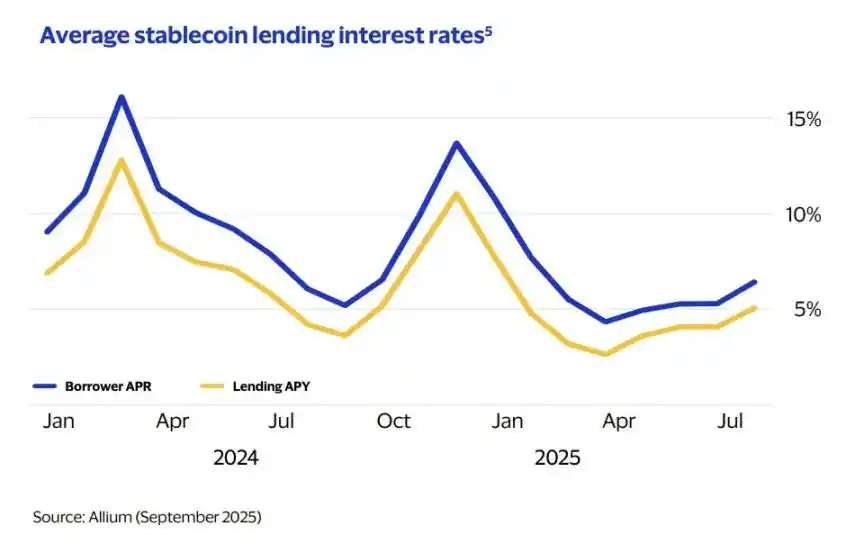
Caption: Average Borrowing Interest Rate

Image Source: @visa

The most直观 example of this end is that stablecoin Borrow APR has fallen to 6.4%. Considering the cumulative lending volume has grown to $670 billion over the past five years,庞大 scale but stable interest rates will become the norm.

The end of DeFi Lego has caused DeFi project governance tokens to completely lose value. The function of governance tokens is not in voting value but in long-term坚定 holding. 1 person creates BNB, 100 people hold BNB, 1000 people trade BNB, 10000 people will believe BNB has value.

The unit of measurement for vaults is not the power consumption of public chains, nor the governance standards of DeFi protocols themselves, but the standard dollar recognized by other vaults. In a sense, USDC/USDT directly取代了 the function of cross-chain bridges.

If USDT/USDC themselves become channels, then Pools/Vaults will not emphasize接入 specific cross-chain bridges and assets; they only need to support stablecoins to meet most people's needs.

People and their value are排斥ed out of the DeFi operating system. Human consumption value is the sole demand for economic operation, and stablecoins ultimately become the sole demand of Vaults.

Even Vaults themselves, as interest-bearing assets for stablecoins, also need users' USDT/USDC. But these stablecoins are not invested in other DeFi protocols, or even in the repurchase of treasury bonds; they lie idle in limited steps waiting for withdrawal.

Referring to the fact that the interest rates on large deposit products of some domestic rural commercial banks have fallen below 1%, we can expect to see the奇景 of stablecoin projects charging users fees in 2026.

Ultimately, all DeFi protocols become homogenized deposit products. Whether it's traditional spot DEX, lending, or Perp DEX, Cap even directly launches Stabledrop, with more airdrop value exchanged for stablecoin assets rather than the project's own tokens.

If you carefully map the current shape of DeFi, it would be a semi-finished product with a "big head, big tail, and hollow middle"—countless DeFi Vaults compete for user deposits, but Vaults no longer intertwine to increase leverage. They even wary of each other to avoid deposit outflows, and the underlying assets are all U.S. bonds,最终 flowing to numerous Neobanks.
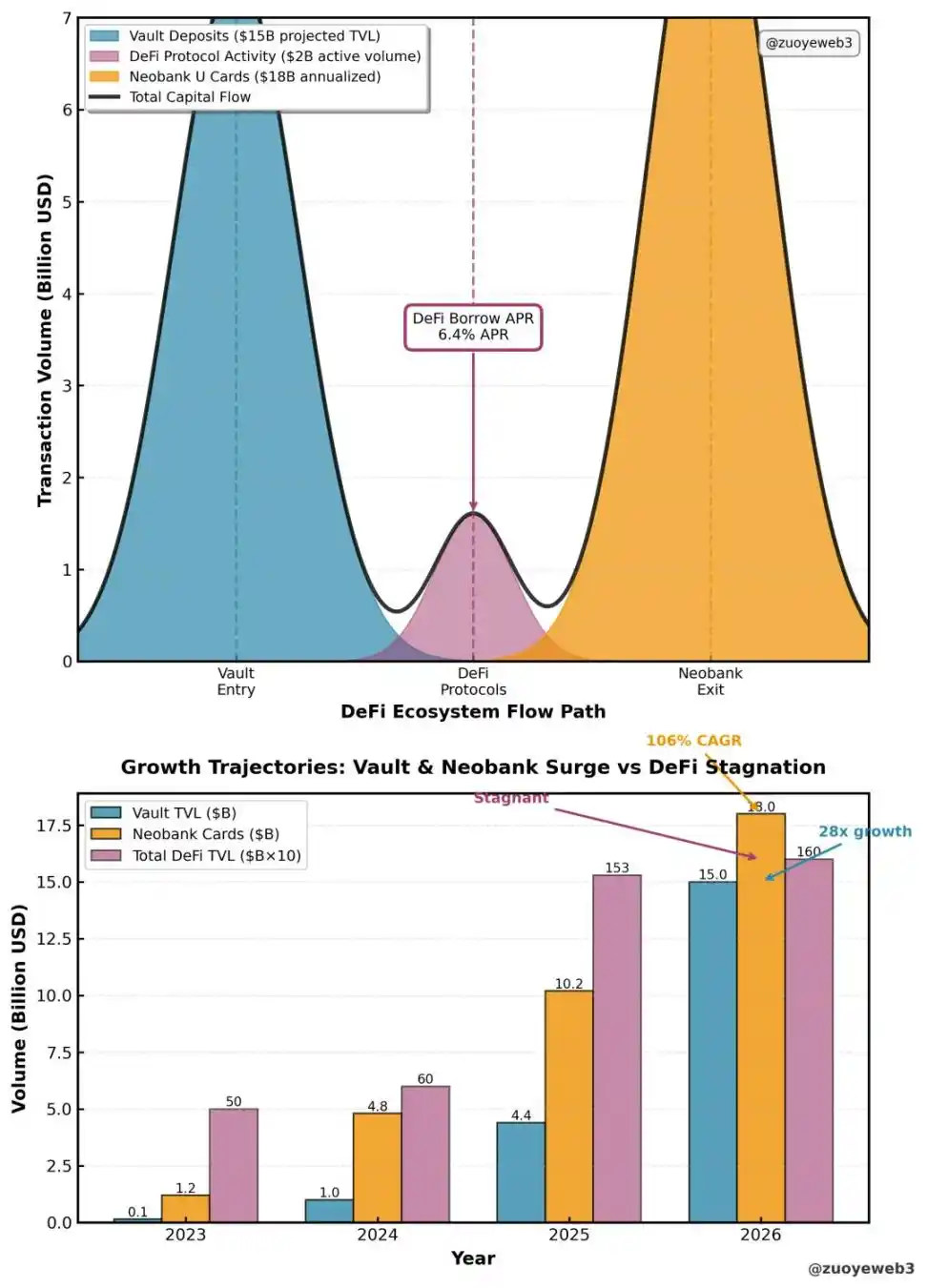
Caption: DeFi Circulation Pattern

Image Source: @visa @artemis @DefiLlama

Neobanks collectively rushing towards U cards has caused their monthly transaction volume to soar from $100 million in 2023 to $1.5 billion. The main users of current Neobanks are still the on-chain群体, proving their considerable spending power, but the decline of DeFi is also a major reason for capital outflow.

This leads to a one-way interaction between users and protocols, but Vaults are彻底扁平化. The few connections are private activities, and users only perceive disputes and fear afterwards, just like the old story of xUSD.

From the history of DeFi and stablecoins, the real scenarios are only three tracks: trading, yield, and consumption. Trading is divided among CEX, Spot DEX, and Perp DEX. DeFi has completely shifted to a Vault model focused on yield. Consumption is split between USDT represented by Tron and emerging NeoBanks.

Frankly, when retail deposits flow into Vaults, stock tokens, Perps, prediction markets, and Meme coins, the disappearance of the altseason is理所应当. In a world where retail has nothing to buy or sell, only deposits have not brought prosperity to DeFi.

TradFi启示: Satisfy People, Don't Persuade Them

Learn from AI, then learn from banking; earn money uprightly.

It can be very clearly stated that current stablecoin yields are Features of individual protocols, not a赛道!

A赛道 requires protocols to push the entire industry forward through competition, like Perp DEX or the AI race. But current DeFi Vaults are all acting as entry points without the配合 of process and exit. They are all competitors with no coordination.

Refer to Taobao's Double Eleven event—the details are becoming increasingly变态; even Alibaba's Qianwen might not be able to calculate the best strategy.

Vaults are the same. The strategies set by various Curators are becoming more complex. Users can do nothing but deposit. When a Vault has problems, users can only face off against the professional litigators from law firms.

From the development needs of DeFi, once ordinary users can only consume passively and cannot participate in the production环节, so-called institutionalization occurs, and ordinary retail investors turn to more alternative, freer financial markets.

  • Retail疯狂 bought GME to battle Wall Street
  • Retail疯狂 bought Meme, rejecting altcoins

A clear trend is that while DeFi is developing towards institutionalization, traditional banking is actively seeking transformation, embracing newer market demands. The most typical example is Revolut's valuation reaching $75 billion.
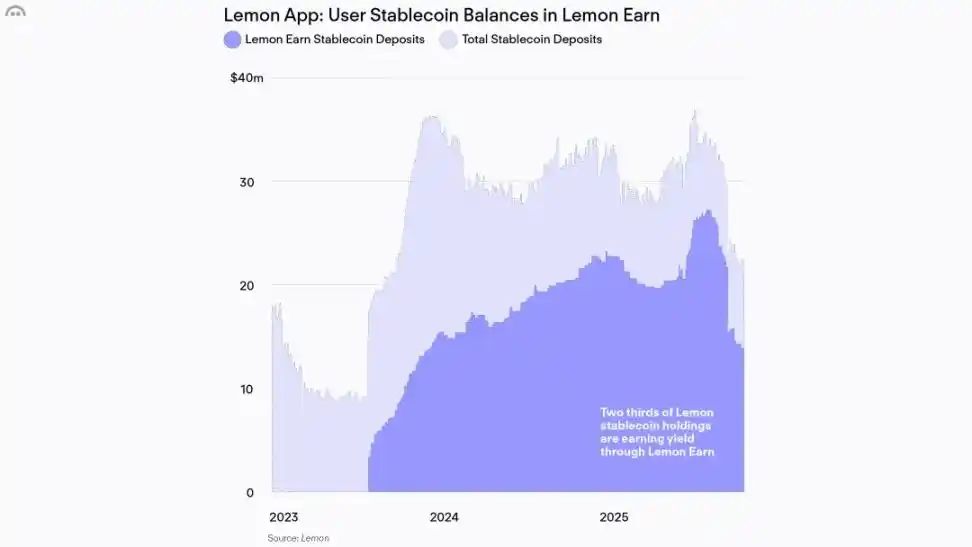
Caption: Off-chain Users Are Worthless

Image Source: @lemonapp_ar

In contrast, the token market cap of Aave, the largest DeFi bank, is only $2.5 billion. Measured by deposits, it would even be among the top 20 banks in the U.S. This is not an isolated case; most DeFi Vault products themselves are worthless.

Refer to Aave's approach in Latin America, embedding itself into younger, more financially underserved populations. Taking the Argentine wealth management product Lemon as an example, it brought 130,000 wealth management users to Aave, but only $40 million in deposits were imported.

Compare this to Aave's on-chain addresses: only 170,000 addresses support its $32 billion TVL. This itself shows that the network effect of retail investors can greatly support project valuation. If only pursuing the scale effect of capital, there is certainly no future for DeFi tokens.

Moreover, as the voice of Vaults within lending protocols increases, the brand value of the traditional protocols themselves decreases. Morpho introduced Sky Vault Curators to "balance" the dominance of Stakehouse. The essence of Aave V4 is also modularization. Eventually, the entire DeFi will become a backend product.

The launch of Aave's mobile app signals anxiety, not greater ease.

In this context, it is not shameful for DeFi to learn from banking. According to a McKinsey report, the global banking industry achieved $1.2 trillion in profits in 2024 alone.

But a crisis has emerged. In 2018, 25% of users would directly choose their开户 bank when spending, but by 2025, this number had dropped to 4%.扪心自问, which Vault has a loyalty rate of 25%?

The疯狂 competition over APY is the consequence of恶性 competition among Vaults. In traditional banking, large banks serve large clients, and small banks serve small clients. Especially younger generations need to gradually build credit scores to gain access to services from high-level banks.

Now is the time for DeFi Vaults to regain the trust of retail investors. Alliances with CEXs are also a beginning. Various Vaults constantly compete for the entry effect of CEXs, making CEXs the upstream of Vaults.

Although they need to actively share profits with CEXs, Vaults can thereby reach tens of millions of real users. Users are not completely passive either;经过 CEXs, they will also seek higher and safer yields, forming a new interaction model.

Conclusion

Products should serve the network, not roles.

When retail investors no longer participate in protocol governance (voting, holding, trading), their remaining awareness of the protocol will also be lost, ultimately leading to the absence of people on-chain.

Now that Vault & Yield has become the mainstream on-chain model, how to rediscover human value in a network without Tokens? DeFi needs to放下身段 and learn from the ever-present TradFi.

Domande pertinenti

QWhat is the main argument presented in the article regarding the current state of DeFi?

AThe article argues that the era of 'DeFi Lego' is over, where protocols were interconnected like building blocks. Instead, DeFi has collapsed into a simplified model where users only care about depositing stablecoins into Vaults to earn yield, with protocols becoming homogenized and their governance tokens losing value. The interaction between protocols has diminished, and the primary flow of value is now from users to centralized exchanges (CEXs) and then into these yield-bearing Vaults.

QAccording to the article, how has the user journey in crypto changed from the 'DeFi Summer' ideal to the current reality in 2026?

AThe ideal user journey during DeFi Summer was: participate in BTC/ETH network nodes to earn tokens -> participate in DeFi protocols -> use various DeFi Lego building blocks'. The current reality in 2026 is: acquire USDC through a CEX or bank card -> find a Vault with a higher APY -> spend using a Neobank's crypto card. Users now interact directly with Vaults as end products, indifferent to the underlying protocols.

QWhat role do centralized exchanges (CEXs) like Binance play in the new DeFi yield landscape described in the article?

ACEXs like Binance have become crucial upstream gateways and partners for DeFi Vaults. They are no longer just measuring listing effects by trading volume but are monetizing their large user bases by selling access to projects. They promote and subsidize specific stablecoins (e.g., Binance with USD1, OKX with USDG), effectively acting as the primary user acquisition channel for Vaults, which then have to share profits with the exchanges.

QWhy does the article suggest that DeFi protocols need to 'learn from TradFi' (Traditional Finance)?

AThe article suggests learning from TradFi because traditional banking, despite its flaws, successfully serves human needs and builds customer relationships over time through trust and graduated services (e.g., building credit scores). In contrast, DeFi Vaults are engaged in a恶性竞争 (vicious competition) purely on APY, leading to user disengagement, a lack of loyalty, and the loss of the 'human network effect' that gives protocols long-term value. DeFi needs to focus on serving people, not just moving capital.

QWhat is the significance of Neobanks and 'U cards' in the current crypto ecosystem as per the article?

ANeobanks and their crypto debit cards (U cards) represent the 'consumption' end of the crypto value flow. Their monthly transaction volume has skyrocketed from $100 million in 2023 to $1.5 billion, indicating strong spending power from crypto users. This trend highlights that the final use case for many users is to off-ramp their yields into spendable currency, further emphasizing that DeFi's current role is primarily as a backend yield generator for stablecoins, which are then spent in the real world.

Letture associate

Trading

Spot
Futures

Articoli Popolari

Cosa è BNB WHALES

Comprendere le Balene BNB: Un Approfondimento nel Paesaggio delle Cryptovalute Introduzione alle Balene BNB Nel vibrante mondo delle criptovalute, emergono regolarmente nuovi progetti, spesso promettendo soluzioni innovative ed esperienze uniche. Uno di questi progetti è Balene BNB, lanciato nel 2023 e costruito sulla BNB Smart Chain (BEP20). Balene BNB si propone di stabilire una presenza distintiva all'interno dell'ecosistema delle criptovalute, concentrandosi sulla creazione di una piattaforma coinvolgente che unisce i benefici della tecnologia blockchain con interazioni sociali e di gioco. Questo articolo mira a esplorare più a fondo Balene BNB, analizzando i suoi componenti principali, meccaniche e traiettoria di sviluppo. Cosa sono le Balene BNB? Le Balene BNB sono un'iniziativa criptovalutaria che cerca di fornire una gamma diversificata di funzionalità e opportunità per i propri utenti nel crescente ambiente del Web3. Utilizzando lo standard BEP20, il progetto opera con un'offerta totale di token di 100 trilioni (100.000.000.000.000.000). Nonostante questa cifra significativa, è interessante notare che attualmente non ci sono token in circolazione, indicando che il progetto potrebbe essere ancora nelle sue fasi iniziali di sviluppo. Il principale obiettivo delle Balene BNB è creare una piattaforma in cui gli utenti possano partecipare a varie attività interattive beneficiando della sicurezza e della trasparenza offerte dalla tecnologia blockchain. Promuovendo un ambiente unico e coinvolgente, Balene BNB punta a costruire una comunità forte di utenti che sono coinvolti nel progetto e nel suo sviluppo. Chi è il Creatore delle Balene BNB? L'identità del creatore delle Balene BNB rimane non divulgata al momento, presentando una sfida per coloro che cercano di capire i principi fondanti e le intuizioni visionarie del progetto. Questa assenza di informazioni disponibili pubblicamente riguardo alla leadership del progetto può sollevare domande tra i potenziali investitori e utenti sulla sua governance e struttura di responsabilità. Chi sono gli Investitori delle Balene BNB? Con l'evoluzione delle Balene BNB, le informazioni riguardanti investitori specifici o supporto da fondazioni di investimento non sono attualmente disponibili. La documentazione ufficiale del progetto, incluso il suo whitepaper, non divulga né sostenitori finanziari individuali né istituzionali. La mancanza di trasparenza in questo senso può talvolta sollevare interrogativi sulla legittimità e sostenibilità dei nuovi progetti all'interno dell'ecosistema delle criptovalute. Come Funzionano le Balene BNB? Le Balene BNB operano sulla BNB Smart Chain utilizzando lo standard BEP20, noto per la sua efficienza e basse commissioni di transazione, attirando una varietà di sviluppatori e progetti. L'aspetto unico delle Balene BNB risiede nella sua attenzione alla creazione di una piattaforma guidata dalla comunità. Sebbene i dettagli operativi precisi siano scarsi, il progetto enfatizza l'interazione e il coinvolgimento, potenzialmente incorporando elementi gamificati nelle sue offerte. L'enfasi sulla comunità è fondamentale, poiché si allinea con le tendenze prevalenti nel campo delle criptovalute, dove il contributo e la partecipazione degli utenti spesso determinano il successo di un progetto. Ulteriori innovazioni potrebbero essere previste, ma attualmente, i meccanismi specifici e le funzionalità che differenziano Balene BNB da altre iniziative crittografiche devono ancora essere completamente chiariti. Senza informazioni dettagliate riguardo alla sua funzionalità, è difficile valutare in modo completo i differenziali del progetto. Timeline delle Balene BNB Lo sviluppo delle Balene BNB si è svolto attraverso tappe chiave, segnando il suo percorso nel panorama delle criptovalute. Di seguito è riportata una cronologia di eventi significativi riguardanti il progetto: 2023: Lancio delle Balene BNB, segnando l'ingresso del progetto nel mercato. 2023: Pubblicazione del whitepaper del progetto, che delinea gli obiettivi generali e il framework operativo. In Corso: Le Balene BNB continuano a sviluppare le proprie funzionalità, puntando a costruire una base utenti solida e ad espandere le proprie offerte. Punti Chiave sulle Balene BNB Piattaforma: BNB Smart Chain (BEP20) Offerta Totale: 100 trilioni di token (100.000.000.000.000.000) Offerta Circolante: 0 token (indicando una fase nascente) Obiettivo del Progetto: Favorire una piattaforma di criptovalute coinvolgente per l'interazione e la costruzione di comunità. Creatore: Sconosciuto Investitori: Non divulgati Stato Operativo: Attivo con sviluppo e espansione in corso Conclusione Nel mentre le Balene BNB navigano nel competitivo panorama delle criptovalute, offrono uno sguardo sul potenziale dei progetti guidati dalla comunità costruiti sulle fondamenta della tecnologia blockchain. Concentrandosi sul coinvolgimento e sull'interazione, l'iniziativa si pone all'avanguardia dell'innovazione nel campo del Web3. Tuttavia, il successo del progetto dipenderà alla fine dalla chiarezza delle sue meccaniche operative, dalla divulgazione della sua governance e dalla creazione di una solida comunità di utenti. Per potenziali utenti e investitori, le Balene BNB rappresentano un caso studio nella natura in evoluzione dei progetti di criptovalute—una che illustra sia le emozionanti possibilità che le complessità associate a nuove iniziative. Con il paesaggio che continua a evolversi, sarà essenziale monitorare i progressi delle Balene BNB e il loro impatto sull'ecosistema più ampio delle criptovalute.

340 Totale visualizzazioniPubblicato il 2024.04.05Aggiornato il 2024.12.03

Cosa è BNB WHALES

Come comprare BNB

Benvenuto in HTX.com! Abbiamo reso l'acquisto di Binance Coin (BNB) semplice e conveniente. Segui la nostra guida passo passo per intraprendere il tuo viaggio nel mondo delle criptovalute.Step 1: Crea il tuo Account HTXUsa la tua email o numero di telefono per registrarti il tuo account gratuito su HTX. Vivi un'esperienza facile e sblocca tutte le funzionalità,Crea il mio accountStep 2: Vai in Acquista crypto e seleziona il tuo metodo di pagamentoCarta di credito/debito: utilizza la tua Visa o Mastercard per acquistare immediatamente Binance CoinBNB.Bilancio: Usa i fondi dal bilancio del tuo account HTX per fare trading senza problemi.Terze parti: abbiamo aggiunto metodi di pagamento molto utilizzati come Google Pay e Apple Pay per maggiore comodità.P2P: Fai trading direttamente con altri utenti HTX.Over-the-Counter (OTC): Offriamo servizi su misura e tassi di cambio competitivi per i trader.Step 3: Conserva Binance Coin (BNB)Dopo aver acquistato Binance Coin (BNB), conserva nel tuo account HTX. In alternativa, puoi inviare tramite trasferimento blockchain o scambiare per altre criptovalute.Step 4: Scambia Binance Coin (BNB)Scambia facilmente Binance Coin (BNB) nel mercato spot di HTX. Accedi al tuo account, seleziona la tua coppia di trading, esegui le tue operazioni e monitora in tempo reale. Offriamo un'esperienza user-friendly sia per chi ha appena iniziato che per i trader più esperti.

917 Totale visualizzazioniPubblicato il 2024.12.12Aggiornato il 2025.03.21

Come comprare BNB

Cosa è BNB CARD

Comprendere BNB Card: Rivoluzionare l'Identità Digitale in Web3 Nel panorama in rapida evoluzione della tecnologia blockchain e delle criptovalute, la BNB Card o $BNBCARD si distingue come un progetto notevole. Questo token meme utilitario guidato dalla comunità sfrutta la BNB Smart Chain (BSC), mirando a integrare la cultura meme con soluzioni innovative per l'identità digitale. Man mano che sempre più utenti si immergono nei regni della decentralizzazione, è fondamentale analizzare cosa offre BNB Card, le sue sfumature operative e il suo potenziale impatto sul mercato. Cos'è BNB Card ($BNBCARD)? Alla sua essenza, BNB Card rappresenta un token meme con una sostanziale utilità. È progettato per dare potere agli utenti consentendo la creazione di carte d'identità digitali personalizzate che sono sia espressive che funzionali. Il progetto racchiude diverse caratteristiche chiave: Carte d'Identità Personalizzabili: Gli utenti hanno la possibilità di progettare carte d'identità digitali a tema Binance, fornendo loro una piattaforma per l'auto-espressione e un'interazione comunitaria migliorata. Struttura Decentralizzata: Sviluppata sulla BSC, BNB Card enfatizza attributi chiave come sicurezza, trasparenza e sovranità degli utenti. La natura decentralizzata della struttura consente transazioni che sono sia efficienti che sicure. Modello Centrato sulla Comunità: L'enfasi sulla partecipazione di base piuttosto che su modelli finanziari guidati da laboratori crea un ambiente coinvolgente per i suoi utenti. Sfruttando la viralità intrinseca della cultura meme, BNB Card promuove un robusto movimento comunitario. L'obiettivo primario di BNB Card è democratizzare gli strumenti di identità digitale in Web3, offrendo soluzioni accessibili che avvantaggiano gli utenti senza i vincoli tipicamente associati ai sistemi di gestione dell'identità tradizionali. Creatore e Investitori Quando si esplora l'identità dietro BNB Card, è importante notare che nessun singolo creatore è esplicitamente accreditato. Invece, il progetto sembra essere guidato dalla comunità, suggerendo uno sforzo collettivo ispirato al concetto della “Early Builder Card” di Binance. Questo approccio allo sviluppo organico è comune tra i progetti all'interno dello spettro dei token meme, dove lo sviluppo è spesso influenzato dalla passione della comunità piuttosto che da un'autorità centrale. In termini di investimento, l'assenza di sostenitori istituzionali pubblicamente dichiarati evidenzia ulteriormente la base comunitaria del progetto. Esso prospera grazie al supporto organico della comunità, riflettendo una caratteristica abituale dei progetti guidati dai meme che spesso coinvolgono il loro pubblico attraverso canali social piuttosto che percorsi di investimento formali. Come Funziona BNB Card impiega diversi meccanismi che delineano il suo funzionamento e spirito innovativo: Utilità del Token: Il token BNBCARD consente agli utenti di accedere a un insieme di strumenti per la creazione di ID, fornendo anche una piattaforma per la governance comunitaria. Il token funge da elemento centrale che abilita queste funzionalità. Integrazione Blockchain: Utilizzando la BSC, BNB Card garantisce compatibilità con applicazioni basate su Ethereum Virtual Machine (EVM). Questa integrazione offre agli utenti i vantaggi di basse commissioni di transazione migliorando l'accessibilità. Ecosistema Fai-da-te (DIY): Centrale nell'appeal di BNB Card è il suo approccio fai-da-te (DIY) alla generazione di carte d'identità digitali. Questo elemento partecipativo incoraggia gli utenti a impegnarsi nell'espressione creativa, promuovendo una cultura inclusiva che prospera sulla contribuzione e collaborazione. Cronologia La cronologia è fondamentale per comprendere la traiettoria di BNB Card. I traguardi importanti nella storia del progetto includono: 18 marzo 2025: BNB Card è stata quotata su LBank, segnando un passo significativo nel suo percorso di scambio e aprendo porte per liquidità e accessibilità per gli utenti. 19 marzo 2025: Un momento cruciale si è verificato quando il token ha registrato un aumento astronomico del 26.000% in 24 ore, attirando l'attenzione per il suo potenziale e l'entusiasmo della comunità. Sviluppi in Corso: Il progetto sta continuamente espandendo le sue partnership con scambi decentralizzati (DEX) come PancakeSwap, migliorando ulteriormente la liquidità e il coinvolgimento degli utenti. Innovazione e Differenziazione Comprendere cosa distingue BNB Card richiede un'esplorazione più profonda del suo framework innovativo: Ibrido Meme-Utilità: BNB Card fonde con successo il fascino giocoso della cultura meme con applicazioni pratiche nella gestione dell'identità digitale. Questo approccio di nicchia si rivolge efficacemente a un ampio pubblico, attirando sia utenti esperti di tecnologia che quelli nuovi nel mondo delle criptovalute. Governance Decentralizzata: Operare senza controllo centralizzato consente al progetto di sfruttare direttamente il contributo della comunità. Il processo decisionale collettivo sostenuto dal coinvolgimento della comunità dà potere agli utenti, assicurando che le loro voci contribuiscano allo sviluppo e alla direzione del progetto. Scalabilità: BNB Card può beneficiare enormemente dagli aggiornamenti della roadmap 2025 per la BNB Chain, che includono miglioramenti come l'aumento della velocità delle transazioni e l'integrazione di strumenti di intelligenza artificiale. Questi miglioramenti posizionano il progetto in modo vantaggioso all'interno di un ambiente altamente competitivo. Conclusione BNB Card è emblematica di una nuova ondata di soluzioni per l'identità digitale all'interno dell'ecosistema Web3. Fondendo divertimento, coinvolgimento della comunità e utilità pratica, invita gli utenti a partecipare attivamente nella definizione delle loro persone digitali. Mentre il progetto naviga nel dinamico panorama delle criptovalute, il suo successo dipenderà probabilmente dal mantenimento di un forte supporto della comunità mentre si adatta ai progressi tecnologici e alle esigenze degli utenti. L'integrazione della decentralizzazione con la cultura meme non serve solo come mezzo per il coinvolgimento guidato dagli utenti, ma anche come base per la narrazione in evoluzione riguardante l'identità digitale nell'era della blockchain. In sintesi, BNB Card non solo esemplifica la convergenza di creatività e utilità all'interno dello spazio crypto, ma sottolinea anche l'importanza della comunità nel guidare il futuro delle tecnologie decentralizzate.

308 Totale visualizzazioniPubblicato il 2025.03.26Aggiornato il 2025.03.26

Cosa è BNB CARD

Discussioni

Benvenuto nella Community HTX. Qui puoi rimanere informato sugli ultimi sviluppi della piattaforma e accedere ad approfondimenti esperti sul mercato. Le opinioni degli utenti sul prezzo di BNB BNB sono presentate come di seguito.

活动图片