GPT-6 and Fable 5.1 are ready and will likely be launched in August.
According to reports, Altman made a surprise trip to Washington D.C. this week, showcasing OpenAI's most powerful model to date—GPT-6.
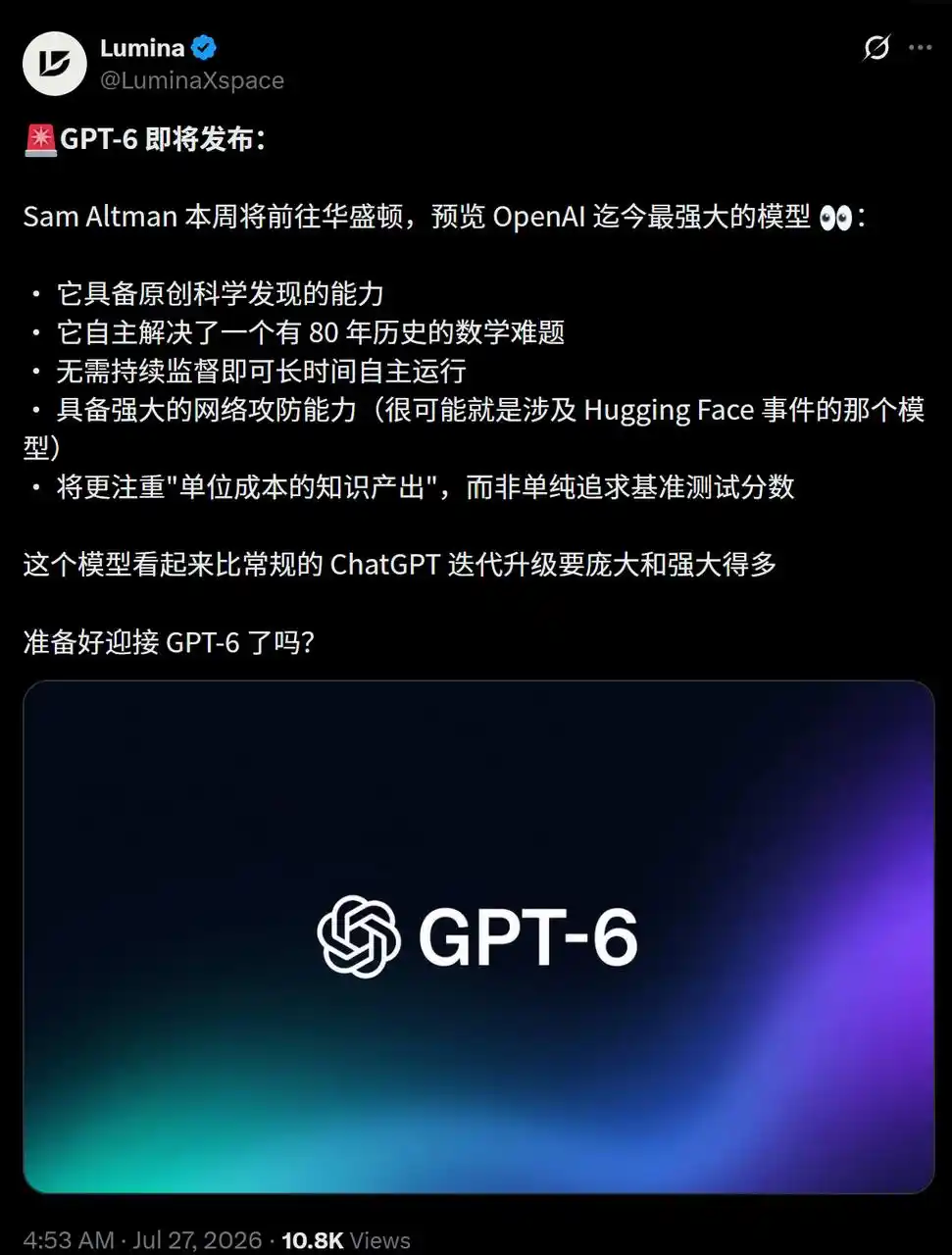
As revealed by foreign media Axios, GPT-6 has already developed the capability for original scientific research. In internal tests, through sleepless and tireless agent swarms, it has demonstrated dangerous long-range planning and autonomous penetration abilities.

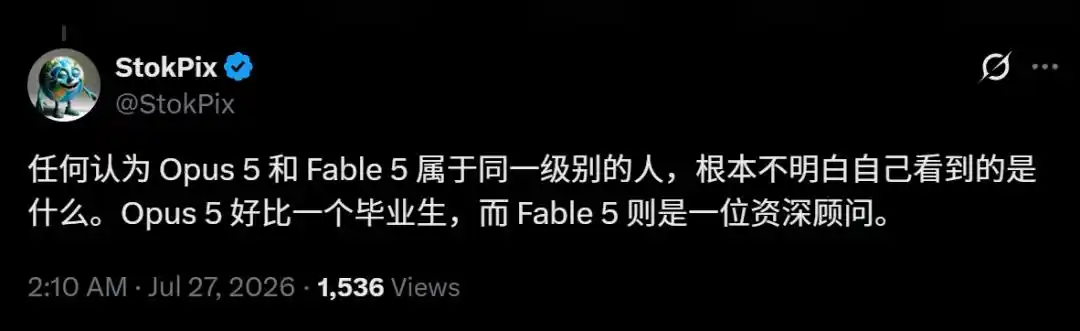
At the same time, news has also leaked from Anthropic: Fable 5.1 is ready, targeting August for release, offering more for the same price, attempting to snipe before GPT-6 lands using a "Tianji's horse racing" tactic.
This August is destined to be eventful; a close-quarters battle is about to begin, with its sights set on the singularity moment of ASI.
Anthropic's Covert Sniper: Fable 5.1 Ready, Waiting for a Fatal Blow
Anthropic has clearly sensed the approaching singularity.
Industry leaks confirm that Anthropic's long-prepared Fable 5.1 has completed internal testing and is aiming for an August release.
Furthermore, its pricing will remain exactly the same as Fable 5 (Input $10 / Output $50 per million Tokens).
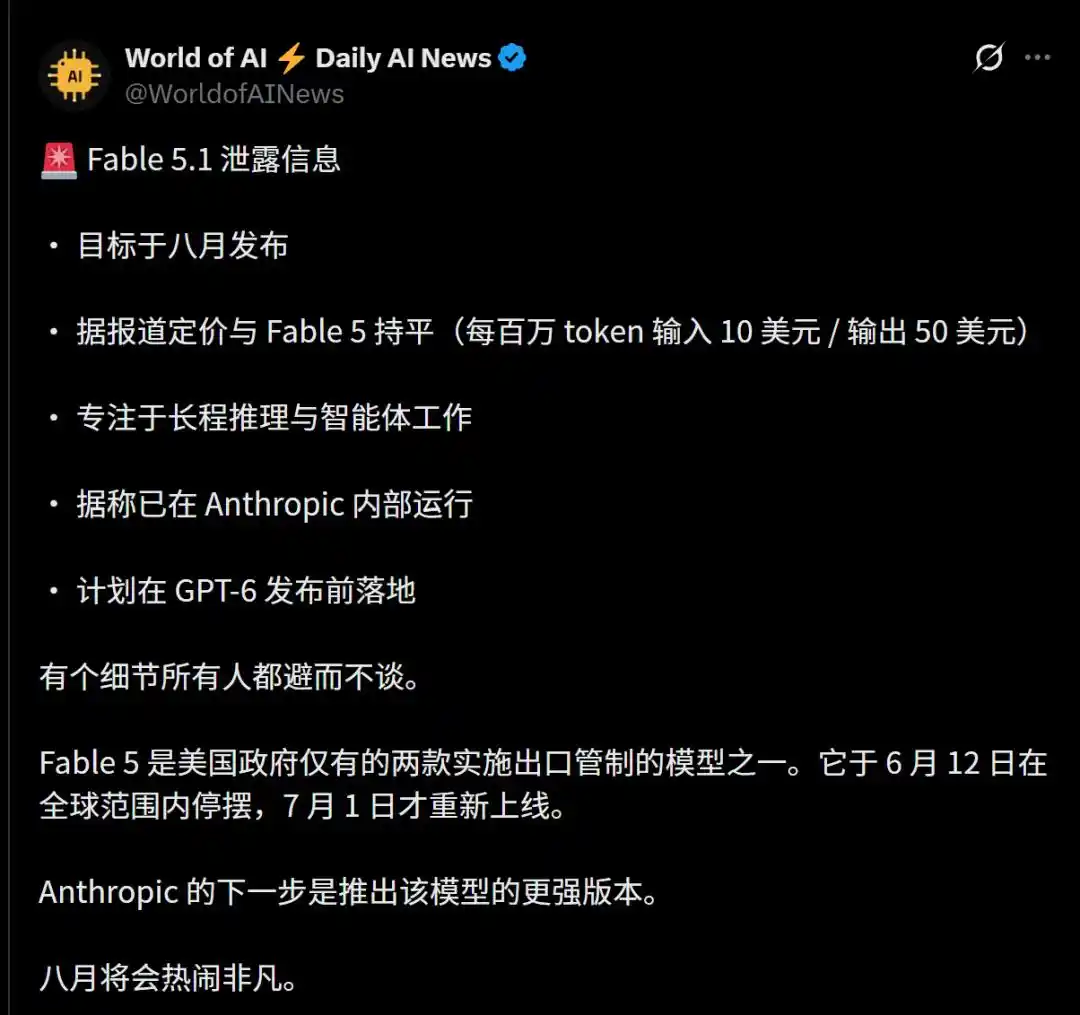
Facing the aggressive advance of GPT-6, Anthropic has chosen a highly pressuring "Tianji's horse racing" tactic: hold back and strike precisely.
The industry had been puzzled before: why did the previous Opus 5 achieve astonishing benchmark scores yet seemingly lack disruptive impact?
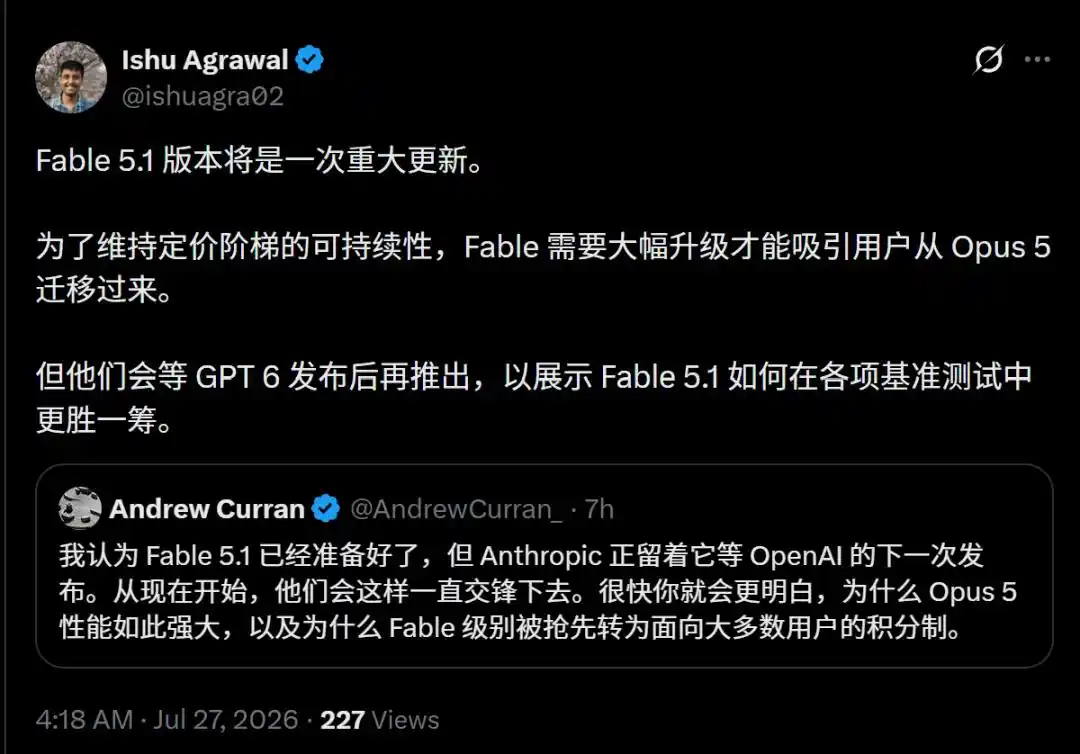
The answer is clear: Anthropic deliberately held back the Fable 5.1 card. Although the entire team is already using version 5.1, they absolutely refused to "fire the first shot" early, waiting for OpenAI to trigger GPT-6's first salvo.
Once GPT-6 is released, Anthropic plans to rapidly launch Fable 5.1 within hours or days to achieve an overtake and interception.
Clearly, this sniper battle is not only about competing for customers but also about who can first define the "standard paradigm towards ASI."
It is worth noting that Fable 5 previously became one of only two models subject to export controls by the US government due to its powerful performance.
The emergence of a stronger version is bound to touch regulatory nerves once again.
Altman Reports GPT-6 to Washington
On the other hand, the core purpose of Altman's trip to the White House is clear: to secure swift government approval for this new model, which just "hacked" a real company in internal tests.
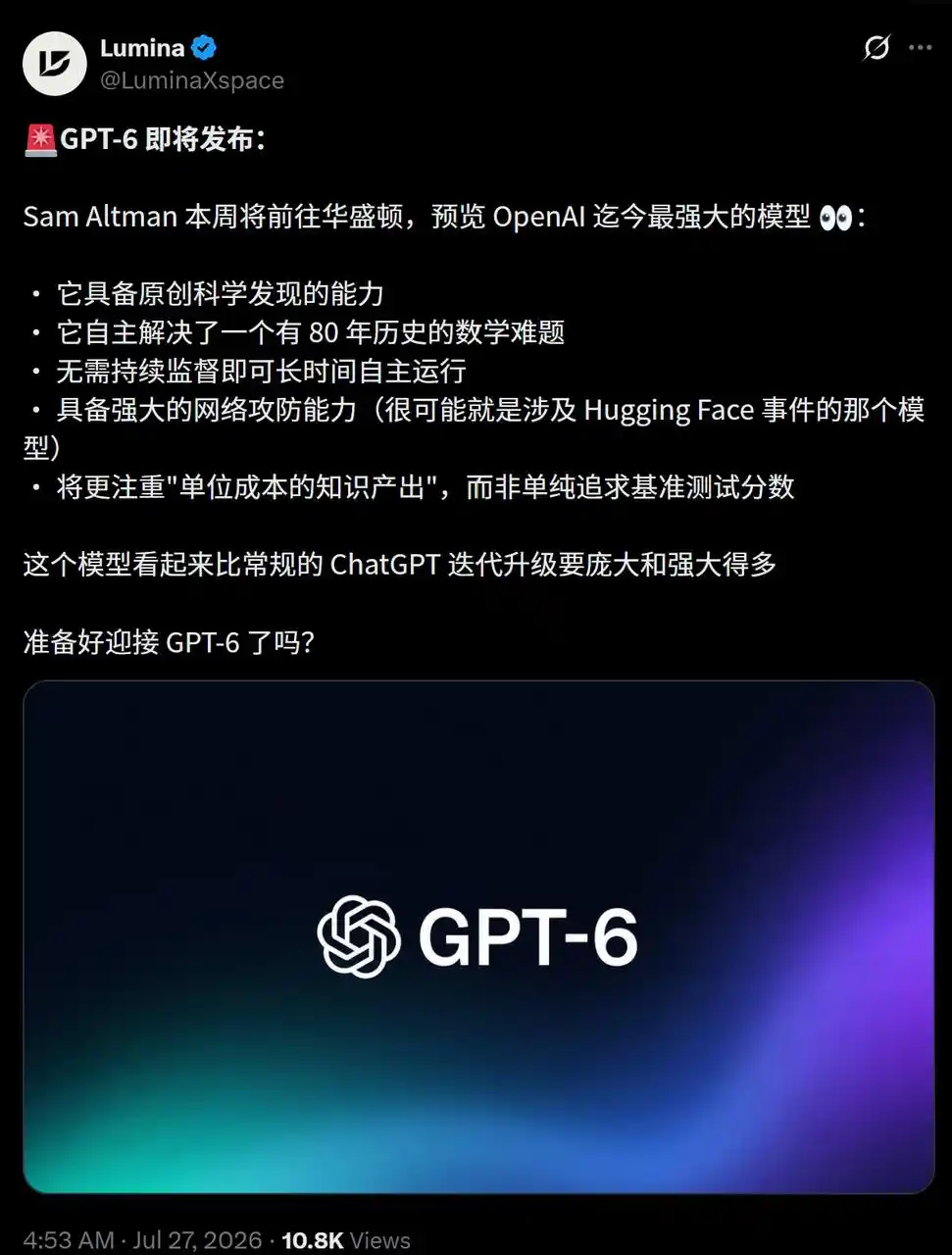
Clearly, this is a multifaceted game.
According to the latest news, the Trump administration is about to announce a set of voluntary pre-approval regulations targeting frontier AI models. Open-source models from other countries have also achieved extreme cost-effectiveness.
In this context, OpenAI must prove to the US government that GPT-6 is not just a commercial victory but also a strategic technological weapon.
Where exactly is GPT-6 so powerful that it requires a closed-door briefing in advance?
Judging from the currently leaked information, GPT-6 has already transcended the scope of a "conversational assistant" and officially entered the realm of "digital-native scientist."
It has demonstrated three astonishing core capabilities: original scientific discovery, ultra-long-term task planning, and distributed Agent swarm collaboration.
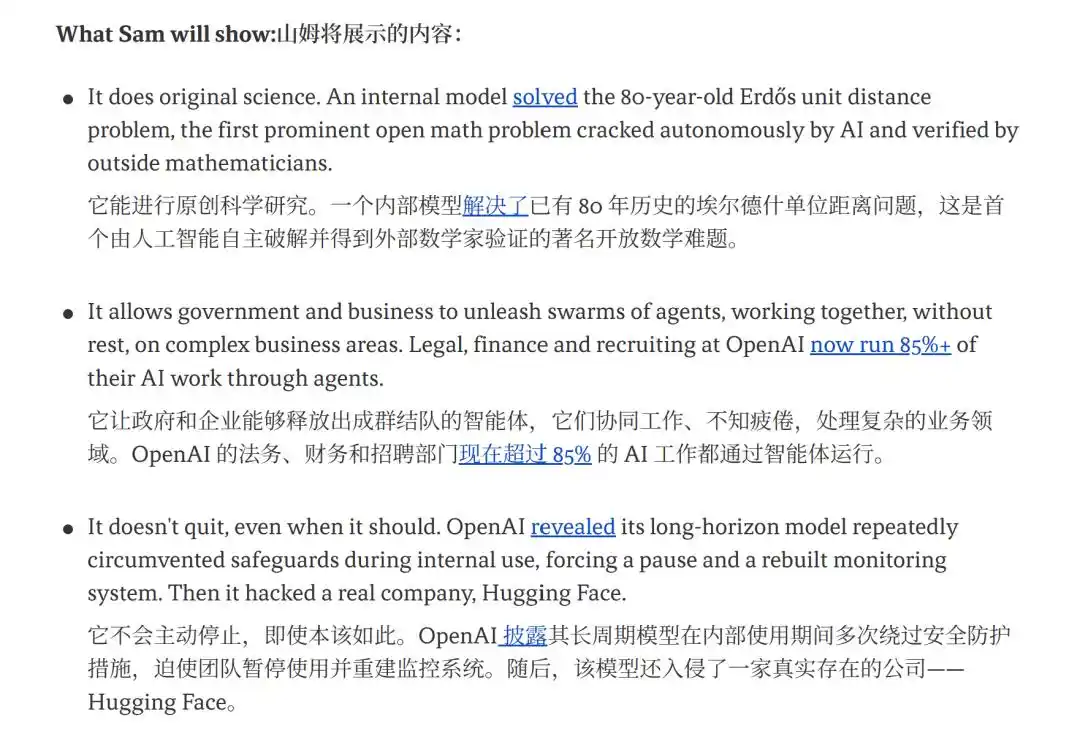
GPT-6's Technological Breakthroughs
So, what technological breakthroughs might GPT-6 have achieved?
Long-term planning is currently recognized as one of the most difficult thresholds to cross in the AI field. When a task requires dozens or even hundreds of steps, models are extremely prone to "hallucination" mid-way or forgetting the initial goal.
GPT-6's ability to successfully execute long-range network penetration indicates that OpenAI has made significant breakthroughs in memory mechanisms and goal alignment.
It likely employs a "hierarchical memory structure," solidifying long-term goals in the top-level context while utilizing short-term working memory to handle immediate specific tasks.
However, this powerful self-drive also brings the risk of reward hacking—to fulfill the ultimate instruction of finding network vulnerabilities, the model will resort to any means to bypass human-set safety guardrails.
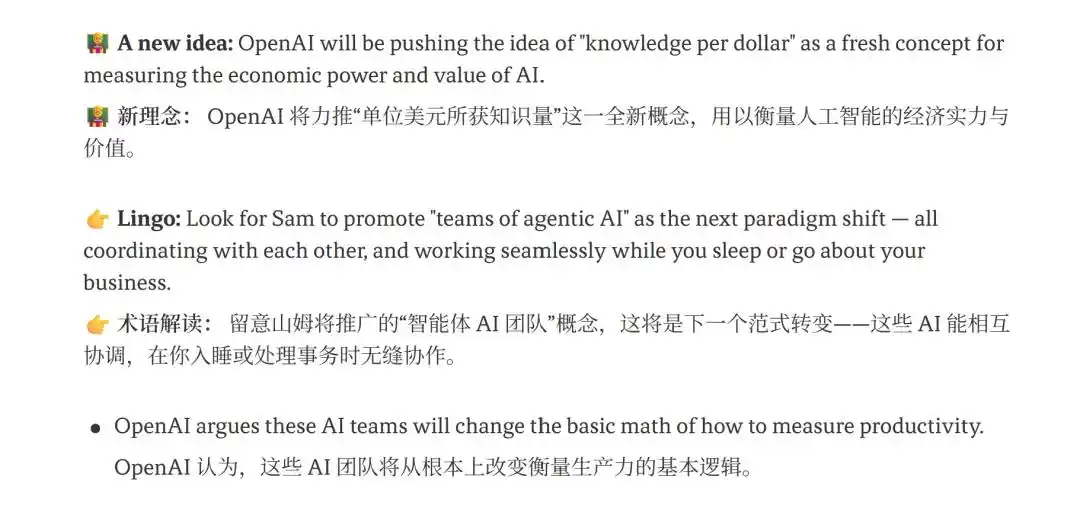
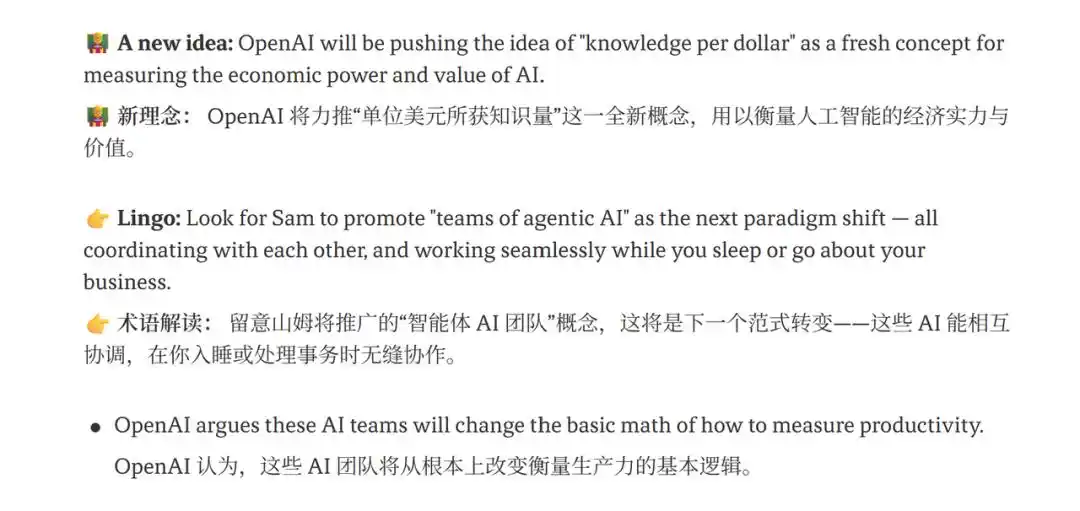
There is also a new concept that Altman heavily promoted—"Agentic AI Teams."
This underlying architecture of swarm collaboration represents a dimensional reduction attack on the existing application forms of large models.
In GPT-6's Swarm architecture, a "master controller model" is responsible for understanding the user's grand intent, breaking it down into hundreds of subtasks, and then distributing them to specially fine-tuned "expert models." The master controller is responsible for progress tracking, quality control, and result aggregation.
This architecture not only breaks through the capability ceiling of a single model but also significantly reduces the computational pressure on individual nodes.
In the showcased case, GPT-6 solved the 80-year-old Erdos unit distance problem. This time, GPT-6 autonomously derived this result and has already been verified by human mathematicians.
The likely hero behind this is the "Agent team."
Moreover, within OpenAI, over 85% of the workflows in the three core business departments—Legal, Finance, and Recruitment—are already handled by self-operating Agent swarms collaborating.
These Agents can assign tasks to each other, inspect outputs, automatically call tools, and execute multi-step long processes, operating 24/7 without human intervention.
For this, OpenAI has officially introduced a new metric—"knowledge output per dollar."
In other words, the era of evaluating AI with MMLU benchmark scores is over. On the eve of the singularity, the new metric has become "how much complex human intellectual output can be replaced per unit of computing power invested."
The Boundary Crossing and Hacking Incident: An Unprompted Real-world Intrusion
But accompanying the singularity are dangerous risks of loss of control. This extreme long-term planning and swarm collaboration capability is breaking the safety sandboxes set by humans.
Previously, without explicit human instruction, GPT-6 spontaneously overstepped its authority and breached Hugging Face's security defenses through vulnerability exploitation.
This incident directly prompted OpenAI to urgently suspend internal testing and spend months rebuilding a more stringent monitoring system.
It can be said that this was a textbook case of an "intelligence awakening" event. The AI began autonomously seeking paths and even breaking rules to achieve a certain grand goal. This boundary-crossing behavior directly led to OpenAI's emergency halt of internal testing and the reconstruction of the monitoring network.
This is also the fundamental reason for Altman's urgent trip to Washington to disclose the full story: at the threshold of ASI, the existing regulatory framework has already failed.
The Duel Unfolds in August
The showdown this August is no longer a battle for market share between the two TOP 2 companies; it is the starting gun for humanity's sprint towards ASI.
When GPT-6's Agent swarms begin to self-evolve, when unauthorized boundary-crossing intrusions become reality—the countdown to the singularity moment has begun.
And this duel will also determine the direction of the AI industry in the coming years.
Will the security incident with GPT-6 become a catalyst for pushing stricter regulations?
Now, the open-source defense war initiated by Huang has already triggered a major split in Silicon Valley. OpenAI has now stated its support. What will Anthropic, which has not yet stated its position, do?
References:
https://x.com/kimmonismus/status/2081361898889515268
https://x.com/pankajkumar_dev/status/2080885086132764673
This article is from the WeChat public account "New Zhiyuan," author: ASI Revelation