The DAO Returns After a Decade, Establishes a $220 Million Security Fund

marsbitPubblicato 2026-02-02Pubblicato ultima volta 2026-02-02

Introduzione

The DAO, the record-breaking 2016 Ethereum crowdfunding project that led to a major hack and the Ethereum Classic split, is making a symbolic return a decade later. Over 75,109 ETH (worth approximately $220 million) from the incident’s unresolved funds will be used to establish The DAO Security Fund. This fund, managed by a multisig group including key figures like Vitalik Buterin and Taylor Monahan, will focus entirely on enhancing Ethereum’s security. The majority of the ETH (around 69,420) will be staked to create a perpetual endowment, with staking yields and remaining assets funding security efforts such as smart contract audits, core protocol upgrades, and wallet safety improvements. While the initiative aims to turn a historic failure into long-term ecosystem protection, it remains controversial. Questions persist around the legitimacy of repurposing what some consider original token holders' assets and the degree of decentralization in the fund’s governance. Nonetheless, The DAO’s evolution reflects Ethereum’s maturation and the resilience of its community.

In the history of Ethereum's development, nothing is more iconic than the "The DAO" incident in 2016. It was not only the most astonishing crowdfunding project in Ethereum's history but also the protagonist of the hacker attack that led to the split of the Ethereum community and the birth of "Ethereum Classic (ETC)".

After a decade, this name that once nearly destroyed Ethereum—The DAO—is making a comeback in another form. It will launch "TheDAO Security Fund," transforming the remaining over 75,109 ETH (worth more than $220 million) from the incident into a long-term fund focused on Ethereum's security development.

Historical Retrospective: A Crowdfunding Myth That Led to an Ecosystem Crisis

Rewind to 2016. At that time, TheDAO set a crowdfunding record with $150 million in financing, attracting a staggering 14% of Ethereum's total supply.

The vision of this decentralized autonomous organization excited the entire crypto ecosystem, but it soon encountered a catastrophic attack. Hackers exploited a recursive call vulnerability in the smart contract to steal a large amount of funds, prompting the Ethereum community to make a highly controversial decision—implement a hard fork to recover the stolen assets. This move directly led to a split in the community's philosophy, giving birth to Ethereum Classic (ETC).

But fund recovery was never simple. Although the hard fork resolved the redemption of standard DAO tokens, it could not handle all edge cases. Thus, a group of veteran Ethereum community members voluntarily formed the "TheDAO Curator Multisig Wallet" to take on the responsibility of resolving these complex legacy issues.

TheDAO Security Fund Emerges

Griff Green, who served as TheDAO's community manager and is now a co-founder of Giveth, was one of the core members of the "TheDAO Curator Multisig Wallet" back then. According to the official announcement, as early as August 2016, these core administrators clearly stated an important plan: if the leftover funds from these edge cases remained unclaimed after January 31, 2017, they would be used to support Ethereum smart contract security development.

Then, these funds lay "dormant" for nearly a decade. Griff Green said in an interview with Unchained: "As of 2026, we have never touched these funds, and the rise in Ethereum's price has led to substantial appreciation. This is an extremely dramatic turn of events—the 'leftover funds' from back then are now worth far more than TheDAO's original $150 million crowdfunding total."

The DAO Fund's Goal: Safeguarding Ethereum Security

According to the official announcement, the funding sources for TheDAO Security Fund are mainly divided into two parts, totaling over 75,109 ETH (worth $220 million):

· Approximately 70,500 ETH in the ExtraBalance contract, which can still be claimed by eligible individuals.

· Approximately 4,600 ETH and some DAO tokens in TheDAO Curator Multisig, worth about $13.5 million, for which there are no clear claimants.
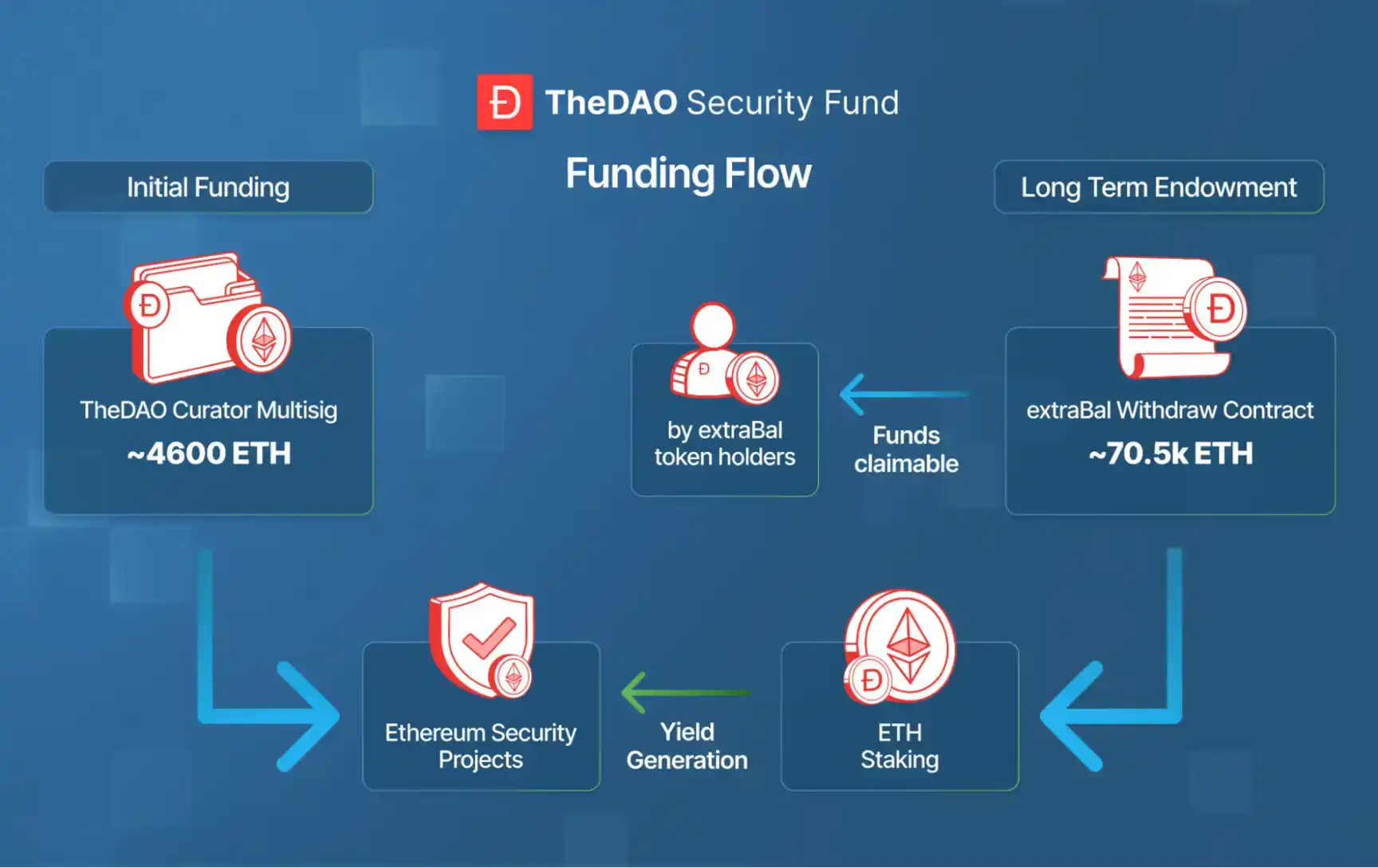
The operation and usage plan for TheDAO Security Fund's funds are clear and specific: 69,420 ETH allocated from the ExtraBalance contract will be staked, generating staking rewards to form a perpetual endowment fund, providing long-term financial support for Ethereum security development. The staking rewards will be combined with the 4,600 ETH from TheDAO Curator Multisig to jointly fund various Ethereum security-related projects. Simultaneously, the ExtraBalance withdrawal contract will retain a portion of ETH to ensure the rights of legitimate claimants are unaffected.

Regarding the scope of funding, TheDAO Security Fund's core objective is very specific—prioritizing the security of the entire Ethereum ecosystem, covering all dimensions of security development: from wallet user experience optimization and smart contract security audits, to emergency response for security incidents and security upgrades for the Ethereum core protocol, to security protection for Layer 2 networks and cross-chain bridge ecosystems. All work contributing to enhancing Ethereum's security level falls within the fund's funding scope.
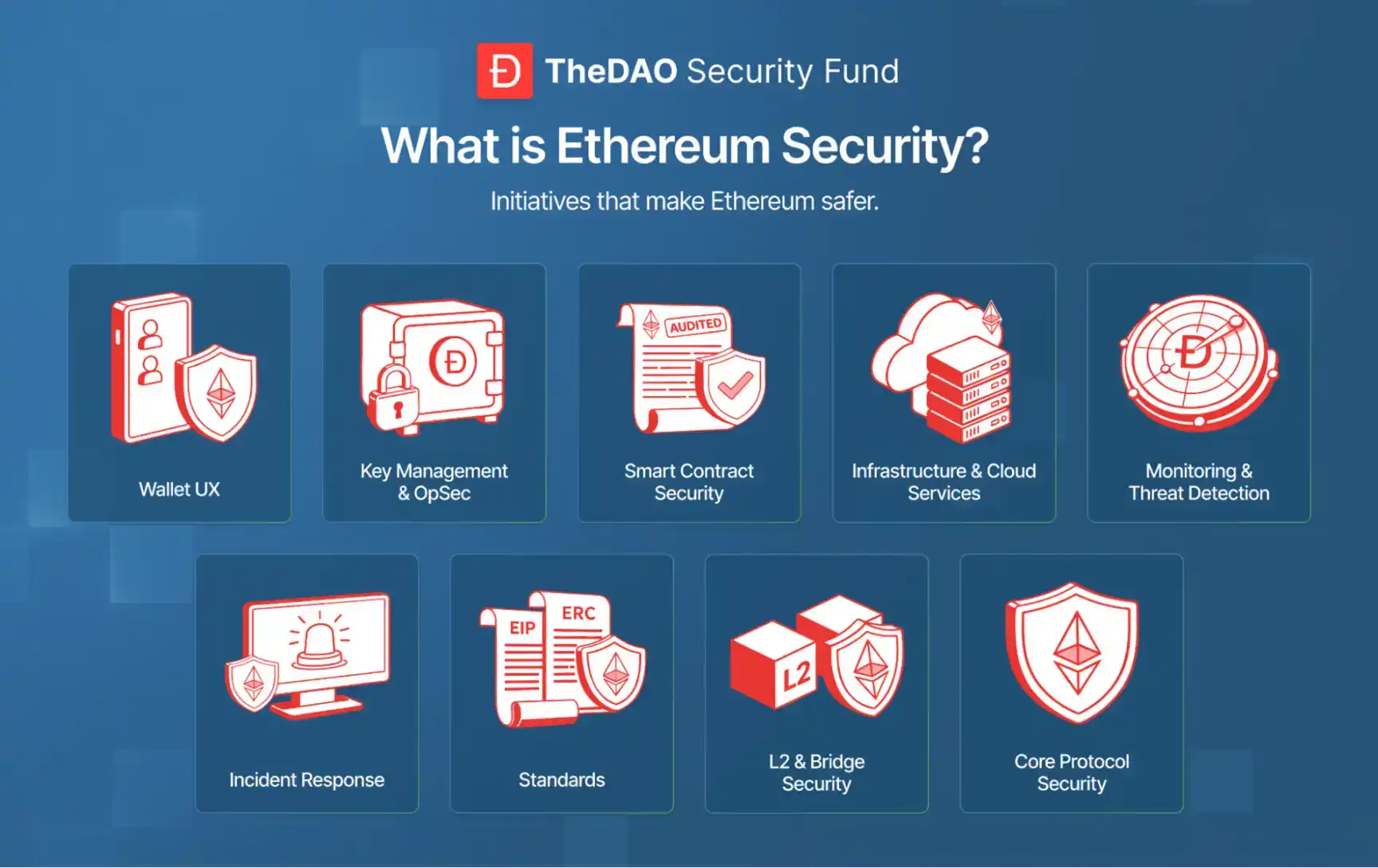
Additionally, the fund will rely on the optimization directions and opportunities in the current security landscape outlined by the Ethereum Foundation's Trillion Dollar Security initiative, combined with ongoing communication with ecosystem partners, to determine the specific scope and focus of each funding round.

In terms of the fund allocation mechanism, TheDAO Security Fund adheres to open, bottom-up governance principles. It will employ diverse methods such as quadratic funding, retroactive funding, and request for proposal (RFP)-based ranking votes to carry out funding work in rounds, allowing ecosystem participants to jointly participate in fund allocation decisions.

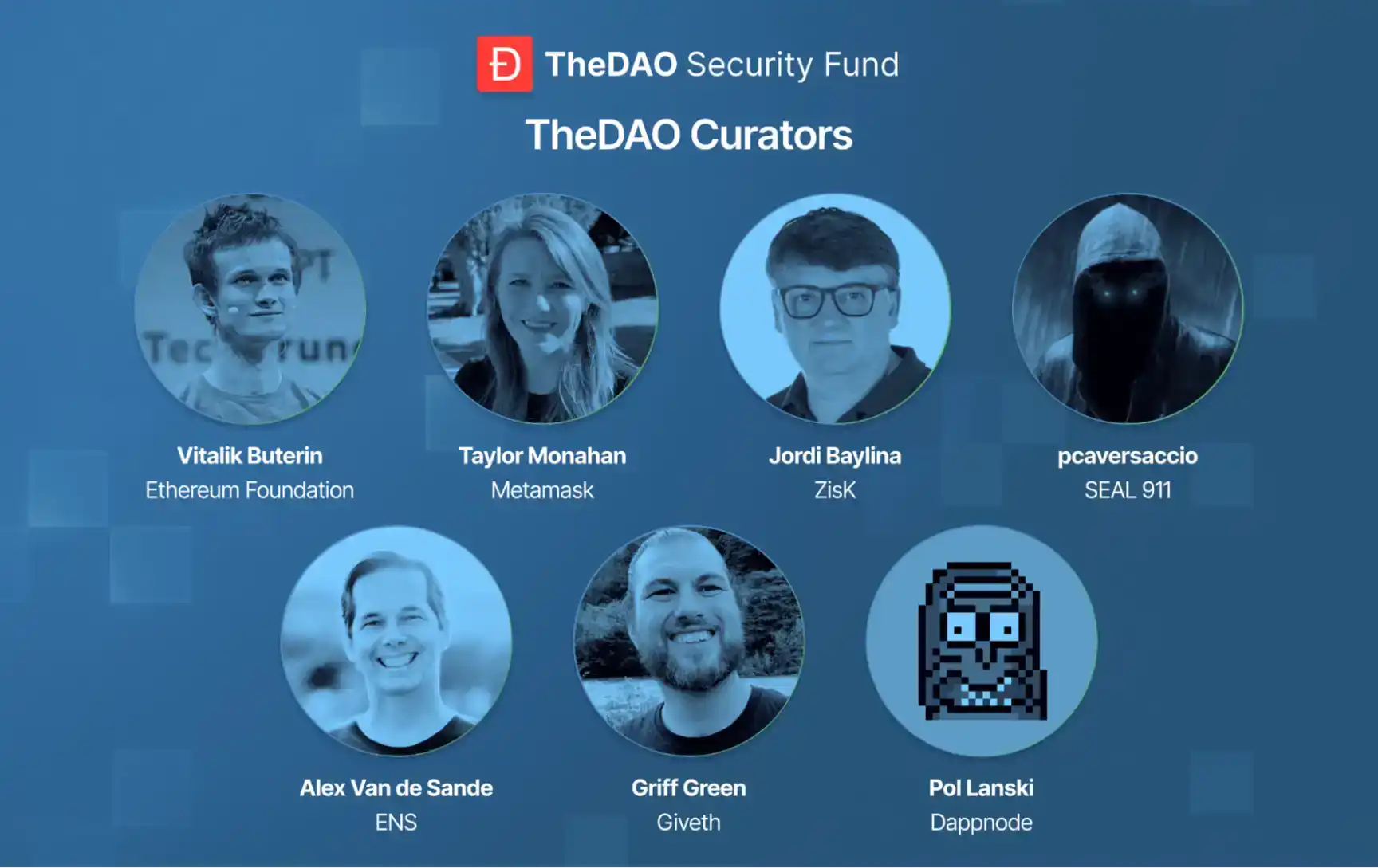
Currently, the fund has assembled a professional curator team to provide expert guidance and supervision for the fund's operation and funding decisions. Team members are all veteran practitioners and security experts in the crypto ecosystem: including Ethereum founder Vitalik Buterin, MetaMask security engineer Taylor Monahan, Zisk, Giveth co-founder Jordi Baylina, security expert pcaversaccio, ENS co-founder Alex Van de Sande, and Dappnode CEO Pol Lanski.
Summary

TheDAO Security Fund is not without controversy. Its core disputes still revolve around two main issues: first, the "legitimacy of the purpose" of using these leftover funds for a security fund, and second, the "degree of decentralization" of the fund's governance mechanism.

Should this huge asset be considered the "private property" of all original token holders, or has it already been deemed ownerless property to be used for the "public good"?

These controversies not only continue the philosophical divide within the Ethereum community sparked by the 2016 The DAO incident but also reflect the deep-seated contradictions in the current crypto ecosystem at the governance level—the balance between the ideal of decentralization and the efficiency of actual operations, as well as the compliance of asset disposal, remains a subject that the entire industry needs to continuously explore.

But setting aside the controversies, from the 2016 crowdfunding myth and ecosystem crisis to the 2026 security fund and ecosystem safeguarding, the decade-long cycle of The DAO is itself a microcosm of Ethereum's ecosystem development. It witnesses Ethereum's growth from immaturity to maturity and confirms the resilience and community strength of the crypto ecosystem.


Crypto di tendenza

Domande pertinenti

QWhat was the original purpose of The DAO in 2016 and what major event occurred?

AThe DAO was a decentralized autonomous organization launched in 2016 that raised a record $150 million in crowdfunding, attracting 14% of the total Ethereum supply. However, it suffered a catastrophic hack where attackers exploited a recursive call vulnerability in its smart contract, leading to a major theft of funds.

QHow is The DAO returning after ten years and what is the value of the new initiative?

AThe DAO is returning through the launch of 'The DAO Security Fund,' which repurposes over 75,109 ETH (worth more than $220 million) from the 2016 incident into a long-term fund dedicated to Ethereum security development.

QWhat are the two main sources of funding for The DAO Security Fund?

AThe funding comes from two sources: approximately 70,500 ETH from the ExtraBalance contract (which can still be claimed by eligible individuals) and about 4,600 ETH and some DAO tokens from The DAO Curator Multisig (valued around $13.5 million, with no clear claimants).

QHow will The DAO Security Fund allocate and use its resources to support Ethereum security?

AThe fund will stake 69,420 ETH from the ExtraBalance to generate yield for a perpetual endowment, while the staking rewards and the 4,600 ETH from the multisig will be used to fund Ethereum security projects. It will support areas like wallet UX, smart contract audits, emergency response, core protocol upgrades, and L2/cross-chain security.

QWho are some of the key members of the guardian team overseeing The DAO Security Fund?

AThe guardian team includes Ethereum founder Vitalik Buterin, MetaMask security engineer Taylor Monahan, Zisk, Giveth co-founder Jordi Baylina, security expert pcaversaccio, ENS co-founder Alex Van de Sande, and Dappnode CEO Pol Lanski.

Letture associate

Only 153 Venture Capital Firms Invested in July: Is the Crypto VC Industry Experiencing a 'Mass Extinction'?

In July 2026, only 153 unique venture capital firms participated in disclosed crypto funding rounds, marking the lowest monthly count since November 2020. This figure represents an 87% decline from the peak of 1,177 firms in 2022. Overall, the first seven months of 2026 saw crypto projects raise approximately $11.78 billion across 481 rounds. This crypto VC contraction contrasts sharply with the broader venture capital landscape, where global VC investment reached a record $560.4 billion in H1 2026, heavily fueled by major AI company financings. This shift in capital allocation has drawn funds away from the crypto sector. Within crypto, funding is highly concentrated. Trading platforms, prediction markets, and payment sectors absorbed 53% of the total capital. While early-stage deals remain frequent, the largest sums flow to a few late-stage rounds and mergers & acquisitions, which surged to $7.23 billion in Q2 2026. The market is consolidating around top funds like a16z crypto and Dragonfly, which successfully raised new multi-billion dollar funds, while many smaller firms have retreated. Analysts describe this as a "great extinction" for crypto VCs, where capital is becoming more selective, favoring proven business models and assets over early-stage speculation. This raises the bar for project quality, funding efficiency, and viable exit paths.

marsbit16 min fa

Only 153 Venture Capital Firms Invested in July: Is the Crypto VC Industry Experiencing a 'Mass Extinction'?

marsbit16 min fa

Strategy's Loss in the Second Quarter Reaches $8.22 Billion Amid Bitcoin Decline

Strategy, the largest corporate holder of Bitcoin, reported a net loss of $8.22 billion for the second quarter. This loss was primarily driven by an $8.32 billion unrealized loss on its Bitcoin holdings due to a decline in the asset's price during the period. Despite these paper losses, the company increased its Bitcoin holdings to 843,775 BTC, a 25% growth since the start of the year. As part of a new monetization strategy, Strategy sold approximately $218.4 million worth of Bitcoin, mainly to fund dividends for preferred shareholders, with $216 million of that sold after Q2 ended. The company also built a $3.75 billion cash reserve, which it claims is sufficient to cover over two years of dividend and interest payments, aiming to insulate itself from Bitcoin's volatility while meeting obligations. Following the earnings release, Strategy's stock (MSTR) rose 4.7% in regular trading but corrected slightly after-hours. This pattern reflects how the company's accounting results are heavily tied to Bitcoin's price swings, even as its long-term strategy remains unchanged. The report indicates that Strategy is maintaining its core strategy of accumulating Bitcoin while building a financial buffer. This quarterly loss follows a recognizable pattern, with the company posting significant unrealized losses in previous quarters (e.g., $12.4 billion in Q4 2025 and ~$12.5 billion in Q1 2026) due to fair-value accounting. A key technical shift is its new monetization program, which introduces periodic selling pressure on the market, transitioning Strategy from a pure accumulator to a participant that occasionally adds supply. A critical question remains: how long can the cash reserve cover dividend obligations if a Bitcoin price downturn persists beyond two years?

cryptonews.ru36 min fa

Strategy's Loss in the Second Quarter Reaches $8.22 Billion Amid Bitcoin Decline

cryptonews.ru36 min fa

Will Terrorist Durov Ban Russian Officials?

Telegram founder Pavel Durov publicly reacted to being labeled a "terrorist" by Russian authorities, stating the designation came after he refused demands for mass surveillance and censorship on the platform. In a Telegram post, he highlighted that this status formally bans him from "publishing information online." Durov concluded with a statement widely circulated: Russian officials "clearly don't understand who can ban whom on the internet." This remark suggests Durov could potentially restrict official Russian government and officials' channels on Telegram, which continue to operate on the platform despite its formal blocking in Russia. The situation parallels previous, slow-moving state directives, like switching officials to domestic cars, contrasted with the current push to migrate all government communication to the Russian-made messenger MAX by 2030. However, reports indicate many officials still use Telegram via workarounds, fearing surveillance on MAX, while alternatives like BiP and KakaoTalk recently became inaccessible in Russia without a VPN. Durov has not specified any immediate actions against state channels. His statement is an initial response, with further developments depending on the authorities' reaction. The dynamic differs from 2020 when Russian regulators lifted a block on Telegram; now, Durov implies control from within the platform itself over the official accounts that persisted through that earlier blockade.

cryptonews.ru36 min fa

Will Terrorist Durov Ban Russian Officials?

cryptonews.ru36 min fa

DeepSeek V4 Official Version Arrives, New Capabilities Emerge, Value-for-Money King Enters the Fray

On July 31st, DeepSeek officially launched the public API beta for its DeepSeek-V4-Flash model. A key highlight is its performance on multiple Agent benchmark tests, reportedly nearing or even surpassing the level of the V4-Pro preview version from three months ago. Notably, the Flash model achieves this with significantly smaller scale (130B active parameters vs. Pro's 490B), suggesting that post-training optimization and data quality may be as crucial as raw model size. DeepSeek emphasized that the V4-Flash-0731 uses the same model architecture and size as its preview version, with improvements attributed solely to "re-trained post-training." The update also marks the official debut of DeepSeek's self-developed Agent framework, "Harness." The move signals DeepSeek's strategic push to position its cost-effective Flash model as a competitive base for Agent applications—scenarios requiring autonomous planning, tool usage, and complex task execution—where inference speed and cost are critical. By natively supporting OpenAI's Responses API format and adapting for code-generation scenarios, DeepSeek aims not just to be a cheaper alternative but to establish its own ecosystem in the Agent era. This release follows DeepSeek's record-breaking ~$50 billion fundraising round roughly two months prior, underscoring market confidence in its technology and commercialization prospects. The company is reportedly preparing for another funding round at a valuation of approximately $71 billion. The Flash model's advancement represents a step in fulfilling the high expectations that come with this valuation, setting the stage for the impending release of the V4-Pro official version and intensifying competition in the global Agent landscape.

marsbit40 min fa

DeepSeek V4 Official Version Arrives, New Capabilities Emerge, Value-for-Money King Enters the Fray

marsbit40 min fa

Trading

Spot

Articoli Popolari

Come comprare DAO

Benvenuto in HTX.com! Abbiamo reso l'acquisto di DAO Maker (DAO) semplice e conveniente. Segui la nostra guida passo passo per intraprendere il tuo viaggio nel mondo delle criptovalute.Step 1: Crea il tuo Account HTXUsa la tua email o numero di telefono per registrarti il tuo account gratuito su HTX. Vivi un'esperienza facile e sblocca tutte le funzionalità,Crea il mio accountStep 2: Vai in Acquista crypto e seleziona il tuo metodo di pagamentoCarta di credito/debito: utilizza la tua Visa o Mastercard per acquistare immediatamente DAO MakerDAO.Bilancio: Usa i fondi dal bilancio del tuo account HTX per fare trading senza problemi.Terze parti: abbiamo aggiunto metodi di pagamento molto utilizzati come Google Pay e Apple Pay per maggiore comodità.P2P: Fai trading direttamente con altri utenti HTX.Over-the-Counter (OTC): Offriamo servizi su misura e tassi di cambio competitivi per i trader.Step 3: Conserva DAO Maker (DAO)Dopo aver acquistato DAO Maker (DAO), conserva nel tuo account HTX. In alternativa, puoi inviare tramite trasferimento blockchain o scambiare per altre criptovalute.Step 4: Scambia DAO Maker (DAO)Scambia facilmente DAO Maker (DAO) nel mercato spot di HTX. Accedi al tuo account, seleziona la tua coppia di trading, esegui le tue operazioni e monitora in tempo reale. Offriamo un'esperienza user-friendly sia per chi ha appena iniziato che per i trader più esperti.

189 Totale visualizzazioniPubblicato il 2024.12.11Aggiornato il 2026.06.02

Come comprare DAO

Discussioni

Benvenuto nella Community HTX. Qui puoi rimanere informato sugli ultimi sviluppi della piattaforma e accedere ad approfondimenti esperti sul mercato. Le opinioni degli utenti sul prezzo di DAO DAO sono presentate come di seguito.

活动图片