Author: Jeff Dorman (Arca CIO)
Compiled by: Deep Tide TechFlow
Deep Tide Introduction:
Is the crypto market becoming increasingly dull? Arca Chief Investment Officer Jeff Dorman writes that although infrastructure and regulatory environments have never been stronger, the current investment climate is "the worst in history."
He sharply criticizes industry leaders' failed attempts to forcibly transform cryptocurrencies into "macro trading tools," leading to extreme convergence in the correlation of various assets. Dorman calls for a return to the essence of "tokens as securities packaging," focusing on equity-like assets such as DePIN and DeFi that have cash flow generation capabilities.
At a time when gold is surging while Bitcoin remains relatively weak, this in-depth reflective article provides an important perspective for re-examining Web3 investment logic.
Full text as follows:
Bitcoin is facing an unfortunate situation
Most investment debates exist because people are on different time horizons, so they often "talk past each other," even though technically both sides are correct. Take the debate between gold and Bitcoin as an example: Bitcoin enthusiasts tend to say that Bitcoin is the best investment because it has far outperformed gold over the past 10 years.
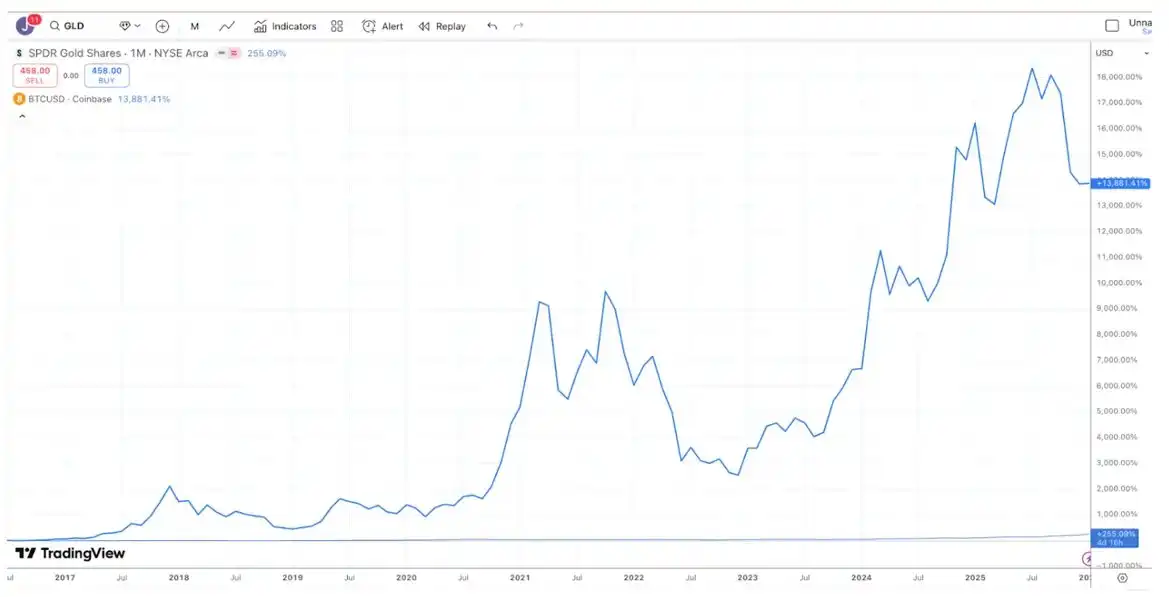
Caption: Source TradingView, Bitcoin (BTC) vs. Gold (GLD) returns over the past 10 years
Gold investors, on the other hand, tend to believe that gold is the best investment and have recently been "mocking" Bitcoin's weakness, as gold has significantly outperformed Bitcoin over the past year (the same goes for silver and copper).
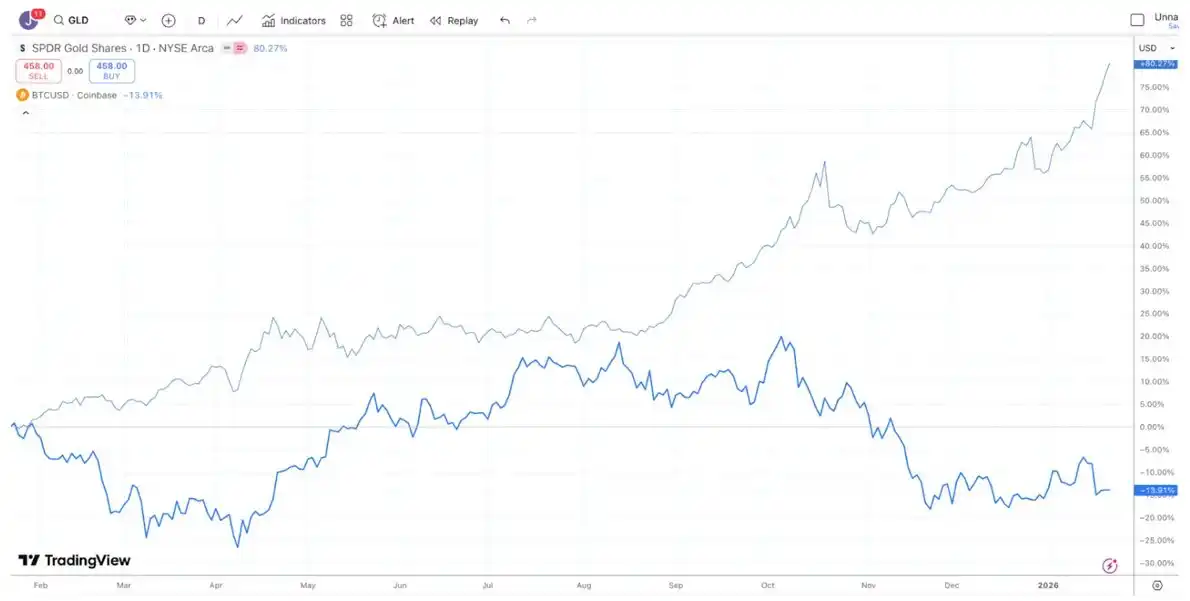
Caption: Source TradingView, Bitcoin (BTC) vs. Gold (GLD) returns over the past 1 year
Meanwhile, over the past 5 years, the returns of gold and Bitcoin have been almost identical. Gold tends to do nothing for long periods of time, then skyrocket when central banks and trend followers buy; Bitcoin tends to have sharp rallies, followed by sharp crashes, but ultimately moves higher.
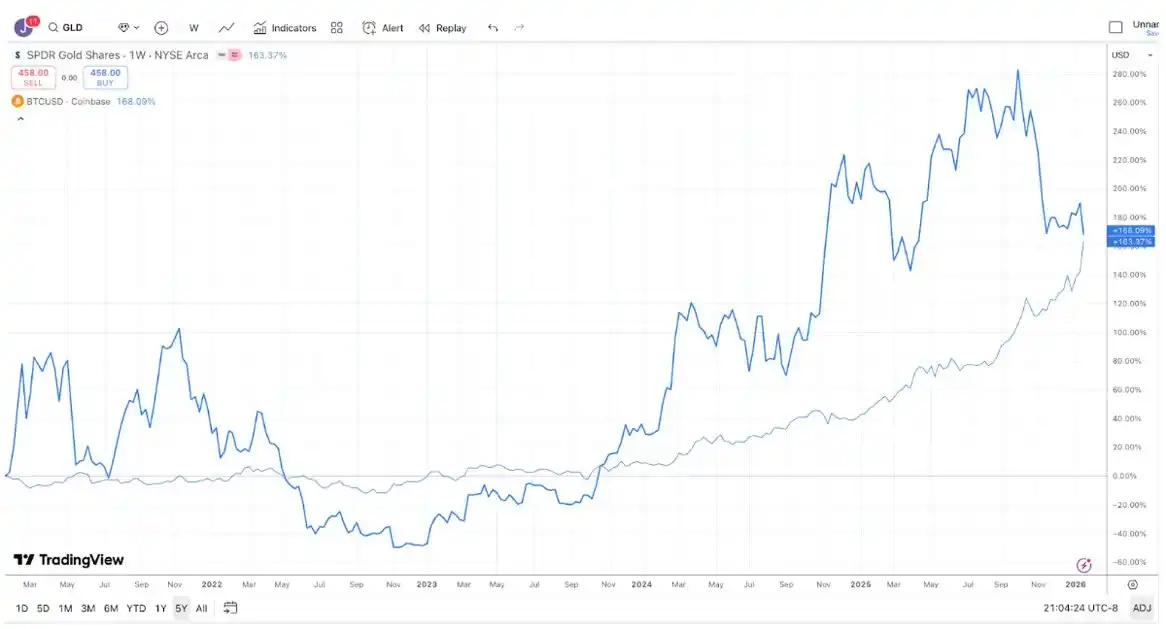
Caption: Source TradingView, Bitcoin (BTC) vs. Gold (GLD) returns over the past 5 years
Therefore, depending on your investment horizon, you can almost win or lose any argument about Bitcoin vs. gold.
Even so, it's undeniable that gold (and silver) have recently shown strength relative to Bitcoin. To some extent, this is somewhat ironic (or pathetic). The largest companies in the crypto industry have spent the past 10 years trying to cater to macro investors rather than true fundamental investors, and as a result, these macro investors are saying, "Never mind, we'll just buy gold, silver, and copper instead." We have long called for a shift in the industry's thinking. There are now over $600 trillion in entrusted assets, and the buyers of these assets are a much stickier investor base. There are many digital assets that look more like bonds and stocks, issued by companies that generate revenue and conduct token buybacks, yet market leaders have decided, for some reason, to ignore this token sub-sector.
Perhaps Bitcoin's recent poor performance relative to precious metals will be enough for large brokers, exchanges, asset managers, and other crypto leaders to realize that their attempts to turn cryptocurrencies into all-encompassing macro trading tools have failed. Instead, they might turn their attention to and educate that $600 trillion pool of investors who tend to buy cash-flow-generating assets. It's not too late for the industry to start focusing on quasi-equity tokens that carry cash-flow-generating tech businesses (such as various DePIN, CeFi, DeFi, and token issuance platform companies).
Then again, if you just move the "finish line," Bitcoin is still king. So, more likely than not, nothing will change.
Asset Differentiation
The "good old days" of crypto investing seem like a thing of the past. Back in 2020 and 2021, it seemed like every month brought a new narrative, sector, use case, and new type of token, with positive returns coming from all corners of the market. Although the blockchain growth engine has never been stronger (thanks to legislative progress in Washington, stablecoin growth, DeFi, and RWA tokenization), the investment environment has never been worse.
One sign of a healthy market is dispersion and low cross-market correlation. You want healthcare and defense stocks to move differently from tech and AI stocks; you want emerging market stocks to move independently of developed markets. Dispersion is generally seen as a good thing.
2020 and 2021 are largely remembered as "everything rallies," but that wasn't entirely the case. It was rare to see the entire market move in lockstep. More often, one sector was rising while another was falling. Gaming surged while DeFi was falling; DeFi surged while "dino" L1 tokens were falling; Layer-1 surged while Web3 was falling. A diversified crypto portfolio actually smoothed returns and often lowered the overall portfolio's beta and correlation. Liquidity came and went as interest and demand shifted, but performance was diverse. This was very exciting. The massive inflow into crypto hedge funds in 2020 and 2021 made sense because the investable universe was expanding, and returns were differentiated.
Fast forward to today, and all "crypto-wrapped" asset returns look the same. Since the flash crash on October 10th, the declines across sectors have been almost indistinguishable. No matter what you hold, or how the token captures economic value, or what the project's trajectory is... the returns are largely the same. This is very frustrating.
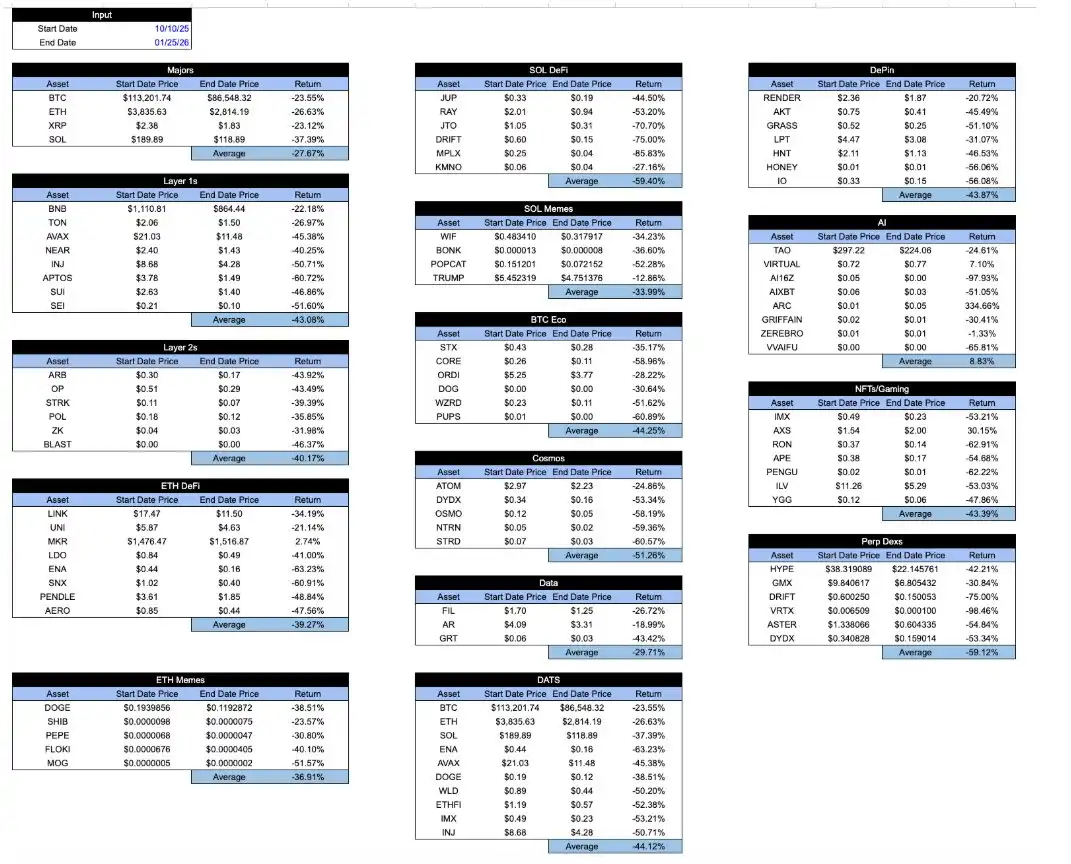
Caption: Arca internal calculations and CoinGecko API data for a representative sample of crypto assets
During market booms, this table looks slightly more encouraging. "Good" tokens tend to outperform "bad" tokens. But a healthy system should actually be the opposite: you want good tokens to perform better in bad times, not just in good times. Here is the same table from the April 7th low to the September 15th high.
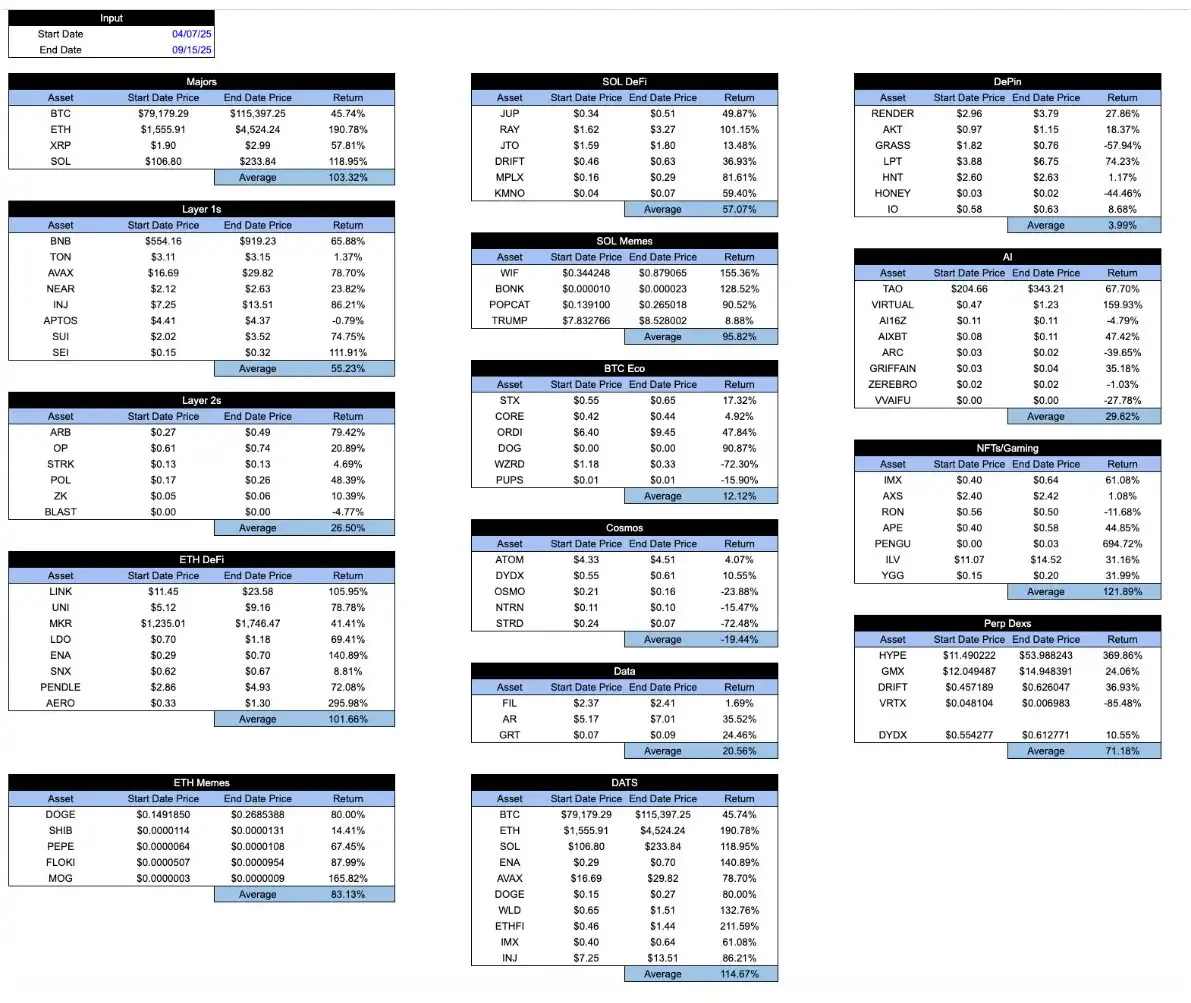
Caption: Arca internal calculations and CoinGecko API data for a representative sample of crypto assets
Interestingly, when the crypto industry was in its infancy, market participants worked very hard to differentiate between different types of crypto assets. For example, I published an article in 2018 where I categorized crypto assets into 4 types:
- Cryptocurrencies/money
- Decentralized protocols/platforms
- Asset-backed tokens
- Pass-through securities
At the time, this categorization was quite unique and attracted many investors. Importantly, crypto assets were evolving, from just Bitcoin, to smart contract protocols, asset-backed stablecoins, to equity-like pass-through securities. Researching different growth areas was a major source of alpha, as investors sought to understand the various valuation techniques required for different asset types. Most crypto investors back then didn't even know when unemployment data was released or when FOMC meetings were held, and rarely looked to macro data for signals.
After the 2022 crash, these different types of assets still exist. Nothing has fundamentally changed. But there has been a huge shift in how the industry markets itself. The "gatekeepers" decided that Bitcoin and stablecoins were the only things that mattered; the media decided they didn't want to write about anything except TRUMP tokens and other memecoins. Over the past few years, not only has Bitcoin outperformed most other crypto assets, but many investors have even forgotten that these other asset types (and sectors) exist. The underlying companies' and protocols' business models haven't become more correlated, but the assets themselves have become more correlated due to investor flight and market makers dominating price action.
This is why Matt Levine's recent article about tokens was so surprising and well-received. In just 4 paragraphs, Levine accurately described the differences and nuances between various tokens. This gives me some hope that this kind of analysis is still possible.

Leading crypto exchanges, asset managers, market makers, OTC platforms, and pricing services still call everything other than Bitcoin "altcoins" and seem to only publish macro research, bundling all "cryptocurrencies" together as one giant asset. Take Coinbase, for example – they seem to have only a very small research team led by one primary analyst (David Duong) whose focus is primarily on macro research. I have nothing against Mr. Bitcoin (Mr. Duong) – his analysis is excellent. But who goes to Coinbase specifically for macro analysis?
Imagine if leading ETF providers and exchanges only wrote generically about ETFs, saying things like "ETFs are down today!" or "ETFs react negatively to inflation data." They would be laughed out of business. Not all ETFs are the same just because they use the same "wrapper," and those who sell and promote ETFs understand this. What's inside the ETF matters most, and investors seem to be able to intelligently distinguish between different ETFs, mainly because industry leaders have helped their clients understand this.
Similarly, a token is just a "wrapper." As Matt Levine eloquently described, what's inside the token matters. The type of token matters, the sector matters, its properties (inflationary or amortizing) matter.
Perhaps Levine isn't the only one who understands this. But he does a better job of explaining the industry than those who actually profit from it.




