The Complete Landscape of Encrypted AI Protocols: Starting from Ethereum's Main Battlefield, How to Build a New Operating System for AI Agents?

marsbitPubblicato 2026-04-16Pubblicato ultima volta 2026-04-16

Introduzione

The year 2026 is emerging as a pivotal moment for the convergence of Crypto and AI, marked by AI's evolution from a tool to an autonomous economic agent. These AI agents require identity, payment channels, and verifiable execution environments—needs that blockchain is uniquely positioned to address. Ethereum is positioning itself as the trust layer for AI. Vitalik Buterin's updated framework outlines a vision where Ethereum provides verifiable, auditable infrastructure for AI, rather than accelerating its development unchecked. This is being realized through key protocol developments: - **Identity & Reputation (ERC-8004):** A standard for creating NFT-based identities for AI agents, complete with a reputation system built on verifiable on-chain interactions. - **Payments (x402):** Now under the Linux Foundation, this protocol embeds machine-to-machine payments directly into HTTP requests, enabling agents to pay for API access seamlessly with stablecoins or traditional methods. - **Execution (ERC-8211):** Allows AI agents to execute complex, multi-step DeFi transactions atomically in a single signature, overcoming a major operational bottleneck. Beyond Ethereum, other ecosystems are finding their roles. Solana is becoming a hub for high-frequency, low-cost agent payments and interactions due to its speed and low fees. Decentralized physical infrastructure networks (DePIN) provide the necessary compute power. In summary, a complementary crypto-AI stack is forming: Eth...

2026 is becoming a critical turning point for the deep convergence of Crypto and AI.

Over the past two years, we have witnessed AI's transformation from an "assistive tool" to an "autonomous economic participant." AI Agents are no longer just chatbots that answer questions; they have begun to autonomously initiate transactions, call APIs, manage asset portfolios, and even hire other Agents to complete tasks.

But the prerequisite for all this is that these Agents need identity, payment channels, reputation records, and a verifiable execution environment.

And these needs are precisely the problems that blockchain is best at solving.

As has often been discussed, the Ethereum Foundation established a decentralized AI (dAI) team in September 2025. Vitalik Buterin published a systematic AI strategic framework in early 2026. A series of protocol standards around Agent identity, payment, and execution have already been launched and are running on the mainnet. Meanwhile, new public chain ecosystems like Solana are also building AI infrastructure along their own paths.

Therefore, this article also attempts to use the Ethereum ecosystem as the main axis, supplemented by important developments on other public chains, to outline the complete picture of the current encrypted AI protocol landscape.

I. Vitalik's AI Blueprint: Ethereum Aims to Be the "Trust Layer" of the AI World

In February 2026, Vitalik Buterin published a systematic post on X, specifically revising the "Crypto × AI" crossover framework he proposed two years ago.
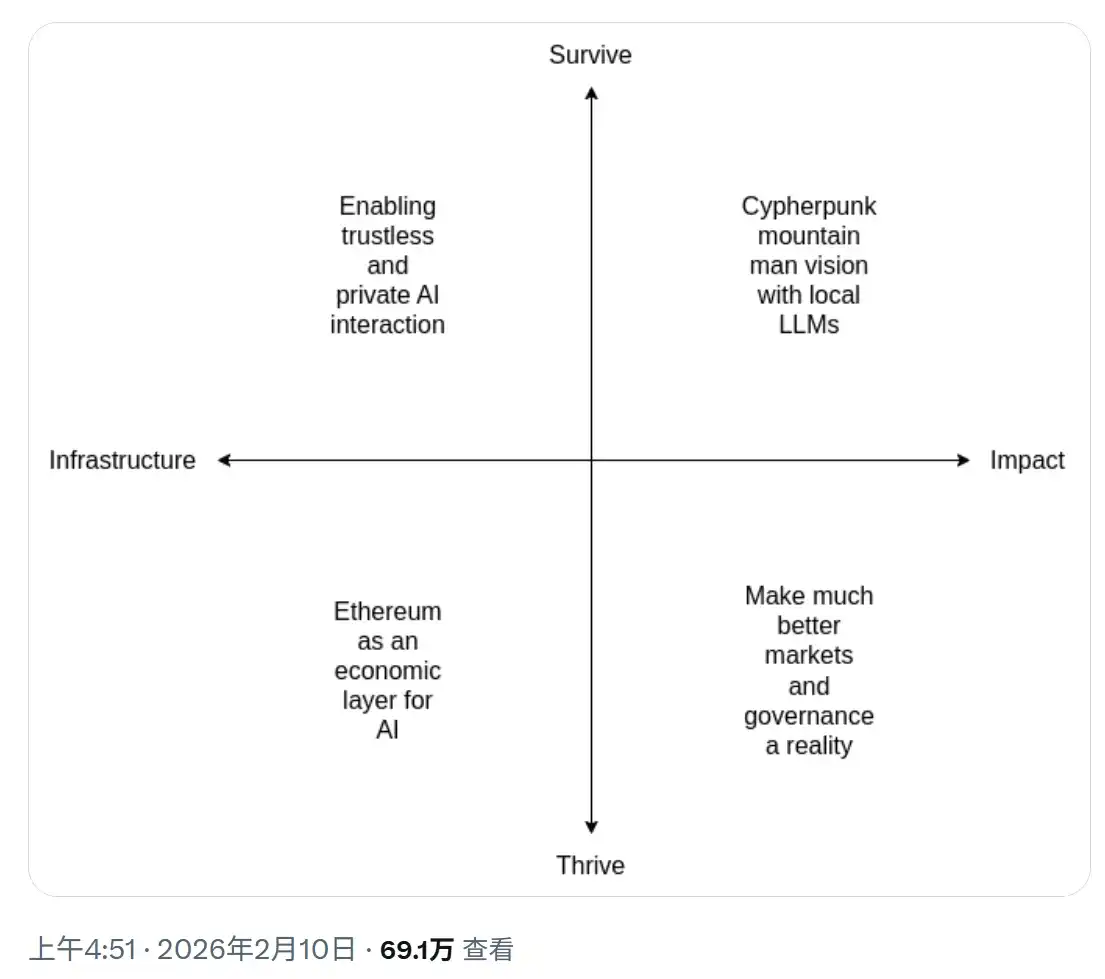
In the article, he revisited the ideas proposed two years ago, believing that the accelerated push towards Artificial General Intelligence (AGI) often resembles the unchecked speed and scale that Ethereum itself was created to challenge. He explicitly opposed simplifying AI development as an "AGI race," instead advocating that Ethereum should become a direction-setter for the AI world.

In other words, what he truly cares about is not how to make AI spiral out of control faster, but how to base AI's expansion on verifiable, auditable, and constrained infrastructure.

Overall, Vitalik's framework consists of four core pillars.

The first is trustworthy AI interaction tools. He advocates for using local large language models (local LLMs), zero-knowledge proof payment mechanisms, and other tools to allow users to use AI services without exposing their identity and raw data.

This attitude is not just abstract expression. In April 2026, Vitalik also publicly shared his own local LLM usage plan. After testing multiple hardware setups, he chose to run the 35-billion parameter open-source model Qwen3.5 locally on a computer equipped with an NVIDIA 5090 GPU. All computation is done locally, aiming to increase inference speed to a level usable for daily tasks and minimize reliance on cloud models.

Of course, the symbolic significance of this is greater than the practical significance, but it also shows that, at least in his view, the direction truly worth pursuing for AI is not just stronger models, but more controllable models.

The second is the AI economic coordination layer. This includes Ethereum's ability to use smart contracts to support mutual payments between Agents, security deposits, dispute resolution, and reputation accumulation, enabling programmable economic relationships between machines. The third is AI as the interface for Web3, for example, local AI assistants can help users draft transactions, audit smart contracts, interpret formal verification proofs, and become a bridge for ordinary people to enter the complex on-chain universe.

Finally, there are AI-enhanced governance systems, such as using AI to upgrade mechanisms like prediction markets, quadratic voting, and public fund allocation, finding a balance between automation and human judgment.

Overall, the core idea of this framework can be condensed into one sentence: Ethereum is not about accelerating AI, but about making AI operate in a verifiable, auditable, decentralized environment.

So how exactly is this achieved?

II. From Identity Protocols, to Payment Protocols, to Execution Protocols, to Verifiable AI

If Vitalik's framework is the macro blueprint, then the recent wave of protocol evolution in the Ethereum ecosystem has begun to embed this methodology into a concrete tech stack.

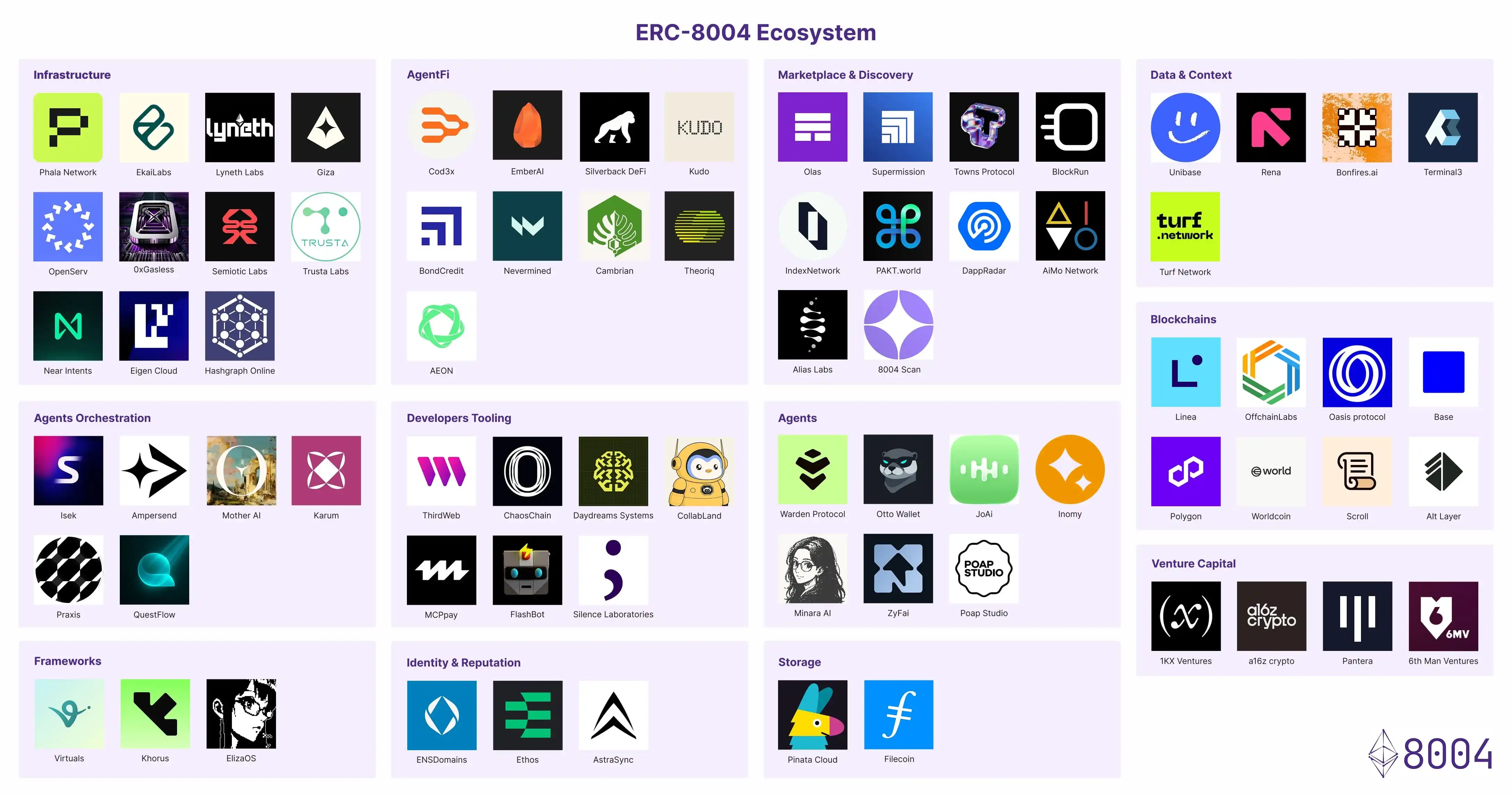
The first infrastructure node most worth watching is ERC-8004.

As an identity, reputation, and verification standard designed by Ethereum for AI Agents, it is led by the Ethereum Foundation's dAI team, with joint participation from Google, Coinbase, and MetaMask in its formulation, almost encompassing the three key entry points of AI, transactions, and wallets (Extended reading: "The New Ticket to the AI Agent Era: What is Ethereum Betting on by Pushing ERC-8004?").

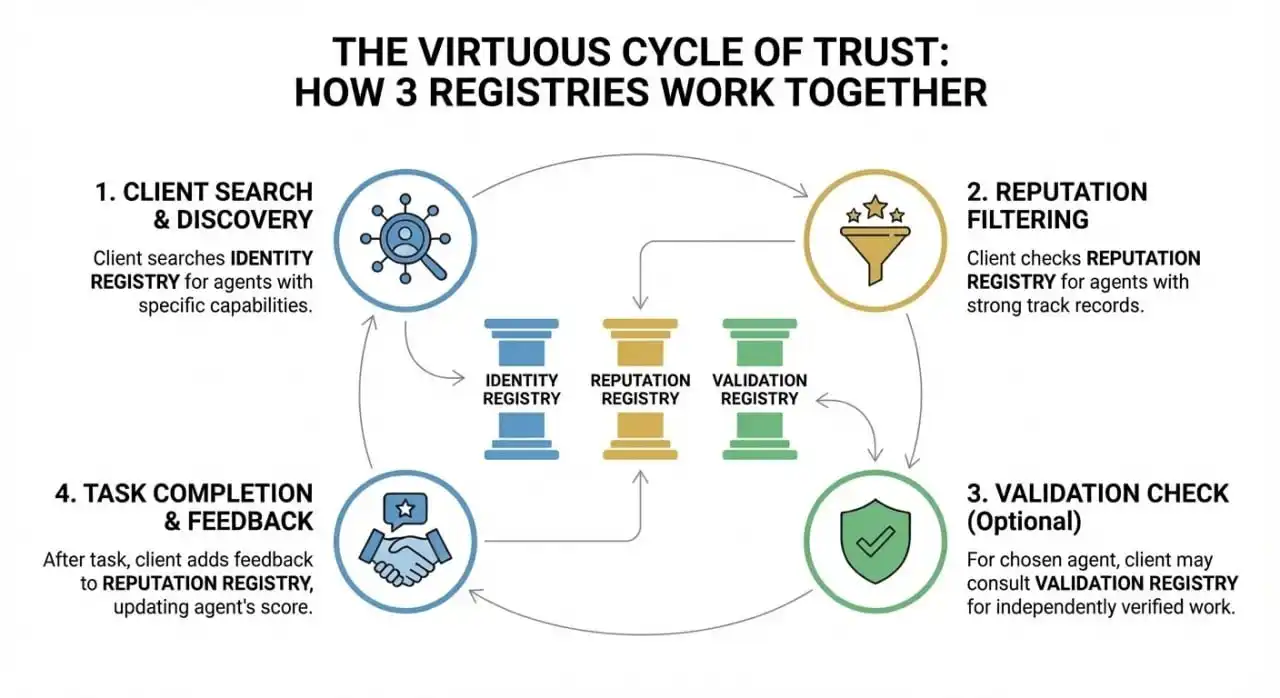
As its official name, Trustless Agents, suggests, its core logic is not complex algorithms, but aims to give AI verifiable identity, reputation, and capability proofs on-chain. Simply put, its design is very restrained, doing only three things:

  • Identity Registry: Based on the ERC-721 standard, each AI Agent is "NFT-ized," meaning AI Agents can be looked up, referenced, and integrated into other protocols like wallet addresses;
  • Reputation Registry: Can be understood as the "Yelp" for AI, allowing users or other Agents who have actually interacted with an Agent to submit feedback. These evaluations can be linked to on-chain payments or escrow behaviors, ensuring reputation is not a narrative generated out of thin air, but a historical record based on real economic activities;
  • Verification Registry: For high-value or high-risk tasks, historical reputation alone is not sufficient. ERC-8004 therefore reserves third-party verification interfaces, allowing capabilities or execution processes of Agents to be endorsed through methods like trusted execution environments (TEE) or zero-knowledge proofs;
If identity answers the question "Who is the Agent?", payment infrastructure represented by the x402 protocol answers the question "How does the Agent transact?".

As is well known, x402 is an open HTTP payment protocol, jointly initiated by Coinbase and Cloudflare. Its basic principle is very clever, reviving the long-dormant 402 status code (Payment Required) in the HTTP protocol. When an Agent attempts to access a paid service, the server returns a 402 status code and a payment request. The Agent uses stablecoins to complete the payment and then gains access.

The entire process is embedded in the HTTP request, requiring no account registration, no credit card, and no manual intervention. In other words, this is a payment system designed for machines, not humans.

It is worth noting that just earlier this month, the Linux Foundation essentially formally took over the x402 Foundation and received the x402 protocol contributed by Coinbase. The official statement was very clear: x402 aims to embed payment directly into HTTP interactions, allowing AI agents, APIs, and applications to exchange value just like they exchange data.

The author believes the importance of this news has been greatly underestimated, on one hand due to x402's potential penetration and significant influence in AI and internet payments, and on the other hand due to the impressively strong lineup. Of course, these giants have always been promoting x402, but this time the effect is clearly 1+1 > 2.

Furthermore, the V2 version of x402 is also striving to achieve an expansion of payment methods, including not only supporting on-chain stablecoins but also兼容 (compatible with) traditional ACH (Automated Clearing House) and bank card networks, to bridge the boundary between AI Agents and the real financial system.
Finally, beyond identity and payment, the third piece of the puzzle that Ethereum has recently added is the execution layer.

In April 2026, Biconomy and the Ethereum Foundation's Improve UX direction jointly promoted ERC-8211, attempting to solve the most realistic bottleneck for AI Agents in the DeFi world. For example, complex on-chain operations are often not a single call, but a multi-step, dynamic, and easily failing execution chain.

We can simply understand it as an "intelligent batching" mechanism specifically designed for AI Agents and complex DeFi operations. Because in traditional on-chain operations, completing a complex DeFi strategy often requires multiple independent transactions: withdrawing funds from a lending protocol, exchanging tokens, and then depositing into another protocol.

Each step requires separate signing and confirmation, which is already cumbersome for human users and is even more of a bottleneck for AI Agents that require high-frequency autonomous operation. The solution of ERC-8211 is to allow multiple blockchain operations to be combined and executed in a single transaction, with each step dynamically parsing the actual value during execution, and proceeding only if predefined conditions are met.

For example, an Agent can complete in one signed transaction: Withdraw funds from Aave → Exchange the actually received amount on Uniswap → Deposit the exchange result into Compound—all executed atomically, without writing a new smart contract.

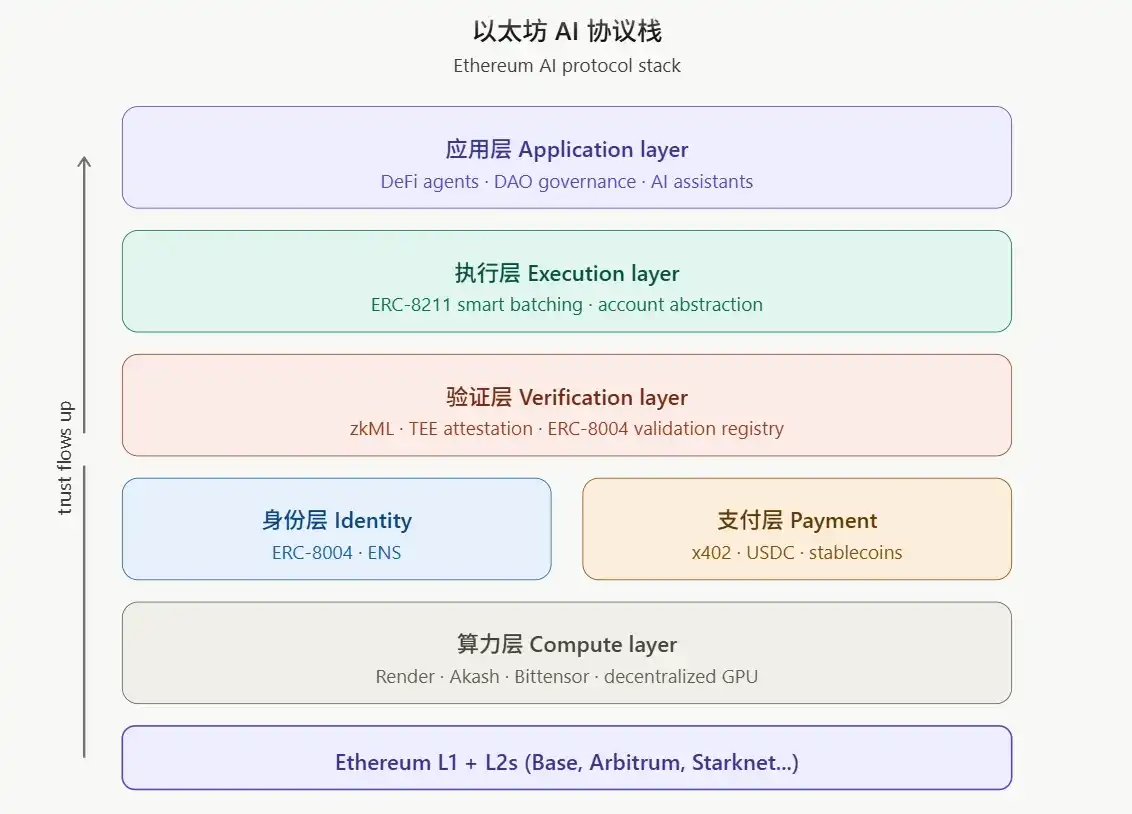
Looking at these three together, Ethereum's recent thread is already very clear: ERC-8004 answers "Who are you, and why should others trust you?", x402 answers "How do you pay for services?", and ERC-8211 answers "How do you efficiently complete complex operations?".

In other words, what the AI Agent economy truly lacks is never just smarter large models, but a set of open, composable, and extensible protocol stacks; and this is precisely what Ethereum does best.
III. Beyond Ethereum: Solana, DePIN, and Decentralized Computing

Of course, even though Ethereum holds a leading position in standard setting and trust infrastructure, the encrypted AI ecosystem is far more than just one chain.

A more accurate statement is that Ethereum is competing for the standard layer and trust layer, while other ecosystems show different advantages on the execution layer and computing power layer.

Solana is the most typical example. The reason its presence is increasingly felt in the topic of Agent payment stems from the fact that the chain requirements for AI Agents are not about ideological correctness, but about "low latency, low cost, and sufficient stability." Solana's official introduction to x402 directly promotes millisecond-level finality and extremely low transaction costs as important selling points for machine payments. This also explains why Solana more easily承接 (undertakes) those high-frequency, small-amount, instant-feedback-required Agent interaction scenarios.

At the same time, the Agent toolchain around Solana is also rapidly maturing. The Solana Agent Kit official GitHub allows Agents on any model to autonomously execute over 60 types of Solana actions, covering transactions, token issuance, lending, airdrops, Blink, cross-chain, and other scenarios, and is reused by a large number of on-chain projects and developers.

Therefore, looking at today's landscape, the division of labor in encrypted AI is becoming clearer. Ethereum seems more like doing the underlying abstraction of protocol standards, identity reputation, and trusted execution, while Solana holds practical advantages in high-frequency payments and low-friction interactions. The value of decentralized computing power networks will also be re-evaluated as more Agents truly enter production environments.

Overall, looking back from the vantage point of April 2026, the landscape of encrypted AI protocols has taken initial shape:

  • Identity Layer: ERC-8004, as Ethereum's leading Agent identity standard, has expanded to multiple chains like Base;
  • Payment Layer: x402 has grown from an experimental project by Coinbase to a global standard under the governance of the Linux Foundation;
  • Execution Layer: Standards like ERC-8211 simplify complex on-chain operations for Agents;
  • Verification Layer: Technologies like zkML, TEE, and cryptographic proofs begin to provide verifiability for high-value Agent interactions;
  • Competitive Landscape: Ethereum handles the standard and trust layer, Solana handles the high-frequency execution layer, and Bittensor can perhaps serve as a supplement in dimensions like computing power, forming a complementary rather than zero-sum格局 (situation);
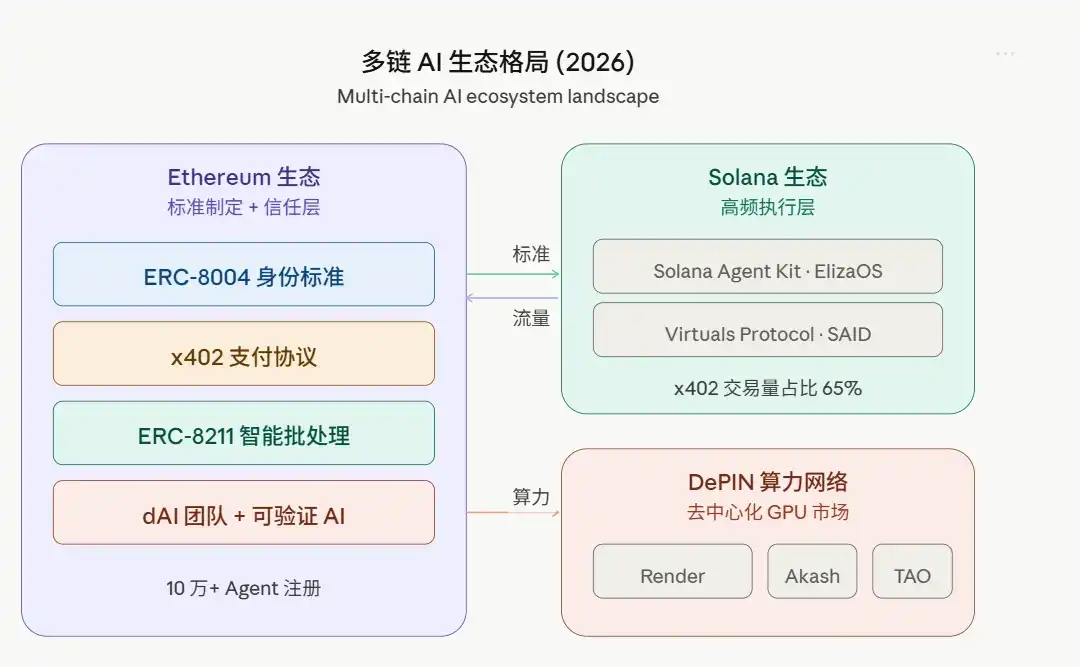
Looking ahead to the second half of the year, the new Ethereum upgrade will likely promote L1 scaling, native account abstraction, and post-quantum security. The普及 (popularization) of account abstraction will undoubtedly significantly reduce the usage threshold for Agent wallets; the deep integration of x402 and ERC-8004 could also give rise to a closed-loop Agent economy, covering Agent registration identity, service discovery, payment initiation, and reputation accumulation, all completed on-chain.

In Conclusion

Ethereum and blockchain are not about accelerating the arrival of AI, but about ensuring that when AI arrives, the world does not spiral out of control.

After all, in the Web2 world, AI's identity is defined by big companies' API Keys, payments are carried by the credit card system, and trust is endorsed by centralized platforms. This system barely functions in scenarios for human users, but under the new paradigm where millions of AI Agents need to collaborate autonomously 7×24, it is increasingly inadequate.

And standard-setters with Ethereum at the core, efficient execution layers represented by Solana, and decentralized computing power supported by DePIN, might just build a whole new set of infrastructure for the AI Agent economy.


Domande pertinenti

QWhat are the four core pillars of Vitalik Buterin's AI framework for Ethereum?

AThe four core pillars are: 1) Trustworthy AI interaction tools (e.g., local LLMs, zero-knowledge proof payment mechanisms), 2) AI economic coordination layer (smart contracts for agent payments, security deposits, dispute resolution, and reputation), 3) AI as a Web3 interface (AI assistants for drafting transactions, auditing contracts, etc.), and 4) AI-enhanced governance systems (upgrading prediction markets, quadratic voting, etc.).

QWhat is the primary purpose of the ERC-8004 standard in the Ethereum AI ecosystem?

AERC-8004 is an identity, reputation, and verification standard for AI Agents. It provides three key functions: an identity registry (NFT-based Agent identities), a reputation registry (user/Agent feedback tied to economic behavior), and a verification registry (third-party validation via TEE or zk-proofs for high-risk tasks).

QHow does the x402 protocol facilitate machine-to-machine payments?

AThe x402 protocol uses HTTP's 402 status code (Payment Required) to enable seamless payments. When an AI Agent accesses a paid service, the server returns a 402 code with payment details. The Agent pays with stablecoins or traditional methods (ACH/cards) without human intervention, embedding payments directly into HTTP interactions.

QWhat problem does ERC-8211 solve for AI Agents in DeFi, and how?

AERC-8211 addresses the inefficiency of multi-step DeFi operations by enabling atomic batch execution. It allows AI Agents to combine actions (e.g., borrowing from Aave, swapping on Uniswap, depositing to Compound) into a single transaction with dynamic value resolution, eliminating the need for multiple signatures or new smart contracts.

QHow do Ethereum and Solana differ in their roles within the crypto AI landscape according to the article?

AEthereum focuses on protocol standards, trust infrastructure (identity, reputation, and verification layers), and abstract底层信任, while Solana excels in high-frequency, low-cost execution layers for Agent payments and interactions due to its millisecond finality and low transaction fees, creating a complementary rather than competitive格局.

Letture associate

$292 Million KelpDAO Cross-Chain Bridge Hack: Who Should Foot the Bill?

On April 18, 2026, an attacker stole 116,500 rsETH (worth ~$292M) from KelpDAO’s cross-chain bridge in 46 minutes—the largest DeFi exploit of 2026. The stolen assets were deposited into Aave V3 as collateral, causing $177–200M in bad debt and triggering a cascade of losses across nine DeFi protocols. Aave’s TVL dropped by ~$6B overnight. This legal analysis argues that KelpDAO and LayerZero Labs share concurrent liability, with fault apportioned 60%/40%. KelpDAO negligently configured its bridge with a 1-of-1 decentralized verifier network (DVN)—a single point of failure—despite LayerZero’s explicit recommendation of a 2-of-3 setup. LayerZero, which operated the compromised DVN, failed to secure its RPC infrastructure against a known poisoning attack vector. Both protocols’ terms of service cap liability at $200 (KelpDAO) or $50 (LayerZero), but these limits are likely unenforceable due to unconscionability, gross negligence exceptions, and potential securities law invalidation (if rsETH is deemed a security under the Howey test). Aave’s governance also faces fiduciary duty claims for raising rsETH’s loan-to-value ratio to 93%—far above competitors’ 72–75%—without adequately assessing bridge risks, amplifying the systemic fallout. Practical recovery targets include LayerZero Labs (a registered Canadian entity), KelpDAO’s founders, auditors, and identifiable Aave governance delegates. The incident underscores escalating legal risks for DeFi protocols, infrastructure providers, and governance participants.

marsbit47 min fa

$292 Million KelpDAO Cross-Chain Bridge Hack: Who Should Foot the Bill?

marsbit47 min fa

Insider Trading in War: 5 People Involved, the Highest Earner Was Arrested

On April 24, the U.S. Department of Justice arrested U.S. Army Special Forces Staff Sergeant Gannon Ken Van Dyke for insider trading related to the capture of Venezuelan President Nicolás Maduro on January 3. Van Dyke allegedly profited over $400,000 by placing bets on a prediction market, Polymarket, using insider knowledge of the covert operation. According to the indictment, Van Dyke registered an account (0x31a5) on December 26 and made a series of bets predicting Maduro’s capture and U.S. military involvement in Venezuela. He withdrew most of his funds on the day of the operation and attempted to obscure his tracks by transferring assets through crypto and brokerage accounts. This case marks the first time the DOJ has prosecuted insider trading on Polymarket. PolyBeats had previously identified five suspicious accounts, including Van Dyke’s—the highest earner—in January. The other accounts, with profits ranging from $34,000 to $145,000, remain under unofficial scrutiny but have not been charged. Their lower profits, indirect access to information, and unclear legal boundaries may complicate prosecution. Polymarket has since strengthened its market integrity rules, explicitly prohibiting trading based on confidential or insider information. Van Dyke’s arrest, nearly four months after his trades, signals increased regulatory attention and the persistent traceability of blockchain-based transactions.

marsbit49 min fa

Insider Trading in War: 5 People Involved, the Highest Earner Was Arrested

marsbit49 min fa

Bitwise: Bullish on Bitcoin's Performance in the Second Half of the Year, AI and Regulation Will Spark a New Altcoin Season

Bitwise CIO Matt Hougan and Research Lead Ryan Rasmussen express strong bullish sentiment on Bitcoin's long-term prospects, suggesting that its $1 million price target may be too conservative. They argue Bitcoin serves a dual role: as digital gold and a potential global settlement asset, especially amid declining trust in traditional monetary systems. Despite a weak Q1 2026 where nearly all crypto assets and prices saw double-digit declines, the analysts remain optimistic due to strong forward-looking catalysts, including institutional adoption via Bitcoin ETFs from major firms like Morgan Stanley and Goldman Sachs. Geopolitical instability, such as Iran’s mention of using Bitcoin for international payments, increases the value of Bitcoin’s “out-of-the-money call option” as a non-political, global settlement currency. This enhances its appeal beyond a mere store of value. . Additionally, Hougan highlights that a clearer regulatory token framework under current SEC leadership, combined with AI efficiency gains and high-performance blockchains, could fuel a new “altseason” by late 2026. This may lead to a wave of legitimate, value-capturing token projects, unlike the earlier ICO boom. . Bitwise also announced an Avalanche ETF, citing its unique architecture and rapid growth in real-world asset (RWA) tokenization, which has surged 10x to nearly $30 billion in two years. The firm believes Layer 1 blockchains are still early in their growth cycle, with significant potential ahead.

marsbit1 h fa

Bitwise: Bullish on Bitcoin's Performance in the Second Half of the Year, AI and Regulation Will Spark a New Altcoin Season

marsbit1 h fa

Trading

Spot
Futures

Articoli Popolari

Cosa è $S$

Comprendere SPERO: Una Panoramica Completa Introduzione a SPERO Mentre il panorama dell'innovazione continua a evolversi, l'emergere delle tecnologie web3 e dei progetti di criptovaluta gioca un ruolo fondamentale nel plasmare il futuro digitale. Un progetto che ha attirato l'attenzione in questo campo dinamico è SPERO, denotato come SPERO,$$s$. Questo articolo mira a raccogliere e presentare informazioni dettagliate su SPERO, per aiutare gli appassionati e gli investitori a comprendere le sue basi, obiettivi e innovazioni nei domini web3 e crypto. Che cos'è SPERO,$$s$? SPERO,$$s$ è un progetto unico all'interno dello spazio crypto che cerca di sfruttare i principi della decentralizzazione e della tecnologia blockchain per creare un ecosistema che promuove l'impegno, l'utilità e l'inclusione finanziaria. Il progetto è progettato per facilitare interazioni peer-to-peer in modi nuovi, fornendo agli utenti soluzioni e servizi finanziari innovativi. Al suo interno, SPERO,$$s$ mira a responsabilizzare gli individui fornendo strumenti e piattaforme che migliorano l'esperienza dell'utente nello spazio delle criptovalute. Questo include la possibilità di metodi di transazione più flessibili, la promozione di iniziative guidate dalla comunità e la creazione di percorsi per opportunità finanziarie attraverso applicazioni decentralizzate (dApps). La visione sottostante di SPERO,$$s$ ruota attorno all'inclusività, cercando di colmare le lacune all'interno della finanza tradizionale mentre sfrutta i vantaggi della tecnologia blockchain. Chi è il Creatore di SPERO,$$s$? L'identità del creatore di SPERO,$$s$ rimane piuttosto oscura, poiché ci sono risorse pubblicamente disponibili limitate che forniscono informazioni dettagliate sul suo fondatore o fondatori. Questa mancanza di trasparenza può derivare dall'impegno del progetto per la decentralizzazione—un ethos che molti progetti web3 condividono, dando priorità ai contributi collettivi rispetto al riconoscimento individuale. Centrando le discussioni attorno alla comunità e ai suoi obiettivi collettivi, SPERO,$$s$ incarna l'essenza dell'empowerment senza mettere in evidenza individui specifici. Pertanto, comprendere l'etica e la missione di SPERO rimane più importante che identificare un creatore singolo. Chi sono gli Investitori di SPERO,$$s$? SPERO,$$s$ è supportato da una varietà di investitori che vanno dai capitalisti di rischio agli investitori angelici dedicati a promuovere l'innovazione nel settore crypto. Il focus di questi investitori generalmente si allinea con la missione di SPERO—dando priorità a progetti che promettono avanzamenti tecnologici sociali, inclusività finanziaria e governance decentralizzata. Queste fondazioni di investitori sono tipicamente interessate a progetti che non solo offrono prodotti innovativi, ma contribuiscono anche positivamente alla comunità blockchain e ai suoi ecosistemi. Il supporto di questi investitori rafforza SPERO,$$s$ come un concorrente degno di nota nel dominio in rapida evoluzione dei progetti crypto. Come Funziona SPERO,$$s$? SPERO,$$s$ impiega un framework multifunzionale che lo distingue dai progetti di criptovaluta convenzionali. Ecco alcune delle caratteristiche chiave che sottolineano la sua unicità e innovazione: Governance Decentralizzata: SPERO,$$s$ integra modelli di governance decentralizzati, responsabilizzando gli utenti a partecipare attivamente ai processi decisionali riguardanti il futuro del progetto. Questo approccio favorisce un senso di proprietà e responsabilità tra i membri della comunità. Utilità del Token: SPERO,$$s$ utilizza il proprio token di criptovaluta, progettato per servire varie funzioni all'interno dell'ecosistema. Questi token abilitano transazioni, premi e la facilitazione dei servizi offerti sulla piattaforma, migliorando l'impegno e l'utilità complessivi. Architettura Stratificata: L'architettura tecnica di SPERO,$$s$ supporta la modularità e la scalabilità, consentendo un'integrazione fluida di funzionalità e applicazioni aggiuntive man mano che il progetto evolve. Questa adattabilità è fondamentale per mantenere la rilevanza nel panorama crypto in continua evoluzione. Coinvolgimento della Comunità: Il progetto enfatizza iniziative guidate dalla comunità, impiegando meccanismi che incentivano la collaborazione e il feedback. Nutrendo una comunità forte, SPERO,$$s$ può affrontare meglio le esigenze degli utenti e adattarsi alle tendenze di mercato. Focus sull'Inclusione: Offrendo basse commissioni di transazione e interfacce user-friendly, SPERO,$$s$ mira ad attrarre una base utenti diversificata, inclusi individui che potrebbero non aver precedentemente interagito nello spazio crypto. Questo impegno per l'inclusione si allinea con la sua missione generale di empowerment attraverso l'accessibilità. Cronologia di SPERO,$$s$ Comprendere la storia di un progetto fornisce preziose intuizioni sulla sua traiettoria di sviluppo e sui traguardi. Di seguito è riportata una cronologia suggerita che mappa eventi significativi nell'evoluzione di SPERO,$$s$: Fase di Concettualizzazione e Ideazione: Le idee iniziali che formano la base di SPERO,$$s$ sono state concepite, allineandosi strettamente con i principi di decentralizzazione e focus sulla comunità all'interno dell'industria blockchain. Lancio del Whitepaper del Progetto: Dopo la fase concettuale, è stato rilasciato un whitepaper completo che dettaglia la visione, gli obiettivi e l'infrastruttura tecnologica di SPERO,$$s$ per suscitare interesse e feedback dalla comunità. Costruzione della Comunità e Prime Interazioni: Sono stati effettuati sforzi attivi di outreach per costruire una comunità di early adopters e potenziali investitori, facilitando discussioni attorno agli obiettivi del progetto e ottenendo supporto. Evento di Generazione del Token: SPERO,$$s$ ha condotto un evento di generazione del token (TGE) per distribuire i propri token nativi ai primi sostenitori e stabilire una liquidità iniziale all'interno dell'ecosistema. Lancio della Prima dApp: La prima applicazione decentralizzata (dApp) associata a SPERO,$$s$ è stata attivata, consentendo agli utenti di interagire con le funzionalità principali della piattaforma. Sviluppo Continuo e Partnership: Aggiornamenti e miglioramenti continui alle offerte del progetto, inclusi partnership strategiche con altri attori nello spazio blockchain, hanno plasmato SPERO,$$s$ in un concorrente competitivo e in evoluzione nel mercato crypto. Conclusione SPERO,$$s$ rappresenta una testimonianza del potenziale del web3 e delle criptovalute di rivoluzionare i sistemi finanziari e responsabilizzare gli individui. Con un impegno per la governance decentralizzata, il coinvolgimento della comunità e funzionalità progettate in modo innovativo, apre la strada verso un panorama finanziario più inclusivo. Come per qualsiasi investimento nello spazio crypto in rapida evoluzione, si incoraggiano potenziali investitori e utenti a ricercare approfonditamente e a impegnarsi in modo riflessivo con gli sviluppi in corso all'interno di SPERO,$$s$. Il progetto mostra lo spirito innovativo dell'industria crypto, invitando a ulteriori esplorazioni delle sue innumerevoli possibilità. Mentre il percorso di SPERO,$$s$ è ancora in fase di sviluppo, i suoi principi fondamentali potrebbero effettivamente influenzare il futuro di come interagiamo con la tecnologia, la finanza e tra di noi in ecosistemi digitali interconnessi.

75 Totale visualizzazioniPubblicato il 2024.12.17Aggiornato il 2024.12.17

Cosa è $S$

Cosa è AGENT S

Agent S: Il Futuro dell'Interazione Autonoma in Web3 Introduzione Nel panorama in continua evoluzione di Web3 e criptovalute, le innovazioni stanno costantemente ridefinendo il modo in cui gli individui interagiscono con le piattaforme digitali. Uno di questi progetti pionieristici, Agent S, promette di rivoluzionare l'interazione uomo-computer attraverso il suo framework agentico aperto. Aprendo la strada a interazioni autonome, Agent S mira a semplificare compiti complessi, offrendo applicazioni trasformative nell'intelligenza artificiale (AI). Questa esplorazione dettagliata approfondirà le complessità del progetto, le sue caratteristiche uniche e le implicazioni per il dominio delle criptovalute. Cos'è Agent S? Agent S si presenta come un innovativo framework agentico aperto, progettato specificamente per affrontare tre sfide fondamentali nell'automazione dei compiti informatici: Acquisizione di Conoscenze Specifiche del Dominio: Il framework apprende in modo intelligente da varie fonti di conoscenza esterne ed esperienze interne. Questo approccio duale gli consente di costruire un ricco repository di conoscenze specifiche del dominio, migliorando le sue prestazioni nell'esecuzione dei compiti. Pianificazione su Lungo Orizzonte di Compiti: Agent S impiega una pianificazione gerarchica potenziata dall'esperienza, un approccio strategico che facilita la suddivisione e l'esecuzione efficiente di compiti complessi. Questa caratteristica migliora significativamente la sua capacità di gestire più sottocompiti in modo efficiente ed efficace. Gestione di Interfacce Dinamiche e Non Uniformi: Il progetto introduce l'Interfaccia Agente-Computer (ACI), una soluzione innovativa che migliora l'interazione tra agenti e utenti. Utilizzando Modelli Linguistici Multimodali di Grandi Dimensioni (MLLM), Agent S può navigare e manipolare senza sforzo diverse interfacce grafiche utente. Attraverso queste caratteristiche pionieristiche, Agent S fornisce un framework robusto che affronta le complessità coinvolte nell'automazione dell'interazione umana con le macchine, preparando il terreno per innumerevoli applicazioni nell'AI e oltre. Chi è il Creatore di Agent S? Sebbene il concetto di Agent S sia fondamentalmente innovativo, informazioni specifiche sul suo creatore rimangono elusive. Il creatore è attualmente sconosciuto, il che evidenzia sia la fase embrionale del progetto sia la scelta strategica di mantenere i membri fondatori sotto anonimato. Indipendentemente dall'anonimato, l'attenzione rimane sulle capacità e sul potenziale del framework. Chi sono gli Investitori di Agent S? Poiché Agent S è relativamente nuovo nell'ecosistema crittografico, informazioni dettagliate riguardanti i suoi investitori e sostenitori finanziari non sono documentate esplicitamente. La mancanza di approfondimenti pubblicamente disponibili sulle fondazioni di investimento o sulle organizzazioni che supportano il progetto solleva interrogativi sulla sua struttura di finanziamento e sulla roadmap di sviluppo. Comprendere il supporto è cruciale per valutare la sostenibilità del progetto e il suo potenziale impatto sul mercato. Come Funziona Agent S? Al centro di Agent S si trova una tecnologia all'avanguardia che gli consente di funzionare efficacemente in contesti diversi. Il suo modello operativo è costruito attorno a diverse caratteristiche chiave: Interazione Uomo-Computer Simile a Quella Umana: Il framework offre una pianificazione AI avanzata, cercando di rendere le interazioni con i computer più intuitive. Mimando il comportamento umano nell'esecuzione dei compiti, promette di elevare le esperienze degli utenti. Memoria Narrativa: Utilizzata per sfruttare esperienze di alto livello, Agent S utilizza la memoria narrativa per tenere traccia delle storie dei compiti, migliorando così i suoi processi decisionali. Memoria Episodica: Questa caratteristica fornisce agli utenti una guida passo-passo, consentendo al framework di offrire supporto contestuale mentre i compiti si sviluppano. Supporto per OpenACI: Con la capacità di funzionare localmente, Agent S consente agli utenti di mantenere il controllo sulle proprie interazioni e flussi di lavoro, allineandosi con l'etica decentralizzata di Web3. Facile Integrazione con API Esterne: La sua versatilità e compatibilità con varie piattaforme AI garantiscono che Agent S possa adattarsi senza problemi agli ecosistemi tecnologici esistenti, rendendolo una scelta attraente per sviluppatori e organizzazioni. Queste funzionalità contribuiscono collettivamente alla posizione unica di Agent S all'interno dello spazio crittografico, poiché automatizza compiti complessi e multi-fase con un intervento umano minimo. Man mano che il progetto evolve, le sue potenziali applicazioni in Web3 potrebbero ridefinire il modo in cui si svolgono le interazioni digitali. Cronologia di Agent S Lo sviluppo e le tappe di Agent S possono essere riassunti in una cronologia che evidenzia i suoi eventi significativi: 27 Settembre 2024: Il concetto di Agent S è stato lanciato in un documento di ricerca completo intitolato “Un Framework Agentico Aperto che Usa i Computer Come un Umano”, mostrando le basi per il progetto. 10 Ottobre 2024: Il documento di ricerca è stato reso pubblicamente disponibile su arXiv, offrendo un'esplorazione approfondita del framework e della sua valutazione delle prestazioni basata sul benchmark OSWorld. 12 Ottobre 2024: È stata rilasciata una presentazione video, fornendo un'idea visiva delle capacità e delle caratteristiche di Agent S, coinvolgendo ulteriormente potenziali utenti e investitori. Questi indicatori nella cronologia non solo illustrano i progressi di Agent S, ma indicano anche il suo impegno per la trasparenza e il coinvolgimento della comunità. Punti Chiave su Agent S Man mano che il framework Agent S continua a evolversi, diversi attributi chiave si distinguono, sottolineando la sua natura innovativa e il potenziale: Framework Innovativo: Progettato per fornire un uso intuitivo dei computer simile all'interazione umana, Agent S porta un approccio nuovo all'automazione dei compiti. Interazione Autonoma: La capacità di interagire autonomamente con i computer attraverso GUI segna un passo avanti verso soluzioni informatiche più intelligenti ed efficienti. Automazione di Compiti Complessi: Con la sua metodologia robusta, può automatizzare compiti complessi e multi-fase, rendendo i processi più veloci e meno soggetti a errori. Miglioramento Continuo: I meccanismi di apprendimento consentono ad Agent S di migliorare dalle esperienze passate, migliorando continuamente le sue prestazioni e la sua efficacia. Versatilità: La sua adattabilità attraverso diversi ambienti operativi come OSWorld e WindowsAgentArena garantisce che possa servire un'ampia gamma di applicazioni. Man mano che Agent S si posiziona nel panorama di Web3 e delle criptovalute, il suo potenziale per migliorare le capacità di interazione e automatizzare i processi segna un significativo avanzamento nelle tecnologie AI. Attraverso il suo framework innovativo, Agent S esemplifica il futuro delle interazioni digitali, promettendo un'esperienza più fluida ed efficiente per gli utenti in vari settori. Conclusione Agent S rappresenta un audace passo avanti nell'unione tra AI e Web3, con la capacità di ridefinire il modo in cui interagiamo con la tecnologia. Sebbene sia ancora nelle sue fasi iniziali, le possibilità per la sua applicazione sono vaste e coinvolgenti. Attraverso il suo framework completo che affronta sfide critiche, Agent S mira a portare le interazioni autonome al centro dell'esperienza digitale. Man mano che ci addentriamo nei regni delle criptovalute e della decentralizzazione, progetti come Agent S giocheranno senza dubbio un ruolo cruciale nel plasmare il futuro della tecnologia e della collaborazione uomo-computer.

416 Totale visualizzazioniPubblicato il 2025.01.14Aggiornato il 2025.01.14

Cosa è AGENT S

Come comprare S

Benvenuto in HTX.com! Abbiamo reso l'acquisto di Sonic (S) semplice e conveniente. Segui la nostra guida passo passo per intraprendere il tuo viaggio nel mondo delle criptovalute.Step 1: Crea il tuo Account HTXUsa la tua email o numero di telefono per registrarti il tuo account gratuito su HTX. Vivi un'esperienza facile e sblocca tutte le funzionalità,Crea il mio accountStep 2: Vai in Acquista crypto e seleziona il tuo metodo di pagamentoCarta di credito/debito: utilizza la tua Visa o Mastercard per acquistare immediatamente SonicS.Bilancio: Usa i fondi dal bilancio del tuo account HTX per fare trading senza problemi.Terze parti: abbiamo aggiunto metodi di pagamento molto utilizzati come Google Pay e Apple Pay per maggiore comodità.P2P: Fai trading direttamente con altri utenti HTX.Over-the-Counter (OTC): Offriamo servizi su misura e tassi di cambio competitivi per i trader.Step 3: Conserva Sonic (S)Dopo aver acquistato Sonic (S), conserva nel tuo account HTX. In alternativa, puoi inviare tramite trasferimento blockchain o scambiare per altre criptovalute.Step 4: Scambia Sonic (S)Scambia facilmente Sonic (S) nel mercato spot di HTX. Accedi al tuo account, seleziona la tua coppia di trading, esegui le tue operazioni e monitora in tempo reale. Offriamo un'esperienza user-friendly sia per chi ha appena iniziato che per i trader più esperti.

833 Totale visualizzazioniPubblicato il 2025.01.15Aggiornato il 2025.03.21

Come comprare S

Discussioni

Benvenuto nella Community HTX. Qui puoi rimanere informato sugli ultimi sviluppi della piattaforma e accedere ad approfondimenti esperti sul mercato. Le opinioni degli utenti sul prezzo di S S sono presentate come di seguito.

活动图片