The CLARITY Act Could Kill Stablecoin Yield – Here Is Where the Money Goes Instead

bitcoinistPubblicato 2026-03-25Pubblicato ultima volta 2026-03-25

Introduzione

The CLARITY Act's proposed ban on stablecoin yield is causing significant market shift, as evidenced by Circle's (USDC) 18% value drop, erasing $4.6 billion. This legislative move aims to separate stablecoins' dual functions—yield generation and utility—by restricting passive returns. The report argues this won't eliminate yield demand but redirect it to DeFi, tokenized Treasuries, or offshore markets. Meanwhile, stablecoins may evolve into pure utility tools for payments, settlement, and collateral, with on-chain data showing active addresses at all-time highs, indicating sustained capital movement and usage.

The stablecoin market is facing a critical test. Not a market cycle. Not a liquidity event. A legislative one — and the damage is already visible.

An XWIN Research Japan report documents what happened in a single session: Circle, the issuer behind USDC, shed 18% of its market value yesterday, erasing roughly $4.6 billion in a matter of hours. The trigger was not an earnings miss or an exchange collapse. It was a draft amendment — a proposed update to the CLARITY Act that would ban yield on stablecoins entirely.

That one legislative clause, not yet law, not yet finalized, was enough to reprice the entire thesis of what Circle is worth. The market understood the implication before the headlines did.

The report places the price reaction in its proper context: this is not volatility. It is a structural signal. For years, stablecoins operated as dual-purpose instruments — digital dollars for payments and settlement, yield-generating assets for the wallets that held them. That combination was the product. The CLARITY framework, as currently drafted, moves to separate those functions permanently, restricting passive yield while permitting only activity-based rewards.

One draft law. Two functions severed. The model that built USDC into a market cornerstone is now the model under review.

Stablecoin Capital Does Not Disappear. It Relocates.

The report is precise about what is actually at stake beneath the regulatory language: this is a competition for capital, and every participant in the financial system knows it. Banks are not lobbying against stablecoin yield out of principle. They are lobbying because deposit outflows are a solvency concern. Crypto platforms are not defending yield out of ideology. They are defending the incentive structure that keeps liquidity on their platforms. Regulation is the arena. Capital is the prize.

What history tells us — and the report invokes it directly — is that capping yield does not destroy yield demand. It redirects it. When deposit rates were capped in an earlier era, money flowed into money market funds. The same logic applies here. Yield demand will migrate toward DeFi protocols, tokenized Treasuries, or offshore markets that operate outside the CLARITY framework’s reach. The capital will move. It always does.

What remains — and this is the report’s most consequential observation — may be more durable than what is lost. Strip yield from stablecoins and what survives is utility: payments, settlement, collateral, liquidity. They stop being financial products competing with savings accounts and start being infrastructure competing with correspondent banking.
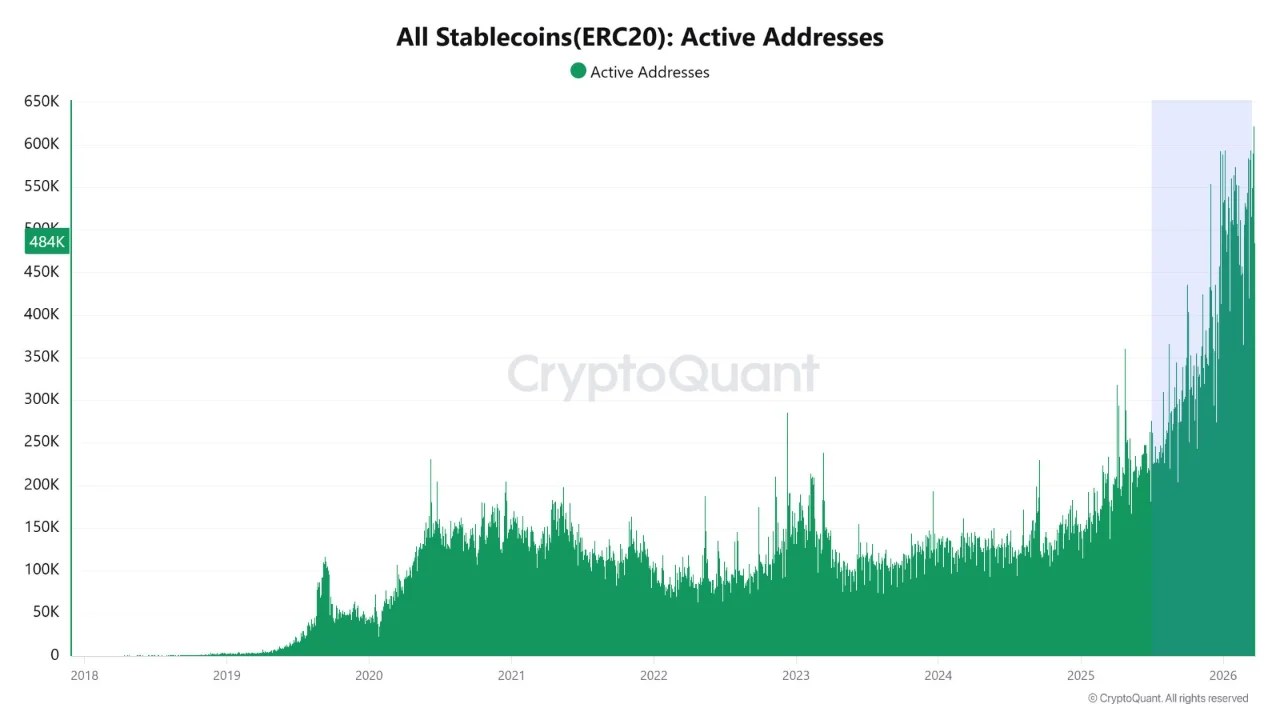
All Stablecoin (ERC20) Active Addresses | Source: CryptoQuant

The on-chain data already reflects this transition. Stablecoin active addresses are at all-time highs. The capital is not idle. It is being used — and if regulation delivers the clarity it promises, that usage curve has further to climb.


Domande pertinenti

QWhat was the immediate market impact of the proposed CLARITY Act amendment on Circle and USDC?

ACircle, the issuer of USDC, lost 18% of its market value in a single session, erasing approximately $4.6 billion in market capitalization.

QAccording to the article, what is the fundamental purpose of the CLARITY Act's proposed restriction on stablecoin yield?

AThe proposed update to the CLARITY Act would ban yield on stablecoins entirely, separating their dual functions by restricting passive yield while permitting only activity-based rewards.

QWhere does the article suggest capital will flow if stablecoin yields are capped by regulation?

AThe article suggests yield demand will migrate toward DeFi protocols, tokenized Treasuries, or offshore markets that operate outside the CLARITY framework's reach, similar to how money flowed into money market funds when deposit rates were capped historically.

QWhat does the article identify as the core utility that will remain for stablecoins if yield is removed?

AIf yield is stripped from stablecoins, their core utility that remains includes payments, settlement, collateral, and liquidity functions, transforming them from financial products into infrastructure competing with correspondent banking.

QWhat on-chain metric does the article cite as evidence that stablecoin capital remains active despite regulatory concerns?

AThe article cites that stablecoin active addresses are at all-time highs, indicating the capital is not idle but is being used, with potential for further growth if regulatory clarity is achieved.

Letture associate

Dan Koe: The Counterintuitive Truth—You Don't Need to Remember Everything You Read

Dan Koe: The Counterintuitive Truth — You Don't Need to Remember Everything You Read The central idea is that deliberately trying to remember information is often misguided. True learning isn't about memorizing facts but about having important knowledge surface naturally when needed through use. Most forgetting is normal, not a failure. The article reframes learning using a control theory framework—a four-step feedback loop: having a clear Goal, accurately Sensing your current state, Comparing the gap, and Acting to close it. Most learning stalls because people only do step 2 (blind input) without a goal to create the necessary "error signal" for focused action. The most effective method is to start with output, not input. Begin a meaningful personal project first, and learn only what's necessary to complete it. This project-driven, "just-in-time" learning ensures knowledge is contextual and retained. The concept of a "Second Brain" often fails because it becomes a digital graveyard—over-collected and under-utilized. The goal should be building a "Second Subconscious"—a dynamic system that proactively surfaces relevant ideas during creation, not a static storage vault. Tools like Obsidian+Claude or Eden can help by automating organization and enabling semantic search, but their value depends on linking knowledge to active projects. Ultimately, what matters is not what you store, but what you filter and internalize. Focus on ideas that shape your worldview, use projects as filters, and transform collected material through writing and sharing. AI should be used to reduce friction in research and editing, not to formulate your core views. In conclusion, remembering is a byproduct, not the goal. Knowledge that sticks comes from pursuing personal goals, applying it in real projects, and digesting it through creation. The tools are merely aids; the crucial step is to start doing meaningful work and let the necessary knowledge find you.

marsbit49 min fa

Dan Koe: The Counterintuitive Truth—You Don't Need to Remember Everything You Read

marsbit49 min fa

A New Era: The Fundamental Transformation of China's Entrepreneurs

A profound generational shift is underway among Chinese entrepreneurs. The wealth and influence once dominated by real estate and internet giants is now being claimed by a new wave of founders driving breakthroughs in AI, semiconductors, and robotics. This change is vividly reflected in 2026's wealth rankings. Figures like Zhang Yiming (ByteDance), Liang Wenfeng (DeepSeek), Chen Tianshi (Cambricon), and Wang Xingxing (Unitree Robotics) are ascending. Their wealth stems not from traditional business models but from market expectations for future technological competitiveness, with AI, chips, and smart hardware becoming the primary engines of wealth creation. Their common trait is a foundational focus on technology, often starting from the laboratory rather than a business plan. Examples include Chen Tianshi's decade-long push in AI chips, Liang Wenfeng's core algorithmic innovations at DeepSeek with a compact team, and Zhu Yiming's "no salary until profitable" 9-year journey to build Changxin Memory into a global DRAM player. This transition marks a fundamental shift in China's economic imperative: from commercial expansion and learning to indigenous innovation and deep industrial capability. While the previous generation built the foundational market and infrastructure, this new cohort is tasked with achieving global leadership in core technologies, moving China from "keeping pace" to pioneering original, breakthrough innovations that are industrialized at scale. The baton is being passed to those competing on the world stage through technological originality.

marsbit49 min fa

A New Era: The Fundamental Transformation of China's Entrepreneurs

marsbit49 min fa

Once-Popular Web3 Enters Wave of Layoffs

The once-hot Web3 industry is experiencing a severe wave of layoffs. While many companies attribute job cuts to AI-driven restructuring, the primary reason is often financial pressure. The Web3 sector, at the intersection of tech and finance, has been hit particularly hard. Employees at major cryptocurrency exchanges report sudden, impersonal layoffs—often with system access revoked overnight—and minimal or no severance. Common tactics include setting impossible performance targets or terminating employees for minor policy violations. The working atmosphere has become toxic, marked by intense monitoring, excessive meetings, and management obsessed with control and internal politics rather than product innovation. The industry's core business model is collapsing. Exchange revenue from trading fees and listing charges has plummeted due to a decline in quality projects and retail investor exodus. Events like the massive forced liquidation on October 10th further shattered confidence. Competition from on-chain derivatives platforms and prediction markets is intensifying the downturn. As layoffs continue, displaced workers struggle to find new opportunities. Many transition to the AI sector, but face significant bias from traditional finance and even some AI firms, which view crypto industry experience with suspicion. The current downturn appears more structural than cyclical, driven by unsustainable practices, internal strife, and a failure to innovate, raising questions about the industry's future trajectory.

marsbit1 h fa

Once-Popular Web3 Enters Wave of Layoffs

marsbit1 h fa

Trading

Spot
活动图片