The CLARITY Act Could Kill Stablecoin Yield – Here Is Where the Money Goes Instead

bitcoinistPubblicato 2026-03-25Pubblicato ultima volta 2026-03-25

Introduzione

The CLARITY Act's proposed ban on stablecoin yield is causing significant market shift, as evidenced by Circle's (USDC) 18% value drop, erasing $4.6 billion. This legislative move aims to separate stablecoins' dual functions—yield generation and utility—by restricting passive returns. The report argues this won't eliminate yield demand but redirect it to DeFi, tokenized Treasuries, or offshore markets. Meanwhile, stablecoins may evolve into pure utility tools for payments, settlement, and collateral, with on-chain data showing active addresses at all-time highs, indicating sustained capital movement and usage.

The stablecoin market is facing a critical test. Not a market cycle. Not a liquidity event. A legislative one — and the damage is already visible.

An XWIN Research Japan report documents what happened in a single session: Circle, the issuer behind USDC, shed 18% of its market value yesterday, erasing roughly $4.6 billion in a matter of hours. The trigger was not an earnings miss or an exchange collapse. It was a draft amendment — a proposed update to the CLARITY Act that would ban yield on stablecoins entirely.

That one legislative clause, not yet law, not yet finalized, was enough to reprice the entire thesis of what Circle is worth. The market understood the implication before the headlines did.

The report places the price reaction in its proper context: this is not volatility. It is a structural signal. For years, stablecoins operated as dual-purpose instruments — digital dollars for payments and settlement, yield-generating assets for the wallets that held them. That combination was the product. The CLARITY framework, as currently drafted, moves to separate those functions permanently, restricting passive yield while permitting only activity-based rewards.

One draft law. Two functions severed. The model that built USDC into a market cornerstone is now the model under review.

Stablecoin Capital Does Not Disappear. It Relocates.

The report is precise about what is actually at stake beneath the regulatory language: this is a competition for capital, and every participant in the financial system knows it. Banks are not lobbying against stablecoin yield out of principle. They are lobbying because deposit outflows are a solvency concern. Crypto platforms are not defending yield out of ideology. They are defending the incentive structure that keeps liquidity on their platforms. Regulation is the arena. Capital is the prize.

What history tells us — and the report invokes it directly — is that capping yield does not destroy yield demand. It redirects it. When deposit rates were capped in an earlier era, money flowed into money market funds. The same logic applies here. Yield demand will migrate toward DeFi protocols, tokenized Treasuries, or offshore markets that operate outside the CLARITY framework’s reach. The capital will move. It always does.

What remains — and this is the report’s most consequential observation — may be more durable than what is lost. Strip yield from stablecoins and what survives is utility: payments, settlement, collateral, liquidity. They stop being financial products competing with savings accounts and start being infrastructure competing with correspondent banking.
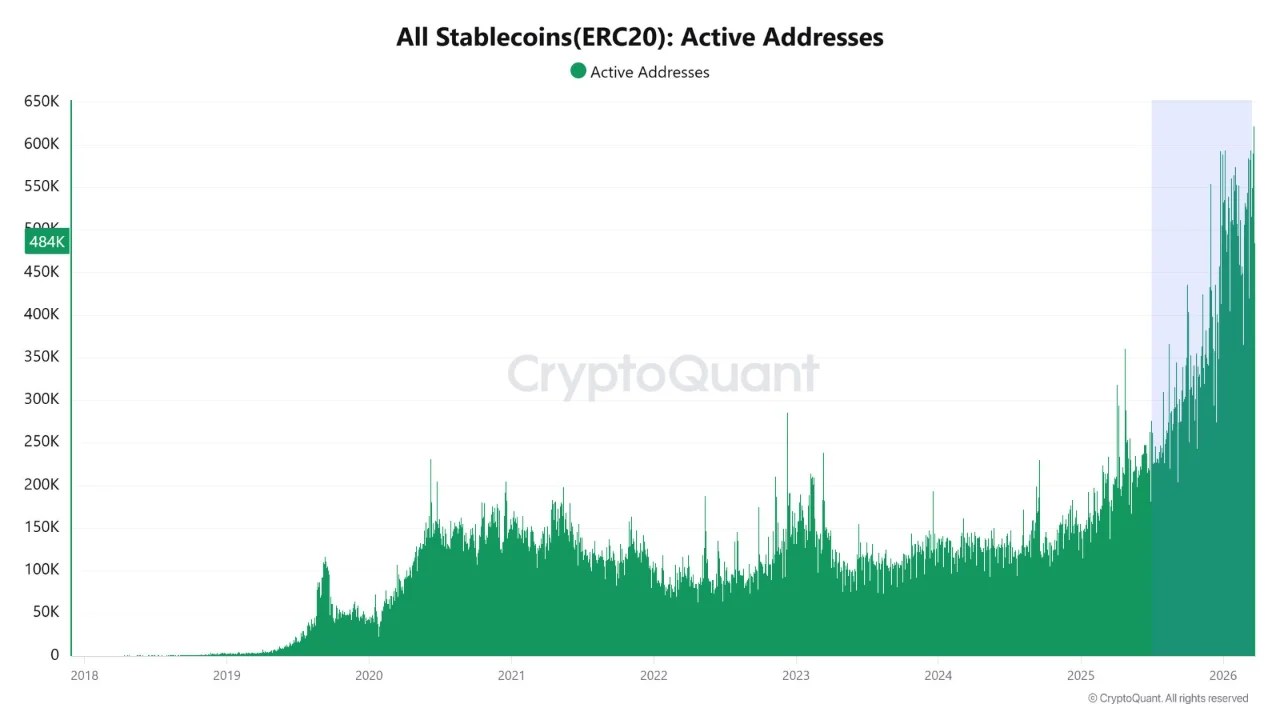
All Stablecoin (ERC20) Active Addresses | Source: CryptoQuant

The on-chain data already reflects this transition. Stablecoin active addresses are at all-time highs. The capital is not idle. It is being used — and if regulation delivers the clarity it promises, that usage curve has further to climb.


Domande pertinenti

QWhat was the immediate market impact of the proposed CLARITY Act amendment on Circle and USDC?

ACircle, the issuer of USDC, lost 18% of its market value in a single session, erasing approximately $4.6 billion in market capitalization.

QAccording to the article, what is the fundamental purpose of the CLARITY Act's proposed restriction on stablecoin yield?

AThe proposed update to the CLARITY Act would ban yield on stablecoins entirely, separating their dual functions by restricting passive yield while permitting only activity-based rewards.

QWhere does the article suggest capital will flow if stablecoin yields are capped by regulation?

AThe article suggests yield demand will migrate toward DeFi protocols, tokenized Treasuries, or offshore markets that operate outside the CLARITY framework's reach, similar to how money flowed into money market funds when deposit rates were capped historically.

QWhat does the article identify as the core utility that will remain for stablecoins if yield is removed?

AIf yield is stripped from stablecoins, their core utility that remains includes payments, settlement, collateral, and liquidity functions, transforming them from financial products into infrastructure competing with correspondent banking.

QWhat on-chain metric does the article cite as evidence that stablecoin capital remains active despite regulatory concerns?

AThe article cites that stablecoin active addresses are at all-time highs, indicating the capital is not idle but is being used, with potential for further growth if regulatory clarity is achieved.

Letture associate

Dalio Warns: AI Boom Shows Signs of a Bubble, Day of Reckoning Will Be the Time of Burst

Ray Dalio, founder of Bridgewater Associates, warns that the current artificial intelligence investment boom shows classic signs of a bubble, which he expects will eventually burst. In a Bloomberg Television interview, he noted that great technological revolutions often lead to capital inflows that create bubbles, making it difficult for investors and companies to calibrate their spending accurately—either overspending to capture market share or underspending and losing their competitive position. This caution comes amid significant rallies in AI-related assets, particularly chipmakers, driven by soaring demand for data centers and high-bandwidth chips, raising debates about overheating valuations. In contrast, Nvidia CEO Jensen Huang recently asserted that investors embracing the AI wave would see "crazy" returns and dismissed concerns over return on investment for data center spending as outdated. Dalio, however, focuses on the risks in the profit realization phase. He argues that bubbles tend to show signs of破裂 when markets transition from investment to the need for tangible returns, describing the burst as a process of converting paper wealth into cash. While acknowledging AI's intrinsic value, he expressed concern over the future profitability of some AI companies, suggesting the market is repeating a familiar pattern. The 76-year-old billionaire, who fully exited Bridgewater in 2025, has a net worth estimated at $21.5 billion according to the Bloomberg Billionaires Index.

marsbit16 min fa

Dalio Warns: AI Boom Shows Signs of a Bubble, Day of Reckoning Will Be the Time of Burst

marsbit16 min fa

Privacy Coin Crisis of Confidence! ZEC Plunges Over 56% in a Single Day

Zcash (ZEC), a leading privacy-focused cryptocurrency, experienced a severe crash on June 5th, plummeting over 56% in a single day and erasing nearly two months of gains. The flash crash was triggered by the disclosure of a critical zero-knowledge proof vulnerability within Zcash's Orchard privacy pool, which had existed since the pool's launch in May 2022. The flaw theoretically allowed an attacker to forge unlimited ZEC undetectably due to the pool's privacy features. The vulnerability was discovered on May 29th by independent security researcher Taylor Hornby during a proactive audit commissioned by Shielded Labs, utilizing AI-assisted analysis. The Zcash development team responded swiftly, implementing an emergency soft fork to disable Orchard transactions on June 2nd and executing a permanent hard fork fix (NU6.2) on June 3rd. Despite the technical fix, a major crisis of confidence emerged. The core issue is that Orchard's privacy design makes it cryptographically impossible to prove whether the vulnerability was exploited over the past four years, casting permanent doubt on the historical supply integrity of ZEC. While Shielded Labs argues exploitation was unlikely, the inability to provide definitive proof has severely damaged market trust. This sentiment was exacerbated when BitMEX co-founder Arthur Hayes, a prominent ZEC supporter, announced he was selling his entire position. He stated that privacy assets require "perfect security" rather than "probable safety." The combined effect of the disclosure and Hayes's exit ignited widespread panic selling, leading to massive liquidations and significant price decline. Analysts note the event highlights a fundamental tension within privacy coins: the conflict between verifiable supply and cryptographic privacy.

链捕手18 min fa

Privacy Coin Crisis of Confidence! ZEC Plunges Over 56% in a Single Day

链捕手18 min fa

Trading

Spot
Futures
活动图片