The Bustle Belongs to the 'Epsteins', Saylor Just Wants to Hoard Coins

比推Pubblicato 2026-02-02Pubblicato ultima volta 2026-02-02

Introduzione

The article discusses Michael Saylor, founder of MicroStrategy (now Strategy), in the context of the recently released Epstein documents. Saylor was mentioned in a 2010 email from Epstein's PR agent, Peggy Siegal, who described him as a socially awkward "zombie-like" figure who was difficult to engage with at a high-society dinner party. This perceived social ineptitude, a liability in elite circles, is presented as a key strength in his role as a Bitcoin maximalist. Saylor’s company is the largest corporate holder of Bitcoin, with 712,647 BTC purchased at an average cost of $76,037. Despite recent market volatility pushing Bitcoin below his average buy price and causing a 60% drop in his company's stock, Saylor remains unwavering. His strategy is simple and relentless: buy Bitcoin consistently and never sell, a philosophy he summarizes as "More Orange." The piece argues that the very traits that made him an outsider in social settings—being "boring," unemotional, and immune to external noise—are the same traits that make him uniquely suited to his long-term, single-minded accumulation strategy. While cautioning that his corporate financial tools are not available to the average investor, the article concludes that in a noisy market, a "boring" and disciplined approach is often the most profitable, contrasting Saylor's current success with the downfall of many involved in the Epstein scandal.

Author: Curry, Deep Tide TechFlow

Original Title: The Bustle Belongs to the 'Epsteins', Saylor Just Wants to Hoard Coins


There's a reason why one person can hoard 710,000 Bitcoins.

Last Friday, the U.S. Department of Justice released documents related to the Epstein case, spanning 3 million pages. Politicians, billionaires, celebrities—a string of names are popping up from these materials. And the founder of Strategy (formerly MicroStrategy), Michael Saylor, is also in there.

However, Saylor's appearance is a bit special; he was at the table that was looked down upon.

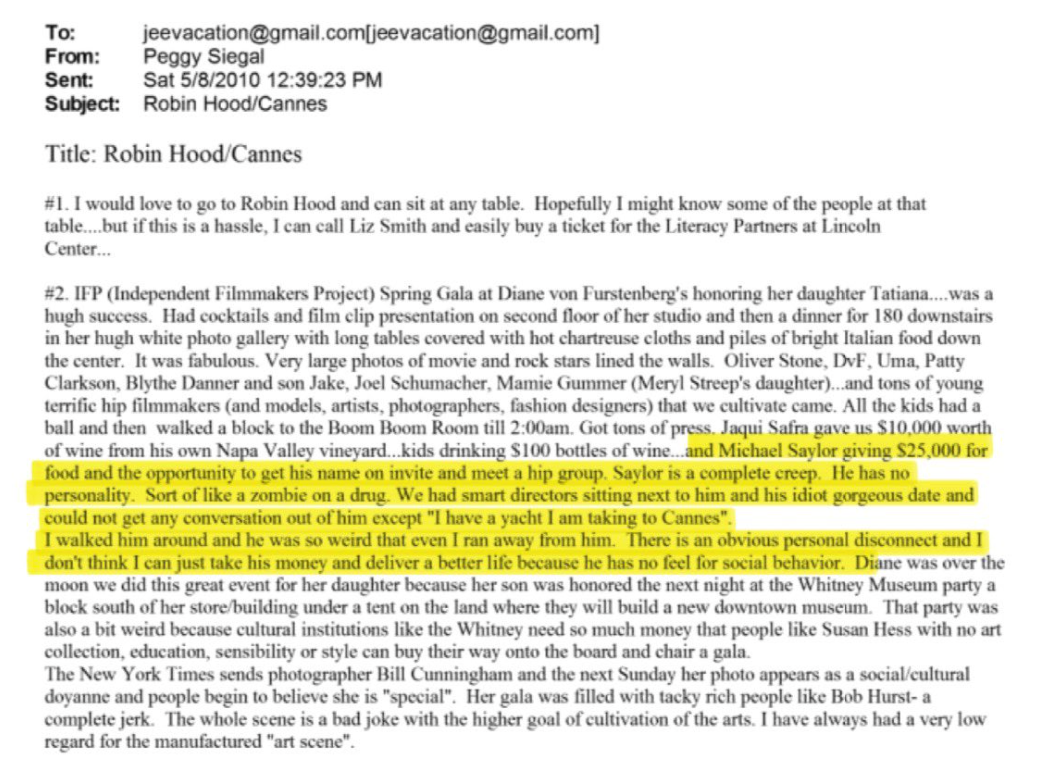
From the currently disclosed information, in 2010, Epstein's publicist Peggy Siegal once complained in a private email:

"There's a guy named Saylor who spent twenty-five thousand dollars on a dinner ticket, and I was responsible for socializing with him. But this guy was completely unapproachable, like a drugged zombie. I couldn't stand it and ran away halfway through."

Peggy's main job is as a Hollywood movie publicist, and her side hustle is helping Epstein organize dinners—essentially scouting for wealthy people to pull into the circle.

Socializing with the rich, helping them meet the right people at parties and dinners, ensuring they have a good time and spend their money comfortably. Having been in the business for decades, she's按理说 seen all kinds of billionaires.
But Saylor, she couldn't handle.

The reason wasn't that he had character flaws; it was that he was too dull. He paid to get in, sat there unable to chat, showed no interest in socializing at all.

Peggy's exact words were, "I don't even know if I can take his money, couldn't figure out how to handle him... He has no personality, completely ignorant of social etiquette."

Now that the Epstein case has exploded, people on the list are busy distancing themselves. Saylor, on the other hand, never managed to squeeze in back then.

Being overly boring and reclusive became a protective shield.

But when this "boredom" is placed in a different context, it's another story.

Saylor's company, Strategy (formerly MicroStrategy), is the publicly traded company holding the most Bitcoin globally. This January, when Bitcoin was still fluctuating around $90,000, they bought over 37,000 more Bitcoins, spending $3.5 billion.

Buying almost every week, rain or shine.

As of now, Strategy holds 712,647 Bitcoins, with an average cost of $76,037. And today, Bitcoin just fell below $76,000, meaning Saylor's position is right on the break-even line.

The market fear index hit a 20-week high, and the crypto world is filled with cries of despair. Strategy's stock price has also dropped 60% from its peak.
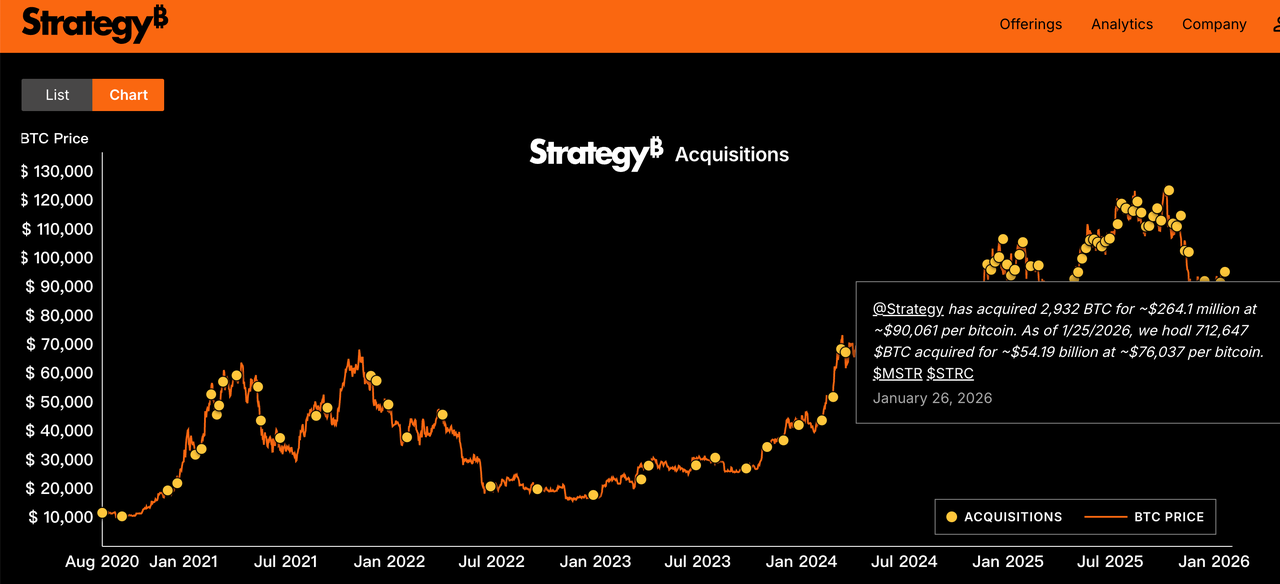
But Saylor tweeted "More Orange," implying he'll keep buying next week.

Back then, Peggy called him a zombie. Looking at it now, hoarding coins might just be a job for zombies.

No explanations, no timing the market, no getting off the ride. Feeling nothing from the outside world, and feeling good about oneself.

And while Peggy complained back then about not knowing how to help him spend money, Saylor has clearly found his way to spend it now: buying Bitcoin, all of it.

From that email, Saylor was an outsider in the world of fame and fortune. He couldn't sit still, couldn't chat, spent a night as if he never came. But such people are反而 steady in trading.

No need to socialize, no need to build relationships, no need to guess what others are thinking. Just focus on one thing, buy every week, and never sell.

Dull, uninteresting, insensitive to the outside world... These traits are flaws in social settings, but when it comes to hoarding coins, they might be a talent.

After this news spread, classic memes have already appeared on Twitter, roughly meaning that Saylor has no interest in underage girls but is extremely obsessed with underage assets (referring to young/early Bitcoin).
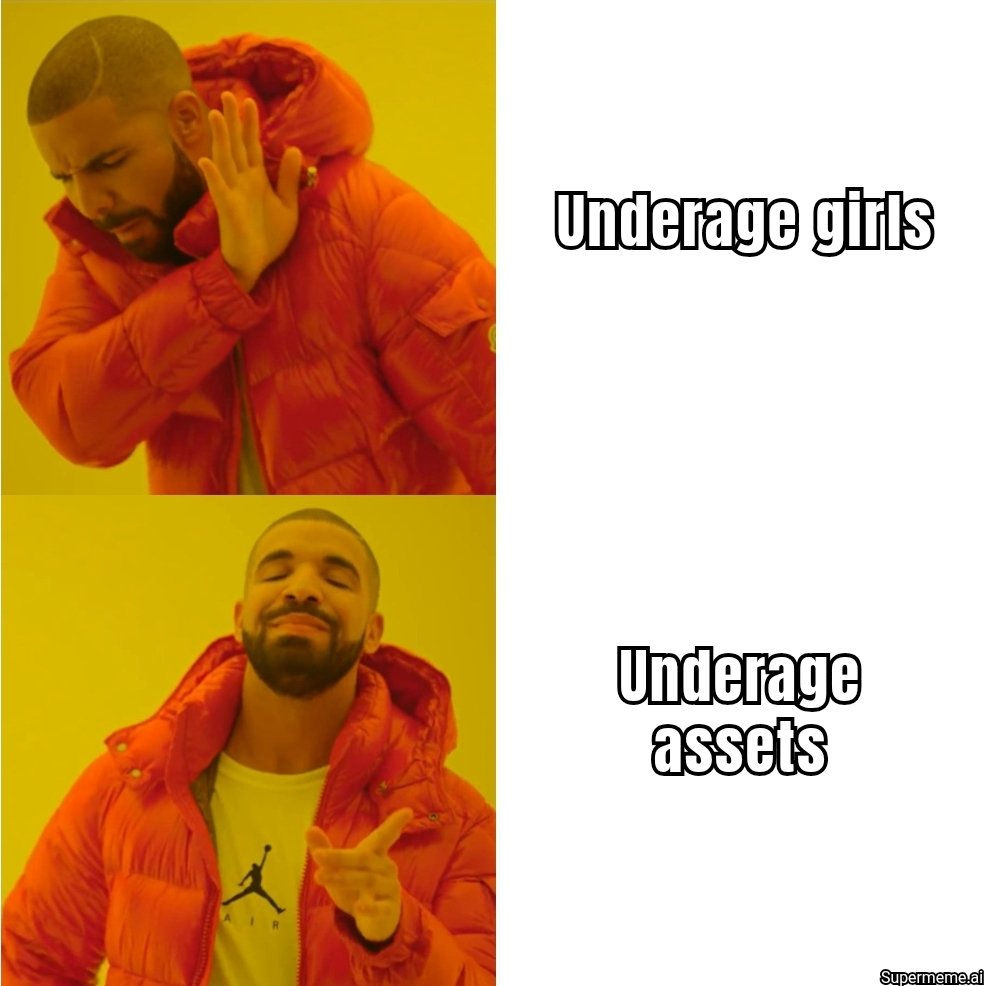
From a hindsight perspective, this exposure has, to some extent, also built a positive image for Saylor.

After the Epstein case broke out in 2019, Peggy, the publicist, had all her contracts canceled by clients like Netflix and FX, which basically ended her PR career; meanwhile, Saylor is now one of the world's largest Bitcoin holders.

The rejected one is still buying coins; the one who rejected him is already out of the game.

But to be fair, Saylor's current situation isn't that easy either.

The new Fed Chairman Warsh is hawkish, and the market expects he won't aggressively cut interest rates after taking office. Once interest rate expectations change, all kinds of assets worldwide come under pressure collectively.

Gold fell, silver fell, and Bitcoin fell even harder.

Coupled with tariff friction and tense U.S.-Europe relations, capital is starting to flow towards traditional safe-haven assets. The narrative of Bitcoin as "digital gold" is gradually fading.

If Bitcoin continues to fall, Strategy's ability to raise funds by issuing new shares will weaken, and the flywheel of coin-stock rotation could turn into a death spiral.

But Saylor really doesn't seem to care about any of this; this might be the other side of "boredom."

Ordinary investors can't do what Saylor does, not because they lack money, but because they are too "normal." Normal people read news, look at K-lines, see what others say. When the fear index soars, their hands start to itch, and their hearts start to ache.

Making decisions every day, each decision consuming willpower.

But in Saylor's strategy, there seems to be no "decision-making"环节. Buying is the only action; not selling is the only principle.

In his own words: "Bitcoin is the best asset ever invented by humanity, why would I sell?"

You can call this faith, or you can call it obsession. But from an execution perspective, the biggest advantage of this system is:

It doesn't require you to be smart; it only requires you to be boring.

Of course, this is not advice to imitate him. Saylor's底气 comes from being a publicly traded company—he can issue stock, borrow money. Ordinary people don't have these;模仿 his approach will most likely only lead to losses.

But there is one thing that might be worth learning from.

In investing, "fun" is often the source of losses.

Frequent trading, chasing hot trends, following news, using leverage... these behaviors that make investing "fun" are precisely the enemies of returns.

And the strategies that truly make money are often so boring they make people want to sleep.

Saylor's case is a bit extreme, but the logic holds. In a market full of noise, "boredom" might be the rarest ability.

Those who were socially adept at the parties back then are now either distancing themselves, under investigation, or have completely disappeared.

Perhaps, hoarding coins and being a person share the same principle:

Don't linger in lively places; boring things are worth doing long-term.


Twitter:https://twitter.com/BitpushNewsCN

Bitpush TG Discussion Group:https://t.me/BitPushCommunity

Bitpush TG Subscription: https://t.me/bitpush

Original link:https://www.bitpush.news/articles/7608011

Domande pertinenti

QWhy was Michael Saylor described as a 'zombie on drugs' in the context of the Epstein scandal?

AHe was described that way by Epstein's PR Peggy Siegal because he was extremely dull, unable to engage in conversation, and showed no interest in socializing at the dinner party he paid $25,000 to attend.

QHow many bitcoins does Saylor's company Strategy currently hold, and what is their average cost basis?

AStrategy currently holds 712,647 bitcoins with an average cost basis of $76,037.

QWhat is Saylor's investment strategy regarding Bitcoin according to the article?

AHis strategy is to buy Bitcoin almost every week without selling, following a simple principle of continuous accumulation regardless of market conditions.

QHow did the market conditions and new Fed Chair affect Bitcoin and Strategy's position?

AThe new Fed Chair's hawkish stance reduced expectations for aggressive rate cuts, putting pressure on assets like Bitcoin. Bitcoin's price briefly fell below Strategy's average cost, and the company's stock price declined by 60% from its peak.

QWhat broader investment lesson does the article draw from Saylor's approach?

AThe article suggests that in investing, 'boring' strategies—like consistent buying without frequent decisions—often outperform 'interesting' behaviors such as frequent trading, chasing trends, and using leverage, which are typically detrimental to returns.

Letture associate

The Recursive AI Anthropic Warned About: Tian Yuandong's New Company Has Just Taken the "First Step"

Anthropic recently highlighted the rapid progress toward "recursive self-improvement," where AI systems autonomously design and train their successors. In response, Recursive Superintelligence, a new company co-founded by former Meta researcher Tian Yuan Dong, has publicly demonstrated its first step toward automating AI research. The company released a system designed to autonomously execute the full AI research cycle: generating ideas, implementing code, running experiments, and learning from results. It validated this approach by achieving state-of-the-art results on three diverse benchmarks: 1. **NanoChat Autoresearch:** Optimizing a small language model's validation loss under a fixed 5-minute GPU budget, improving upon the community's best result. 2. **NanoGPT Speedrun:** Reducing the time to train a GPT model to a specific loss on 8 H100 GPUs from 79.7 seconds to 77.5 seconds, beating a highly optimized, human-driven community effort. 3. **SOL-ExecBench:** Improving the overall score on NVIDIA's suite of 235 GPU kernel optimization tasks by 18%, closing the gap to the hardware limit. The system discovered novel optimizations in this highly specialized domain without direct human expertise. Recursive's system operates as a general framework, capable of parallel exploration and cross-task knowledge transfer while incorporating safeguards against reward hacking. The company, backed by $650M in funding and a star-studded team including Richard Socher and Alexey Dosovitskiy, aims to create AI that recursively enhances its own research capabilities. This development represents an early but concrete move toward a new paradigm where AI accelerates its own advancement. It occurs alongside Anthropic's warnings about the need for industry coordination and potential pauses when recursive self-improvement thresholds are reached, highlighting the dual trajectory of rapid technical progress and growing calls for careful stewardship.

marsbit4 min fa

The Recursive AI Anthropic Warned About: Tian Yuandong's New Company Has Just Taken the "First Step"

marsbit4 min fa

The Gold Buy-on-the-Dip Guide: Watch Interest Rates, Not Just War

"Gold Buying Guide: Focus on Interest Rates, Not Just War" Four months ago, gold buyers likely didn't anticipate buying at a peak that even a war couldn't sustain. After hitting a record high of $5,596 on January 29, gold entered a bear market just 91 days later, its fastest decline since 2008. A key trigger was the Fed's hawkish shift, highlighting that monetary policy, not geopolitics, is the primary driver. The article argues that the traditional "buy gold in turmoil" script has changed. While the US-Iran conflict initially boosted prices, the sustained rally in oil prices heightened inflation fears, forcing central banks to maintain or consider tighter policy. Since gold yields no interest, higher rates increase its opportunity cost, eroding its appeal. This dynamic was evident when gold fell sharply on May 18 despite positive peace talks, as lower oil prices eased inflation and thus rate hike pressures. The recent sell-off is also part of a broader market deleveraging. Correlations between gold, Nasdaq, and Bitcoin spiked as leveraged investors sold liquid assets to cover losses, creating a synchronized downturn. Historically, gold bottoms align with policy shifts, not conflict resolutions. The 2008 and 2022 bear markets ended with shifts to extreme easing and peak inflation expectations, respectively. For potential buyers, the author suggests monitoring three signals: 1) Peak interest rate hike expectations, 2) Reopening of the Strait of Hormuz (to ease oil/inflation pressure), and 3) A return to net inflows for Gold ETFs, indicating the end of forced selling. While predicting the exact bottom is impossible, the author's personal strategy involves scaling into a position across price levels like $4000, $3700, and $3500, committing no more than 30% of the intended total allocation initially, and adding the remainder only if key signals emerge. The core conclusion: In turbulent times, watching interest rates is more crucial than watching wars.

marsbit10 min fa

The Gold Buy-on-the-Dip Guide: Watch Interest Rates, Not Just War

marsbit10 min fa

Recent On-Chain Review: No Clear Narrative Under U.S. Stock Market Pressure, Just Hype

This article analyzes the current state of the Solana meme coin and community token ecosystem, highlighting a market caught between two dominant forces: attention-based PvP and a gradual return to community-centric projects. The first part explores the "Attention PvP" dynamic, where success is driven by celebrity endorsements, viral events, and speed. Examples include $JOTCHUA, which surged after its meme creator's social media activity, and $WORLDCUP, which outperformed a similar Base chain project ($PITCH) largely due to influencer support. The recent "pump.fun GO" feature, allowing bounty tasks for token promotion, is critiqued for fostering sensationalist and often negative stunts—like people getting token tickers tattooed on their bodies for rewards—reminiscent of old internet shock content. In contrast, the article points to a resurgence of organic, community-driven tokens that survive market volatility through strong holder bases and shared ideology, not just hype. Influencer Ansem is cited, arguing that durable meme coins rely on communities willing to endure losses and promote their core message daily. Examples given are older tokens like $neet (anti-work ethos), $troll, $buttcoin, and $triplet, which have maintained relative price stability. A prime example of this community-build model is the new project $KINS, the token for the browser-based MMORPG Kintara. Its success stems not from advanced graphics but from consistently delivering updates, fostering player trust, and creating genuine engagement (e.g., in-game economies, events, property auctions). It has attracted a growing player base and even notable KOLs as participants, demonstrating that sustainable growth can come from building trust rather than orchestrating pumps. The article concludes by questioning whether the market is ultimately a game of mutual trust or mutual deception, expressing hope that such reflection might lead to a healthier ecosystem.

marsbit11 min fa

Recent On-Chain Review: No Clear Narrative Under U.S. Stock Market Pressure, Just Hype

marsbit11 min fa

On-Chain Scene on Opening Day: $20 Billion Already Staked, How Do On-Chain Contracts Know Who Wins?

On the opening day of the 2026 World Cup, over $2 billion had already been wagered on just the "tournament winner" contracts on platforms like Polymarket and Kalshi. This article explores how these blockchain-based prediction markets actually function once the games begin. It breaks down the massive volume and explains how single-game and tournament-long contracts are priced, with values moving between 1-99 cents to reflect implied probabilities. A key mechanism highlighted is "elimination zeroing," where a team's "champion yes" contract immediately settles to zero once they are mathematically eliminated. The core technical question answered is: how does a smart contract "know" who won a real-world match? The answer lies in oracles. The article details two primary paradigms: UMA's "optimistic oracle" (used by most of Polymarket), which allows a challenge period after a proposed result, and Chainlink's multi-source data aggregation (used by FIFA partners like ADI Predictstreet), which automates settlement with minimal dispute windows. Finally, the article injects a note of caution, citing research estimating that a significant portion of historical trading volume on these platforms might be "wash trading" to inflate numbers. It concludes by contrasting the legal status of these "event contracts" under CFTC rules in the U.S. versus traditional, state-regulated sports betting. As the tournament progresses, the real-time operation of this multi-billion dollar machine—its settlements, eliminations, and underlying mechanisms—becomes a story as compelling as the football itself.

marsbit26 min fa

On-Chain Scene on Opening Day: $20 Billion Already Staked, How Do On-Chain Contracts Know Who Wins?

marsbit26 min fa

Trading

Spot
Futures
活动图片





