The Bitcoin Inheritance Challenge: How to Help Your Family Recover Your Assets?

比推Pubblicato 2026-03-18Pubblicato ultima volta 2026-03-18

Introduzione

Self-custody of Bitcoin fundamentally changes estate planning. A robust inheritance plan must protect assets during the owner’s lifetime while ensuring designated individuals can recover them after death. Bitcoin’s key advantage—bypassing banks and custodians—also complicates inheritance, as the network only recognizes cryptographic keys, not legal documents. Key challenges include balancing security and accessibility, managing technical complexity for non-expert heirs, preserving privacy, and ensuring long-term viability. Common solutions include: 1. Custodial Inheritance: Relies on exchanges or institutions, sacrificing self-custody benefits for familiar legal processes. 2. DIY Inheritance: Ranges from simple seed-phrase handovers to complex multisig setups. High autonomy but requires technical competence from heirs. 3. Assisted Custody: Uses a service provider for multisig setup and recovery guidance, improving usability but depending on the provider’s longevity. 4. On-Chain Collaborative Inheritance: Combines assisted recovery with on-chain fallbacks (e.g., timelocks), ensuring access even if the provider fails. The strongest plans integrate a smooth, guided recovery path with a durable on-chain backup. Regular testing and updates are crucial. Inheritance isn’t just a technical issue—it must align with legal frameworks and family circumstances. Ultimately, a well-designed Bitcoin inheritance plan ensures assets remain secure, private, and recoverable for generati...

Author: Nunchuk

Compiled by: AididiaoJP, Foresight News

Original title: "After You're Gone": How Should Bitcoin Be Inherited?


Self-custody is changing the way we plan for inheritance. A good Bitcoin inheritance plan must: protect your Bitcoin during your lifetime, while also ensuring that designated individuals can successfully recover these assets after you pass away.

Bitcoin grants individuals a rare ability: to hold wealth without relying on banks, brokerages, or custodial institutions. This is one of its greatest advantages.

But it is precisely this feature that makes inheritance exceptionally difficult.

For traditional assets, there is usually an intermediary institution. Banks can freeze accounts, verify documents, cooperate with courts, and transfer control. Bitcoin is completely different. The network does not recognize heirs, death certificates, probate documents, nor does it handle customer service requests. It only recognizes keys and spending conditions.

This leads to a simple but severe problem: the very characteristics that make Bitcoin difficult to steal also make it difficult to inherit.

Why Bitcoin is Different

Bitcoin inheritance is essentially a "recovery design" problem: who can access the Bitcoin, under what conditions, and through what safeguards.

The first challenge is the contradiction between security and accessibility. During your life, you need strong protection against theft, coercion, and operational errors; after you die or become incapacitated, you want trusted individuals to have a clear path to recovery. These two goals are often in conflict.

The second challenge is complexity. Many powerful Bitcoin setups (especially multisig) might be clear to the designer, but they can be completely incomprehensible to a spouse, children, trustees, or executors who don't regularly use Bitcoin. A plan that only a calm, technical person can operate is likely to fail when recovery is truly needed.

The third challenge is privacy. Inheritance planning exposes sensitive information: who owns Bitcoin, roughly how much, and who will inherit it. A poorly designed plan creates unnecessary risks for both the owner and the heirs.

The fourth challenge is time. A true inheritance plan might need to remain effective for years or even decades. This means evaluating a solution not just on whether it works today, but on whether it can outlast devices, assumptions, and even the companies involved in its setup.

This is more important than many realize. An inheritance plan that relies on a specific company existing forever might be convenient, but it is certainly not durable.

Six Questions to Ask Yourself

Every Bitcoin inheritance solution involves trade-offs. The simplest way to compare them is to ask six questions:

  • Autonomy: Does it preserve your full control over the assets, or does it rely on a company, custodian, trustee, or legal process to function?

  • Security: During your lifetime, does it effectively prevent Bitcoin from being stolen, coerced, or accidentally misplaced?

  • Heir Experience: Can your designated heirs actually recover the funds without confusion or making fatal mistakes?

  • Privacy: How much sensitive information about you or your family does this solution expose?

  • Flexibility: Is it easy to update the plan when beneficiaries, timelines, or family circumstances change?

  • Legal Compatibility: If needed, can it work alongside wills, trusts, or trustee systems?

No single solution excels in all dimensions, but these six questions make the trade-offs clear.

Four Common Solutions

1. Custodial Inheritance

The most traditional method is to keep Bitcoin on an exchange, in an ETF, with a brokerage, or with another custodian, and let the traditional legal system handle the transfer.

Its appeal is obvious: accounts are tied to identity, there are statements, customer support, and a relatively clear legal process for heirs.

But the cost is also clear: the institution holds the private keys. This means whether the assets can be withdrawn depends on the institution's policies, compliance processes, jurisdiction, and its ability to survive long-term. Heirs might face the dual hurdles of both the legal system and the trading platform. The concentration of vast amounts of sensitive customer data in one place also introduces privacy and security risks that don't exist with self-custody.

This approach is feasible, but its way of solving the inheritance problem essentially abandons the core value proposition of self-custodying Bitcoin.

2. DIY Inheritance

DIY inheritance covers a broad spectrum. At the simplest end is single-signature handover: directly leaving the seed phrase, hardware wallet, or a complete recovery backup to heirs. At the complex end are multisig and timelock setups built with open-source tools.

These should not be conflated.

From a security perspective, the most vulnerable is the simple single-signature handover. Each additional seed phrase backup is another target for theft, especially when a single person or location can unlock the entire wallet. Leaving complete recovery materials in a home safe, office drawer, or bank safety deposit box with no additional protection is even riskier.

Adding a BIP39 passphrase can improve this situation, but it brings new risks: there's no checksum to detect transcription errors; short passphrases can be brute-forced; long and complex passphrases might be impossible for the owner or heirs to accurately reproduce years later, locking them out of the wallet.

On the other end, well-designed DIY multisig or timelock scheme can be extremely robust. Many experienced Bitcoin users choose this path for good reason. But the cost is operational: the responsibility for setup, maintenance, and recovery falls entirely on the owner and their heirs, with often no one to ask for help if something goes wrong.

If executed properly, DIY can offer极强的 (extremely strong) autonomy and security, but it demands more from everyone involved.

3. Service-Assisted Collaborative Custody

There is a middle path: collaborative custody. In this model, the owner still uses a multisig setup, but a service provider assists with account setup, key management, recovery operations, and the inheritance process.

Compared to pure custody or pure DIY, this is a definite step forward. The owner retains more control, while heirs get assistance when needed.

Most of these services handle the inheritance logic off-chain: waiting periods, proof of life checks, beneficiary arrangements, and recovery processes are coordinated through the service provider's systems, rather than being directly encoded into the Bitcoin chain's spending conditions.

This has clear benefits. Off-chain inheritance is easier to update. If the owner wants to change beneficiaries, adjust waiting periods, or set up more complex phased distribution plans, off-chain operations are usually much more convenient than fully on-chain solutions.

The cost is the reliability of the recovery path. Whether inheritance can be realized still depends on whether the service provider exists and is willing to cooperate when the heirs make a request.

For many families, this is still a good choice, especially when guided recovery and operational flexibility are important.

4. On-Chain Collaborative Inheritance

A newer model builds on collaborative support by adding an on-chain fallback option.

The owner still gets the security of multisig and the guidance of a service provider, but the recovery path for inheritance is also written into the Bitcoin chain's spending rules. For example, using a timelock to set a deadline, after which the spending conditions automatically change, allowing heirs to recover the funds on their own even if the service provider is unavailable.

This is an important change in risk control: the recovery path is anchored in Bitcoin's rules, not just dependent on the continued cooperation of a single service provider.

This model, of course, also has costs. Because part of the plan is enforced on-chain, it is less convenient to adjust. Modifying inheritance timing or plan structure might require moving funds and paying network fees.

But for holders who want collaborative support while also having a long-term reliable backup, on-chain inheritance is a significant advancement.
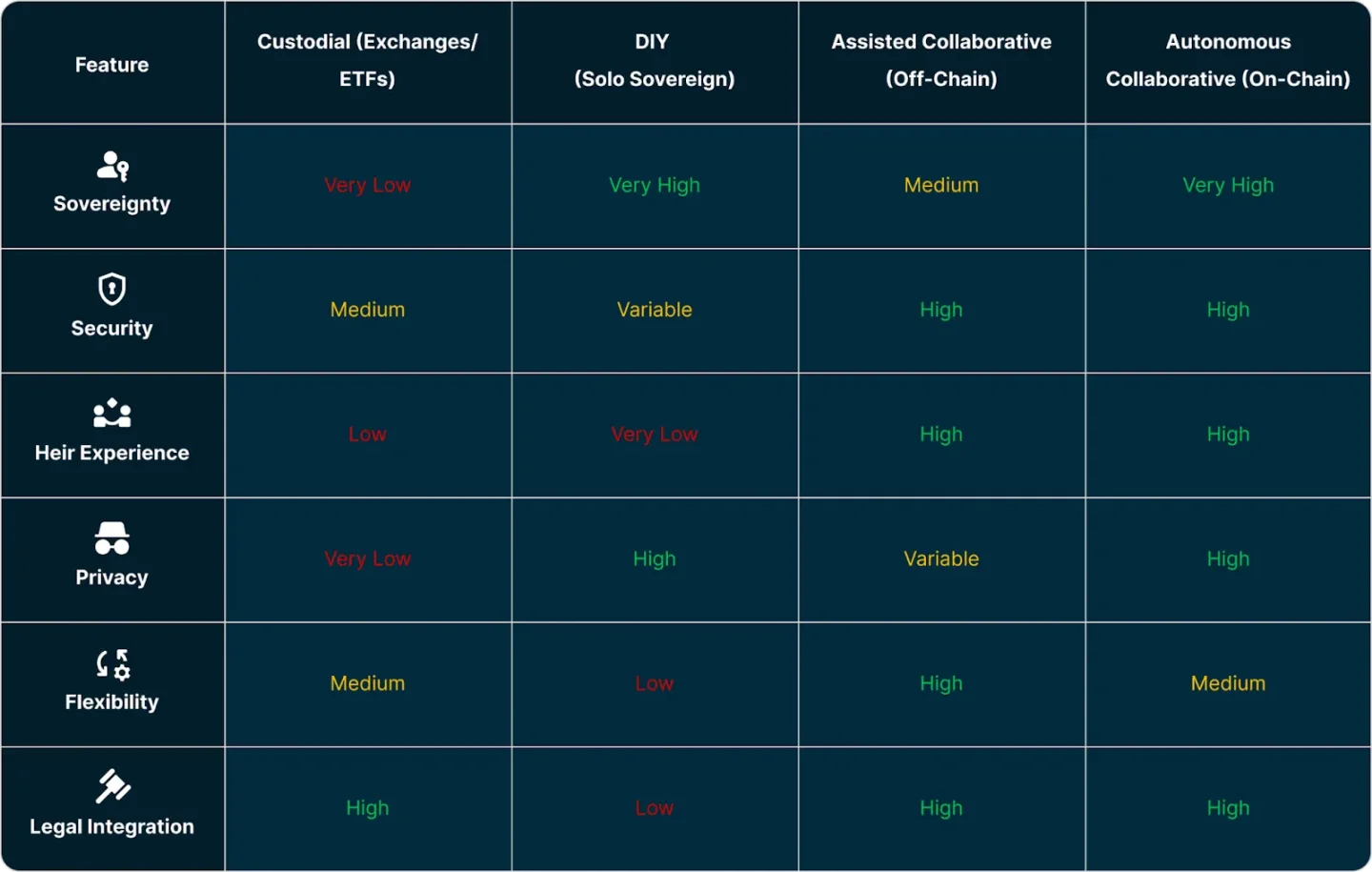
Where the Real Trade-offs Lie

When comparing modern inheritance solutions, the most meaningful question isn't "which is best," but "what are you most trying to optimize for?"

Off-chain collaborative solutions often excel in flexibility: easy to update, adaptable to family changes, and simple to adjust over time.

On-chain collaborative solutions often excel in durability: the fallback path is designed to work even if the service provider fails, which is crucial for inheritance plans that need to remain effective for decades.

Many families could reasonably choose either. The key is what matters most to you.

If you view Bitcoin as generational wealth, then durability should be a core consideration.

Smooth Path + Last Line of Defense

Most Bitcoin inheritance solutions tend to lean towards two extremes.

One end sacrifices autonomy for convenience: easy to understand, but heavily reliant on institutions, identity verification, or service provider cooperation.

The other end sacrifices usability for autonomy: reduces trust in third parties, but places the complex technical burden on the heirs, and at their most vulnerable time.

The most robust方案 (solution) combines both paths.

The first is the smooth path: when the service provider is available and everything is normal, heirs recover the assets through a guided process that is smooth, low-stress, and error-resistant.

The second is the last line of defense: a recovery path enforced by the Bitcoin network, executable even if the service provider disappears.

This combination is important because it aligns with real inheritance scenarios: most people want their families to receive help, not face complex technical operations alone; simultaneously, very few are willing to entrust their legacy to a company that "must exist forever."

Estate Planning is Still Important

A common misconception is that Bitcoin inheritance must either completely脱离 (break away from) the traditional system or be fully integrated into the traditional financial system.

In reality, many families need a hybrid model.

Some holders want Bitcoin transferred directly and privately to their families. Others want trustee involvement, for example, for phased distribution, protecting minor children, or integrating with existing trusts. Some want to clarify their intentions with legal documents, while keeping the actual recovery path out of public probate records.

A good Bitcoin inheritance solution should support these different choices.

Therefore, it helps to think about two questions separately: Who should receive these assets? Who can actually recover these assets?

A will or trust can clarify intentions, define beneficiaries, and set legal obligations, but it doesn't itself solve the "how to recover" problem. Conversely, a purely technical recovery solution cannot bypass tax, reporting, and inheritance law requirements.

The most comprehensive plans consider both levels clearly.

Common Mistakes

Many inheritance plans fail for very ordinary reasons.

One mistake is assuming a spouse, child, or executor will "figure it out." Possessing a hardware wallet does not equate to understanding the recovery process.

Another mistake is concentrating too much power in a single point: one document, one device, one envelope that can completely unlock the funds. This certainly facilitates inheritance, but it also facilitates theft.

Another mistake is overestimating the security of a "passphrase" without thinking through the human factors in recovery. A passphrase can indeed enhance the security of a single-signature setup, but only if there is true operational discipline in every step of creation, storage, and communication.

Finally, many people make a plan once and never revisit it. Beneficiaries may change, devices may fail, family relationships may shift. A Bitcoin inheritance plan is not a static object, but a system that needs regular review.

A Simple Action List

Inheritance planning can start simple, as long as each step is intentional and regularly revisited.

  • Step 1: Determine who should inherit your Bitcoin, and whether these individuals have the ability to handle self-custody directly. Some can receive Bitcoin directly, others might need a trustee, phased handover, or guided assistance.

  • Step 2: Choose an appropriate security model based on the size of the assets and the situation of the heirs. The larger the amount, the more important multisig and formal inheritance design become.

  • Step 3: Store secrets and instructions separately. Private keys, hardware devices, and "instruction manuals" (explaining how to recover) are best kept separate, and preferably not given to the same person.

  • Step 4: Clarify what you value most. Some families are better suited for flexible off-chain coordination, others need an on-chain fallback that can outlive the service provider.

  • Step 5: Test the plan. Not with all assets, but enough to verify that the recovery path is actually usable. A plan never rehearsed is just a theory.

  • Step 6: Review your plan after major life events and periodically. Marriage, divorce, childbirth, death, moving, service providers changing – all can affect whether the original plan remains sound.

The Final Question: The True Test of Self-Custody

It's easy to think of inheritance as something to deal with "later." But in reality, it is the ultimate test of whether a custody solution is truly robust.

Custodial solutions offer familiarity, but at the cost of reintroducing reliance on institutions. DIY solutions can be excellent if technically sound, but demand more from both the owner and the heirs. Off-chain collaborative inheritance improves usability and flexibility. On-chain collaborative inheritance adds a robust long-term backup.

The most important recent advancement in this field is inheritance design that combines guided recovery with autonomous on-chain fallbacks.

For holders who want Bitcoin to become generational wealth, this shift in direction makes a lot of sense. The goal is no longer just "leaving instructions," but "leaving a recovery path that is secure, private, and operable in the long term."


Twitter:https://twitter.com/BitpushNewsCN

Bitpush TG Discussion Group:https://t.me/BitPushCommunity

Bitpush TG Subscription: https://t.me/bitpush

Original link:https://www.bitpush.news/articles/7620845

Domande pertinenti

QWhat is the core challenge of Bitcoin inheritance according to the article?

AThe core challenge is the conflict between security and accessibility: Bitcoin's design makes it difficult to steal, but this same feature also makes it difficult for intended heirs to recover the assets after the owner's death or incapacitation.

QWhat are the four common solutions for Bitcoin inheritance mentioned in the article?

AThe four common solutions are: 1. Custodial Inheritance, 2. DIY Inheritance, 3. Service-Assisted Collaborative Custody, and 4. On-Chain Collaborative Inheritance.

QWhat key advantage does an On-Chain Collaborative Inheritance model provide?

AIt provides a robust, permanent backup recovery path that is enforced by the Bitcoin network's rules, ensuring the inheritance plan remains executable even if the service provider goes out of business or is unavailable.

QWhat is a major pitfall of relying solely on a 'passphrase' for security in a DIY inheritance plan?

AIt introduces new risks: there is no checksum to detect transcription errors; a short passphrase could be brute-forced; and a long, complex one might be impossible for the owner or heirs to accurately reproduce years later, potentially locking them out of the wallet.

QWhat is the recommended first step in creating a Bitcoin inheritance plan?

AThe first step is to determine who should inherit the Bitcoin and assess whether those individuals have the capability to handle self-custody directly, or if they would require a trustee, a staged handover, or guided assistance.

Letture associate

Trading

Spot
Futures

Articoli Popolari

Cosa è BITCOIN

Comprendere HarryPotterObamaSonic10Inu (ERC-20) e la sua posizione nel mondo delle criptovalute Negli ultimi anni, il mercato delle criptovalute ha assistito a un aumento della popolarità delle meme coin, catturando l'interesse non solo dei trader, ma anche di coloro che cercano coinvolgimento comunitario e valore di intrattenimento. Tra questi token unici c'è HarryPotterObamaSonic10Inu (ERC-20), un progetto intrigante che mescola riferimenti culturali nel tessuto delle criptovalute. Questo articolo esplora gli aspetti chiave di HarryPotterObamaSonic10Inu, analizzando i suoi meccanismi, l'etica guidata dalla comunità e il suo coinvolgimento con il panorama crittografico più ampio. Che cos'è HarryPotterObamaSonic10Inu (ERC-20)? Come suggerisce il suo nome, HarryPotterObamaSonic10Inu è una meme coin costruita sulla blockchain di Ethereum, classificata secondo lo standard ERC-20. A differenza delle criptovalute tradizionali che possono enfatizzare l'utilità pratica o il potenziale investimento, questo token prospera grazie al valore di intrattenimento e alla forza della sua comunità. Il progetto mira a creare un ambiente in cui gli utenti coinvolti possono riunirsi, condividere idee e partecipare ad attività ispirate a diversi fenomeni culturali. Una caratteristica notevole di HarryPotterObamaSonic10Inu è la zero tassa sulle transazioni. Questo elemento allettante tende a incoraggiare il trading e il coinvolgimento della comunità, privo di costi aggiuntivi che possono scoraggiare i trader di piccole dimensioni. L'offerta totale della moneta è fissata a un miliardo di token, un numero che segna la sua intenzione di mantenere una circolazione sostanziale all'interno della comunità. Creatore di HarryPotterObamaSonic10Inu (ERC-20) Le origini di HarryPotterObamaSonic10Inu sono avvolte in un certo mistero; i dettagli sul creatore rimangono sconosciuti. Lo sviluppo di questo token non presenta un team identificabile o un piano esplicito, cosa non rara nel settore delle meme coin. Invece, il progetto è emerso organicamente, con il suo progresso fortemente dipendente dall'entusiasmo e dalla partecipazione della sua comunità. Investitori di HarryPotterObamaSonic10Inu (ERC-20) Per quanto riguarda investimenti esterni e finanziamenti, HarryPotterObamaSonic10Inu rimane ambiguo. Il token non elenca alcuna fondazione di investimento conosciuta o un sostegno organizzativo significativo. Invece, la linfa vitale del progetto è la sua comunità di base, che informa la sua crescita e sostenibilità attraverso azioni collettive e coinvolgimento nello spazio crittografico. Come funziona HarryPotterObamaSonic10Inu (ERC-20)? In quanto meme coin, HarryPotterObamaSonic10Inu opera principalmente al di fuori delle strutture tradizionali che governano spesso il valore degli asset. Ci sono diversi aspetti distintivi che definiscono il funzionamento del progetto: Transazioni senza tasse: Senza costi fiscali sulle transazioni, gli utenti possono comprare e vendere liberamente il token senza preoccuparsi di costi nascosti. Coinvolgimento della comunità: Il progetto prospera sull'interazione della comunità, sfruttando le piattaforme social per creare entusiasmo e facilitare il coinvolgimento. Discussioni, condivisione di contenuti e coinvolgimento sono elementi cruciali che aiutano ad espandere la sua portata e a favorire la lealtà tra i sostenitori. Nessuna utilità pratica: Va notato che HarryPotterObamaSonic10Inu non offre un'utilità concreta all'interno dell'ecosistema finanziario. Piuttosto, è classificato come un token principalmente per attività di intrattenimento e comunitarie. Riferimento culturale: Il token incorpora astutamente elementi della cultura pop per attirare interesse, collegandosi a appassionati di meme e seguaci delle criptovalute. HarryPotterObamaSonic10Inu esemplifica come le meme coin operino in modo diverso rispetto ai progetti di criptovalute più tradizionali, entrando nel mercato come costrutti sociali innovativi piuttosto che come asset utilitari. Cronologia di HarryPotterObamaSonic10Inu (ERC-20) La storia di HarryPotterObamaSonic10Inu è segnata da diversi traguardi notevoli: Creazione: Il token è emerso da un meme virale, catturando l'immaginazione di molti appassionati di criptovalute. Le date di creazione specifiche non sono disponibili, sottolineando la sua crescita organica. Inserimento negli scambi: HarryPotterObamaSonic10Inu ha fatto il suo ingresso in vari scambi, consentendo un accesso e un trading più facili da parte della comunità. Iniziative di coinvolgimento della comunità: Attività in corso volte a migliorare l'interazione della comunità, comprese gare, campagne sui social media e generazione di contenuti da parte di fan e sostenitori. Piani di espansione futura: La tabella di marcia del progetto include il lancio di una collezione NFT, merchandising e un sito di eCommerce relativo ai suoi temi culturali, coinvolgendo ulteriormente la comunità e cercando di aggiungere più dimensioni al suo ecosistema. Punti chiave su HarryPotterObamaSonic10Inu (ERC-20) Natura guidata dalla comunità: Il progetto dà priorità al contributo collettivo e alla creatività, garantendo che il coinvolgimento degli utenti sia al centro del suo sviluppo. Classificazione come meme coin: Rappresenta l'epitome delle criptovalute basate sull'intrattenimento, distinguendosi dai veicoli d'investimento tradizionali. Nessuna affiliazione diretta con Bitcoin: Nonostante la somiglianza nel nome del ticker, HarryPotterObamaSonic10Inu è distintivo e non ha alcuna relazione con Bitcoin o altre criptovalute consolidate. Focus sulla collaborazione: HarryPotterObamaSonic10Inu è progettato per creare uno spazio per la collaborazione e la condivisione di storie tra i suoi detentori, fornendo un canale per la creatività e il legame comunitario. Prospettive future: L'ambizione di espandersi oltre il suo presupposto iniziale verso NFT e merchandising delinea un percorso per il progetto per potenzialmente entrare in strade più mainstream all'interno della cultura digitale. Poiché le meme coin continuano a catturare l'immaginazione della comunità crittografica, HarryPotterObamaSonic10Inu (ERC-20) si distingue per i suoi legami culturali e il suo approccio centrato sulla comunità. Anche se potrebbe non adattarsi al modello tipico di un token orientato all'utilità, la sua essenza risiede nella gioia e nella camaraderia coltivate tra i suoi sostenitori, evidenziando la natura in evoluzione delle criptovalute in un'epoca sempre più digitale. Con la continuazione dello sviluppo del progetto, sarà importante osservare come le dinamiche della comunità influenzano la sua traiettoria nel panorama in continuo cambiamento della tecnologia blockchain.

1.1k Totale visualizzazioniPubblicato il 2024.04.01Aggiornato il 2024.12.03

Cosa è BITCOIN

Come comprare BTC

Benvenuto in HTX.com! Abbiamo reso l'acquisto di Bitcoin (BTC) semplice e conveniente. Segui la nostra guida passo passo per intraprendere il tuo viaggio nel mondo delle criptovalute.Step 1: Crea il tuo Account HTXUsa la tua email o numero di telefono per registrarti il tuo account gratuito su HTX. Vivi un'esperienza facile e sblocca tutte le funzionalità,Crea il mio accountStep 2: Vai in Acquista crypto e seleziona il tuo metodo di pagamentoCarta di credito/debito: utilizza la tua Visa o Mastercard per acquistare immediatamente BitcoinBTC.Bilancio: Usa i fondi dal bilancio del tuo account HTX per fare trading senza problemi.Terze parti: abbiamo aggiunto metodi di pagamento molto utilizzati come Google Pay e Apple Pay per maggiore comodità.P2P: Fai trading direttamente con altri utenti HTX.Over-the-Counter (OTC): Offriamo servizi su misura e tassi di cambio competitivi per i trader.Step 3: Conserva Bitcoin (BTC)Dopo aver acquistato Bitcoin (BTC), conserva nel tuo account HTX. In alternativa, puoi inviare tramite trasferimento blockchain o scambiare per altre criptovalute.Step 4: Scambia Bitcoin (BTC)Scambia facilmente Bitcoin (BTC) nel mercato spot di HTX. Accedi al tuo account, seleziona la tua coppia di trading, esegui le tue operazioni e monitora in tempo reale. Offriamo un'esperienza user-friendly sia per chi ha appena iniziato che per i trader più esperti.

3.5k Totale visualizzazioniPubblicato il 2024.12.12Aggiornato il 2025.03.21

Come comprare BTC

Cosa è $BITCOIN

ORO DIGITALE ($BITCOIN): Un'Analisi Completa Introduzione all'ORO DIGITALE ($BITCOIN) L'ORO DIGITALE ($BITCOIN) è un progetto basato su blockchain che opera sulla rete Solana, con l'obiettivo di combinare le caratteristiche dei metalli preziosi tradizionali con l'innovazione delle tecnologie decentralizzate. Sebbene condivida un nome con Bitcoin, spesso definito “oro digitale” a causa della sua percezione come riserva di valore, l'ORO DIGITALE è un token separato progettato per creare un ecosistema unico all'interno del panorama Web3. Il suo obiettivo è posizionarsi come un asset digitale alternativo valido, anche se i dettagli riguardanti le sue applicazioni e funzionalità sono ancora in fase di sviluppo. Cos'è l'ORO DIGITALE ($BITCOIN)? L'ORO DIGITALE ($BITCOIN) è un token di criptovaluta esplicitamente progettato per l'uso sulla blockchain di Solana. A differenza di Bitcoin, che fornisce un ruolo di stoccaggio di valore ampiamente riconosciuto, questo token sembra concentrarsi su applicazioni e caratteristiche più ampie. Aspetti notevoli includono: Infrastruttura Blockchain: Il token è costruito sulla blockchain di Solana, nota per la sua capacità di gestire transazioni ad alta velocità e a basso costo. Dinamiche di Offerta: L'ORO DIGITALE ha un'offerta massima fissata a 100 quadrilioni di token (100P $BITCOIN), sebbene i dettagli riguardanti la sua offerta circolante siano attualmente non divulgati. Utilità: Sebbene le funzionalità precise non siano esplicitamente delineate, ci sono indicazioni che il token potrebbe essere utilizzato per varie applicazioni, potenzialmente coinvolgendo applicazioni decentralizzate (dApp) o strategie di tokenizzazione degli asset. Chi è il Creatore dell'ORO DIGITALE ($BITCOIN)? Attualmente, l'identità dei creatori e del team di sviluppo dietro l'ORO DIGITALE ($BITCOIN) rimane sconosciuta. Questa situazione è tipica tra molti progetti innovativi nel settore blockchain, in particolare quelli allineati con la finanza decentralizzata e i fenomeni delle meme coin. Sebbene tale anonimato possa favorire una cultura guidata dalla comunità, intensifica le preoccupazioni riguardo alla governance e alla responsabilità. Chi sono gli Investitori dell'ORO DIGITALE ($BITCOIN)? Le informazioni disponibili indicano che l'ORO DIGITALE ($BITCOIN) non ha alcun sostenitore istituzionale noto o investimenti di venture capital prominenti. Il progetto sembra operare su un modello peer-to-peer incentrato sul supporto e sull'adozione della comunità piuttosto che su percorsi di finanziamento tradizionali. La sua attività e liquidità si trovano principalmente su exchange decentralizzati (DEX), come PumpSwap, piuttosto che su piattaforme di trading centralizzate consolidate, evidenziando ulteriormente il suo approccio di base. Come Funziona l'ORO DIGITALE ($BITCOIN) Le meccaniche operative dell'ORO DIGITALE ($BITCOIN) possono essere elaborate in base al suo design blockchain e alle caratteristiche della rete: Meccanismo di Consenso: Sfruttando il proof-of-history (PoH) unico di Solana combinato con un modello di proof-of-stake (PoS), il progetto garantisce una validazione efficiente delle transazioni contribuendo all'alta performance della rete. Tokenomics: Sebbene meccanismi deflazionistici specifici non siano stati dettagliati ampiamente, l'ampia offerta massima di token implica che potrebbe soddisfare microtransazioni o casi d'uso di nicchia che devono ancora essere definiti. Interoperabilità: Esiste il potenziale per l'integrazione con l'ecosistema più ampio di Solana, inclusi vari piattaforme di finanza decentralizzata (DeFi). Tuttavia, i dettagli riguardanti integrazioni specifiche rimangono non specificati. Cronologia degli Eventi Chiave Ecco una cronologia che evidenzia traguardi significativi riguardanti l'ORO DIGITALE ($BITCOIN): 2023: Il dispiegamento iniziale del token avviene sulla blockchain di Solana, contrassegnato dal suo indirizzo di contratto. 2024: L'ORO DIGITALE guadagna visibilità poiché diventa disponibile per il trading su exchange decentralizzati come PumpSwap, consentendo agli utenti di scambiarlo contro SOL. 2025: Il progetto assiste a un'attività di trading sporadica e a un potenziale interesse per impegni guidati dalla comunità, sebbene non siano state documentate partnership significative o avanzamenti tecnici fino ad ora. Analisi Critica Punti di Forza Scalabilità: L'infrastruttura sottostante di Solana supporta alti volumi di transazioni, il che potrebbe migliorare l'utilità di $BITCOIN in vari scenari di transazione. Accessibilità: Il potenziale basso prezzo di trading per token potrebbe attrarre investitori al dettaglio, facilitando una partecipazione più ampia grazie a opportunità di proprietà frazionata. Rischi Mancanza di Trasparenza: L'assenza di sostenitori, sviluppatori o di un processo di audit pubblicamente noti potrebbe generare scetticismo riguardo alla sostenibilità e all'affidabilità del progetto. Volatilità del Mercato: L'attività di trading è fortemente dipendente dal comportamento speculativo, il che può comportare una significativa volatilità dei prezzi e incertezze per gli investitori. Conclusione L'ORO DIGITALE ($BITCOIN) emerge come un progetto intrigante ma ambiguo all'interno dell'evolvente ecosistema di Solana. Sebbene tenti di sfruttare la narrativa dell'“oro digitale”, la sua partenza dal ruolo consolidato di Bitcoin come riserva di valore sottolinea la necessità di una chiara differenziazione della sua utilità e struttura di governance. L'accettazione e l'adozione future dipenderanno probabilmente dall'affrontare l'attuale opacità e dalla definizione più esplicita delle sue strategie operative ed economiche. Nota: Questo rapporto comprende informazioni sintetizzate disponibili a ottobre 2023, e potrebbero essersi verificati sviluppi oltre il periodo di ricerca.

99 Totale visualizzazioniPubblicato il 2025.05.13Aggiornato il 2025.05.13

Cosa è $BITCOIN

Discussioni

Benvenuto nella Community HTX. Qui puoi rimanere informato sugli ultimi sviluppi della piattaforma e accedere ad approfondimenti esperti sul mercato. Le opinioni degli utenti sul prezzo di BTC BTC sono presentate come di seguito.

活动图片