The Biggest Airdrop for Crypto Enthusiasts is Given by Yuanbao

marsbitPubblicato 2026-02-04Pubblicato ultima volta 2026-02-04

Introduzione

The article "The Biggest Airdrop for Crypto Enthusiasts is Given by Yuanbao" discusses the recent trend of crypto investors turning to Yuanbao, a Web2 platform by Tencent, for cash red packet rewards amid a severe market downturn. Starting February 1st, Yuanbao’s cash reward campaign attracted widespread participation, with crypto community members shifting from trading to actively engaging in Yuanbao’s referral-based tasks to earn small but guaranteed cash payouts. This comes as global financial markets, including crypto, experienced significant losses, with Bitcoin dropping below $75,000 and Ethereum and Solana also declining sharply. On January 31st, the crypto market saw over $2.56 billion in liquidations. The author contrasts Yuanbao’s straightforward, no-cost cash rewards with the high-risk, often disappointing airdrops in the crypto space. While crypto airdrops typically offer tokens that require selling to realize gains—and often come with hidden costs like time, research, and potential losses—Yuanbao provides immediate, tangible cash benefits. A case study highlights an Infinex user who lost over $11,900 after a 406-day participation, receiving tokens worth far less than invested. The piece argues that crypto airdrops have evolved from rewarding early users to serving as exit strategies for projects, with declining returns and increased risks. Unlike Web2 companies like Tencent, which use reliable cash incentives backed by strong cash flow and legal frameworks, ...

Author|Golem(@web 3_golem)
"xxx has sent you a cash red envelope!"

After the Yuanbao cash red envelope activity began on February 1st, many long-dead project/research exchange groups completely transformed into "grab Yuanbao wool" mutual aid groups.

For crypto enthusiasts, transitioning from esteemed crypto traders to wool-pulling participants in Yuanbao red envelopes is also a helpless move.

Starting from January 31st, global financial markets plummeted. Precious metals, which had previously surged, quickly crashed. Spot silver nearly erased its yearly gains, and spot gold once fell below $4500. The crypto market didn't fare much better. On February 2nd, Bitcoin broke below the $75,000 support level, hitting a low of $74,604. ETH fell to a low of $2157.14, and SOL even lost the $100 level, touching a low of $95.95.

According to Coinglass data, the crypto market saw a total of $2.5615 billion in liquidations on January 31st, setting a record for the highest single-day liquidation volume since the "10/11 crash." Therefore, "too亏损到不想说话 (losing so much that I don't want to talk)" became the true psychological state of many crypto enthusiasts (like the silent Yi Lihua).

For crypto enthusiasts who just experienced a bloodbath, grabbing Yuanbao red envelopes, though a drop in the bucket for recouping losses, provides some psychological comfort, offering a temporary escape from the harsh market reality.
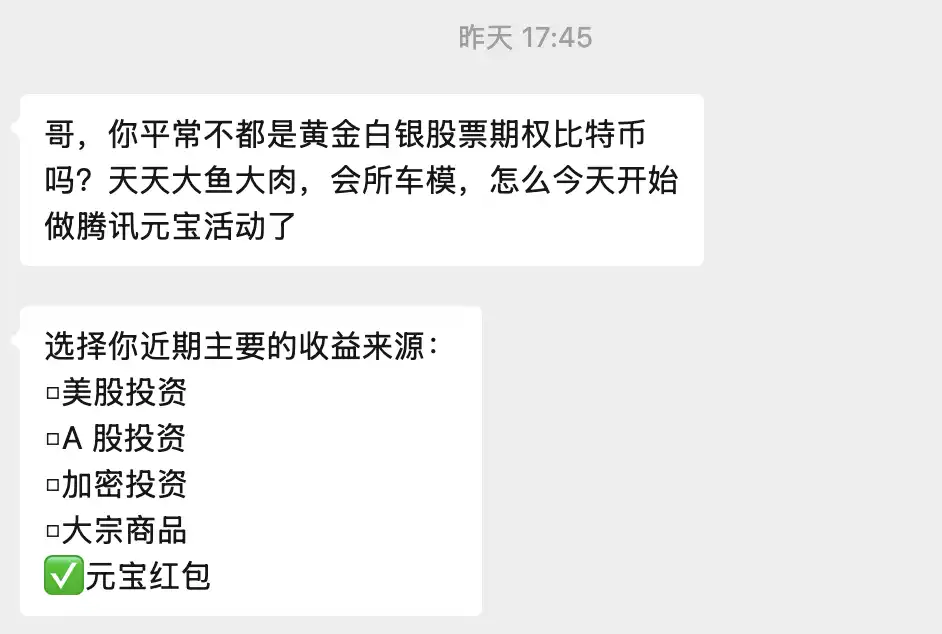
A joke in group chats

Crypto Airdrops: From Swallowing Losses to Passionate Rights Defense

Calling Yuanbao's cash red envelopes the biggest airdrop for crypto enthusiasts today is not a gimmick.

The amount of cash red envelopes Yuanbao can distribute to each user is not large, mostly ranging from a dozen to a few dozen RMB, but the valuable part is that the interaction is simple and truly cost-free. Users only need to spend a little time recruiting people and step-by-step experiencing product features to get cash red envelopes. The task cycle is short, allowing for quick returns.

In contrast, airdrops from crypto projects are first distributed in the form of tokens. Profit is realized only after the tokens are sold. Although the amount received seems much larger than Yuanbao's in most cases, after deducting the costs of time, research, opportunity, friction, and potential risk of being stuck with worthless tokens, how much is really left?

A user who accompanied Infinex for 406 days deeply feels this. On January 31st, the decentralized perpetual contract trading platform Infinex announced its TGE and airdrop claims. The project team successfully上岸 (made it ashore), but the community was collectively反撸 (screwed over).

一千万是只猫 (X: @RXu107) is a typical example of being反撸. On February 1st, he posted that he spent over $11,900 (approximately 82,000 RMB) participating in this project (4400 U for NFT, 7500 U for public sale) and deeply accompanied it for 406 days as a community member. But on TGE day, not only did he not recover his costs, but his paper loss also exceeded 100,000 RMB (2900 U + 11,284 locked INX tokens).

Facing the反撸, the blogger had no choice but to repeatedly tell his friends how upset he was.
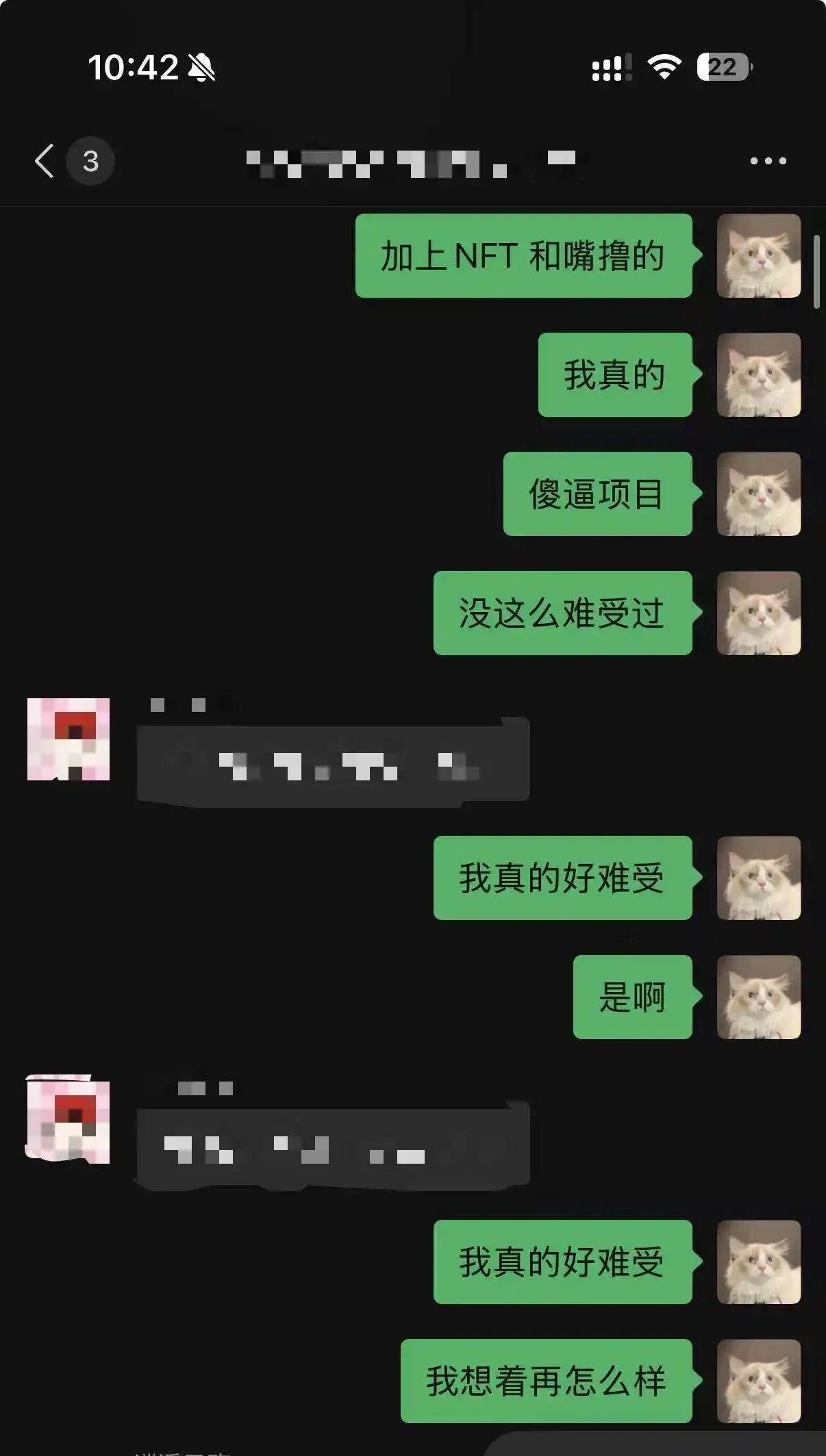
The blogger反撸 by Infinex tells his friend how upset he is

Infinex's fully diluted valuation at TGE was only $150 million. The total investment in Yuanbao's New Year red envelope activity is approximately $140 million USD. What does this mean? It's equivalent to Tencent directly buying Infinex at its maximum valuation and giving it away for free to the entire nation.

Facing the pain of being反撸 and deceived, most people in the community choose the same approach as "一千万是只猫" – swallowing their losses. But some choose to stand up and confront the project team.

Crypto blogger Ice Frog (X: @Ice_Frog666666) is a typical representative. He started by airdrop hunting, but ironically, in 2025, Ice Frog was either defending airdrop rights or on his way to defend airdrop rights. He is still negotiating with the prediction market project Space (Odaily Note: Space raised $20 million publicly, the team privately took $13 million) and has even taken legal measures.

Web2 Can Afford Airdrops, Web3 Can't Fulfill Promises

The most ironic point is that today's imbalance between "input and return" in crypto airdrops is not the "moral decay" of a single project, but the result of a整套 (whole set of) changes in the industry structure.

In 2020, Uniswap opened the era of crypto project airdrops. Since then, there have been constant major airdrop opportunities (大毛) in the crypto space. Stories of getting a car, a house, or reaching A8 (wealth level) from airdrops attracted batch after batch of people into the airdrop hunting track, presenting an aesthetic of "the industry is on the rise."

But by 2025, this changed. Market narratives dried up, primary financing weakened, secondary buying power was insufficient. Airdrops were no longer about sharing the future with early users, but more like mortgaging the future for present data, creating an exit path for the project team itself or换取 (exchanging for) the next round of financing window. Thus, major airdrops disappeared, small airdrops shrank, and "being反撸" became the industry norm.

The so-called airdrop is essentially rewriting the advertising budget into a reward pool, bypassing third parties to directly establish growth relationships with users. Whether it's the 1 billion RMB given by Web2's Yuanbao or the fixed airdrop allocation in Web3 project tokenomics, the essence is this same logic.

But the difference is that Web2 giants use cash to buy user certainty, while Web3 offers token rewards as a promise that may be fulfilled. This results in the same strategy leading to two different destinies.

The certainty of Yuanbao's cash red envelopes comes from cash flow and约束机制 (binding mechanisms). Tencent's strong cash flow determines that Yuanbao "can pay out." The binding mechanisms under mature laws determine that Yuanbao "cannot renege." Coupled with the "simple and brainless" no-threshold interaction, users naturally understand it as a "welfare benefit."

In contrast, crypto enthusiasts not only付出 (invest) costs several times higher than Web2羊毛党 (wool-pullers) (e.g., capital, time, energy), but also worry about being sybil attacked, token unlock periods, and ever-changing airdrop rules. The most ironic thing is that the收益 (returns) obtained in the end are not even as good as Yuanbao's.

Therefore, airdrops in the crypto space today have long degenerated from direct growth rewards into promises where the fulfillment of responsibility is constantly postponed, or even not fulfilled at all. If this situation does not change in 2026, the user retention rate will be sacrificed along with it.

From User Growth to Retention, the Utility of Airdrops Can Only Last the First Half

Using airdrops for user growth has always been the most common and direct means in the business world to deal with powerful competitors.

Tencent invested 1 billion RMB cash to support Yuanbao because its competitor Doubao is strong enough. By the end of 2025, Doubao was the first AI product in China to reach 100 million daily active users. The same goes for Web3. In the prediction market track, Polymarket dominates. To compete for users, Opinion, predict.fun, and Limitless also use points airdrops for user growth, directly pulling users into the product.

In the short term, airdrops can indeed create a huge user influx entry point. But in the long run, what determines user retention is still product-market fit, user experience, and ecological linkage, among other factors. In Web3's business history, there are no shortage of project cases that were bustling before the airdrop but became deserted afterwards. Therefore, both Web2 and Web3 face the same "post-airdrop problem": how to retain users.

Ten years ago, Tencent, a company adept at imitating and then surpassing, used "WeChat red envelopes" to push WeChat Pay into a national-level入口 (entry point), proving its extreme familiarity with the "user growth → retention → habit" chain. Whether they can create another miracle for Yuanbao in the same way is still debated, but they at least have ample experience in "how to convert airdrops into retention."

To this end, Odaily Planet Daily contacted an internal staff member of Yuanbao and asked from a product perspective how Web3 project airdrops should be improved. The answer was very practical:

"As one of the internet companies with the largest market capitalization, Web3 projects may not have direct lessons to learn from Tencent. But the core of user growth methods like airdrops is still improving retention. This requires a series of联动 (linkages) after the airdrop. For example, PR and marketing need to think about how to further spread the玩法 (gameplay/mechanism). The product side also needs to make more moves to achieve this."

From the perspective of Web3 practitioners, merely discussing traffic tactics feels shallow. What product features, beyond the token, can actually retain users is worth more scrutiny.


Domande pertinenti

QWhat is the main reason cryptocurrency enthusiasts are turning to Yuanbao' cash red envelope activity according to the article?

AAfter a significant market crash that caused heavy losses, cryptocurrency enthusiasts are seeking psychological comfort and a temporary escape from the harsh market reality. The activity offers a simple, no-cost way to earn small cash rewards, which provides some solace despite being insufficient to recoup their trading losses.

QHow does the article contrast the 'Yuanbao' cash red envelope with typical cryptocurrency project airdrops?

AThe article contrasts them by highlighting that Yuanbao's red envelopes are simple, require no capital investment, and offer immediate cash payouts. In contrast, crypto airdrops are paid in tokens that must be sold to realize profits, involve significant costs (time, research, opportunity cost, potential losses), and often result in users being 'counter-farmed' or receiving less value than expected.

QWhat specific example does the article use to illustrate the problem of being 'counter-farmed' in a crypto airdrop?

AThe article uses the example of a user named '一千万是只猫' who participated in the Infinex project for 406 days. He invested over $11,900 (approx. 82,000 RMB) by buying an NFT and participating in the public sale, but at the Token Generation Event (TGE), he not only failed to recover his costs but also faced an on-paper loss of over 100,000 RMB (2,900 USDT plus 11,284 locked INX tokens).

QWhat fundamental difference does the article point out between Web2 companies like Tencent (Yuanbao) and Web3 projects when conducting airdrop campaigns?

AThe fundamental difference is certainty. Web2 companies like Tencent use cash from their strong cash flow to buy user growth, and mature legal constraints ensure they 'can pay and cannot renege.' Web3 projects, however, offer token rewards as a promise that may be fulfilled later, introducing uncertainty due to factors like vesting periods, changing rules, and the risk of the token's value plummeting.

QAccording to the Yuanbao insider quoted in the article, what is the core challenge for both Web2 and Web3 projects after an airdrop campaign?

AThe core challenge is user retention. The insider stated that the key is improving retention after the airdrop through a series of follow-up actions. This requires efforts from PR and marketing to further spread awareness of the product's features and, crucially, requires the product side to implement more features and improvements to genuinely keep users engaged beyond the initial incentive.

Letture associate

Fu Peng's First Public Speech in 2026: What Exactly Are Crypto Assets? Why Did I Join the Crypto Asset Industry?

Fu Peng, a renowned macroeconomist and now Chief Economist at New火 Group, delivered his first public speech of 2026 at the Hong Kong Web3 Festival. He explained his perspective on crypto assets and why he joined the industry, framing it within the context of macroeconomic trends and financial evolution. Fu emphasized that crypto assets are transitioning from an early, belief-driven phase to a mature, institutionally integrated asset class. He drew parallels to the 1970s-80s, when technological advances (like computing) revolutionized traditional finance, leading to the rise of FICC (Fixed Income, Currencies, and Commodities). Similarly, current advancements in AI, data, and blockchain are reshaping finance, with crypto assets becoming part of a new "FICC + C" (C for Crypto) framework. He noted that institutional capital, including traditional hedge funds, avoided early crypto due to its speculative nature but are now engaging as regulatory clarity emerges (e.g., stablecoin laws, CFTC classifying crypto as a commodity). Fu predicted that 2025-2026 marks a turning point where crypto becomes a standardized, financially viable asset for diversified portfolios, akin to commodities or derivatives in traditional finance. Fu defined Bitcoin not as "digital gold" in a simplistic sense but as a value-preserving, financially tradable asset. He highlighted that crypto's future lies in regulated, institutional adoption, moving away from retail-dominated trading. His entry into crypto signals this maturation, where traditional finance integrates crypto into mainstream asset management.

marsbit1 h fa

Fu Peng's First Public Speech in 2026: What Exactly Are Crypto Assets? Why Did I Join the Crypto Asset Industry?

marsbit1 h fa

Justin Sun Sues Trump Family: What $75 Million Bought Was Only a Blacklist

Justin Sun, founder of Tron, has filed a lawsuit in federal court against World Liberty Financial (WLF), alleging he was made the "primary target of a fraudulent scheme" after investing $75 million. Sun claims the investment secured him an advisor title and WLFI tokens, which were later frozen by WLF, causing "hundreds of millions in losses." The dispute began in late 2024 when Sun's investment helped revive WLF's struggling token sale, which ultimately raised $550 million. Shortly after, the SEC dropped its lawsuit against Sun following Donald Trump's inauguration. However, relations soured when Sun refused WLF's demands for additional funding. In August 2025, WLF added a "blacklist" function to its smart contract, allowing it to unilaterally freeze tokens. Sun's holdings, worth approximately $107 million, were frozen, and he was threatened with token destruction. The lawsuit highlights WLF's structure, which directs 75% of token sale profits to the Trump family, who had earned $1 billion by December 2025. WLF's CEO is Zach Witkoff, son of U.S. Middle East envoy Steve Witkoff. The project faces scrutiny for opaque operations, including a controversial loan arrangement on the Dolomite platform, co-founded by a WLF advisor. Despite Sun's history with the SEC, the case underscores centralization risks within DeFi, as WLF controls governance and holds powers to freeze assets arbitrarily. Sun's tokens remain frozen as legal proceedings begin.

marsbit1 h fa

Justin Sun Sues Trump Family: What $75 Million Bought Was Only a Blacklist

marsbit1 h fa

$500 to Buy OpenAI Stock: Silicon Valley's Most Respectable Liquidity Invitation

Silicon Valley's largest venture capital platform, AngelList, has launched a new fund called USVC, allowing U.S. retail investors to buy into high-profile AI companies like OpenAI, Anthropic, and xAI with a minimum investment of $500—no accredited investor status required. Promoted by AngelList co-founder Naval Ravikant, the fund is framed as an opportunity for ordinary people to access high-growth private tech investments traditionally reserved for VCs. However, critics argue it functions more like an exit vehicle for early insiders. USVC acquires shares not through primary rounds but largely via secondary transactions—purchasing stakes from early investors, VC funds, and employees looking to cash out at peak valuations. With companies like xAI heavily weighted in the portfolio, the fund effectively channels retail money into providing liquidity for insiders who entered at much lower valuations. The fund’s structure raises concerns: shares are illiquid, with no secondary market, and buybacks are limited and discretionary. The actual annual fee reaches 3.61%, far above the advertised 1% management fee. This model parallels the "low float, high fully diluted valuation" strategy seen in crypto, where early investors profit by selling to latecomers at inflated prices. The timing—alongside similar moves by platforms like Robinhood—suggests that Silicon Valley’s sudden interest in retail inclusion may be less about democratizing access and more about securing exits for insiders.

marsbit1 h fa

$500 to Buy OpenAI Stock: Silicon Valley's Most Respectable Liquidity Invitation

marsbit1 h fa

Trading

Spot
Futures
活动图片




