The AI Agent Era Accelerates Its Arrival: Questflow Defines a New Paradigm of Financial Intelligence with On-Chain AI Brokerage

链捕手Pubblicato 2026-05-11Pubblicato ultima volta 2026-05-11

Introduzione

The AI Agent era is accelerating, with the CB Insights AI 100 list highlighting global investment confidence. The focus has shifted from whether AI works to its speed of deployment and ability to manage complex workflows, with autonomous AI Agents driving this transformation. At the forefront is Questflow, a Singapore-based startup redefining financial intelligence through its on-chain AI brokerage. Unlike tools that merely provide data dashboards, Questflow deploys AI Agents that proactively scan markets, form judgments, and execute trades via a conversational interface—operating 24/7 without requiring manual confirmation for each decision. This embodies the new AI paradigm of agents capable of executing multi-step workflows autonomously. Questflow's mission is to democratize institutional-grade trading intelligence. Historically reserved for the ultra-wealthy, this capability is now accessible starting from just $1 through Questflow's "AI Clone + Copy Trade" model. The platform charges only a 1% execution fee, aligning its incentives directly with users and eliminating traditional management or performance fees. The timing is opportune, aligning with key trends identified by CB Insights: the scalable deployment of AI Agents, accelerated AI adoption in financial services, and the maturation of on-chain infrastructure. With robust liquidity on platforms like Hyperliquid and Polymarket, alongside advancements in AI reasoning and non-custodial wallet security, Questflow is p...

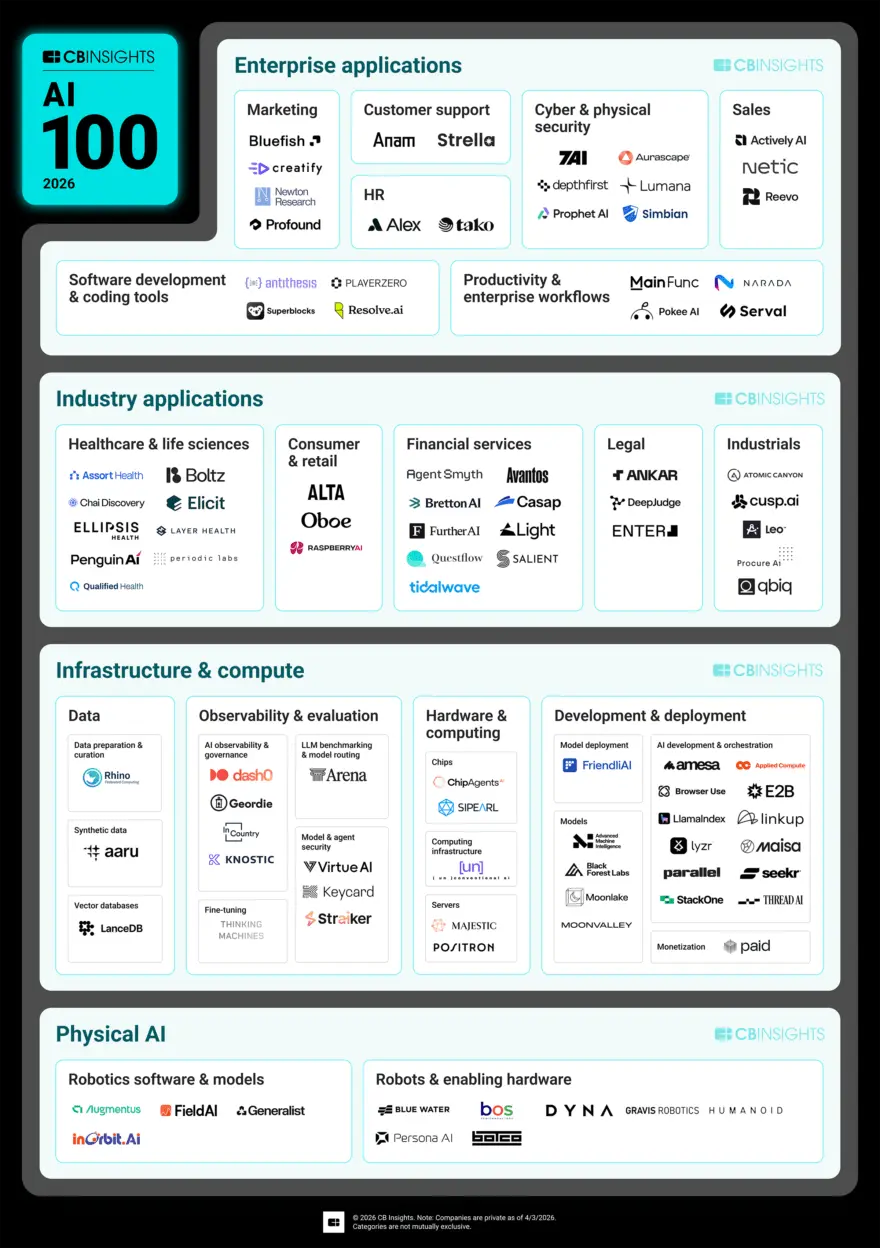
CB Insights, a globally influential technology market intelligence firm, has released its tenth annual AI 100 list, selecting the world's 100 most promising AI startups in 2026. The list covers the full spectrum of AI innovation from infrastructure to industry-specific vertical applications. The selected companies have collectively raised over $10.9 billion, with more than $2 billion raised in 2026 alone, strongly validating global capital's confidence in the AI Agent sector.

CB Insights noted that the core theme this year has shifted from "Can AI work?" to "How quickly can AI be deployed, governed, and scaled into complex workflows." Among these trends, AI Agents capable of autonomously executing multi-step tasks in production environments are emerging as the core driving force behind the new wave of industrial transformation.
As a deep participant in this wave, Questflow—a Singapore-headquartered startup focused on on-chain AI brokerage—is at the forefront of this transformation with its unique product architecture and business model.

Not Just a Tool, But an AI That Trades For You

While most AI financial tools are still in the "data dashboard" phase, Questflow has already advanced AI Agents to the level of autonomous trading entities. Users don't need to actively search for opportunities; the AI Agents on the platform proactively scan the market, form judgments, and execute trades directly through a conversational interface, operating 24/7 without requiring manual intervention for every decision.

This is precisely the new AI paradigm defined by CB Insights' latest list: Agents capable of independently executing multi-step workflows without requiring step-by-step human confirmation represent the true deployment of AI in production environments. The operation of Questflow's AI Clone simultaneously on the Polymarket prediction market and the Hyperliquid perpetual contract market is the most direct application of this paradigm in the financial field.

Democratizing Financial Intelligence, Breaking Down Wealth Barriers

Questflow's core proposition is concise and powerful: Robinhood got everyone a seat at the table; Questflow gives everyone a brain.

In the past, institutional-grade trading intelligence was a privilege exclusive to wealth—family offices serve clients with over $30 million, private banks even more so, leaving ordinary retail investors to rely on luck. Through its AI Clone + Copy Trade product architecture, Questflow lowers the entry barrier for such capabilities to as little as $1, while maintaining a structure with zero management fees and zero performance fees. Revenue comes from a 1% trade execution fee, aligning interests highly with users and eliminating conflicts.

The Timing Is Right

The three key industry signals emphasized by CB Insights in this year's list—the large-scale deployment of AI Agents, accelerated AI penetration in financial services, and the maturation of on-chain infrastructure—closely align with Questflow's strategic assessment: sufficient on-chain asset liquidity (Hyperliquid monthly trading volume exceeds $30 billion, Polymarket monthly trading volume exceeds $1 billion), enhanced AI reasoning capabilities, and improved security of non-custodial wallet infrastructure. These three forces are converging simultaneously, opening a window of opportunity.

"When millions of people can operate their own quantitative funds, brokers, funds, and exchanges will merge into a single platform," stated the Questflow team. "That's what we are building."


Domande pertinenti

QAccording to the article, what is the key theme shift noted by CB Insights regarding AI development in 2026?

AThe core theme has shifted from 'whether AI works' to 'how fast AI can be deployed, governed, and scaled into complex workflows.'

QWhat specific role does Questflow's AI Agent play in the financial markets, distinguishing it from other AI financial tools?

AQuestflow's AI Agent acts as an autonomous trading entity. It proactively scans markets, forms judgments, and directly executes trades through a conversational interface, 24/7 without requiring human intervention for every decision.

QHow does Questflow aim to 'democratize financial intelligence' according to its core proposition?

AIts proposition is: 'Robinhood put everyone at the table, Questflow gives everyone a brain.' It lowers the access barrier to institutional-grade trading intelligence to as low as $1, using an AI Clone + Copy Trade model with zero management fees, aligning its revenue (1% execution fee) with user success.

QWhat are the three converging forces that create a timely opportunity for Questflow's business, as mentioned in the article?

AThe three converging forces are: 1) Sufficient on-chain asset liquidity (e.g., Hyperliquid's monthly volume exceeding $30B), 2) Enhanced AI reasoning capabilities, and 3) Improved security of non-custodial wallet infrastructure.

QWhat is Questflow's ultimate vision for the future structure of financial services, as stated by its team?

AThe team envisions a future where 'brokers, funds, and exchanges merge into a single platform' when millions of people can operate their own quantitative funds.

Letture associate

Will the Next Crypto Bull Run Start with On-Chain Trading of SpaceX?

This article presents a scenario-based forecast for the crypto industry from 2026 to 2029, arguing that the next major cycle will be driven not by technological narratives but by legal access to real-world assets. The author predicts that by mid-2026, pre-IPO perpetual contracts for top private companies like SpaceX, OpenAI, and Anthropic on platforms like Hyperliquid will become the primary gateway for accessing quality assets, as most crypto-native tokens fail to capture real value. The much-hyped AI x Crypto intersection largely fails except for prediction markets, which thrive on betting on AI model supremacy. By 2027, public blockchain foundations are forced to choose between catering to retail speculation or building compliant infrastructure for institutions, with many opting for the latter. Growth in stablecoins and tokenized private credit/equity hits a "triple ceiling" due to regulatory and political uncertainty rather than market demand. The pivotal shift is forecast for 2028. A major liquidation event in pre-IPO perpetuals exposes the structural flaw of synthetic markets lacking a real underlying asset anchor. In response, regulatory changes finally allow the public solicitation of private securities resales to verified accredited investors. This creates a legitimate secondary market for real company equity, which then becomes the core asset class of the new bull market, relegating synthetic perps to a niche role. By 2029, the industry becomes "boring" but foundational. Tokens without claims on real cash flows or assets cease trading. Stablecoin growth is steady but politically capped. Crypto infrastructure fades from view as it gets absorbed into traditional finance backends. The article's central thesis is that the key bottleneck for crypto's next phase is legal and regulatory channels for real asset ownership, not technology.

marsbit1 h fa

Will the Next Crypto Bull Run Start with On-Chain Trading of SpaceX?

marsbit1 h fa

The Value Distribution of Stablecoins

**Summary: The Value Distribution of Stablecoins** The article argues that stablecoins are evolving from mere trading tools into broader channels for dollar access. It divides the stablecoin ecosystem into four layers to analyze how value is distributed: 1. **Issuance Layer:** Mints stablecoins, holds reserve assets, and captures the spread between reserve yield and user costs (e.g., Tether, Circle). This layer currently earns the largest profit margin. 2. **Infrastructure Layer:** Connects stablecoins to the traditional financial system, handling fiat on/off-ramps, banking integration, compliance (KYC/AML), and asset management (e.g., Bridge, BVNK). This is the "unglamorous" but critical work, building the essential bridges between crypto and real-world finance. 3. **Acquiring/Distribution Layer:** Integrates stablecoins into merchant systems, manages payment flows, and provides enterprise financial software (e.g., Stripe, Coinbase). They act as the access point for businesses. 4. **Application Layer:** The end-users and businesses that ultimately use stablecoins for payments, settlements, or as a store of value. They benefit from convenience but have little pricing power. The core thesis is that while the issuance layer currently dominates profits, the often-overlooked **infrastructure layer holds significant long-term potential**. The real challenge and barrier to mass adoption is not the on-chain transfer of stablecoins (which is simple), but the complex "last mile" integration into existing business workflows, banking systems, and regulatory frameworks across different countries. Companies in this layer are currently in a "land grab" phase, investing heavily to build networks, secure bank partnerships, and establish compliance pathways. While their position is currently pressured by the profitable issuers above and distribution platforms below, the article suggests that if stablecoins become a default financial rail for businesses, the infrastructure providers who have done the hard work of integration will ultimately gain strong pricing power and become entrenched, essential players.

marsbit8 h fa

The Value Distribution of Stablecoins

marsbit8 h fa

The Value Distribution of Stablecoins

The Value Distribution of Stablecoins The article argues that stablecoins are evolving from a mere trading tool into a broad "dollar channel." It analyzes the industry's value chain through four layers: 1. **Issuance Layer (e.g., Tether, Circle):** The top layer that mints stablecoins, holds reserve assets, and captures the thickest interest rate spread. 2. **Infrastructure Layer (e.g., Bridge, BVNK):** Connects stablecoins to the traditional financial system, handling critical but complex "dirty work" like fiat on/off-ramps, banking integration, compliance (KYC/AML), and cross-border settlement. 3. **Acquiring/Distribution Layer (e.g., Stripe, Coinbase):** Embeds stablecoins into merchant systems, manages payment flows, and integrates with enterprise software. 4. **Application Layer:** End-users and businesses that ultimately use stablecoins for payments, settlement, or storing value. The author posits that while the issuance layer currently captures the most profit, the most overlooked and potentially critical layer is infrastructure. The core challenge for stablecoin adoption isn't the on-chain transfer (which is simple), but bridging the gap between blockchain and the real-world financial system. This involves solving practical problems for businesses: fiat conversion, reconciliation, tax handling, and user onboarding. Infrastructure companies are currently in a difficult "land-grab" phase—building networks, securing banking relationships, and achieving compliance country-by-country. They face pressure from both the profitable issuance layer above and distribution platforms below. However, the author suggests this layer is building a crucial moat. Once stablecoins become a default business rail, the infrastructure players who have done the hard work of integration may gain significant, durable value and pricing power.

链捕手8 h fa

The Value Distribution of Stablecoins

链捕手8 h fa

Trading

Spot
Futures

Articoli Popolari

Come comprare ERA

Benvenuto in HTX.com! Abbiamo reso l'acquisto di Caldera (ERA) semplice e conveniente. Segui la nostra guida passo passo per intraprendere il tuo viaggio nel mondo delle criptovalute.Step 1: Crea il tuo Account HTXUsa la tua email o numero di telefono per registrarti il tuo account gratuito su HTX. Vivi un'esperienza facile e sblocca tutte le funzionalità,Crea il mio accountStep 2: Vai in Acquista crypto e seleziona il tuo metodo di pagamentoCarta di credito/debito: utilizza la tua Visa o Mastercard per acquistare immediatamente CalderaERA.Bilancio: Usa i fondi dal bilancio del tuo account HTX per fare trading senza problemi.Terze parti: abbiamo aggiunto metodi di pagamento molto utilizzati come Google Pay e Apple Pay per maggiore comodità.P2P: Fai trading direttamente con altri utenti HTX.Over-the-Counter (OTC): Offriamo servizi su misura e tassi di cambio competitivi per i trader.Step 3: Conserva Caldera (ERA)Dopo aver acquistato Caldera (ERA), conserva nel tuo account HTX. In alternativa, puoi inviare tramite trasferimento blockchain o scambiare per altre criptovalute.Step 4: Scambia Caldera (ERA)Scambia facilmente Caldera (ERA) nel mercato spot di HTX. Accedi al tuo account, seleziona la tua coppia di trading, esegui le tue operazioni e monitora in tempo reale. Offriamo un'esperienza user-friendly sia per chi ha appena iniziato che per i trader più esperti.

351 Totale visualizzazioniPubblicato il 2025.07.17Aggiornato il 2026.06.02

Come comprare ERA

Discussioni

Benvenuto nella Community HTX. Qui puoi rimanere informato sugli ultimi sviluppi della piattaforma e accedere ad approfondimenti esperti sul mercato. Le opinioni degli utenti sul prezzo di ERA ERA sono presentate come di seguito.

活动图片