The $290 Million Deficit: A Three-Way Game Between Aave, L0, and Kelp—Who Should Foot the Bill?

Odaily星球日报Pubblicato 2026-04-20Pubblicato ultima volta 2026-04-20

Introduzione

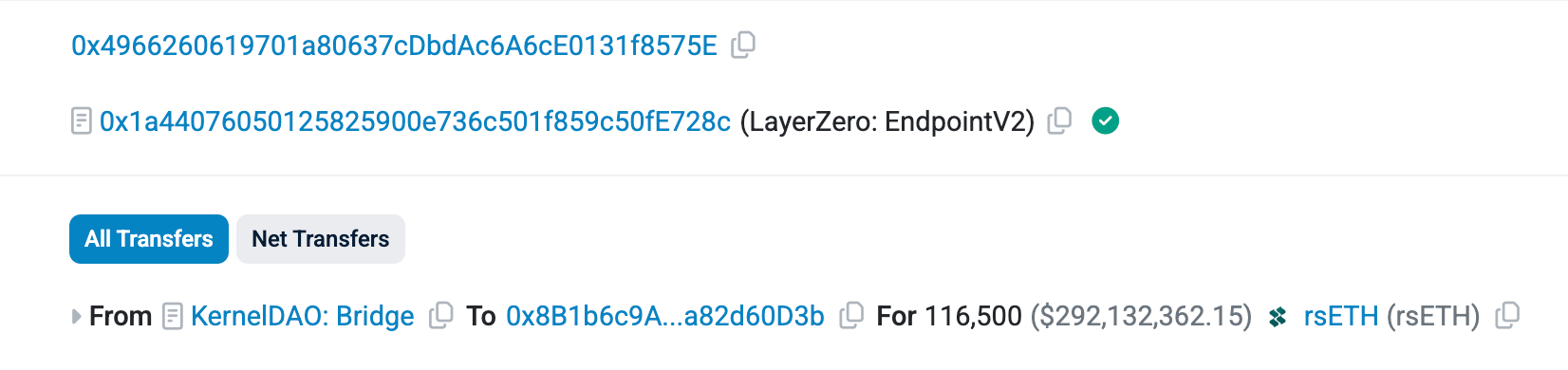
An incident involving the theft of 116,500 rsETH (worth approximately $290 million) from Kelp DAO’s cross-chain bridge contract has triggered a complex dispute over responsibility and compensation among Kelp DAO, LayerZero, and Aave. The attack occurred due to a compromised RPC provider used by LayerZero’s Decentralized Verifier Network (DVN). Since Kelp DAO’s bridge used a 1/1 DVN configuration—a single point of failure—the attacker successfully forged a cross-chain message, leading to the unauthorized release of rsETH tokens from the mainnet. These genuine tokens were then deposited into Aave and other lending platforms to borrow WETH, enabling the attacker to exit with the funds. Responsibility is attributed primarily to Kelp DAO for its risky 1/1 DVN setup. LayerZero bears secondary responsibility for permitting such a vulnerable configuration in its protocol layer. Aave also shares indirect blame for over-collateralizing rsETH and other Liquid Restaking Token (LRT) assets without adequate ongoing risk oversight. Kelp DAO lacks sufficient funds to cover the loss, shifting focus to the deeper-pocketed players: LayerZero, whose cross-chain ecosystem and reputation are at risk, and Aave, which faces massive bad loans and declining Total Value Locked (TVL). Aave has asserted that mainnet rsETH remains fully backed, implying it expects Kelp DAO to allow redemption of underlying ETH. This approach would preserve Aave’s mainnet positions but invalidate Layer2 rsETH, damaging...

Original | Odaily Planet Daily (@OdailyChina)

Author | Azuma (@azuma_eth)
More than 30 hours have passed since the bridge contract of Kelp DAO's rsETH was compromised. Although the parties involved (LayerZero, Kelp DAO, Aave) have made statements (primarily "shifting blame" and emphasizing their own innocence), a final solution has yet to be provided.

Therefore, this article aims to discuss the current positions and attitudes of the involved parties, explore the reasons for the delay in finalizing a solution, and attempt to speculate on how the incident might ultimately be resolved.

Odaily Note: For background, please refer to "DeFi Hacked Again for $292 Million, Is Even Aave Unsafe Now?"

Who Should Be Responsible?

First, let's discuss the issue of responsibility.

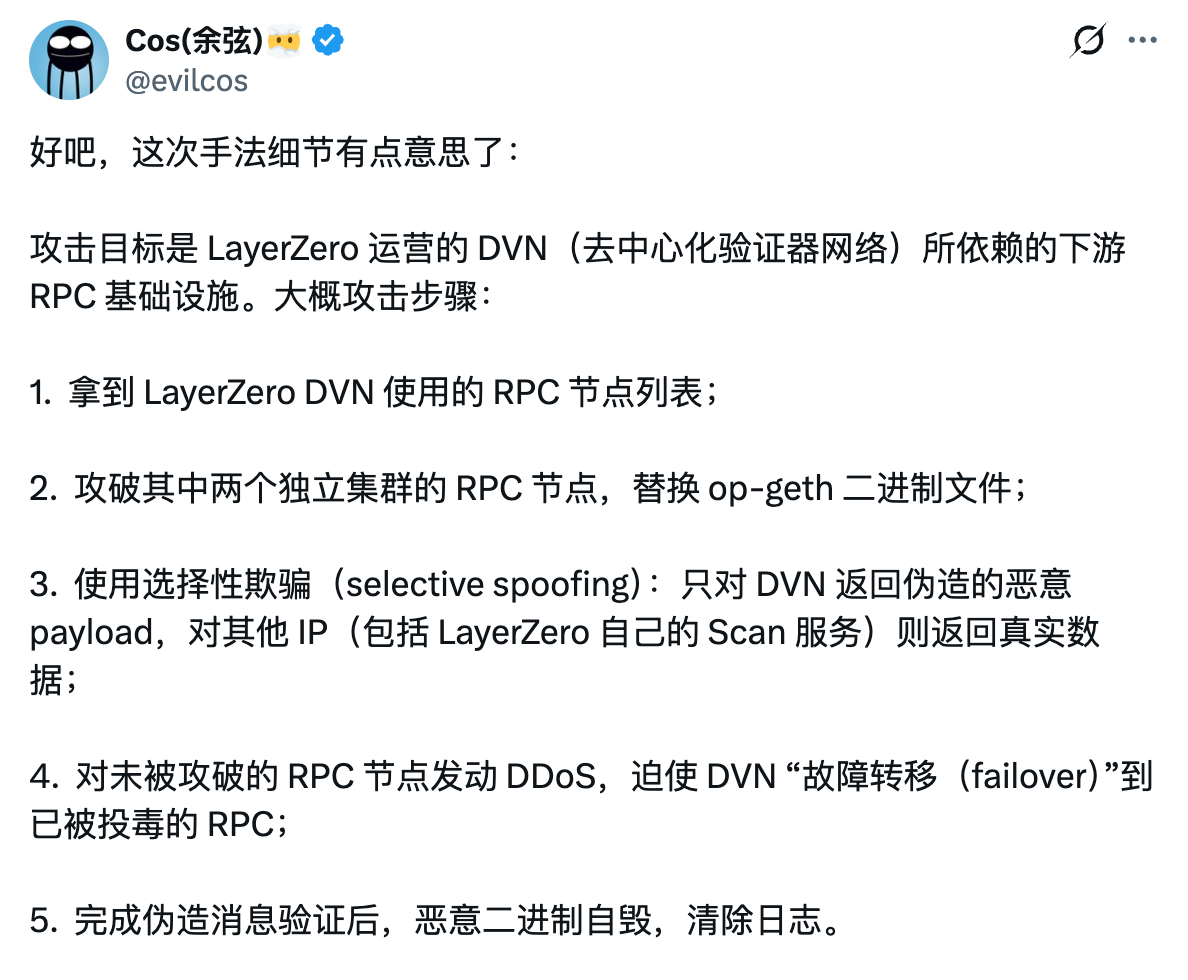
According to the details disclosed by LayerZero, the direct cause of the incident is quite clear: the downstream RPC infrastructure relied upon by LayerZero's operated Decentralized Verifier Network (DVN) was compromised (see the analysis by SlowMist founder Yu Xian in the image below). Furthermore, because Kelp DAO's bridge contract used a 1/1 DVN configuration, the attacker only needed to complete one forged message verification to carry out the attack.
LayerZero believes that Kelp DAO, which adopted the 1/1 DVN configuration, is the most directly responsible party in this incident. This is indisputable—such an obvious "single point of failure" is utterly absurd.

However, as the underlying cross-chain protocol, LayerZero should also bear some responsibility. While LayerZero allows each upper-layer application to configure the number and threshold of DVNs itself, and the 1/1 DVN was Kelp DAO's own choice, as the designer of the underlying architecture, it should also avoid allowing such an obviously flawed configuration.

Finally, there are lending protocols like Aave (focusing on Aave here). Although they are also indirectly affected victims, objectively speaking, Aave's excessive lending permissions granted to rsETH and other LRT assets for expansion purposes are the direct reason it finds itself in its current passive position. Additionally, it is worth mentioning that Aave's former risk control team, BGD Labs (now separated from Aave), explicitly pointed out the DVN issue with Kelp DAO back in January last year. Kelp accepted the advice at the time but clearly did not make the changes... Aave's failure to continue supervising and taking corresponding measures is also a case of reaping what it sowed.
So the assignment of responsibility is clear: Kelp DAO bears primary responsibility, LayerZero secondary responsibility, and Aave also has some indirect responsibility.

The Awkward Reality

Reality is always more complex than theoretical expectations. The most critical issue is that the Kelp DAO team, which should bear the primary responsibility, does not have enough money to cover the shortfall... Directly imposing a loss write-down on all rsETH holders or betraying Layer2 token holders is essentially a dead end.

So who has the money? The first is LayerZero, which is facing a reputation crisis due to this incident, has been temporarily disabled by multiple institutions and protocols such as Bitgo, Tron, Ethena, Curve, and ether.fi, and risks losing a significant share of the cross-chain market. The second is Aave, which is facing huge potential bad debts and watching over ten billion dollars in TVL flow out.

Thus, the "ulterior motives" of each party are clear. The primarily responsible party, Kelp DAO, is basically paralyzed and unable to lead the subsequent compensation efforts; what to do needs to be discussed with the two bigger players. Meanwhile, LayerZero and Aave, the secondary and indirectly responsible parties with the ability to pay, have both stated that their protocols did not have vulnerabilities, clearly indicating they are not planning to easily take on such a huge responsibility... So the situation seems somewhat deadlocked for now.

However, I do not believe this situation will last long because both major protocols have a need to resolve the issue quickly—LayerZero cannot abandon its OFT cross-chain ecosystem ambitions, and Aave cannot ignore the continued outflow of existing funds.

The Key to the各方博弈 (Parties' Game Theory)

This morning, Aave issued an updated statement on the incident. The most important piece of information in the statement was—Aave emphasized that "rsETH on the Ethereum mainnet is fully backed".

How should this be understood? We need to start with the design of rsETH.

rsETH is essentially a liquidity restaking voucher token issued by Kelp DAO. Each rsETH token is backed by 1 ETH within the staking and restaking system, following the path "ETH - Lido - EigenLayer - Kelp DAO - rsETH".

The rsETH on the mainnet refers to the original voucher tokens issued by Kelp DAO on Ethereum. Later, to expand within the Layer2 ecosystem, Kelp DAO would use LayerZero's bridge contract (the thing that caused trouble in this incident) to map the mainnet rsETH to various Layer2s. For every 1 rsETH issued on a Layer2, the corresponding rsETH on the mainnet is deposited into Kelp DAO's custodian contract, to be released only when the Layer2 rsETH is bridged back to the mainnet.

Now, back to the incident itself. As mentioned earlier, the reason for the theft was that the hacker tricked the DVN into forging a cross-chain message, causing the bridge contract to "mistakenly release" 116,500 rsETH—note, this did not involve printing new coins out of thin air, but rather obtaining the original voucher tokens from the mainnet that should not have been released.

The problem lies precisely here. These tokens were already circulating on Layer2 through mapping, while the tokens on the mainnet were in a locked state. However, after the hacker obtained them, they deposited them into lending protocols like Aave and borrowed more liquid WETH, thus completing their escape—again, it must be emphasized that the rsETH deposited by the hacker was real, which is why Aave supported the抵押借贷 (collateralized lending) behavior for this token.

Now, looking back at Aave's statement is very interesting. The phrase "rsETH on the Ethereum mainnet is fully backed" is essentially saying: "These coins are real! Kelp DAO, you should support us in using these coins to redeem the underlying ETH (contracts are paused, redemption is currently not possible)... As for the mapped version of rsETH on Layer2 that lost the backing of the mainnet rsETH, we can't deal with that!"

This is likely Aave's inclination. Although emphasizing the value of mainnet rsETH means disregarding the value of the mapped rsETH on Layer2, and since Aave itself also has some rsETH debt positions on its Layer2 lending products (current real-time scale is $359 million), this would also create some bad debt. But weighing the two evils, Aave most likely assessed the potential impact of both options and determined that protecting its core mainnet product best serves its maximum interests.

But this is just the stance of Aave alone. How the incident is resolved ultimately depends on whether an agreement can be reached with LayerZero and Kelp DAO.

Although the latter have not yet issued further statements, I personally believe LayerZero will have difficulty accepting this solution, because abandoning the mapped tokens on Layer2 would directly threaten LayerZero's cross-chain reputation.

Potential Solutions

The problem must ultimately be solved. Various big names on social media have been offering suggestions to Aave, LayerZero, and Kelp DAO these past two days.

DefiLlama founder 0xngmi speculated on three possible paths but also stated that all three have obvious flaws. The first path is for all rsETH holders to jointly bear an 18.5% value write-down (proportion of lost tokens/issued tokens), with Kelp DAO taking the blame itself, and Aave also bearing roughly $216 million in bad debt on the mainnet. The second path is to disregard the value of all mapped rsETH on Layer2, thus preserving Aave's mainnet product, but likely causing the Layer2 ecosystem to collapse and Kelp DAO's reputation to hit zero. The third path is to fully compensate holders of rsETH before the hacker attack based on a snapshot, with subsequent buyers or transferees bearing the losses themselves. However, since funds have moved significantly after the attack, this is practically impossible to execute.

OneKey founder Yishi stated: "The best outcome now is to negotiate with the hacker, offer a 10–15% bounty, get most of the funds back, and everyone is happy. If negotiations fail, the LayerZero生态基金 (ecosystem fund) should contribute the most—it's the richest, has the most long-term interest, and paying up could save the OFT ecosystem. Kelp DAO is the poorest; either use tokens + future revenue to compensate, or simply sell the entire project to LayerZero or Bitmine. Aave's Umbrella and stkAAVE cover the last layer, but WETH depositors absolutely must not suffer a value write-down. Otherwise, Morpho, Spark, Fluid, Euler would all undergo repricing simultaneously, the entire LRT sector would be blacklisted, and the entire DeFi industry would be set back three years."

In any case, the parties will certainly continue to argue for a while longer, as involving hundreds of millions in real money means no one wants to be the biggest sucker.

As for how much more time is needed to provide a solution, as mentioned earlier, the two giants dare not delay too long. LayerZero is currently forced into a pause by various partner institutions and protocols; delaying longer will likely lead these partners to switch cross-chain solutions. Aave's situation is also not optimistic; the utilization rates of multiple pools have reached 100%, leaving depositors 'trapped'... If ETH were to suddenly plummet sharply, Aave would likely be unable to effectively liquidate (which is indeed the case now) and could incur more bad debt, ultimately causing the problem to snowball—if it reaches this point, the foundation of the industry could be shaken, a situation obviously no one would like to see.


Crypto di tendenza

Domande pertinenti

QWhat was the direct cause of the security incident involving Kelp DAO's rsETH bridge contract?

AThe direct cause was the compromise of the downstream RPC infrastructure relied upon by LayerZero's Decentralized Verifier Network (DVN). The attacker exploited this to forge a cross-chain message validation, which was possible because Kelp DAO's bridge contract used a 1/1 DVN configuration, creating a single point of failure.

QAccording to the article, how is the responsibility for the incident allocated among Aave, LayerZero, and Kelp DAO?

AKelp DAO bears the primary responsibility for using a flawed 1/1 DVN configuration. LayerZero bears secondary responsibility as the underlying protocol designer that allowed such a risky configuration. Aave also has indirect responsibility for granting excessive borrowing permissions to rsETH and failing to follow up on previously identified risks.

QWhat is the key reason why resolving the situation is particularly complex and slow?

AThe primary responsible party, Kelp DAO, lacks the financial resources to cover the massive $290 million shortfall. Meanwhile, the parties with the funds to potentially help—LayerZero and Aave—have both publicly claimed their protocols were not at fault and are reluctant to accept the financial burden, leading to a stalemate in negotiations.

QWhat does Aave's statement that 'rsETH on the Ethereum mainnet is fully backed' imply about their proposed solution?

AIt implies that Aave's preferred solution is to treat the mainnet rsETH (the original tokens) as the only valid assets, using the underlying staked ETH to cover losses on its mainnet platform. This would mean writing off the value of the Layer2 mapped versions of rsETH, which would severely impact LayerZero's cross-chain ecosystem and Kelp DAO's reputation.

QWhat are two potential negative outcomes if a resolution is not reached quickly, as mentioned in the article?

A1. LayerZero risks losing significant cross-chain market share as partners like Bitgo and Tron have already disabled its services. 2. Aave faces the risk of its bad debt snowballing if ETH prices drop sharply, as high utilization rates in its pools prevent effective liquidations, potentially causing wider instability in the DeFi sector.

Letture associate

Must-Watch Events Next Week|CLARITY Act Could Face Senate Vote; SpaceX, Circle to Report Earnings (8.3-8.9)

**Summary: Key Events and Developments to Watch (August 3-9)** The upcoming week is marked by significant financial disclosures, key legislative deadlines, and notable product updates. **Major Financial Events:** Several companies are scheduled to release their Q2 2026 earnings. American Bitcoin (ABTC) will report on August 3, followed by SpaceX and Hut 8 Mining Corp. on August 4, and Circle on August 5. Notably, a significant portion of SpaceX shares (up to 12% of total shares) will be unlocked on August 6 following their earnings release. **Key Legislative Deadline:** The U.S. Senate faces an August 7 deadline to secure 60 votes for the CLARITY Act, a bipartisan bill aiming to establish a federal regulatory framework for cryptocurrencies. The Senate may hold a full vote on the bill during the week. **Economic Data:** The U.S. July Non-Farm Payrolls report will be released on August 7, providing crucial labor market data. **Technology & Product Updates:** * **Shutdowns:** DeFi portfolio tracker Zapper and wallet app Ctrl Wallet will cease operations on August 3. * **Upgrades:** LayerZero will deprecate its v1 relayers on August 3. XRP Ledger's new version 3.3.0, featuring five new functions, is expected next week. * **AI:** Elon Musk announced that the advanced Grok 4.6 AI model is set for release around August 7. * **Bitcoin:** The BIP-110 forced signaling for a potential Bitcoin network change is scheduled to begin around August 8. **Other Notable Events:** Chinese robotics firm Unitree Tech has set its preliminary price inquiry for its IPO for August 5. South Korean exchange Upbit will delist AQT and AERGO tokens on August 3.

marsbit1 h fa

Must-Watch Events Next Week|CLARITY Act Could Face Senate Vote; SpaceX, Circle to Report Earnings (8.3-8.9)

marsbit1 h fa

Stocks Are Plummeting More Sharply Than Cryptocurrencies. Where Has the Money Gone?

Stock Markets Plunge Deeper Than Cryptocurrencies: Where Did the Money Go? In late July, Seoul's Kospi index triggered circuit breakers for two consecutive days, plummeting over 40% from its June high. The collapse was led by heavyweight stocks like SK Hynix, whose record profits still disappointed investors, and devastating leveraged ETFs, with one major product losing over 83% of its value. This signaled a global, forced deleveraging targeting the most crowded trades. Interestingly, while stocks exhibited extreme volatility akin to crypto markets, Bitcoin rose nearly 15% in July after a prior steep drop. Analysis shows the money fleeing equities did not flow into Bitcoin. Instead, Bitcoin had already absorbed its sell-off in May-June, when U.S. spot Bitcoin ETFs saw historic outflows. The true safe-haven beneficiary was gold, whose price rose over 20% year-on-year, highlighting a decoupling between Bitcoin and gold as "digital gold." The sell-off was a targeted unwinding of leveraged positions in tech and semiconductors, accelerated by broker-dealer risk management and shifts in the AI narrative, including new competition from Chinese memory chipmakers. The retreat path was clear: from high-valuation tech stocks to cash and U.S. Treasuries, then to gold. For Bitcoin to attract sustained institutional inflows, conditions like eased global liquidity pressure, a "soft-landing" Fed rate cut, and U.S. regulatory clarity via legislation like the stalled CLARITY Act are needed. Currently, Bitcoin is not a safe haven but an already-cleared asset. Its low correlation with tech stocks, however, makes it a potential diversification play for institutional portfolios once the storm passes. The money isn't here yet, but the positioning is underway.

marsbit1 h fa

Stocks Are Plummeting More Sharply Than Cryptocurrencies. Where Has the Money Gone?

marsbit1 h fa

In Conversation with Ray Dalio: We Are Currently in an AI Bubble, with 1% of My Portfolio in Bitcoin

Ray Dalio, founder of Bridgewater Associates, warns in an interview that the current AI boom shows classic bubble characteristics, which could lead to significant economic downturns as seen in past cycles like 1929 or 2000. He explains that speculative enthusiasm, fueled by debt and overvaluation, often precedes a crash when rising rates or taxation force asset sales, causing widespread losses and recession. Dalio also outlines his "Big Cycle" theory, describing an approximate 80-year pattern where widening wealth gaps, massive government deficits, and shifting geopolitical power (like China's rise) create internal conflict and global instability. He emphasizes that we are in a late-cycle, transitional phase where traditional powers like the US and UK face decline. For personal wealth protection, Dalio advises diversification beyond cash into assets like stocks, bonds, real estate, and particularly gold, which he prefers over Bitcoin. While he holds about 1% of his portfolio in Bitcoin as a non-printable hard asset, he views gold as more secure from technological or governmental threats. Regarding AI's impact, Dalio believes it will disproportionately benefit capital owners, worsening inequality by replacing both physical and cognitive labor. He suggests that human intuition and emotional intelligence, combined with AI, will be key for future workers. On taxation, Dalio argues that wealth taxes are impractical and risk triggering asset sell-offs, reducing productive investment. He points to the UK as a cautionary example of debt, low productivity, and political strife. Geopolitically, Dalio foresees a more regionalized world, with the US showing weakness in prolonged conflicts like with Iran, akin to past imperial declines. The ideal outcome, he suggests, is coexisting powerful blocs (e.g., Americas, China-Asia Pacific) without major war.

marsbit5 h fa

In Conversation with Ray Dalio: We Are Currently in an AI Bubble, with 1% of My Portfolio in Bitcoin

marsbit5 h fa

Trading

Spot

Articoli Popolari

Come comprare AAVE

Benvenuto in HTX.com! Abbiamo reso l'acquisto di Aave Protocol (AAVE) semplice e conveniente. Segui la nostra guida passo passo per intraprendere il tuo viaggio nel mondo delle criptovalute.Step 1: Crea il tuo Account HTXUsa la tua email o numero di telefono per registrarti il tuo account gratuito su HTX. Vivi un'esperienza facile e sblocca tutte le funzionalità,Crea il mio accountStep 2: Vai in Acquista crypto e seleziona il tuo metodo di pagamentoCarta di credito/debito: utilizza la tua Visa o Mastercard per acquistare immediatamente Aave ProtocolAAVE.Bilancio: Usa i fondi dal bilancio del tuo account HTX per fare trading senza problemi.Terze parti: abbiamo aggiunto metodi di pagamento molto utilizzati come Google Pay e Apple Pay per maggiore comodità.P2P: Fai trading direttamente con altri utenti HTX.Over-the-Counter (OTC): Offriamo servizi su misura e tassi di cambio competitivi per i trader.Step 3: Conserva Aave Protocol (AAVE)Dopo aver acquistato Aave Protocol (AAVE), conserva nel tuo account HTX. In alternativa, puoi inviare tramite trasferimento blockchain o scambiare per altre criptovalute.Step 4: Scambia Aave Protocol (AAVE)Scambia facilmente Aave Protocol (AAVE) nel mercato spot di HTX. Accedi al tuo account, seleziona la tua coppia di trading, esegui le tue operazioni e monitora in tempo reale. Offriamo un'esperienza user-friendly sia per chi ha appena iniziato che per i trader più esperti.

360 Totale visualizzazioniPubblicato il 2024.12.11Aggiornato il 2026.06.02

Come comprare AAVE

Discussioni

Benvenuto nella Community HTX. Qui puoi rimanere informato sugli ultimi sviluppi della piattaforma e accedere ad approfondimenti esperti sul mercato. Le opinioni degli utenti sul prezzo di AAVE AAVE sono presentate come di seguito.

活动图片












