Texas Poker Bluffing Battle | The Key to Victory in WPT Global High-Stakes Cash Game: AK vs 99

bitcoinistPubblicato 2025-12-24Pubblicato ultima volta 2025-12-24

Introduzione

An analysis of a high-stakes cash game hand on WPT Global between Alan Keating (A♠K♥) and Nik Airball (9♠9♦). The hand demonstrates how player image and credibility are often more critical than raw hand strength in deep-stack play. Keating, known for a loose and aggressive style with a wide range, 3-bet pre-flop. Airball, a skilled player adept at reading opponents, responded with a 4-bet. Keating then made a large 5-bet, a polarized move representing either a very strong hand or a pure bluff. Airball called, taking position to the flop (J♠4♦6♠). With his A-K missing the flop, Keating moved all-in with a massive overbet, attempting to maximize fold equity by representing a very strong range. However, Airball instantly called. His decision was a strategic read based on Keating's image; he calculated that Keating’s line was more likely a bluff with overcards. The board ran out twice with no A or K, and Airball's pocket nines held. The hand underscores a key high-stakes concept: betting power is determined not just by the cards, but by how opponents perceive your image and credibility. Keating’s aggressive play lost its effectiveness against an opponent who correctly adjusted his calling frequency to exploit it.

Learning from real battles, stealing skills from the masters. This hand between Keating and Airball with AK versus 99 at the WPT Global high-stakes cash table is a classic example. On the surface, it's a common high card versus medium pocket pair scenario, but in reality, it's an extreme confrontation under deep stack conditions, pushing image, credibility, and range reading to the limit.

To understand the direction of this hand, we must first understand the table personas of the two players, because at this level, hand strength is just the entry point; the core of decision-making is how much your opponent believes you.

Table Personas: One Relies on Chaotic Pressure, the Other on Reading Hands to Counter

Alan Keating is one of the most popular and difficult types to face at high-stakes tables. His VPIP is extremely high, his entering range is so wide it's almost distorted—he plays strong hands, marginal hands, and even garbage hands, daring to use massive sizing to apply pressure and bluff. His bankroll depth and risk preference give him a natural advantage in many confrontations, making it hard for opponents to pin down his hole cards using traditional signals, as his raises could be AA or 72 offsuit.

This near-crazy image can yield significant fold equity in the long run, but it also erodes his credibility. Once opponents categorize him as "polarized with a high bluff frequency," his big moves are easily counter-interpreted, ultimately becoming the starting point of a tragedy.

Nik Airball is the other extreme. A regular on shows like Hustler Casino Live, he is known for his incessant speech play and strong aggression. Public opinion on him is divided, but his technical foundation should not be underestimated. He is quite solid in range reading and tempo adjustment, especially skilled at making exploitative calls against specific opponents.

Facing an overly aggressive opponent like Keating, he knows when to increase his calling frequency and when to use calls to let the opponent bluff all the way. In other words, he isn't competing with Keating to see who is more aggressive, but rather who is better at turning the opponent's image into harvestable EV.

Pre-flop Raising War: Not AK vs 99, but the Pricing of Credibility

The hand starts with Airball opening with 9♠9♦. Keating's 3bet with A♠K♥ is a standard strong hand line, aiming to isolate the opponent and establish initiative. Airball then chooses to 4bet. This move is crucial in a deep stack scenario. 99 is an awkward medium pocket pair in most frameworks—it doesn't just seek set value like small pocket pairs, nor is it as comfortable under pressure as QQ or better. Airball's 4bet is both a test and a counter, betting that Keating's 3bet range is wide enough for him to still extract value and maintain initiative in the confrontation.

The real turning point occurs when Keating makes a 5bet, raising to 165,000. For most players, a 5bet is often seen as a signal for AA or KK, but in Keating's image framework, his 5bet is closer to a polarized move—either the nuts or using deep stacks and table credibility to force a fold. The question at this moment becomes: does Airball believe Keating's "represented range"? Airball doesn't shove all-in, nor does he fold. Instead, he chooses to call, taking the decision to the flop, using position and information advantage to delay the decision—a common high-level approach in high-stakes games, preserving room to observe Keating's post-flop line.

Flop: J♠4♦6♠, The Purpose and Cost of Keating's Overbet Shove

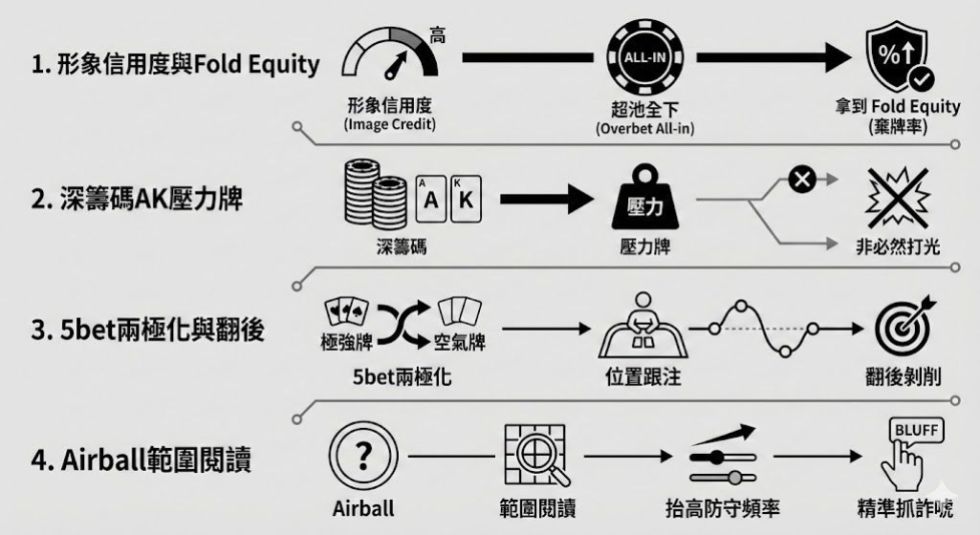
The flop doesn't bring an A or K; AK misses. Keating still chooses an overbet All-in shove. The core of this line is not hand strength, but maximizing Fold Equity. He hopes to use an extreme size to represent high-weight combinations like AA, KK, JJ, or strong flush draws, forcing a medium pocket pair like 99 to fold under immense pressure. Because if he checks or makes a small bet, AK can easily be passively led to a showdown disadvantage.

From a pure strategy perspective, this is a decision that settles the outcome in one go—success means taking the pot directly, failure means risking almost the entire buy-in.

The problem is, an overbet shove极度依赖信用度 (relies extremely on credibility). If the opponent believes you, it's a highly efficient pressure tool. If the opponent doesn't believe you, it becomes a move that locks the opponent's calling range into the "specifically designed to catch your bluff" zone, providing the opponent with the best incentive to call with your maximum size.
Airball's Instant Call: Calling with 99, Catching the Crack in Keating's Image

Airball's instant call looks like a hand strength decision, but it's actually a model decision. He calculates Keating's entire line within the framework of his opponent's persona: Keating has a wide pre-flop range, his 5bet has polarized characteristics, and when he misses the flop, he is more likely to push all the way with his two high-card air using a large size, trying to win the pot in one go.

Under this assumption, the relative strength of 99 on J♠4♦6♠ increases significantly. The call isn't about toughing it out; it's about exploiting the structural flaw of an opponent who applies excessive pressure and lacks credibility. They run it twice; neither runout produces an A or K. 99 holds its lead and busts Keating. The ending is sealed by the deal, but the logic of victory was actually determined the moment the instant call was made.

CoinPoker Gambling – The Overall Best Bitcoin Poker Gambling Site

CoinPoker has long been regarded as the most comprehensive Bitcoin gambling platform in the crypto space, establishing high competitiveness with its smooth interface, diverse gameplay, and strong bonus structure. The platform offers a 150% welcome bonus, with the first deposit going up to $2,000, making it an extremely attractive starting condition for both beginners and advanced players, and successfully solidifying its position as a mainstream BTC gambling site.

In terms of gameplay, CoinPoker offers over 15 betting markets, covering live sports, esports, virtual events, and more. It also supports deposits in multiple mainstream cryptocurrencies. Withdrawals are known for instant processing, zero fees, and anonymous settlement, ensuring players can withdraw their winnings quickly and safely. Beyond sports betting, the platform also features a mature casino system, including high-quality live dealer games, presented in HD stream from Blackjack to Roulette, allowing players to enjoy an immersion close to a physical casino on their mobile or desktop.

For poker players, CoinPoker's appeal is even more evident. The platform offers stable, active poker tables and diverse tournament formats. A 33% online poker rakeback is offered every Monday, providing substantial value for long-term players. Coupled with the platform's transparent operation and continuously promoted events, it creates a highly rated professional poker environment for global players.

CoinPoker combines Bitcoin gambling, live dealer casino, and a professional poker ecosystem, offering fast settlement,完善的奖金制度 (完善的 bonus system), and high anonymity, making it an ideal choice for crypto players seeking security, speed, and entertainment.

Enter CoinPoker to Play

Conclusion: The True Hand Strength in High-Stakes Games is How Your Opponent Sees You

The value of this hand lies in how clearly it illustrates the most essential reality of high-stakes games: the power of your bet is not only determined by the board but also by how your opponent prices your image. Keating's chaotic style can force excessive folds against many opponents, earning him a lot of non-showdown EV in the long run. But once he encounters an opponent who can calculate his bluff frequency into the equation, his 5bet and flop shove lose their intimidation power, even反过来 becoming the most comfortable calling point for the opponent. Airball wins by daring to increase his calling frequency and accurately choosing the most suitable structure to withstand the pressure.

A more realistic statement is: in a deep stack environment, AK is no longer a no-brainer all-in weapon. It's more like a pressure hand that requires credibility加成 (credibility bonus). When you are perceived as loose-aggressive, you must accept that opponents will call more boldly; your value lines need to be more direct, and your bluff lines need to be more selective. The reason this hand becomes a classic is not because 99 beat AK, but because it demonstrates the ultimate rule of high-stakes games: when your opponent sees through who you are, the cards in your hand get repriced.

Domande pertinenti

QWhat was the key factor that determined the outcome of the AK vs. 99 hand between Keating and Airball on the WPT Global high-stakes cash game?

AThe key factor was the players' table image and perceived credibility, not just the raw hand strength. Keating's hyper-aggressive and wide-ranging style had eroded his credibility, allowing Airball to accurately read his large bet on the flop as a likely bluff and make a profitable call with his pocket nines.

QHow did Nik Airball's playing style differ from Alan Keating's in this hand?

ANik Airball's style was based on solid range reading and making exploitative adjustments against specific opponents. He was adept at knowing when to increase his defense frequency and when to call down aggression. In contrast, Alan Keating employed a chaotic, high-VPIP style with a very wide range, using large bet sizes to apply pressure and bluff frequently.

QWhy did Alan Keating choose to make a 5-bet pre-flop and then an overbet all-in on the flop with A♠K♥?

AKeating's 5-bet pre-flop was a polarized move, representing either a very strong hand or a bluff designed to exploit his deep stack and force a fold. His overbet all-in on the J♠4♦6♠ flop was an attempt to maximize fold equity by representing a very strong hand (like an overpair or a strong draw) since his A-K had missed the board, hoping to win the pot without a showdown.

QWhat does the article suggest is the 'ultimate rule' of high-stakes poker, as demonstrated by this hand?

AThe 'ultimate rule' is that the power of a bet is not just determined by the cards, but by how an opponent prices your table image. When an opponent sees through your playing style and understands your tendencies, the value of the cards you hold is re-priced accordingly.

QAccording to the article, what makes A-K a different type of hand in a deep-stack environment against a skilled opponent?

AIn a deep-stack environment against a skilled opponent, A-K is no longer a hand to automatically commit all chips with. It becomes a pressure hand that requires credibility to be effective. If a player is perceived as loose and aggressive, opponents will be more willing to call, meaning value bets need to be more straightforward and bluffs need to be more carefully selected.

Letture associate

Gensyn AI: Don't Let AI Repeat the Mistakes of the Internet

In recent months, the rapid growth of the AI industry has attracted significant talent from the crypto sector. A persistent question among researchers intersecting both fields is whether blockchain can become a foundational part of AI infrastructure. While many previous AI and Crypto projects focused on application layers (like AI Agents, on-chain reasoning, data markets, and compute rentals), few achieved viable commercial models. Gensyn differentiates itself by targeting the most critical and expensive layer of AI: model training. Gensyn aims to organize globally distributed GPU resources into an open AI training network. Developers can submit training tasks, nodes provide computational power, and the network verifies results while distributing incentives. The core issue addressed is not decentralization for its own sake, but the increasing centralization of compute power among tech giants. In the era of large models, access to GPUs (like the H100) has become a decisive bottleneck, dictating the pace of AI development. Major AI companies are heavily dependent on large cloud providers for compute resources. Gensyn's approach is significant for several reasons: 1) It operates at the core infrastructure layer (model training), the most resource-intensive and technically demanding part of the AI value chain. 2) It proposes a more open, collaborative model for compute, potentially increasing resource utilization by dynamically pooling idle GPUs, similar to early cloud computing logic. 3) Its technical moat lies in solving complex challenges like verifying training results, ensuring node honesty, and maintaining reliability in a distributed environment—making it more of a deep-tech infrastructure company. 4) It targets a validated, high-growth market with genuine demand, rather than pursuing blockchain integration without purpose. Ultimately, the boundaries between Crypto and AI are blurring. AI requires global resource coordination, incentive mechanisms, and collaborative systems—areas where crypto-native solutions excel. Gensyn represents a step toward making advanced training capabilities more accessible and collaborative, moving beyond a niche controlled by a few giants. If successful, it could evolve into a fundamental piece of AI infrastructure, where the most enduring value in the AI era is often created.

marsbit10 h fa

Gensyn AI: Don't Let AI Repeat the Mistakes of the Internet

marsbit10 h fa

Why is China's AI Developing So Fast? The Answer Lies Inside the Labs

A US researcher's visit to China's top AI labs reveals distinct cultural and organizational factors driving China's rapid AI development. While talent, data, and compute are similar to the West, Chinese labs excel through a pragmatic, execution-focused culture: less emphasis on individual stardom and conceptual debate, and more on teamwork, engineering optimization, and mastering the full tech stack. A key advantage is the integration of young students and researchers who approach model-building with fresh perspectives and low ego, prioritizing collective progress over personal credit. This contrasts with the US culture of self-promotion and "star scientist" narratives. Chinese labs also exhibit a strong "build, don't buy" mentality, preferring to develop core capabilities—like data pipelines and environments—in-house rather than relying on external services. The ecosystem feels more collaborative than tribal, with mutual respect among labs. While government support exists, its scale is unclear, and technical decisions appear driven by labs, not state mandates. Chinese companies across sectors, from platforms to consumer tech, are building their own foundational models to control their tech destiny, reflecting a broader cultural drive for technological sovereignty. Demand for AI is emerging, with spending patterns potentially mirroring cloud infrastructure more than traditional SaaS. Despite challenges like a less mature data industry and GPU shortages, Chinese labs are propelled by vast talent, rapid iteration, and deep integration with the open-source community. The competition is evolving beyond a pure model race into a contest of organizational execution, developer ecosystems, and industrial pragmatism.

marsbit11 h fa

Why is China's AI Developing So Fast? The Answer Lies Inside the Labs

marsbit11 h fa

3 Years, 5 Times: The Rebirth of a Century-Old Glass Factory

Corning, a 175-year-old glass company, is experiencing a dramatic revival as a key player in AI infrastructure, driven by surging demand for high-performance optical fiber in data centers. AI data centers require vastly more fiber than traditional ones—5 to 10 times as much per rack—to handle high-speed data transmission between GPUs. This structural demand shift, coupled with supply constraints from the lengthy expansion cycle for fiber preforms, has created a significant supply-demand gap. Nvidia has invested in Corning, along with Lumentum and Coherent, in a $4.5 billion total commitment to secure the optical supply chain for AI. Corning's competitive edge lies in its expertise in producing ultra-low-loss, high-density, and bend-resistant specialty fiber, which is critical for 800G+ and future 1.6T data rates. Its deep involvement in co-packaged optics (CPO) with partners like Nvidia further solidifies its position. While not the largest fiber manufacturer globally, Corning's revenue from enterprise/data center clients now exceeds 40% of its optical communications sales, and it has secured multi-year supply agreements with major hyperscalers including Meta and Nvidia. Financially, Corning's optical communications revenue has surged, doubling from $1.3 billion in 2023 to over $3 billion in 2025. Its stock price has risen nearly 6-fold since late 2023. Key future catalysts include the rollout of Nvidia's CPO products and the scale of undisclosed customer agreements. However, risks include high current valuations and potential disruption from next-generation technologies like hollow-core fiber. The company's long-term bet on light over electricity, maintained even through the telecom bubble crash, is now being validated by the AI boom.

marsbit12 h fa

3 Years, 5 Times: The Rebirth of a Century-Old Glass Factory

marsbit12 h fa

Trading

Spot
Futures
活动图片