Tether's USDt awarded key regulatory status in Abu Dhabi

cointelegraphPubblicato 2025-12-08Pubblicato ultima volta 2025-12-08

Introduzione

Tether's USDt, the largest stablecoin by circulation, has been formally recognized as an "accepted fiat-referenced token" by the Abu Dhabi Global Market (ADGM). This regulatory milestone allows licensed financial institutions in the international financial center to offer regulated services involving USDt, including trading, custody, and cross-border settlements. The move reinforces Abu Dhabi's position as a key hub for digital assets, with its clear regulatory framework attracting major industry players. The approval follows a recent similar designation for Ripple's RLUSD stablecoin and coincides with plans by a local consortium to launch a dirham-pegged stablecoin.

Tether’s USDt, the largest stablecoin by circulation, has secured a regulatory milestone in Abu Dhabi’s international financial center, opening the door for licensed institutions to use the token in regulated services.

Announced Monday, USDt (USDT) was formally recognized as an “accepted fiat-referenced token,” allowing regulated firms in the Abu Dhabi Global Market (ADGM) to offer trading, custody and other services involving the stablecoin.

ADGM — an international financial center and free economic zone — has become a magnet for digital asset companies seeking clear rules and institutional access.

Tether CEO Paolo Ardoino said the designation “reinforces the role of stablecoins as essential components of today’s financial landscape,” a nod to their growing use in remittances, cross-border settlements and digital asset markets.

ADGM had already classified USDT as an accepted virtual asset across issuance on Ethereum, Solana and Avalanche. The latest recognition extends that framework, potentially boosting USDT’s usability for cross-border payments, institutional custody and settlement.
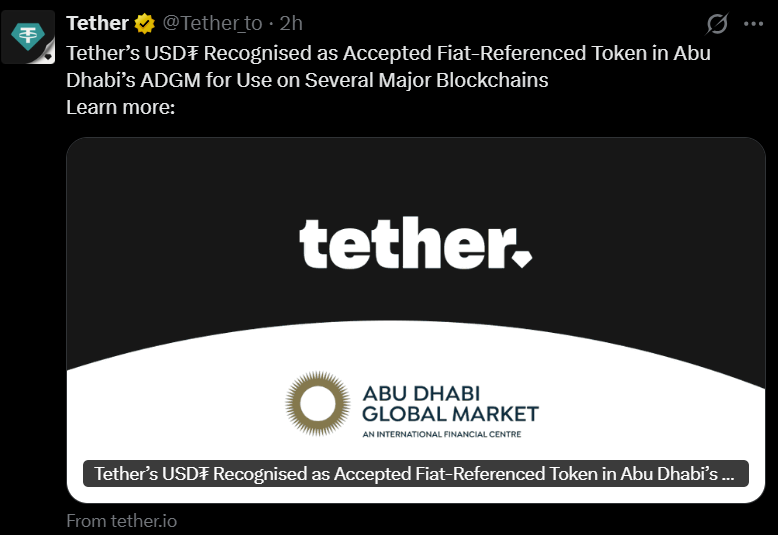
Source: Tether

Related: Binance secures ADGM licenses to operate international platform

Abu Dhabi targets stablecoins for finance

Tether’s USDT isn’t the only stablecoin gaining traction in Abu Dhabi. Local regulators recently approved Ripple’s dollar-pegged RLUSD as an accepted fiat-referenced token, clearing the way for institutional use.

The development comes as expectations build around a separate initiative backed by some of Abu Dhabi’s largest financial players.

A consortium including ADQ — the emirate’s sovereign wealth fund — International Holding Company and First Abu Dhabi Bank has announced plans for a dirham-pegged stablecoin, pending approval from the UAE Central Bank.
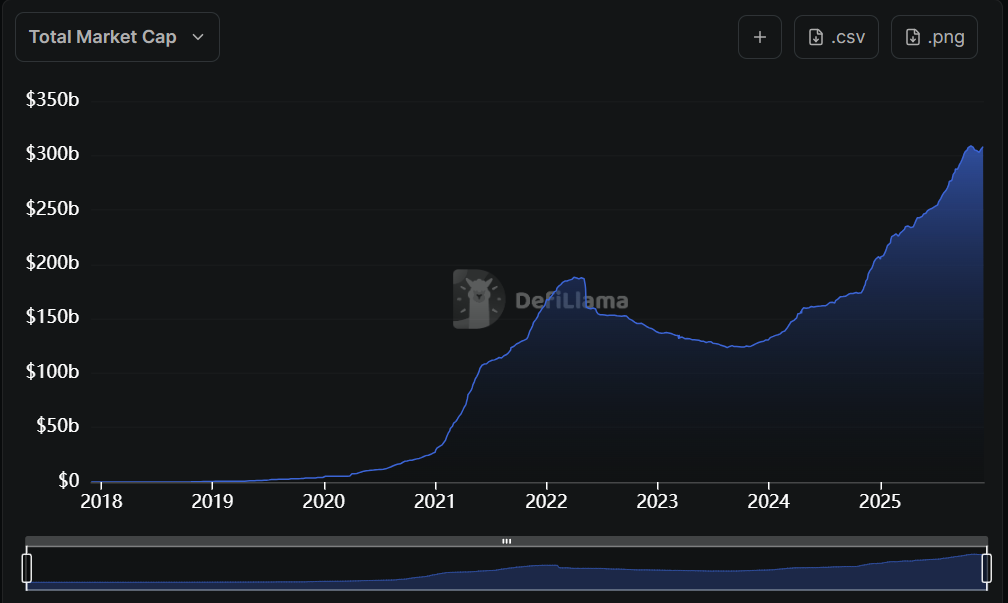
Valued at over $300 billion, the global stablecoin market has experienced rapid growth over the past two years. Source: DefiLlama

Abu Dhabi and the UAE, more broadly, have emerged as key players in the developing stablecoin and digital asset markets, thanks to a relatively clear regulatory framework in a region already positioned as a global hub for commerce. ADGM has become a central venue for licensing exchanges, custodians and other crypto-focused firms seeking structured oversight.

Magazine: The one thing these 6 global crypto hubs all have in common...
Letture associate

Central Bank Responds to Call to 'Exit the Sandbox' and Allows Stablecoins

Sberbank CEO Herman Gref expressed the bank's hope for the authorization of stablecoins for domestic transactions in Russia, stating that Sber is actively discussing this possibility with the Bank of Russia. He emphasized the need to move beyond the current regulatory "sandbox" and allow basic transactional functionality with stablecoins, primarily ruble-denominated tokens for internal use. However, the Bank of Russia maintains its position that stablecoins are a form of cryptocurrency and excludes their use for domestic payments. Kirill Pronin, head of the central bank's financial market infrastructure department, argued that Russia's digital payment ecosystem is already highly developed, making such authorization unnecessary. The article notes that Russia currently operates with Digital Financial Assets (DFAs), which are tokenized versions of real assets issued on approved blockchain platforms. Some foreign digital rights, including compliant stablecoins, can be classified as DFAs. The first such recognized asset was a Kyrgyzstani ruble stablecoin, permitted only for foreign economic activity. Pronin also mentioned that the central bank is considering allowing banks and token issuers to directly issue digital assets in public blockchains, as the current method of transferring domestically issued tokens to open networks has not gained significant traction. This shift could reduce operational costs and cybersecurity risks.

RBK-crypto9 min fa

Central Bank Responds to Call to 'Exit the Sandbox' and Allows Stablecoins

RBK-crypto9 min fa

17 Most Anticipated Things in the Cryptocurrency Space in 2026

17 Key Crypto Developments to Watch in 2026 Stablecoin on/off ramps will mature, connecting digital dollars to local payment systems and enabling new behaviors like real-time cross-border payments and merchant adoption without bank accounts. Stablecoins will evolve into a foundational internet settlement layer. RWA tokenization will shift toward crypto-native approaches like perpetual futures for deeper liquidity. Stablecoins will see more native issuance rather than tokenization, and on-chain native debt issuance will reduce costs and improve accessibility. Banks will leverage stablecoins to innovate without overhauling legacy systems. The internet itself will become a banking layer as value moves programmatically via smart contracts and new primitives like x402. Wealth management will become personalized and automated for everyone via tokenized assets and AI-driven portfolio management. DeFi tools and tokenized private markets will expand access. AI agents will require identity verification (KYA - Know Your Agent) and new economic models to compensate content creators as agents scrape the open web. AI will also enable new research methodologies via layered, reasoning agents. Privacy will become crypto's key moat, creating strong network effects as bridging between private and public chains risks metadata leakage. Decentralized, quantum-resistant messaging will rise, emphasizing user ownership. "Secrets-as-a-service" will emerge for programmable data access control. DeFi security will evolve from "code is law" to "specification is law" with runtime enforcement of invariants. Prediction markets will expand with more contracts, AI-powered oracles, and decentralized governance. "Staked media" will rise, where commentators back arguments with verifiable, on-chain commitments. SNARKs will become efficient enough (~10,000x overhead) for verifiable cloud computing, moving beyond blockchain. Finally, crypto market structure regulation could align legal and technical frameworks, enabling networks to operate as truly open, decentralized systems.

marsbit10 min fa

17 Most Anticipated Things in the Cryptocurrency Space in 2026

marsbit10 min fa

Trading

Spot
Futures
活动图片