Introduzione
Tether, the issuer of the world's largest stablecoin USDT, is launching a new U.S.-focused stablecoin called USAT in September 2025, marking a strategic shift toward regulatory compliance. USDT, with $170 billion in assets, has long dominated the global crypto market but faced criticism over its opaque reserves and offshore structure.
To legitimize its operations in the U.S., Tether is deploying a three-pronged strategy: appointing Bo Hines, a 29-year-old former White House advisor who helped draft stablecoin legislation, as CEO of USAT; partnering with Cantor Fitzgerald, a primary dealer of U.S. Treasuries, to back USAT with transparent, Treasury-heavy reserves; and using Anchorage Digital Bank, a federally chartered crypto bank, for issuance and compliance. USAT will be headquartered in Charlotte, North Carolina.
This move directly challenges Circle’s USDC, the leading compliant stablecoin in the U.S., and signals Tether’s attempt to shed its "shadow empire" image. While USDT will continue serving global markets, USAT aims to capture institutional and domestic demand, potentially reshaping the stablecoin landscape. However, Tether’s success hinges on regulatory acceptance and execution amid growing competition from Circle, Paxos, and traditional finance giants like Visa and Mastercard.
Author: Peggy, Lin Wanwan, BlockBeats
The most stable asset in the crypto market is actually a dollar without an ID.
Over the past decade, USDT has turned itself into the "de facto dollar" of the crypto world with $170 billion in assets and ubiquitous liquidity. But the more successful it becomes, the sharper its identity anxiety grows: a dollar without U.S. backing remains a vulnerability.
{"@context":"https://schema.org","@type":"FAQPage","mainEntity":[{"@type":"Question","name":"What is the main strategic move Tether is making with the launch of USAT in 2025?","acceptedAnswer":{"@type":"Answer","text":"Tether is launching USAT as a fully compliant, US-regulated stablecoin to address its long-standing 'identity anxiety' and lack of a US regulatory license. It aims to move from being a 'shadow dollar' supplier to a legitimate, institutional participant within the US financial system."}},{"@type":"Question","name":"Who is Bo Hines and what role does he play in Tether's new strategy?","acceptedAnswer":{"@type":"Answer","text":"Bo Hines is a 29-year-old former White House advisor who was the Executive Director of the Presidential Digital Asset Advisory Committee. He was appointed as the CEO of USAT to lead its US market expansion and regulatory compliance, leveraging his political experience and involvement in drafting the GENIUS Act."}},{"@type":"Question","name":"How does USAT's reserve backing differ from that of USDT?","acceptedAnswer":{"@type":"Answer","text":"Unlike USDT, which has faced scrutiny over its opaque reserve composition (including commercial paper and complex offshore assets), USAT's reserves will be primarily backed by US Treasury bonds and held by Cantor Fitzgerald, a primary dealer for the US Treasury, ensuring greater transparency and trust."}},{"@type":"Question","name":"Which US company is the main competitor that USAT is directly challenging?","acceptedAnswer":{"@type":"Answer","text":"USAT is directly challenging Circle and its USDC stablecoin, which has been the dominant compliant stablecoin in the US market. Tether aims to break what it perceives as a potential monopoly by offering a product that combines its massive scale with US regulatory compliance."}},{"@type":"Question","name":"What historical parallel does the article draw to Tether's attempt to gain a legitimate identity?","acceptedAnswer":{"@type":"Answer","text":"The article draws a parallel to the 19th-century Morgan banking family, which transformed its image from a perceived 'financial oligarchy' into a 'national financial agent' by helping the government solve fiscal crises and restructuring debt, similar to Tether's current strategy of buying US Treasuries and pushing for compliance."}}]}Domande pertinenti
QWhat is the main strategic move Tether is making with the launch of USAT in 2025?
ATether is launching USAT as a fully compliant, US-regulated stablecoin to address its long-standing 'identity anxiety' and lack of a US regulatory license. It aims to move from being a 'shadow dollar' supplier to a legitimate, institutional participant within the US financial system.
QWho is Bo Hines and what role does he play in Tether's new strategy?
ABo Hines is a 29-year-old former White House advisor who was the Executive Director of the Presidential Digital Asset Advisory Committee. He was appointed as the CEO of USAT to lead its US market expansion and regulatory compliance, leveraging his political experience and involvement in drafting the GENIUS Act.
QHow does USAT's reserve backing differ from that of USDT?
AUnlike USDT, which has faced scrutiny over its opaque reserve composition (including commercial paper and complex offshore assets), USAT's reserves will be primarily backed by US Treasury bonds and held by Cantor Fitzgerald, a primary dealer for the US Treasury, ensuring greater transparency and trust.
QWhich US company is the main competitor that USAT is directly challenging?
AUSAT is directly challenging Circle and its USDC stablecoin, which has been the dominant compliant stablecoin in the US market. Tether aims to break what it perceives as a potential monopoly by offering a product that combines its massive scale with US regulatory compliance.
QWhat historical parallel does the article draw to Tether's attempt to gain a legitimate identity?
AThe article draws a parallel to the 19th-century Morgan banking family, which transformed its image from a perceived 'financial oligarchy' into a 'national financial agent' by helping the government solve fiscal crises and restructuring debt, similar to Tether's current strategy of buying US Treasuries and pushing for compliance.
Letture associate
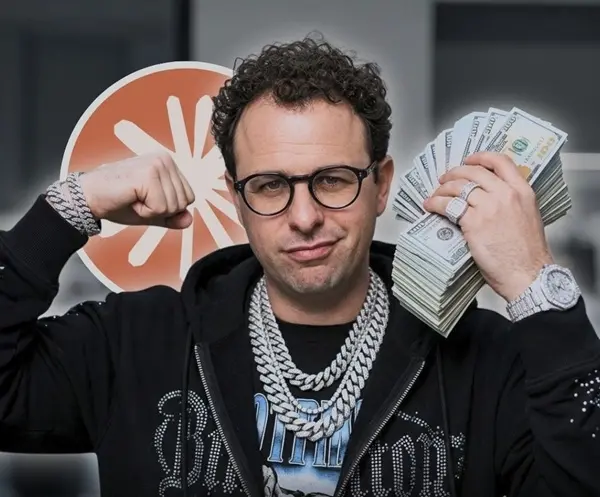
Anthropic's IPO Launch: Commercial Miracle or Valuation Bubble?
Anthropic has confidentially filed for an IPO, led by Morgan Stanley and Goldman Sachs, potentially going public by October. Following its latest $650 billion funding round, its pre-IPO valuation stands at $965 billion, with projections reaching up to $2 trillion at listing, which would make it the highest-valued private company ever.
The article, written by Fu Sheng, addresses skepticism that this represents an AI bubble akin to the 2000 dot-com crash. It argues the current situation differs fundamentally. Unlike the internet bubble era, which relied on speculative narratives with little revenue, Anthropic's valuation is backed by unprecedented, measurable financial performance.
Key data points include:
* **Revenue Growth:** ARR skyrocketed from $10 billion in early 2025 to $470 billion by May 2026, targeting $100 billion by year-end—a growth curve unmatched in business history.
* **Profitability:** It achieved operating profitability in Q2 2026 with an estimated $5.6 billion profit.
* **Efficiency:** With ~3,000 employees and ~$470 billion ARR, its revenue per employee exceeds $10 million. Products like Claude Code, launched less than a year ago, already generate $25 billion in annualized revenue.
* **Enterprise Adoption:** It boasts a strong enterprise client base, with 8 of the Fortune 10 and over 1,000 large firms spending over $1 million annually on Claude.
The valuation is framed using a traditional SaaS model (e.g., a 10x Price-to-Sales multiple on $100 billion revenue). The author contends the core question for analysts has shifted from "How big could this be?" to "How much is it earning and will earn next quarter?"
The discussion extends beyond Anthropic to a broader paradigm shift: the transition from a "carbon-based" to a "silicon-based" economy. Companies are increasingly prioritizing investment in compute and AI capabilities over human resources, as these directly scale productivity and competitive advantage. Anthropic's IPO is thus positioned not just as a corporate milestone, but as a price anchor for this new economic era.
链捕手28 min fa
链捕手28 min fa
US Senators Press Bank Regulators For ‘Fair’ Crypto Capital Rules
A group of U.S. Senate Republicans, led by Senator Cynthia Lummis, is urging federal bank regulators to establish clear and fair capital rules for banks involved with crypto assets. In a letter to the Federal Reserve, FDIC, and OCC, the lawmakers criticized the international Basel Committee's standards, which impose a punitive 1,250% risk weight on crypto assets, calling it a de facto ban not based on actual risk. They applauded recent interagency guidance that granted tokenized securities the same capital treatment as traditional ones, arguing this risk-based principle should apply consistently to all digital assets. The senators called on the agencies to develop a new capital framework, aligning with recent legislative progress on crypto market structure. Their push coincides with testimonies from top regulators, who emphasized a shift toward more risk-based supervision and responsible innovation, while also addressing stablecoin oversight under new proposals.
bitcoinist34 min fa
bitcoinist34 min fa
Near Returns to the AI Stage: Transformation into a Public Chain Due to 'Payroll Difficulties,' Agent and Privacy Emerge as New Growth Narratives
NEAR Returns to AI Origins: From Payroll Struggles to Blockchain, Now Focusing on AI Agents and Privacy
NEAR Protocol's journey began not with grand blockchain ambitions, but from a practical hurdle: its AI startup founders, including Transformer paper co-author Illia Polosukhin, couldn't efficiently pay international developers in 2017. This led them to pivot and build a high-performance, scalable blockchain.
After years navigating various crypto narratives like sharding and cross-chain interoperability, NEAR is now leveraging its AI roots to re-enter the AI arena. A key driver is its "NEAR Intents" layer, which abstracts complex cross-chain transactions. Users simply state their goal (e.g., swap BTC for ETH), and a solver network finds the optimal route. This system has processed over $20B in cross-chain volume, generating significant fee revenue.
A major growth area is private transactions via "Confidential Intents/Swaps," which hide trade details until settlement to protect against MEV and front-running. Remarkably, private swaps recently accounted for over 40% of NEAR's transaction volume, highlighting strong demand but also potential regulatory scrutiny.
With its AI-founder pedigree, NEAR is positioning itself at the intersection of blockchain, AI agents, and privacy, aiming to become infrastructure for the emerging agent economy while navigating the challenges of its rapid adoption.
marsbit3 h fa
marsbit3 h fa
From Ethereum to AI's 'CROPS': What Exactly is This Set of 'Slow Variables' That Vitalik Repeatedly Emphasizes?
In recent discussions, Vitalik Buterin has frequently emphasized the concept of "CROPS," a framework defining core values for Ethereum's development. CROPS stands for Censorship Resistance, Capture Resistance, Open Source, Privacy, and Security. Initially outlined in the Ethereum Foundation's "EF Mandate," it represents a commitment to user sovereignty, ensuring that the network resists external control, remains open, protects privacy, and prioritizes security.
The relevance of CROPS extends beyond Ethereum's foundational principles, becoming crucial in the context of AI integration. As AI agents begin handling wallet operations and automated transactions, the risk increases that users may cede control over their digital assets, privacy, and intentions to centralized AI service providers. A "CROPS AI" would therefore emphasize local execution where possible, privacy-preserving remote model calls (e.g., using zero-knowledge proofs), and transparent, verifiable processes to maintain user agency.
Vitalik highlights a significant convergence between "CROPS Ethereum access layer" and "CROPS AI." Both address the same fundamental challenge: how users can access powerful services—be it blockchain data via RPCs or AI models—without exposing sensitive information or relinquishing ultimate control. This intersection points toward a future digital entry point that is more private, secure, and user-controlled.
Ultimately, CROPS is not merely an abstract ideal but a practical guidepost. It steers development—from protocol resilience and wallet design to AI agent safety—towards a future where users retain self-sovereignty even as digital systems grow more complex and powerful. In an era of accelerating AI adoption, these "slow variables" of censorship resistance, openness, privacy, and security may define Ethereum's enduring value.
marsbit3 h fa
marsbit3 h fa
Articoli Popolari
Benvenuto in HTX.com! Abbiamo reso l'acquisto di USAT (USAT) semplice e conveniente. Segui la nostra guida passo passo per intraprendere il tuo viaggio nel mondo delle criptovalute.Step 1: Crea il tuo Account HTXUsa la tua email o numero di telefono per registrarti il tuo account gratuito su HTX. Vivi un'esperienza facile e sblocca tutte le funzionalità,Crea il mio accountStep 2: Vai in Acquista crypto e seleziona il tuo metodo di pagamentoCarta di credito/debito: utilizza la tua Visa o Mastercard per acquistare immediatamente USATUSAT.Bilancio: Usa i fondi dal bilancio del tuo account HTX per fare trading senza problemi.Terze parti: abbiamo aggiunto metodi di pagamento molto utilizzati come Google Pay e Apple Pay per maggiore comodità.P2P: Fai trading direttamente con altri utenti HTX.Over-the-Counter (OTC): Offriamo servizi su misura e tassi di cambio competitivi per i trader.Step 3: Conserva USAT (USAT)Dopo aver acquistato USAT (USAT), conserva nel tuo account HTX. In alternativa, puoi inviare tramite trasferimento blockchain o scambiare per altre criptovalute.Step 4: Scambia USAT (USAT)Scambia facilmente USAT (USAT) nel mercato spot di HTX. Accedi al tuo account, seleziona la tua coppia di trading, esegui le tue operazioni e monitora in tempo reale. Offriamo un'esperienza user-friendly sia per chi ha appena iniziato che per i trader più esperti.
442 Totale visualizzazioniPubblicato il 2026.01.27Aggiornato il 2026.06.02