Tether’s $23B Gold Hoard Rivals Nation States As Smart Money Pivots To $HYPER

bitcoinistPubblicato 2026-02-09Pubblicato ultima volta 2026-02-09

Introduzione

Tether, the issuer of USDT, has accumulated a massive $23 billion in physical gold, placing it among the world's top 30 holders and surpassing many G20 nations. This signals a defensive move against macroeconomic uncertainty. Meanwhile, sophisticated investors are shifting toward high-utility infrastructure projects like Bitcoin Hyper ($HYPER), a Bitcoin Layer 2 solution integrated with Solana Virtual Machine (SVM). It aims to unlock over $1 trillion in dormant Bitcoin capital by enabling fast, low-cost transactions and decentralized applications. With over $31 million raised from large-scale investors, $HYPER is positioned to redefine Bitcoin's utility beyond a store of value.

The definition of a safe haven is shifting under our feet. According to a recent report from investment bank Jefferies, Tether, issuer of the ubiquitous $USDT, has stockpiled a staggering $23B in physical gold. This hasn’t gone unnoticed, with many commenting about the purchase on social media.

That stash places the crypto firm among the top 30 global holders of bullion, eclipsing the official reserves of many G20 nations.

This isn’t just diversification. It’s a signal. Tether holds at least 148 tonnes of the yellow metal, using commodities to back a digital dollar. The irony is rich: the main on-ramp to the crypto ecosystem is hedging against the very fiat currency it represents. This massive accumulation suggests that even the biggest liquidity providers are bracing for prolonged macroeconomic turbulence.

But while Tether plays defense with physical commodities, a more aggressive rotation is brewing elsewhere. Sophisticated investors are moving beyond passive “store of value” plays. They’re hunting for infrastructure that wakes up dormant liquidity.

Gold sits in a vault. It doesn’t yield. Bitcoin, historically, has suffered the same limitation, functioning as digital gold but offering little utility. That narrative, however, is fracturing. As institutional interest hits fever pitch, the market is aggressively repricing protocols that solve Bitcoin’s scalability bottlenecks.

This search for yield on top of the world’s most secure blockchain has channeled significant volume toward Bitcoin Hyper ($HYPER), a project engineering the first bridge between Bitcoin’s security and high-speed execution.

Bitcoin Hyper ($HYPER) Unlocks The Trillion-Dollar Dormant Economy

For over a decade, Bitcoin has faced one persistent critique: it’s secure, but it’s slow. Transactions are pricey (sometimes painfully so), and programmability is virtually non-existent compared to chains like Ethereum or Solana. The result? Over $1T in capital is essentially ‘stuck’ in digital wallets, sidelined from the DeFi economy.

Bitcoin Hyper tackles this inefficiency head-on by deploying the first-ever Bitcoin Layer 2 integrated with the Solana Virtual Machine (SVM).
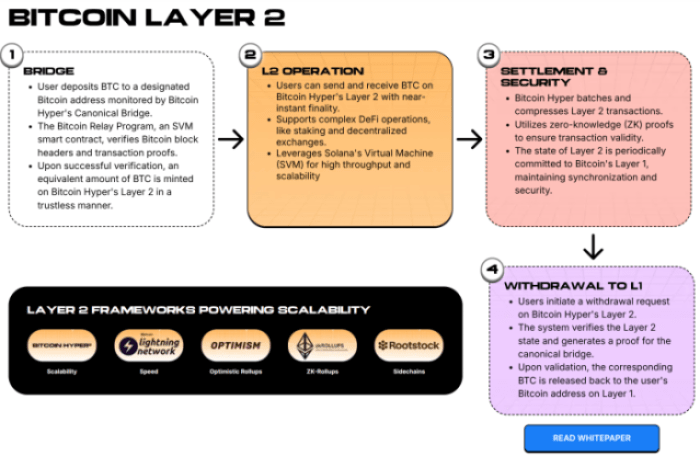
Why does this architecture matter? Because it fundamentally changes the network’s capabilities. By using the SVM for execution while relying on Bitcoin L1 for settlement, $HYPER creates a hybrid environment. Developers can build high-performance dApps using Rust, the standard for high-speed trading systems, while users keep Bitcoin’s immutable security guarantees.

The project uses a decentralized Canonical Bridge for seamless $BTC transfers into the Layer 2 ecosystem. Once bridged, that capital moves with sub-second finality and negligible fees. Suddenly, high-frequency trading, lending markets, and gaming applications, previously impossible on the mainnet, become viable.

For the broader market, this is a pivot point. It’s no longer just about holding an asset that resists inflation (like Gold or $BTC); it’s about owning the rails that power the future financial system.

EXPLORE THE BITCOIN HYPER ($HYPER) ECOSYSTEM

Whales Accumulate $31M As High-Speed Layer 2 Redefines Market Expectations

The market’s appetite for this ‘Bitcoin-on-steroids’ infrastructure shows up clearly in the on-chain flows. While retail investors chase meme coins, smart money seems to be positioning itself in infrastructure plays with tangible utility. Bitcoin Hyper ($HYPER) has already raised an impressive $31M+, signaling strong conviction from early backers.

Whale activity backs this up. Large-scale purchases of $500K, $379.9K, and $274K stand out, not only showing conviction in the project but also the desire to get in early and potentially maximize returns.

With the token currently priced at $0.0136753, these large-scale buys suggest investors see the asset as undervalued relative to its utility. The project’s tokenomics (designed to incentivize the long haul) offer high APY staking rewards immediately after the Token Generation Event (TGE). The structure includes a 7-day vesting period for presale stakers, a classic mechanism to prevent immediate dumping and stabilize price action.

The logic driving these inflows is straightforward. If Bitcoin is the digital equivalent of Tether’s gold stash, then Bitcoin Hyper is the logistical network allowing that gold to be spent, lent, and leveraged at internet speed.

JOIN THE BITCOIN HYPER ($HYPER) PRESALE

The content of this article is for informational purposes only and does not constitute financial advice. Cryptocurrency investments, including presales and Layer 2 tokens, carry inherent risks. Always conduct your own due diligence before making investment decisions.


Domande pertinenti

QHow much physical gold has Tether stockpiled, and what does this make them in terms of global holders?

ATether has stockpiled $23 billion in physical gold, which places the crypto firm among the top 30 global holders of bullion.

QWhat is the primary limitation that Bitcoin Hyper ($HYPER) aims to solve for the Bitcoin network?

ABitcoin Hyper aims to solve Bitcoin's scalability bottlenecks, high transaction fees, and lack of programmability to unlock over $1 trillion in dormant capital for the DeFi economy.

QWhat key technology does Bitcoin Hyper use to integrate with Bitcoin's security while enabling high-speed execution?

ABitcoin Hyper deploys the first-ever Bitcoin Layer 2 integrated with the Solana Virtual Machine (SVM), using it for execution while relying on Bitcoin L1 for settlement.

QHow much funding has Bitcoin Hyper ($HYPER) raised from early backers, according to the article?

ABitcoin Hyper has raised over $31 million from early backers, signaling strong conviction in the project.

QAccording to the article, what is the new investment focus shifting towards, beyond passive 'store of value' assets?

AThe investment focus is shifting towards infrastructure that unlocks dormant liquidity, allowing capital to be used for high-performance dApps, lending markets, and other financial applications, rather than just holding inflation-resistant assets.

Letture associate

Agent Race Ends, Super Workbench Takes Over

The era of fragmented AI agents is ending. Over the past month, China's tech giants—Tencent, Alibaba, and ByteDance—have simultaneously shifted strategy: instead of launching new, standalone AI agents, they are consolidating their various agent projects into unified "super workbenches." Tencent integrated its QClaw teams into WorkBuddy, a strategic product hailed as a potential third flagship after QQ and WeChat. Alibaba is merging its QoderWork, Wukong, and MuleRun agents into a new "Qianwen Office" platform under DingTalk's leadership. ByteDance rebranded its TRAE SOLO coding agent to TRAE Work, signaling a broader focus on workflow collaboration. This convergence marks a pivotal industry consensus. The initial exploration phase, where companies rapidly built numerous overlapping agents for different scenarios, proved costly and inefficient. With open-source tools eroding technical barriers, competition has shifted from agent creation to resource consolidation and cost control. Historically, platform wars are won not by creating more products, but by simplifying them—as seen with browsers unifying web access and super-apps consolidating services. Now, the "super workbench" aims to become the unified AI entry point for work. This reflects a deeper market realization: the primary audience for AI is no longer just programmers (a market in the tens of millions) but all knowledge workers (a market of billions). The real opportunity lies in augmenting everyday tasks—managing emails, documents, data, and meetings—across the entire workday. The core battleground is becoming control over the primary AI entry point that employees use daily. Tencent's WorkBuddy leverages WeChat and Tencent Docs; Alibaba's Qianwen Office taps into DingTalk's organizational data; ByteDance's TRAE Work integrates with Feishu's workflows. Whoever owns this "super workbench" gains strategic control over orchestrating enterprise data and APIs. This shift is redefining enterprise software. Traditional SaaS applications, valued for their user interfaces, will recede into the background. Their core functionalities will be exposed as standardized "Skills" or APIs for the super workbench's agents to invoke. Software value will shift from selling user seats to charging based on API calls and outcomes delivered. The evolution of agents is moving through clear stages: first as novel standalone products, then as consolidated primary work entry points, and finally as pervasive, invisible capabilities embedded into the digital fabric. The recent moves by major tech firms signal the transition from the first stage into the second, accelerating toward the third. In the end, the most successful agent technology may become invisible—like electricity or the HTTP protocol—a fundamental, unnamed infrastructure powering work itself.

marsbit6 min fa

Agent Race Ends, Super Workbench Takes Over

marsbit6 min fa

Michael Saylor: 110 Reasons to Oppose BIP-110

Michael Saylor presents 110 arguments against Bitcoin Improvement Proposal (BIP) 110, a soft fork aimed at restricting certain non-monetary data storage uses (like inscriptions) on the Bitcoin blockchain. He acknowledges the proponents' valid concerns—such as node costs, fee pressure, and preserving Bitcoin's monetary focus—but fundamentally disagrees with the proposed solution. Saylor argues that BIP 110 represents a dangerous precedent of using consensus rules to enforce value judgments on transaction validity, moving away from Bitcoin's core principles of neutrality and permissionless innovation. His key objections are organized into eleven categories: 1) It violates neutrality and hard consensus by banning currently valid transactions. 2) It fails to meet the high burden of proof required for a consensus change, lacking concrete data on the alleged crisis. 3) Its seven bundled technical restrictions are overly broad, targeting generic script functionalities and blocking future upgrade paths. 4) It sacrifices compatibility and future optionality by closing off designed upgrade hooks. 5) Its temporary rules add significant complexity (grandfathering, expiry states) without sufficient justification. 6) The economic and security impacts, particularly on miner revenue and fee markets, are uncertain and unmodeled. 7) Superior, market-based tools (fee markets, relay/mining policies) already exist to manage blockchain load. 8) It stifles innovation by creating a chilling effect for developers. 9) Its modified activation mechanism (55% threshold, forced signaling) is aggressive and risks network splits. 10) The precedent it sets—using consensus to suppress disliked but legal uses—is more dangerous than the problem it aims to solve. 11) A better path exists: improving measurements, refining resource-based policies, and allowing market forces to work. Saylor concludes that Bitcoin's strength lies in its neutral rules, open markets, and hard consensus. Changing these foundational elements to target specific use cases is an unnecessary and risky "iatrogenic" intervention. He advocates for guarding Bitcoin's neutrality rather than acting as its redeemer.

marsbit21 min fa

Michael Saylor: 110 Reasons to Oppose BIP-110

marsbit21 min fa

Trading

Spot
活动图片

