Tether’s $23B Gold Hoard Rivals Nation States As Smart Money Pivots To $HYPER

bitcoinistPubblicato 2026-02-09Pubblicato ultima volta 2026-02-09

Introduzione

Tether, the issuer of USDT, has accumulated a massive $23 billion in physical gold, placing it among the world's top 30 holders and surpassing many G20 nations. This signals a defensive move against macroeconomic uncertainty. Meanwhile, sophisticated investors are shifting toward high-utility infrastructure projects like Bitcoin Hyper ($HYPER), a Bitcoin Layer 2 solution integrated with Solana Virtual Machine (SVM). It aims to unlock over $1 trillion in dormant Bitcoin capital by enabling fast, low-cost transactions and decentralized applications. With over $31 million raised from large-scale investors, $HYPER is positioned to redefine Bitcoin's utility beyond a store of value.

The definition of a safe haven is shifting under our feet. According to a recent report from investment bank Jefferies, Tether, issuer of the ubiquitous $USDT, has stockpiled a staggering $23B in physical gold. This hasn’t gone unnoticed, with many commenting about the purchase on social media.

That stash places the crypto firm among the top 30 global holders of bullion, eclipsing the official reserves of many G20 nations.

This isn’t just diversification. It’s a signal. Tether holds at least 148 tonnes of the yellow metal, using commodities to back a digital dollar. The irony is rich: the main on-ramp to the crypto ecosystem is hedging against the very fiat currency it represents. This massive accumulation suggests that even the biggest liquidity providers are bracing for prolonged macroeconomic turbulence.

But while Tether plays defense with physical commodities, a more aggressive rotation is brewing elsewhere. Sophisticated investors are moving beyond passive “store of value” plays. They’re hunting for infrastructure that wakes up dormant liquidity.

Gold sits in a vault. It doesn’t yield. Bitcoin, historically, has suffered the same limitation, functioning as digital gold but offering little utility. That narrative, however, is fracturing. As institutional interest hits fever pitch, the market is aggressively repricing protocols that solve Bitcoin’s scalability bottlenecks.

This search for yield on top of the world’s most secure blockchain has channeled significant volume toward Bitcoin Hyper ($HYPER), a project engineering the first bridge between Bitcoin’s security and high-speed execution.

Bitcoin Hyper ($HYPER) Unlocks The Trillion-Dollar Dormant Economy

For over a decade, Bitcoin has faced one persistent critique: it’s secure, but it’s slow. Transactions are pricey (sometimes painfully so), and programmability is virtually non-existent compared to chains like Ethereum or Solana. The result? Over $1T in capital is essentially ‘stuck’ in digital wallets, sidelined from the DeFi economy.

Bitcoin Hyper tackles this inefficiency head-on by deploying the first-ever Bitcoin Layer 2 integrated with the Solana Virtual Machine (SVM).
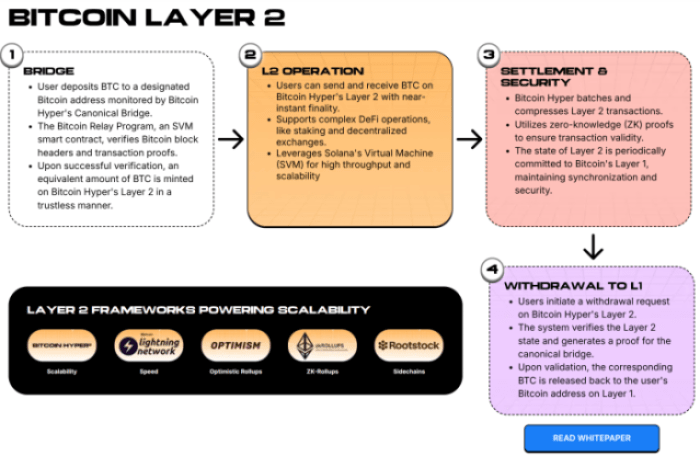
Why does this architecture matter? Because it fundamentally changes the network’s capabilities. By using the SVM for execution while relying on Bitcoin L1 for settlement, $HYPER creates a hybrid environment. Developers can build high-performance dApps using Rust, the standard for high-speed trading systems, while users keep Bitcoin’s immutable security guarantees.

The project uses a decentralized Canonical Bridge for seamless $BTC transfers into the Layer 2 ecosystem. Once bridged, that capital moves with sub-second finality and negligible fees. Suddenly, high-frequency trading, lending markets, and gaming applications, previously impossible on the mainnet, become viable.

For the broader market, this is a pivot point. It’s no longer just about holding an asset that resists inflation (like Gold or $BTC); it’s about owning the rails that power the future financial system.

EXPLORE THE BITCOIN HYPER ($HYPER) ECOSYSTEM

Whales Accumulate $31M As High-Speed Layer 2 Redefines Market Expectations

The market’s appetite for this ‘Bitcoin-on-steroids’ infrastructure shows up clearly in the on-chain flows. While retail investors chase meme coins, smart money seems to be positioning itself in infrastructure plays with tangible utility. Bitcoin Hyper ($HYPER) has already raised an impressive $31M+, signaling strong conviction from early backers.

Whale activity backs this up. Large-scale purchases of $500K, $379.9K, and $274K stand out, not only showing conviction in the project but also the desire to get in early and potentially maximize returns.

With the token currently priced at $0.0136753, these large-scale buys suggest investors see the asset as undervalued relative to its utility. The project’s tokenomics (designed to incentivize the long haul) offer high APY staking rewards immediately after the Token Generation Event (TGE). The structure includes a 7-day vesting period for presale stakers, a classic mechanism to prevent immediate dumping and stabilize price action.

The logic driving these inflows is straightforward. If Bitcoin is the digital equivalent of Tether’s gold stash, then Bitcoin Hyper is the logistical network allowing that gold to be spent, lent, and leveraged at internet speed.

JOIN THE BITCOIN HYPER ($HYPER) PRESALE

The content of this article is for informational purposes only and does not constitute financial advice. Cryptocurrency investments, including presales and Layer 2 tokens, carry inherent risks. Always conduct your own due diligence before making investment decisions.


Domande pertinenti

QHow much physical gold has Tether stockpiled, and what does this make them in terms of global holders?

ATether has stockpiled $23 billion in physical gold, which places the crypto firm among the top 30 global holders of bullion.

QWhat is the primary limitation that Bitcoin Hyper ($HYPER) aims to solve for the Bitcoin network?

ABitcoin Hyper aims to solve Bitcoin's scalability bottlenecks, high transaction fees, and lack of programmability to unlock over $1 trillion in dormant capital for the DeFi economy.

QWhat key technology does Bitcoin Hyper use to integrate with Bitcoin's security while enabling high-speed execution?

ABitcoin Hyper deploys the first-ever Bitcoin Layer 2 integrated with the Solana Virtual Machine (SVM), using it for execution while relying on Bitcoin L1 for settlement.

QHow much funding has Bitcoin Hyper ($HYPER) raised from early backers, according to the article?

ABitcoin Hyper has raised over $31 million from early backers, signaling strong conviction in the project.

QAccording to the article, what is the new investment focus shifting towards, beyond passive 'store of value' assets?

AThe investment focus is shifting towards infrastructure that unlocks dormant liquidity, allowing capital to be used for high-performance dApps, lending markets, and other financial applications, rather than just holding inflation-resistant assets.

Letture associate

How Many Tokens Away Is Yang Zhilin from the 'Moon Chasing the Light'?

The article explores the intense competition between two leading Chinese AI companies, DeepSeek and Kimi (Moon Dark Side), and the mounting pressure on Yang Zhilin, the founder of Kimi. While DeepSeek re-emerged after 15 months of silence with its powerful V4 model—boasting 1.6 trillion parameters and low-cost, long-context capabilities—Kimi has been focusing on long-context processing and multi-agent systems with its K2.6 model. Yang faces a threefold challenge: technological rivalry, commercialization pressure, and investor expectations. Despite Kimi’s high valuation (reaching $18 billion), its revenue heavily relies on a single product with low paid conversion rates, while DeepSeek’s strategic silence and open-source influence have strengthened its market position and valuation prospects, now targeting over $20 billion. Both companies reflect broader trends in China’s AI ecosystem: Kimi aims for global influence through open-source contributions and agent-based advancements, while DeepSeek prioritizes foundational innovation and hardware independence, notably shifting to Huawei’s chips. Their competition is seen as vital for China’s AI progress, with the gap between top Chinese and U.S. models narrowing to just 2.7% on the Elo rating scale. Ultimately, the article argues that this rivalry, though anxiety-inducing for leaders like Zhilin, is essential for driving innovation and solidifying China’s role in the global AI landscape.

marsbit5 h fa

How Many Tokens Away Is Yang Zhilin from the 'Moon Chasing the Light'?

marsbit5 h fa

TechFlow Intelligence Bureau: ChatGPT Helps Amateur Mathematician Crack 60-Year-Old Problem, CFTC Sues New York Regulator Over Coinbase and Gemini

An amateur mathematician, with the assistance of ChatGPT, has solved a combinatorial mathematics puzzle originally proposed by Hungarian mathematician Paul Erdős in the 1960s. This marks another milestone in AI-aided mathematical research, demonstrating the evolving capabilities of large language models in formal reasoning. In other AI developments, OpenAI introduced a new privacy filter tool for enterprise API usage, automatically screening sensitive data. Meanwhile, the Qwen3.6-27B model achieved 100 tokens per second on a single RTX 5090 GPU using quantization, significantly lowering the cost barrier for local AI deployment. In crypto and Web3, the U.S. CFTC sued New York’s financial regulator, challenging its oversight of Coinbase and Gemini—a first-of-its-kind federal-state regulatory clash. Following a vulnerability, KelpDAO and major DeFi protocols established a recovery fund. Tether froze $344 million in assets linked to Iran’s central bank upon U.S. Treasury request, highlighting the centralized control risks in stablecoins. Separately, Litecoin underwent a 3-hour chain reorganization to undo a privacy-layer exploit. In the U.S., former President Trump invoked the Defense Production Act to address power grid bottlenecks affecting AI data centers and dismissed the entire National Science Board, raising concerns over research independence. A retail trader gained 250% on a $600k Intel options bet amid AI-related speculation. Xiaomi announced its first performance electric vehicle, targeting rivals like Tesla. Meanwhile, iPhone users reported devices automatically reinstalling a hidden app daily, suspected to be MDM-related. A Chinese securities report noted that A-share institutional crowding has reached its second-longest streak since 2007, signaling high valuations and potential style rotation. The day’s developments reflect a dual narrative: AI is enabling unprecedented individual breakthroughs, while centralized power structures—whether governmental or corporate—are becoming more assertive, underscoring that decentralization is as much a political-economic challenge as a technical one.

marsbit5 h fa

TechFlow Intelligence Bureau: ChatGPT Helps Amateur Mathematician Crack 60-Year-Old Problem, CFTC Sues New York Regulator Over Coinbase and Gemini

marsbit5 h fa

Trading

Spot
Futures
活动图片