Tether To Terminate Offshore Yuan (CNH₮) Operations – Here’s Why

bitcoinistPubblicato 2026-02-22Pubblicato ultima volta 2026-02-22

Introduzione

Tether has announced it will discontinue its offshore Chinese Yuan stablecoin (CNH₮) due to a lack of market demand and operational inefficiency. Effective immediately, new issuance of CNH₮ has been halted. Existing users have one year to redeem their tokens before the stablecoin is permanently phased out. The company stated it will reallocate resources to products with stronger adoption, such as its flagship USDT, which has a market cap of $183.7 billion. In related news, a survey highlighted Nigeria and South Africa as leading markets for stablecoin adoption, with 80% of respondents in these countries holding stablecoins.

Stablecoin operator Tether has announced its decision to discontinue support for its offshore Chinese Yuan token CNH₮. The USDT operator has attributed this development to a lack of market demand, among other points.

Tether To Terminate CNH₮ Redemption In One Year

In a recent blog post, Tether shared a strategic update on its CNH₮, communicating a management decision to withdraw the stablecoin product from its offerings. This decision is based on multiple factors centered around demand and operational efficiency.

A statement from the announcement read:

Community interest and adoption are central to every product decision we make. When evaluating whether to maintain or introduce a Tether token, we assess market demand, operational sustainability, and broader ecosystem conditions that influence long-term usability. Our priority is to allocate resources where they can most effectively enhance security, reliability, and innovation across the digital asset landscape.

Tether explains that the CNH₮ recorded low interest, adoption, and community demand compared to their products, thereby failing to produce an acceptable return on technical and operational efforts.

As of this moment, all new issuance of CNH₮ has been halted. Meanwhile, CNH₮ users will have the next year to process any redemptions before the stablecoin is permanently phased out. The stablecoin operator will issue another reminder ahead of the redemption deadline. Following this development, Tether reiterates its commitment to stablecoin global growth and adoption.

The statement read:

Tether will continue to focus its efforts on stablecoins and infrastructure that demonstrate strong, organic adoption and long-term relevance. This includes advancing core stablecoin liquidity, expanding tokenization infrastructure, and supporting new financial tools that better serve global users and builders.

Tether remains the operator of the world’s largest stablecoin, USDT, which presently boasts a total market cap of $183.7 billion. In January, the stablecoin company launched USAT, designed specifically for American users.

Nigeria Leads Demand For Stablecoins

In other news, a recent survey by BVNK has revealed that Africa’s largest economies are leading the demand for stablecoins. This survey, done in collaboration with Coinbase, YouGov, and Artemis, involved 4658 adults across 15 countries. The results revealed that 80% of Nigerian and South African respondents presently hold stablecoin, while 75% aim to increase holdings as citizens seek a haven from their local fragile currencies.

At press time, the total stablecoin market cap is valued at $310 billion, with high expectations of future market expansion following the approval of the GENIUS Act last July.
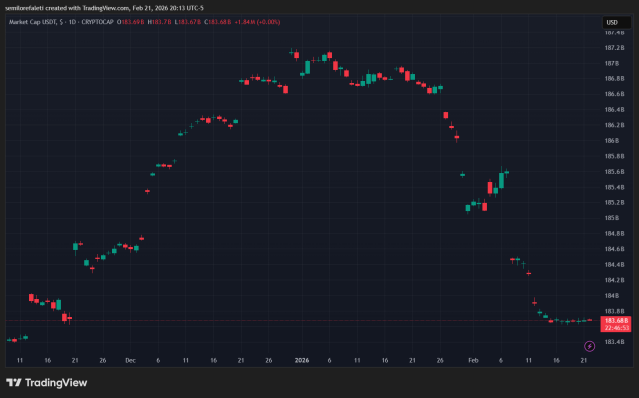
USDT market cap valued at $183.68 billion on the daily chart | Source: USDT chart on Tradingview.com

Domande pertinenti

QWhy is Tether discontinuing its offshore Chinese Yuan token (CNH₮)?

ATether is discontinuing CNH₮ due to a lack of market demand, low community interest and adoption, and the failure to produce an acceptable return on the technical and operational efforts required to maintain it.

QWhat is the timeline for users to redeem their CNH₮ tokens?

ACNH₮ users have one year to process any redemptions before the stablecoin is permanently phased out. Tether will issue another reminder ahead of the redemption deadline.

QWhat is the current market capitalization of Tether's USDT stablecoin?

ATether's USDT stablecoin currently has a total market capitalization of $183.7 billion.

QAccording to the article, which country is leading the demand for stablecoins?

AAccording to a survey by BVNK, Nigeria is leading the demand for stablecoins, with 80% of Nigerian respondents holding stablecoins.

QWhat will Tether focus on following the discontinuation of CNH₮?

ATether will continue to focus on stablecoins and infrastructure that demonstrate strong, organic adoption and long-term relevance, including advancing core stablecoin liquidity, expanding tokenization infrastructure, and supporting new financial tools.

Letture associate

Bitcoin's 'Rally Ends,' Officially Entering the Later Stage of a Bear Market?

Bitcoin prices declined 13% this week, reversing the recent rebound and signaling a likely transition into the later stages of a bear market. Key on-chain metrics deteriorated, with the short-term holder cost basis falling below the Realized Price—a pattern last seen in early 2022, characteristic of bear market maturity. The rally to ~$82k proved to be a bear market bounce, as evidenced by the 90-day realized profit/loss ratio failing to sustain above the bullish threshold of 2. Daily realized losses surged to $1.35B, including significant selling from long-term holders who accumulated near cycle tops, indicating ongoing supply redistribution. Price was rejected almost precisely at the aggregate US spot ETF cost basis of ~$83k, turning that level into resistance and leaving the average ETF investor underwater again. Spot market selling pressure intensified, with the 7-day volume delta turning significantly negative to its weakest level since February. While a major long liquidation event cleared over $400M in leverage, spot demand has not yet stepped in to absorb the resulting supply. Options markets continue pricing in higher future volatility (elevated volatility risk premium) and maintain a skew toward put options, reflecting persistent demand for downside protection, though not yet panic. Overall, market structure remains fragile. Sustained recovery likely requires a reclaim of the ETF cost basis, a shift back to positive spot demand, and a slowdown in realized loss-taking. Until then, the market risks further downside or extended consolidation within the broader bear trend.

Foresight News1 h fa

Bitcoin's 'Rally Ends,' Officially Entering the Later Stage of a Bear Market?

Foresight News1 h fa

How Risky is the "Death Spiral" of MSTR and STRC?

Summary: This article explores the perceived "death spiral" risk between MicroStrategy (MSTR), its Bitcoin holdings, and its perpetual preferred stock (STRC), drawing comparisons to the LUNA-UST collapse. While both systems feature price anchors, high yields for holders, and potential feedback loops, their core mechanisms differ fundamentally. The MSTR-STRC structure relies on continuous financing to sustain its high dividend payouts, primarily through stock ATM offerings. A negative feedback cycle could occur: falling MSTR stock price makes raising equity capital harder, increasing pressure to sell Bitcoin, which undermines STRC confidence and further depresses MSTR. However, unlike LUNA-UST's automated, direct linkage, the MSTR-STRC loop is weaker and has brakes: STRC dividends can be deferred or rates lowered, and STRC holders have a $100/share liquidation preference in bankruptcy, providing a price floor. The company's sustainability hinges on its ability to continue financing. Its current ~$900 million USD reserves cover only about 6.3 months of its ~$1.71 billion annual interest/dividend burden. The next six months are critical, aligning with both the potential bottom in Bitcoin's four-year cycle and the depletion timeline of its reserves. While a LUNA-style catastrophic collapse is deemed highly unlikely due to structural differences, the key question is whether MicroStrategy can navigate this period through healthy deleveraging to restart its capital engine.

Foresight News1 h fa

How Risky is the "Death Spiral" of MSTR and STRC?

Foresight News1 h fa

Trading

Spot
Futures
活动图片