Tether Ramps Up Wallet Freezes, Blocking Over $500M In USDT

bitcoinistPubblicato 2026-05-10Pubblicato ultima volta 2026-05-10

Introduzione

Tether has significantly increased its wallet freezing activity, blocking over $514 million in USDT across 370 addresses on the Tron and Ethereum networks in just the past 30 days. Data from BlockSec shows the vast majority of these freezes (328 addresses, $506 million) occurred on Tron. The pace is accelerating, with the 2025 annual total of $1.26 billion across 4,163 addresses at risk of being surpassed this year. Once frozen, wallets are rarely reinstated, and more than half of the associated funds are typically permanently destroyed. A growing portion of these enforcement actions are coordinated with law enforcement. Recent examples include freezing $344 million linked to suspected sanctions evasion with Iran and $61 million tied to "pig butchering" scams. Cumulatively from 2023-2025, Tether has frozen roughly $3.3 billion across 7,268 addresses, far exceeding actions by competitors like Circle. This surge has sparked broader debate within crypto about the power issuers and projects hold to freeze or recover funds, highlighting how compliance and central controls remain integral behind the scenes of decentralized ecosystems.

Once frozen, a Tether-blacklisted wallet almost never comes back. Only 3.6% of addresses placed on the blocklist in 2025 were later removed, according to BlockSec data.

More than half of the funds tied to those wallets were permanently destroyed using the contracts’ “destroyBlackFunds” function — a detail that underscores just how final these enforcement actions tend to be.

Freezes Surge Across Tron And Ethereum

In the past 30 days alone, Tether froze over $514 million in USDT across 370 addresses on the Ethereum and Tron networks.

BlockSec’s USDT Freeze Tracker shows 328 of those addresses were on Tron, with about $506 million locked there. Ethereum accounted for 42 addresses and $8.73 million. The gap between the two networks points to Tron as the main front in Tether’s enforcement push.
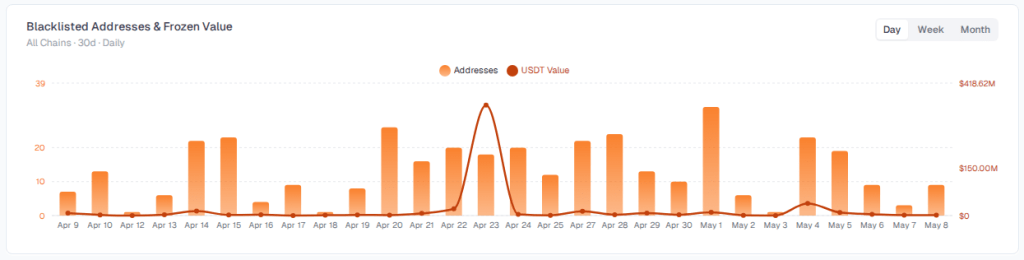
Source: BlockSec

The pace is picking up. All of 2025 saw Tether blacklist 4,163 addresses and freeze a combined $1.26 billion. At the current rate, that annual total could be surpassed well before December.

A broader study covering 2023 through 2025 put the cumulative figure at roughly $3.3 billion across 7,268 addresses — far ahead of rival stablecoin issuer Circle over the same period.

Law Enforcement Plays A Growing Role

Some of the largest recent freezes were tied directly to government investigations. In April, Tether coordinated with the US Treasury’s Office of Foreign Assets Control to lock more than $344 million in USDT across two Tron addresses.

Bitcoin is currently trading at $80,349. Chart: TradingView

Officials said those wallets were linked to suspected sanctions evasion involving Iran. Months earlier, in February, Tether assisted authorities in seizing over $61 million connected to pig butchering scams — a form of fraud where victims are manipulated into sending large sums under false pretenses.

Tether had previously disclosed that it froze around $4.2 billion in tokens over three years due to links with illicit activity, with $3.5 billion of that amount locked since 2023 as law enforcement agencies stepped up crypto-related investigations.

Broader Questions Around Freeze Powers

The surge in blacklisting has sparked debate beyond stablecoins. Some decentralized finance projects have used upgradeable contracts and admin controls to halt or recover funds after major exploits, raising questions about who holds those powers and when they should be used.

For stablecoins like USDT, issuers retain direct control over minting and burning. Data shows these freeze mechanisms are now a routine part of fraud, sanctions, and scam investigations — used not occasionally, but consistently and at scale.

Featured image from Halo, chart from TradingView

Domande pertinenti

QWhat percentage of Tether-blacklisted wallets in 2025 were later removed, and what happens to the funds?

AOnly 3.6% of Tether-blacklisted addresses in 2025 were later removed. More than half of the funds tied to those wallets were permanently destroyed using the 'destroyBlackFunds' contract function.

QHow much USDT did Tether freeze in the past 30 days, and which blockchain network was most impacted?

AIn the past 30 days, Tether froze over $514 million in USDT across 370 addresses. The Tron network was the most impacted, with 328 addresses and about $506 million frozen, compared to 42 addresses and $8.73 million on Ethereum.

QWhat was the cumulative amount of USDT frozen by Tether from 2023 through 2025, and how does it compare to its rival Circle?

AFrom 2023 through 2025, Tether froze roughly $3.3 billion in USDT across 7,268 addresses. This amount is far ahead of what its rival stablecoin issuer, Circle, froze over the same period.

QWhat were two notable law enforcement-related Tether freezes mentioned in the article?

ATwo notable law enforcement-related freezes were: 1) In April, Tether coordinated with the U.S. Treasury's OFAC to freeze over $344 million in USDT linked to suspected sanctions evasion involving Iran. 2) In February, Tether assisted in seizing over $61 million connected to pig butchering scams.

QWhat broader debate has the surge in Tether blacklisting sparked, according to the article?

AThe surge in Tether blacklisting has sparked a broader debate about who holds freeze powers and when they should be used, extending beyond stablecoins to decentralized finance projects that use upgradeable contracts and admin controls to halt or recover funds after major exploits.

Letture associate

Why Bitcoin Holds Above $64,000 After Fed's Hard Pause

**Bitcoin Stabilizes Near $64,000 Following Hawkish Fed Pause** The cryptocurrency market, led by Bitcoin, remained stable around $64,000 despite a volatile reaction to the latest U.S. Federal Reserve meeting. The Fed paused interest rates but signaled a hawkish stance, with three committee members voting for an increase—the highest dissent since 2016. This limits risk appetite but hasn't triggered panic selling. Key market highlights include Bitcoin ETFs seeing a net inflow of $32.1 million, breaking a streak of outflows, while Ethereum ETFs experienced outflows of $18.65 million. Liquidations affected about 90,000 traders. Technically, Bitcoin finds support around $63,000-$63,500, with major resistance near $66,000. While its price is about 49% below its all-time high, institutional demand via ETFs and the absence of mass capitulation support a potential recovery scenario in the second half of the year. Major altcoins showed mixed movements, with Solana attracting capital while Ethereum faced selling pressure despite strong on-chain metrics like a growing staking queue. Regulatory news took a pause as the U.S. Senate delayed the CLARITY Act vote until at least autumn. For the final trading day of July, U.S. inflation and consumer spending data will be crucial. Bitcoin's key levels to watch are $63,000 support and $66,000 resistance. Sustained ETF inflows and Bitcoin holding above $63,000 are seen as positive signs for a potential market recovery later in the year.

cryptonews.ru10 min fa

Why Bitcoin Holds Above $64,000 After Fed's Hard Pause

cryptonews.ru10 min fa

Participants in XRP Fraud Scheme That Stole $9 Million from 71 Investors Arrested

South Korean police have arrested three individuals accused of operating a fraudulent investment platform that stole approximately 3.4 million XRP (worth about $9 million) from 71 investors between October 16 and 23. The suspects promoted the site Fxrpntwork.com through blogs, online articles, and YouTube videos, promising guaranteed principal and monthly returns of 1.5% to 1.8%. Investors were instructed to transfer XRP from Korean exchanges to overseas platforms and then to wallets controlled by the group before the site was shut down. The scammers copied the branding of legitimate projects Flare Network and FXRP to appear credible. Authorities warn that such impersonation frauds, which use familiar branding and urgent promises of guaranteed profits, are a common red flag. Legitimate companies do not solicit cryptocurrency transfers through unsolicited promotions. Seoul police have issued an Interpol Red Notice for a fourth suspect abroad and are investigating others involved in creating and promoting the fraudulent website. While investigators froze 17.3 billion won in assets, approximately 10 billion won was moved during the probe, with wallet analysis revealing transfers totaling 27.3 billion won, suggesting there may be additional unidentified victims and accomplices. The case underscores the organized, cross-border nature of crypto investment fraud.

cryptonews.ru12 min fa

Participants in XRP Fraud Scheme That Stole $9 Million from 71 Investors Arrested

cryptonews.ru12 min fa

Trading

Spot
活动图片





