Tether may tokenize equity to ensure liquidity for investors: Report

cointelegraphPubblicato 2025-12-12Pubblicato ultima volta 2025-12-12

Introduzione

Tether, the issuer of USDT, is reportedly considering tokenizing equity and share buybacks to provide liquidity for investors as it aims for a $500 billion valuation. The company halted a shareholder’s attempt to sell a $1 billion stake, which would have valued Tether at $280 billion. Instead, Tether plans to offer liquidity solutions through tokenization or buybacks after closing a funding round aimed at raising $20 billion for a 3% stake. Tokenized equity enhances liquidity by enabling easier transfers, fractional ownership, and use as collateral in DeFi. The move aligns with growing regulatory support for onchain finance, including the SEC’s recent approval for DTCC to tokenize traditional assets like stocks and bonds.

Tether, the stablecoin company that issues the USDt (USDT) dollar-pegged token, is considering tokenizing investor equity and share buybacks to offer liquidity for investors as it seeks a $500 billion valuation.

Bloomberg reported on Friday, citing a source familiar with the matter, that Tether recently stopped an existing shareholder from selling their stake as the company is in talks to raise $20 billion for a 3% stake in the stablecoin's issuer business.

The investor sought to sell a $1 billion stake that valued Tether at $280 billion, Bloomberg reported. In response, Tether plans to offer investor liquidity through tokenization or share buybacks after the funding round closes.

Cointelegraph reached out to Tether but had not received a response by the time of publication.

Tokenizing a company’s equity can increase liquidity by making shares easier to transfer, fractionalize and borrow against. Onchain equity allows holders to maintain their positions while using a tokenized representation of their equity as collateral in decentralized finance (DeFi) applications.
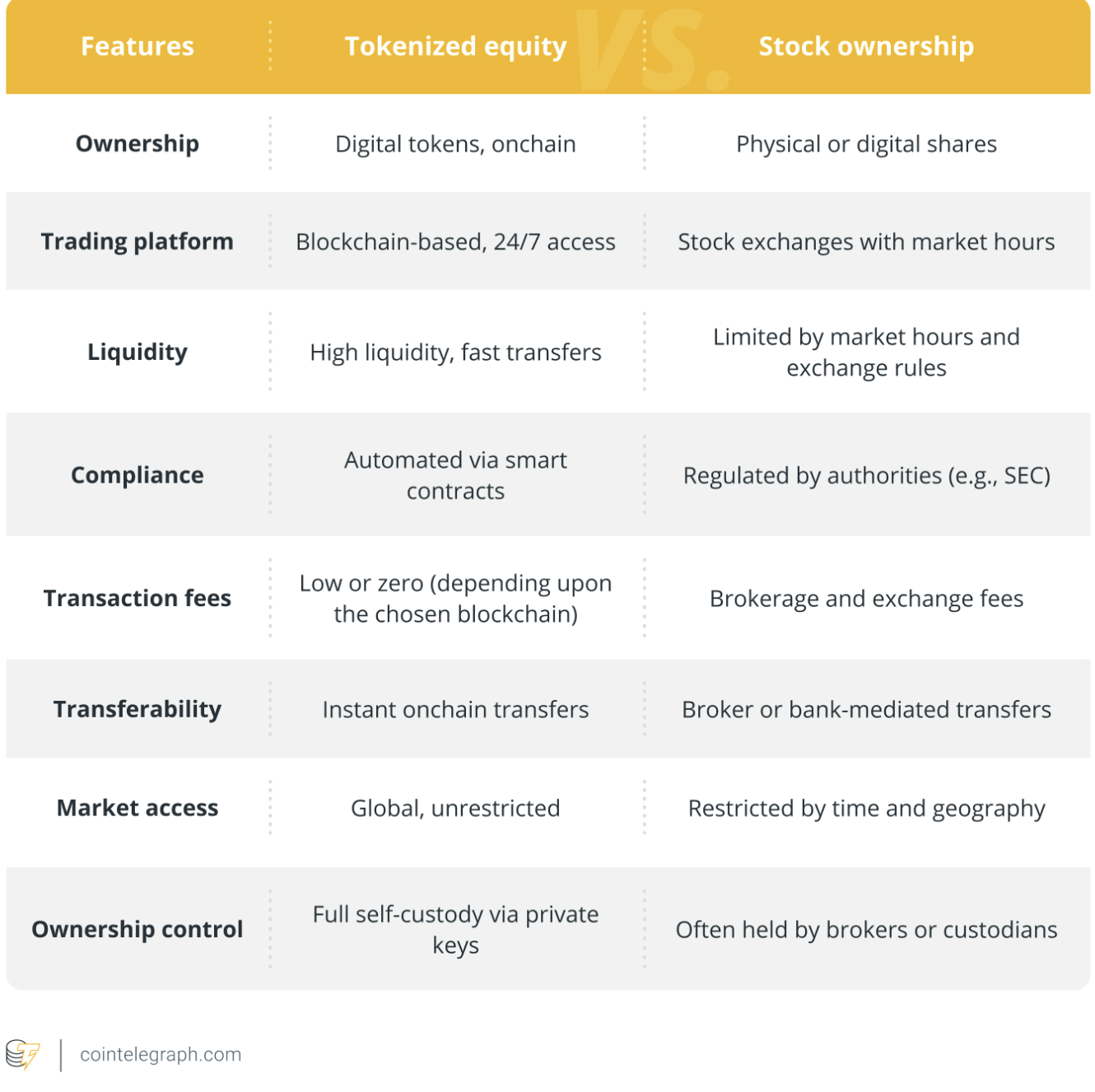
The differences between tokenized equity and shares issued through the traditional financial system. Source: Cointelegraph

Related: Tether solvency fears are ‘misplaced’ as company sits on large surplus: CoinShares

Tokenized finance is gaining steam as US regulators move to overhaul legacy financial tech

On Thursday, the US Securities and Exchange Commission (SEC) gave the green light to the Depository Trust and Clearing Corporation (DTCC), a clearinghouse and settlement company, to tokenize stocks, exchange-traded funds and bonds.

“US financial markets are poised to move onchain,” SEC Chair Paul Atkins said on Thursday, adding, “Onchain markets will bring greater predictability, transparency, and efficiency for investors.”
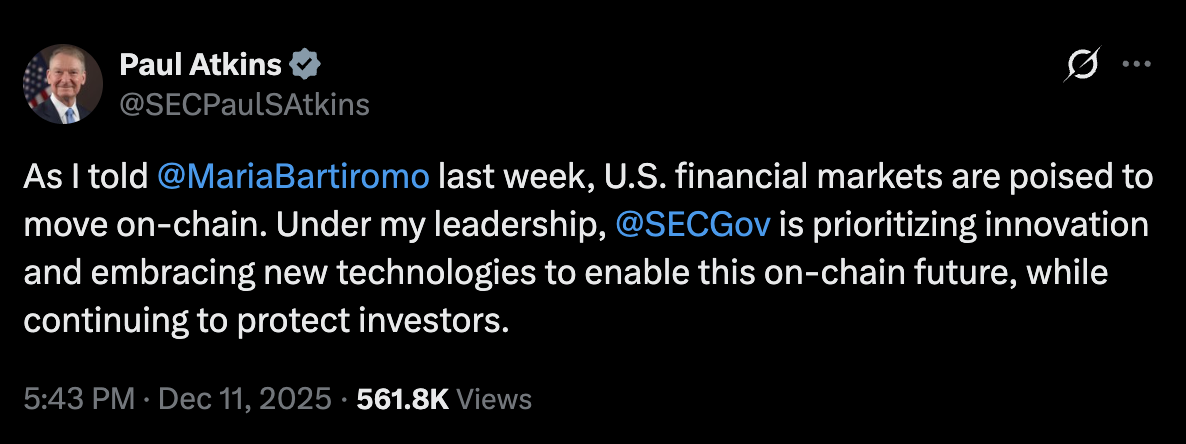
Source: Paul Atkins

Financial services company J.P. Morgan facilitated a $50 million tokenized bond issue for crypto investment company Galaxy Digital Holdings on the same day as Atkins’ announcement.

Crypto exchanges are also looking to expand trading of tokenized products, following the SEC’s nod to the DTCC and Atkins’ comments.

Coinbase, a US-based cryptocurrency exchange, is expected to announce its expansion into tokenized stocks and prediction markets as early as Wednesday.

The company told Cointelegraph that it will host a livestream to showcase new products, but did not specify which products would be unveiled.

Tokenized public stocks are still in the early stages of adoption, with nearly $700 million in public equities tokenized at the time of this writing, according to RWA.xyz data.

Magazine: Bitcoin whale Metaplanet ‘underwater’ but eyeing more BTC: Asia Express

Letture associate

The Biggest Political Economy Question in the AI Era: As Robots Become More Capable, How Do Humans Share the Value?

In the AI era, the most pressing political economy question is: as machines become increasingly capable, how can humanity share in the value they create? An article originally critiquing China's tech focus has sparked a deeper debate on this global challenge. Historically, industrial progress improved efficiency but still relied on human labor for wealth creation and distribution. AI is fundamentally different—it is now replacing cognitive and knowledge work. As AI and robots take over more tasks, economic growth may continue while direct human participation in value creation shrinks, creating a core tension between productivity gains and widespread income generation. The issue is not unique to China. While leading tech companies amass enormous wealth, labor's share of income is declining globally. The core problem is a broken link: technological innovation and corporate profits are not translating into sufficient consumer income and demand. Three potential paths forward are outlined: a traditional capitalist model where profits primarily go to capital owners; a state-capitalist approach with public investment in AI; and more innovative models like digital sovereign wealth funds, universal shareholding, or AI-era basic income schemes to directly distribute AI-generated value. The future competitive advantage may lie not just in technological supremacy, but in which society can build a new, inclusive distribution system for the intelligent economy. The ultimate challenge is ensuring that as AI creates value, humans have a means to obtain income and share in the resulting widespread social benefits.

marsbit4 min fa

The Biggest Political Economy Question in the AI Era: As Robots Become More Capable, How Do Humans Share the Value?

marsbit4 min fa

Generating Profits for Seven Consecutive Quarters, Emerging Markets Carry Trade Outperforms Everything

For the seventh consecutive quarter, dollar-funded emerging market carry trades have delivered positive returns, marking the longest winning streak since 2008. According to Bloomberg's index, this strategy has gained approximately 22% since late 2024, outperforming U.S. Treasuries, emerging market sovereign, and corporate dollar debt. The core of the trade involves borrowing low-interest currencies like the U.S. dollar, euro, or yen to invest in high-yielding emerging market assets, such as Turkish lira bonds offering over 40% returns. Returns were amplified by favorable currency moves, with the dollar weakening against most emerging market currencies and other traditional funding currencies. For instance, the trade gained 48% on the Colombian peso in the past year. A key test came in August 2024 with a historic joint U.S.-Japan currency intervention, which caused only a modest 1% dip in the carry trade risk premium as investors shifted funding from the yen to the euro and Swiss franc. Looking ahead, the primary risk is the timing of Federal Reserve policy changes. While persistent inflation allows the Fed to hold rates, a rapid rise in long-term U.S. yields could threaten the trade. Another concern is crowding, as massive inflows increase vulnerability to a sudden reversal. High interest rates in regions like Latin America and Eastern Europe, supported by external factors like Middle East tensions and energy prices, continue to sustain the opportunity. Major investors remain engaged, favoring currencies like the Mexican peso, South African rand, and Turkish lira.

marsbit19 min fa

Generating Profits for Seven Consecutive Quarters, Emerging Markets Carry Trade Outperforms Everything

marsbit19 min fa

Unpacking the Truth Behind On-chain Assets: Leverage, Liquidity, and Risk

The article analyzes the concept of "real-world asset" (RWA) tokenization, arguing that while tokenizing assets on-chain is a useful step, it is far from transformative on its own. The author compares it to placing a barcode on a shipping container—it enables identification but does not build the necessary market infrastructure. The core argument is that true value emerges not from tokenization, but from integrating these tokens into DeFi systems where they can be valued, financed, hedged, traded, and liquidated under stress. Key challenges identified include: 1. **Multiple Time Clocks**: A fundamental tension exists between blockchain's 24/7 settlement and the slower, business-hour-dependent processes of traditional markets, custody, and redemption. This "duration mismatch" can create dangerous liquidity gaps during crises. 2. **Liquidity Misconceptions**: True liquidity is not measured by Total Value Locked (TVL) or trading pairs, but by the ability to exit a position within a required timeframe at an acceptable price. It requires analyzing multiple exit paths and stress-testing scenarios. 3. **Leverage and Risk**: Leverage unlocks economic utility (e.g., using tokenized assets as collateral) but also introduces fragility. Risk models must account for more than asset volatility, incorporating factors like legal enforceability, oracle freshness, and market structure. Paradoxically, a "safer" asset like tokenized Treasury bonds could require a higher collateral discount than ETH due to slower, less-proven liquidation mechanisms. 4. **A Risk Graph**: RWA risk should be modeled as a network of interconnected dependencies (e.g., issuers, custodians, oracles, stablecoin pools), not a single score. Failures can propagate through this graph, turning operational issues into systemic liquidity crises. The article states that tokenized government bonds are merely an entry point, while more complex frontiers like computing power and energy assets present greater challenges and opportunities. It also examines the interplay and risks between tokenized stocks and perpetual futures contracts. The conclusion is that the future lies not in "tokenizing everything," but in building robust market layers where tokenized rights become resilient financial primitives within a programmable capital system. The token is just the barcode; the market is the machine.

marsbit43 min fa

Unpacking the Truth Behind On-chain Assets: Leverage, Liquidity, and Risk

marsbit43 min fa

Trading

Spot
活动图片