Tether may tokenize equity to ensure liquidity for investors: Report

cointelegraphPubblicato 2025-12-12Pubblicato ultima volta 2025-12-12

Introduzione

Tether, the issuer of USDT, is reportedly considering tokenizing equity and share buybacks to provide liquidity for investors as it aims for a $500 billion valuation. The company halted a shareholder’s attempt to sell a $1 billion stake, which would have valued Tether at $280 billion. Instead, Tether plans to offer liquidity solutions through tokenization or buybacks after closing a funding round aimed at raising $20 billion for a 3% stake. Tokenized equity enhances liquidity by enabling easier transfers, fractional ownership, and use as collateral in DeFi. The move aligns with growing regulatory support for onchain finance, including the SEC’s recent approval for DTCC to tokenize traditional assets like stocks and bonds.

Tether, the stablecoin company that issues the USDt (USDT) dollar-pegged token, is considering tokenizing investor equity and share buybacks to offer liquidity for investors as it seeks a $500 billion valuation.

Bloomberg reported on Friday, citing a source familiar with the matter, that Tether recently stopped an existing shareholder from selling their stake as the company is in talks to raise $20 billion for a 3% stake in the stablecoin's issuer business.

The investor sought to sell a $1 billion stake that valued Tether at $280 billion, Bloomberg reported. In response, Tether plans to offer investor liquidity through tokenization or share buybacks after the funding round closes.

Cointelegraph reached out to Tether but had not received a response by the time of publication.

Tokenizing a company’s equity can increase liquidity by making shares easier to transfer, fractionalize and borrow against. Onchain equity allows holders to maintain their positions while using a tokenized representation of their equity as collateral in decentralized finance (DeFi) applications.
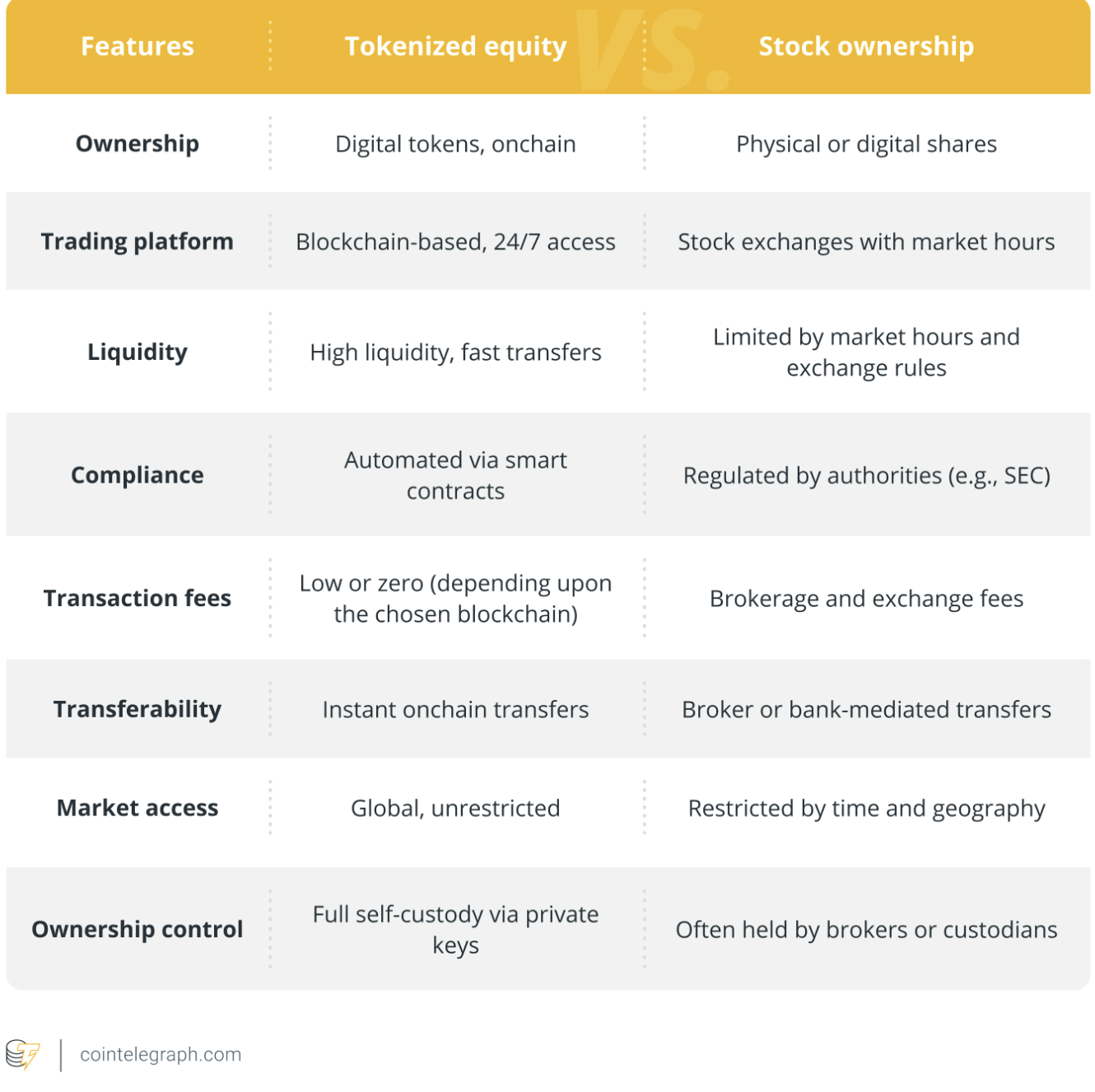
The differences between tokenized equity and shares issued through the traditional financial system. Source: Cointelegraph

Related: Tether solvency fears are ‘misplaced’ as company sits on large surplus: CoinShares

Tokenized finance is gaining steam as US regulators move to overhaul legacy financial tech

On Thursday, the US Securities and Exchange Commission (SEC) gave the green light to the Depository Trust and Clearing Corporation (DTCC), a clearinghouse and settlement company, to tokenize stocks, exchange-traded funds and bonds.

“US financial markets are poised to move onchain,” SEC Chair Paul Atkins said on Thursday, adding, “Onchain markets will bring greater predictability, transparency, and efficiency for investors.”
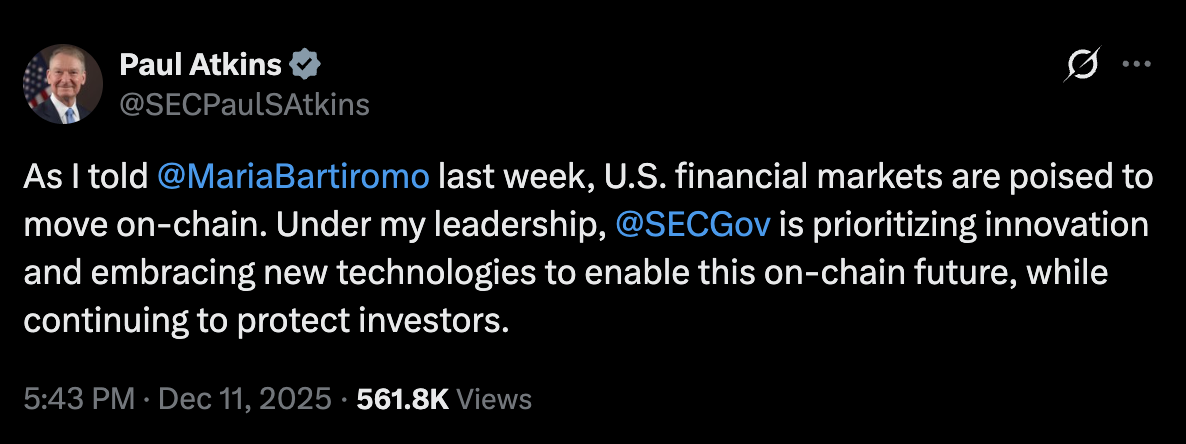
Source: Paul Atkins

Financial services company J.P. Morgan facilitated a $50 million tokenized bond issue for crypto investment company Galaxy Digital Holdings on the same day as Atkins’ announcement.

Crypto exchanges are also looking to expand trading of tokenized products, following the SEC’s nod to the DTCC and Atkins’ comments.

Coinbase, a US-based cryptocurrency exchange, is expected to announce its expansion into tokenized stocks and prediction markets as early as Wednesday.

The company told Cointelegraph that it will host a livestream to showcase new products, but did not specify which products would be unveiled.

Tokenized public stocks are still in the early stages of adoption, with nearly $700 million in public equities tokenized at the time of this writing, according to RWA.xyz data.

Magazine: Bitcoin whale Metaplanet ‘underwater’ but eyeing more BTC: Asia Express

Letture associate

147 Trillion vs 70 Billion: The Rise of On-Chain 'Risk Managers' and the Potential Dawn of a New Era in DeFi Asset Management

"147 Trillion vs 70 Billion: The Rise of On-Chain 'Risk Managers' and the Potential Dawn of a New Era in DeFi Asset Management" Key Points: The role of professional asset managers is emerging in DeFi, ending the era where protocols and governance dictated everything. While early DeFi protocols like Aave and Compound bundled risk management within their code, innovations like Morpho have separated infrastructure from risk judgment. This allows specialized "Risk Managers" to operate independent lending vaults, acting as on-chain asset managers. The market, though early with ~$7B in assets under management (AUM), is rapidly consolidating around top performers like SteakhouseFi (RWA focus), SentoraHQ (AI-driven models), and Gauntlet (crisis management). This modular structure mirrors TradFi's division of labor: distributors (e.g., exchanges) source capital, Risk Managers design strategies and set standards, and underlying protocols handle custody and execution. For traditional asset managers, this familiar structure presents clear entry paths: 1) **Distribution**: Partnering with Risk Managers as a backend service. 2) **Supply**: Bringing real-world assets (RWA) on-chain as collateral. 3) **Operation**: Becoming a Risk Manager themselves (e.g., Bitwise). The core competency required is shifting from coding to traditional risk underwriting and financial expertise—areas where established institutions hold a natural advantage. While the current DeFi market (~$80B) is minuscule compared to global asset management (~$147T), it represents a significant growth runway. The teams that build the trusted standards and rails for risk-managed capital now are poised to define the market's future as institutional capital seeks secure on-ramps.

marsbit6 min fa

147 Trillion vs 70 Billion: The Rise of On-Chain 'Risk Managers' and the Potential Dawn of a New Era in DeFi Asset Management

marsbit6 min fa

Sui Launches Gasless Stablecoin Transfers, Supported by Fireblocks

Sui has officially launched "Gasless Stablecoin Transfers," a new protocol-level feature enabling users and enterprises to send supported stablecoins on Sui without paying gas fees or needing a separate SUI token balance. As the feature rolls out, stablecoin transfer fees on Sui are now effectively $0. Major stablecoins like USDsui, suiUSDe, AUSD, FDUSD, USDB, USDC, and USDY are already supported. This aims to simplify payments and remove a key barrier to mass adoption: requiring users to hold another token for gas. The enterprise platform Fireblocks, securing over $14 trillion in digital asset transactions, has integrated the feature in advance, enhancing institutional accessibility. Other wallets and custodians are also set to support zero-gas transactions. Sui co-founder Adeniyi Abiodun stated this brings Sui closer to being a global payment rail. Fireblocks' Ran Goldi noted it removes a major friction point for businesses building on-chain payments. This is a permanent structural change to Sui's mainnet, not a subsidy. It positions Sui as low-cost infrastructure for enterprises, traders, and AI agents. Sui's stablecoin transfer volume has surpassed $1 trillion since August 2025, with its architecture supporting high-frequency payments. Recent growth includes three SUI Exchange-Traded Products (ETPs) launching in 2026 and the expansion of major stablecoin projects like USDsui and SuiUSDe on the network. Zero-gas stablecoin transfers are now being gradually deployed on the Sui mainnet.

marsbit7 min fa

Sui Launches Gasless Stablecoin Transfers, Supported by Fireblocks

marsbit7 min fa

Major AI Collaboration Breakthrough! Stanford and NVIDIA Jointly Eliminate AI Communication Overhead, Boosting Reasoning Speed by 2.4x

Title: AI Collaboration Breakthrough: Stanford & NVIDIA Eliminate Communication Overhead, Boost Reasoning Speed by 2.4x A new approach called RecursiveMAS, developed by UIUC, Stanford, NVIDIA, and MIT, tackles the major bottleneck in multi-agent AI systems: the "language tax." Currently, AI agents collaborate by generating and reading natural language text, a slow, costly, and information-lossy process akin to inefficient radio communication. RecursiveMAS bypasses this by enabling agents to communicate directly through their "thoughts"—latent space vector representations—instead of text. Inspired by recursive language models, it treats each agent like a reusable layer in a recursive loop. A special lightweight module called RecursiveLink passes these high-dimensional, semantic-rich internal states between agents. Only the final agent decodes the last latent representation into human-readable text. This process, described as "telepathic" communication, dramatically cuts the overhead of encoding and decoding text at each step. The system is highly efficient; the core AI model weights remain frozen, and only the small RecursiveLink modules are trained, requiring updates to just 0.31% of total parameters. This reduces training costs by over 50% compared to full fine-tuning. Comprehensive evaluations across math, science, coding, and QA benchmarks show significant improvements: - **Accuracy:** Average increase of 8.3%, with gains up to 18.1% on complex math problems (AIME2025). - **Speed:** End-to-end reasoning is 1.2x to 2.4x faster, with greater speedups as recursive depth increases. - **Cost:** Token usage is reduced by 34.6% to 75.6%. The research suggests a new scaling paradigm for multi-agent systems: deepening recursive collaboration depth rather than merely adding more agents. This could address key production barriers like compute cost, latency, and memory limits. However, challenges remain, including the need for independent verification, compatibility between different AI models (heterogeneous agents), reduced interpretability of the "black-box" latent communication, and adaptation to complex real-world workflows involving tools and human interaction. If validated, RecursiveMAS could fundamentally change how AI agents work together, moving beyond inefficient "textual handoffs" to more seamless and powerful collaborative reasoning.

marsbit1 h fa

Major AI Collaboration Breakthrough! Stanford and NVIDIA Jointly Eliminate AI Communication Overhead, Boosting Reasoning Speed by 2.4x

marsbit1 h fa

Trading

Spot
Futures

Articoli Popolari

Come comprare MAY

Benvenuto in HTX.com! Abbiamo reso l'acquisto di Mayflower (MAY) semplice e conveniente. Segui la nostra guida passo passo per intraprendere il tuo viaggio nel mondo delle criptovalute.Step 1: Crea il tuo Account HTXUsa la tua email o numero di telefono per registrarti il tuo account gratuito su HTX. Vivi un'esperienza facile e sblocca tutte le funzionalità,Crea il mio accountStep 2: Vai in Acquista crypto e seleziona il tuo metodo di pagamentoCarta di credito/debito: utilizza la tua Visa o Mastercard per acquistare immediatamente MayflowerMAY.Bilancio: Usa i fondi dal bilancio del tuo account HTX per fare trading senza problemi.Terze parti: abbiamo aggiunto metodi di pagamento molto utilizzati come Google Pay e Apple Pay per maggiore comodità.P2P: Fai trading direttamente con altri utenti HTX.Over-the-Counter (OTC): Offriamo servizi su misura e tassi di cambio competitivi per i trader.Step 3: Conserva Mayflower (MAY)Dopo aver acquistato Mayflower (MAY), conserva nel tuo account HTX. In alternativa, puoi inviare tramite trasferimento blockchain o scambiare per altre criptovalute.Step 4: Scambia Mayflower (MAY)Scambia facilmente Mayflower (MAY) nel mercato spot di HTX. Accedi al tuo account, seleziona la tua coppia di trading, esegui le tue operazioni e monitora in tempo reale. Offriamo un'esperienza user-friendly sia per chi ha appena iniziato che per i trader più esperti.

155 Totale visualizzazioniPubblicato il 2025.07.01Aggiornato il 2025.07.01

Come comprare MAY

Discussioni

Benvenuto nella Community HTX. Qui puoi rimanere informato sugli ultimi sviluppi della piattaforma e accedere ad approfondimenti esperti sul mercato. Le opinioni degli utenti sul prezzo di MAY MAY sono presentate come di seguito.

活动图片