Tether Fails $500B Evaluation Amidst Investor Pushback as HYPER Gains Momentum

bitcoinistPubblicato 2026-02-04Pubblicato ultima volta 2026-02-04

Introduzione

The cryptocurrency market is experiencing a significant shift as Tether (USDT) faces investor resistance and fails to achieve a $500 billion valuation, driven by transparency concerns and a move towards decentralized alternatives. This has led to a rotation of liquidity into Bitcoin Layer 2 solutions, which aim to unlock Bitcoin's dormant capital by enhancing its utility. Bitcoin Hyper ($HYPER) is emerging as a key player, integrating the Solana Virtual Machine (SVM) to offer high-speed execution and smart contract capabilities while maintaining Bitcoin's security. It enables sub-second transactions, decentralized finance (DeFi) applications, and seamless BTC transfers, addressing scalability issues. The project has raised over $31.2 million in its presale, indicating strong institutional confidence. With a current token price of $0.0136751, it offers staking rewards and aims to attract long-term investors amid growing interest in Bitcoin's programmability.

The cryptocurrency market is witnessing a decoupling event play out in real-time.

Tether (USDT), long considered the unshakeable bedrock of stablecoin liquidity, has hit a wall in its pursuit of a $500B-implied market valuation.

Institutional investors have reportedly balked at the metrics, spooked by transparency concerns and a regulatory landscape shifting toward decentralized alternatives. This stalemate at the half-trillion-dollar mark isn’t just a pricing failure; it’s a signal that risk appetite is rotating.

But here’s the kicker: liquidity isn’t leaving the ecosystem. It’s just moving deeper into the Bitcoin infrastructure. The market is bored with simple store-of-value assets; traders want utility layers capable of unlocking Bitcoin’s dormant capital.

That shift explains the sudden surge in Bitcoin Layer 2 solutions, which are quietly absorbing the liquidity Tether failed to capture.

Investors appear to be hedging against stablecoin stagnation by betting on the ‘programmability’ of Bitcoin. The logic holds up: if Bitcoin is the gold standard, the rails allowing it to transact like Solana or Ethereum are the ultimate pick-and-shovel plays.

This environment created a perfect storm for emerging protocols like Bitcoin Hyper ($HYPER), which is seeing its valuation climb while Tether’s dominance faces scrutiny.

You can buy your $HYPER here.

Bitcoin Hyper Bridges the Gap Between Store of Value and High-Speed Execution

The core friction point in the current market isn’t a lack of assets, it’s a lack of velocity.

Bitcoin holds over a trillion dollars in value, yet that capital remains largely inert, trapped by slow block times and the absence of native smart contracts. Bitcoin Hyper ($HYPER) answers this bottleneck not just as a sidechain, but as the first Bitcoin Layer 2 to integrate the Solana Virtual Machine (SVM).

Why does this technical architecture matter? It solves the ‘trilemma’ without sacrificing Bitcoin’s security, which is one of Bitcoin Hyper’s mantras.
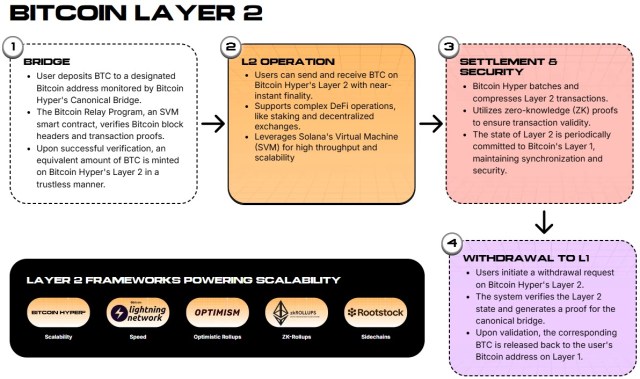
By using the SVM for execution, Bitcoin Hyper achieves the sub-second finality and low-latency performance DeFi developers require, all while anchoring its state to Bitcoin L1.

Finally, developers can write in Rust and deploy high-speed dApps that actually settle on Bitcoin. For the market, that utility is tangible. The protocol offers a Decentralized Canonical Bridge for seamless $BTC transfers and supports SPL-compatible tokens modified for Layer 2 operations.

This opens the door for high-frequency trading, gaming, and complex lending protocols directly on the Bitcoin network, use cases that were previously impossible. Plus, the integration of high-speed payments in wrapped $BTC with negligible fees addresses the precise scalability issues that have historically held the ecosystem back.

Check the $HYPER presale.

Whale Accumulation Signals Confidence With Over $31M Raised

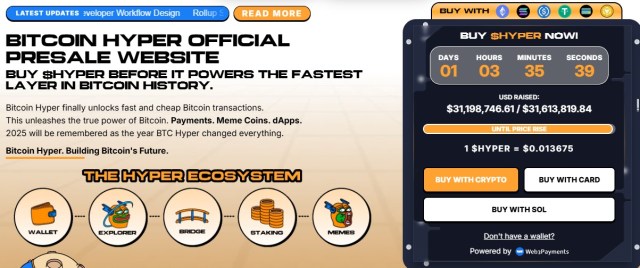
While Tether struggles to justify its valuation, smart money is aggressively positioning itself in the Bitcoin Hyper presale. The sentiment contrast is stark. According to official data, the project has raised over $31.2M. That figure suggests robust institutional confidence, even as the broader market hesitates on stablecoins.
Traders watching this setup will notice this pattern often precedes retail adoption, as whales position themselves before the Token Generation Event.

Frankly, the tokenomics look designed to discourage mercenary capital rotation. With the token currently priced at $0.0136751, early participants are eyeing immediate staking opportunities post-TGE. The protocol offers high APY staking rewards, with a modest 7-day vesting period for presale stakers to prevent immediate dump pressure.

For investors fatigued by the regulatory ambiguity surrounding centralized stablecoins, the programmatic certainty of a Bitcoin L2 offers a compelling alternative, while the presale performance creates the expected FOMO.

Buy your $HYPER today.

Disclaimer: The content of this article is for informational purposes only and does not constitute financial advice. Cryptocurrency investments, including presales and Layer 2 tokens, carry inherent risks. Always perform your own due diligence before investing.


Domande pertinenti

QWhy has Tether (USDT) failed to achieve a $500 billion market valuation according to the article?

AInstitutional investors balked at the metrics due to transparency concerns and a regulatory landscape favoring decentralized alternatives, signaling a shift in risk appetite.

QWhat is Bitcoin Hyper ($HYPER) and how does it address the limitations of Bitcoin?

ABitcoin Hyper is a Bitcoin Layer 2 solution that integrates the Solana Virtual Machine (SVM) to enable sub-second finality, low-latency performance, and support for high-speed dApps, gaming, and DeFi on Bitcoin, solving its scalability and smart contract limitations.

QHow much has the Bitcoin Hyper ($HYPER) presale raised and what does this indicate?

AThe Bitcoin Hyper presale has raised over $31.2 million, indicating robust institutional confidence and smart money positioning ahead of retail adoption, contrasting with Tether's struggles.

QWhat technical feature allows Bitcoin Hyper to achieve high-speed execution while maintaining Bitcoin's security?

ABitcoin Hyper uses the Solana Virtual Machine (SVM) for execution, achieving sub-second finality and low-latency performance while anchoring its state to Bitcoin L1, thus maintaining Bitcoin's security.

QWhat are the benefits of Bitcoin Hyper's integration of SPL-compatible tokens and a Decentralized Canonical Bridge?

AThe integration allows seamless $BTC transfers, supports Layer 2 operations for SPL-compatible tokens, and enables high-frequency trading, gaming, and complex lending protocols directly on the Bitcoin network with negligible fees.

Letture associate

Global Stock Market's Storm Center: South Korea's Stock Market De-leveraging Is Largely Complete

Storm's Eye: South Korean Market De-leveraging Nears Completion The recent sharp correction in South Korean equities, with the KOSPI index dropping 32% from its June high, has been a key trigger for global tech stock volatility. The core driver was not a fundamental shift but a forced de-leveraging process within the market's unique structure, which is now largely complete. Two main leverage channels amplified the sell-off: 1. **Leveraged ETFs:** Their size, proportionally four times larger than in the U.S., peaked near $50 billion. Their mandatory daily rebalancing mechanism created a vicious cycle of "price drop → forced selling → further drop." Approximately 75% of this excess has been unwound, shrinking to $26 billion, with regulatory curbs now blocking new inflows. 2. **Hedge Fund Leverage:** Using swaps to magnify exposure, hedge funds saw their net long positioning fall by over 50% from peak levels. The most intense phase of this institutional de-leveraging is over. In contrast, **retail margin debt** poses minimal systemic risk. At 0.5% of market cap, it is far lower than in the U.S. or China, lacks automatic triggers, and is concentrated in smaller stocks. The conclusion: the high-leverage structures most prone to "chain-reaction selling" have been substantially cleared. The market is transitioning from a liquidity-driven crash to one priced more on fundamentals. The article argues that the AI trend—centered on Korean memory chips—remains intact. This episode represents a painful but necessary clearing of crowded trades, not the end of the AI revolution. For investors, the key question is conviction in the long-term AI direction; if the trend is real, current volatility is a cost of entry, not a terminal risk.

链捕手1 h fa

Global Stock Market's Storm Center: South Korea's Stock Market De-leveraging Is Largely Complete

链捕手1 h fa

The Eternal Fragments of Money: Third-Party Payment Has No First Principle

"The Enduring Fragments of Money: Third-Party Payments Lack a First Principle" Stripe is reportedly attempting to acquire PayPal, marking a significant shift reminiscent of PayPal's merger with the original X.com 30 years ago. The article analyzes Stripe's strategic challenges and the broader payments industry landscape. Despite its initial success with a developer-friendly API model, Stripe missed its optimal IPO window during the pandemic and has since seen its valuation decline. Its attempts to expand through acquisitions and new ventures, particularly in stablecoins (like its OUSD project) and Agent-focused payments (ACP/MPP protocols), have faced headwinds. The author argues that the payment industry remains highly fragmented and is ultimately an adjunct to the traditional banking system. This structure limits the potential for any single player, including Stripe, to achieve complete dominance. While stablecoins and the future rise of autonomous Agent economies present potential growth avenues, they are not yet mainstream and still require integration with the existing financial system. For now, Agent-based transactions are largely used for speculative "volume boosting" rather than substantive business applications. Stripe's current move to acquire PayPal is seen as an attempt to bolster its weak consumer-facing (C-side) business after its stablecoin-focused strategies faltered. Meanwhile, PayPal is described as structurally outdated, unable to revive itself through new products like Venmo or PYUSD. The future of payments may lie not in payments themselves but in value-added services like more efficient settlement networks. The author suggests that companies like Stripe and Circle, which are building their own blockchains (Tempo, Arc) and stablecoins, are positioning themselves to eventually profit from high-efficiency settlement systems. These new networks could potentially bypass some traditional banking layers. In conclusion, the article posits that third-party payment is a perpetually fragmented battlefield where scale alone cannot ensure victory. Players must find new models, focusing on efficiency to compete with the entrenched banking system. Stripe's acquisition of PayPal represents a bet on this uncertain future.

链捕手1 h fa

The Eternal Fragments of Money: Third-Party Payment Has No First Principle

链捕手1 h fa

Trading

Spot
活动图片




