Tens of Millions of Errors Per Hour: Investigation Reveals the 'Accuracy Illusion' of Google AI Search

marsbitPubblicato 2026-04-10Pubblicato ultima volta 2026-04-10

Introduzione

A New York Times investigation, in collaboration with AI startup Oumi, reveals significant accuracy and reliability issues with Google's AI Overviews search feature. Testing over 4,300 queries showed the accuracy rate improved from 85% (Gemini 2) to 91% (Gemini 3). However, given Google's scale of ~5 trillion annual searches, this 9% error rate translates to over 57 million incorrect answers generated hourly. A more critical issue is the prevalence of unsubstantiated citations. For correct answers, the rate of "unfounded citations"—where provided source links do not support the AI's claims—worsened, rising from 37% with Gemini 2 to 56% with Gemini 3. This makes it difficult for users to verify the information. The AI also heavily relies on low-quality sources, with Facebook and Reddit being its second and fourth most cited domains. Furthermore, the system is highly susceptible to manipulation. A BBC journalist successfully "poisoned" it by publishing a fake article; Google's AI began presenting the false information as fact within 24 hours. Google disputed the study's methodology, criticizing the use of the SimpleQA benchmark and an AI model (Oumi's HallOumi) to evaluate its own AI. The company maintains that its internal safeguards and ranking systems improve accuracy beyond the base model's performance.

Author: Claude, Deep Tide TechFlow

Deep Tide Introduction: The latest test by The New York Times in collaboration with AI startup Oumi shows that the accuracy rate of Google Search's AI Overviews feature is about 91%. However, given Google's scale of processing 5 trillion searches annually, this translates to tens of millions of incorrect answers generated every hour. More troublingly, even when the answers are correct, over half of the cited links fail to support their conclusions.
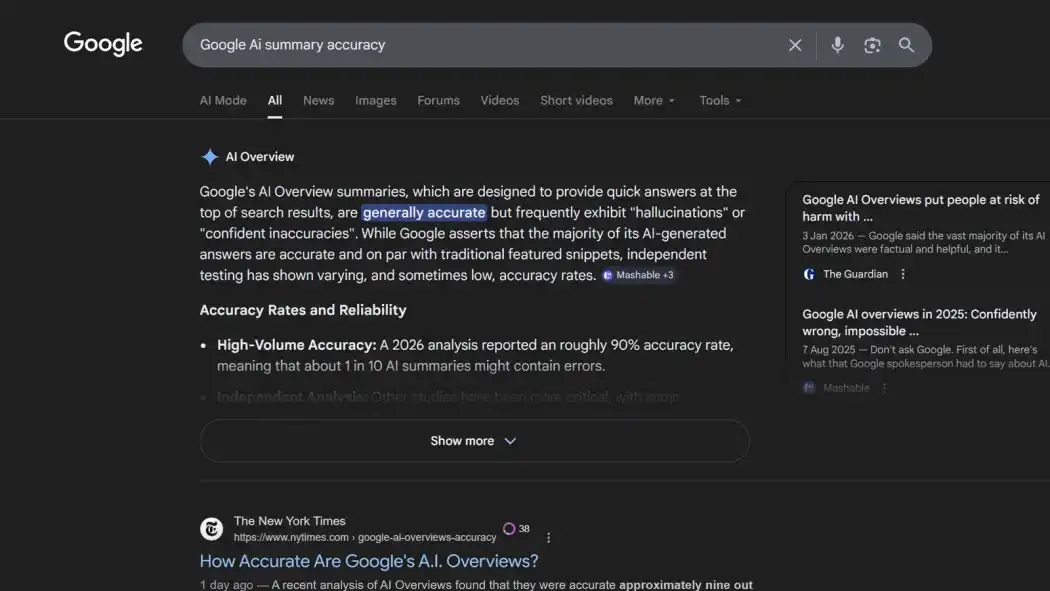
Google is delivering misinformation to users on an unprecedented scale, and most people are completely unaware.

According to The New York Times, AI startup Oumi, commissioned by the publication, used the industry-standard test SimpleQA developed by OpenAI to evaluate the accuracy of Google's AI Overviews feature. The test covered 4,326 search queries, conducting one round in October last year (powered by Gemini 2) and another in February this year (upgraded to Gemini 3). The results showed that Gemini 2's accuracy was about 85%, which improved to 91% with Gemini 3.

91% sounds good, but it's a different story when considering Google's scale. Google processes approximately 5 trillion search queries annually. Calculating with a 9% error rate, AI Overviews generates over 57 million inaccurate answers per hour, nearly 1 million per minute.

Correct Answers, Wrong Sources

More alarming than the accuracy rate is the issue of "unanchored" citation sources.

Oumi's data shows that in the Gemini 2 era, 37% of correct answers had "unsupported citations," meaning the links attached to the AI summaries did not support the information provided. After upgrading to Gemini 3, this proportion increased instead of decreasing, jumping to 56%. In other words, while the model gives correct answers, it's increasingly failing to "show its work."

Oumi CEO Manos Koukoumidis pointedly questioned: "Even if the answer is correct, how do you know it's correct? How do you verify it?"

The problem is exacerbated by AI Overviews' heavy reliance on low-quality sources. Oumi found that Facebook and Reddit are the second and fourth most cited sources for AI Overviews, respectively. In inaccurate answers, Facebook was cited 7% of the time, higher than the 5% in accurate answers.

BBC Journalist's Fake Article "Poisoned" Results Within 24 Hours

Another serious flaw of AI Overviews is its susceptibility to manipulation.

A BBC journalist tested the system with a deliberately fabricated false article. In less than 24 hours, Google's AI Overview presented the false information from the article as fact to users.

This means anyone who understands how the system works could potentially "poison" AI search results by publishing false content and boosting its traffic. Google spokesperson Ned Adriance responded by saying the search AI feature is built on the same ranking and security mechanisms that block spam, and claimed that "most examples in the test are unrealistic queries that people wouldn't actually search for."

Google's Rebuttal: The Test Itself Is Flawed

Google raised several objections to Oumi's research. A Google spokesperson called the study "seriously flawed," citing reasons including: the SimpleQA benchmark itself contains inaccurate information; Oumi used its own AI model HallOumi to judge another AI's performance, potentially introducing additional errors; and the test content doesn't reflect real user search behavior.

Google's internal tests also showed that when Gemini 3 operates independently outside the Google Search framework, it produces false outputs at a rate as high as 28%. But Google emphasized that AI Overviews leverages the search ranking system to improve accuracy, performing better than the model itself.

However, as PCMag's commentary pointed out the logical paradox: If your defense is that "the report pointing out our AI's inaccuracies itself uses potentially inaccurate AI," this probably doesn't enhance users' confidence in your product's accuracy.


Domande pertinenti

QWhat is the accuracy rate of Google's AI Overviews feature according to the Oumi study?

AThe accuracy rate of Google's AI Overviews was found to be approximately 91% when powered by Gemini 3, an improvement from about 85% with Gemini 2.

QHow many inaccurate answers does the article estimate Google's AI Overviews produces per hour?

ABased on Google's annual volume of 5 trillion searches and a 9% error rate, the AI Overviews feature is estimated to produce over 57 million inaccurate answers per hour.

QWhat is the 'unsubstantiated citation' problem identified in the report?

AThe 'unsubstantiated citation' problem refers to instances where the AI Overviews provides a correct answer, but the attached source links do not actually support the information given. This issue increased from 37% with Gemini 2 to 56% with Gemini 3.

QWhich low-quality websites are frequently used as sources by AI Overviews, according to the Oumi data?

AAccording to Oumi's data, Facebook and Reddit are the second and fourth most cited sources by AI Overviews, with Facebook being cited more frequently in inaccurate answers.

QHow did Google respond to the findings of the Oumi study?

AGoogle criticized the study, calling it 'seriously flawed.' Their spokesperson argued that the SimpleQA benchmark itself contains inaccuracies, that using an AI (HallOumi) to judge another AI introduces errors, and that the test queries do not reflect real user search behavior.

Letture associate

Gensyn AI: Don't Let AI Repeat the Mistakes of the Internet

In recent months, the rapid growth of the AI industry has attracted significant talent from the crypto sector. A persistent question among researchers intersecting both fields is whether blockchain can become a foundational part of AI infrastructure. While many previous AI and Crypto projects focused on application layers (like AI Agents, on-chain reasoning, data markets, and compute rentals), few achieved viable commercial models. Gensyn differentiates itself by targeting the most critical and expensive layer of AI: model training. Gensyn aims to organize globally distributed GPU resources into an open AI training network. Developers can submit training tasks, nodes provide computational power, and the network verifies results while distributing incentives. The core issue addressed is not decentralization for its own sake, but the increasing centralization of compute power among tech giants. In the era of large models, access to GPUs (like the H100) has become a decisive bottleneck, dictating the pace of AI development. Major AI companies are heavily dependent on large cloud providers for compute resources. Gensyn's approach is significant for several reasons: 1) It operates at the core infrastructure layer (model training), the most resource-intensive and technically demanding part of the AI value chain. 2) It proposes a more open, collaborative model for compute, potentially increasing resource utilization by dynamically pooling idle GPUs, similar to early cloud computing logic. 3) Its technical moat lies in solving complex challenges like verifying training results, ensuring node honesty, and maintaining reliability in a distributed environment—making it more of a deep-tech infrastructure company. 4) It targets a validated, high-growth market with genuine demand, rather than pursuing blockchain integration without purpose. Ultimately, the boundaries between Crypto and AI are blurring. AI requires global resource coordination, incentive mechanisms, and collaborative systems—areas where crypto-native solutions excel. Gensyn represents a step toward making advanced training capabilities more accessible and collaborative, moving beyond a niche controlled by a few giants. If successful, it could evolve into a fundamental piece of AI infrastructure, where the most enduring value in the AI era is often created.

marsbit8 h fa

Gensyn AI: Don't Let AI Repeat the Mistakes of the Internet

marsbit8 h fa

Why is China's AI Developing So Fast? The Answer Lies Inside the Labs

A US researcher's visit to China's top AI labs reveals distinct cultural and organizational factors driving China's rapid AI development. While talent, data, and compute are similar to the West, Chinese labs excel through a pragmatic, execution-focused culture: less emphasis on individual stardom and conceptual debate, and more on teamwork, engineering optimization, and mastering the full tech stack. A key advantage is the integration of young students and researchers who approach model-building with fresh perspectives and low ego, prioritizing collective progress over personal credit. This contrasts with the US culture of self-promotion and "star scientist" narratives. Chinese labs also exhibit a strong "build, don't buy" mentality, preferring to develop core capabilities—like data pipelines and environments—in-house rather than relying on external services. The ecosystem feels more collaborative than tribal, with mutual respect among labs. While government support exists, its scale is unclear, and technical decisions appear driven by labs, not state mandates. Chinese companies across sectors, from platforms to consumer tech, are building their own foundational models to control their tech destiny, reflecting a broader cultural drive for technological sovereignty. Demand for AI is emerging, with spending patterns potentially mirroring cloud infrastructure more than traditional SaaS. Despite challenges like a less mature data industry and GPU shortages, Chinese labs are propelled by vast talent, rapid iteration, and deep integration with the open-source community. The competition is evolving beyond a pure model race into a contest of organizational execution, developer ecosystems, and industrial pragmatism.

marsbit9 h fa

Why is China's AI Developing So Fast? The Answer Lies Inside the Labs

marsbit9 h fa

3 Years, 5 Times: The Rebirth of a Century-Old Glass Factory

Corning, a 175-year-old glass company, is experiencing a dramatic revival as a key player in AI infrastructure, driven by surging demand for high-performance optical fiber in data centers. AI data centers require vastly more fiber than traditional ones—5 to 10 times as much per rack—to handle high-speed data transmission between GPUs. This structural demand shift, coupled with supply constraints from the lengthy expansion cycle for fiber preforms, has created a significant supply-demand gap. Nvidia has invested in Corning, along with Lumentum and Coherent, in a $4.5 billion total commitment to secure the optical supply chain for AI. Corning's competitive edge lies in its expertise in producing ultra-low-loss, high-density, and bend-resistant specialty fiber, which is critical for 800G+ and future 1.6T data rates. Its deep involvement in co-packaged optics (CPO) with partners like Nvidia further solidifies its position. While not the largest fiber manufacturer globally, Corning's revenue from enterprise/data center clients now exceeds 40% of its optical communications sales, and it has secured multi-year supply agreements with major hyperscalers including Meta and Nvidia. Financially, Corning's optical communications revenue has surged, doubling from $1.3 billion in 2023 to over $3 billion in 2025. Its stock price has risen nearly 6-fold since late 2023. Key future catalysts include the rollout of Nvidia's CPO products and the scale of undisclosed customer agreements. However, risks include high current valuations and potential disruption from next-generation technologies like hollow-core fiber. The company's long-term bet on light over electricity, maintained even through the telecom bubble crash, is now being validated by the AI boom.

marsbit10 h fa

3 Years, 5 Times: The Rebirth of a Century-Old Glass Factory

marsbit10 h fa

Trading

Spot
Futures
活动图片




