Telegram's 'Crypto Accounting': Surging Revenue Behind Net Losses and the $450 Million Token Sale Controversy

marsbitPubblicato 2026-01-10Pubblicato ultima volta 2026-01-10

Introduzione

Telegram's recent unaudited financials reveal a paradox: while its H1 2025 revenue surged 65% year-over-year to $870 million, it reported a net loss of $222 million. This was primarily due to a sharp devaluation of its TON token holdings, which fell over 73% during the crypto market downturn. Revenue growth was driven by an 88% increase in premium subscriptions ($223 million), a 5% rise in ads ($125 million), and nearly $300 million from its exclusive partnership with the TON blockchain. However, the company’s significant crypto assets led to major accounting losses. Telegram also sold over $450 million worth of TON tokens, sparking community concerns about potential "dumping." Officials clarified that these sales—mainly to long-term investors like TONStrategy (TONX)—came with four-year vesting periods to avoid immediate sell pressure. Founder Pavel Durov emphasized that the move aimed to decentralize TON ownership and fund development, not just cash out. As Telegram eyes a potential IPO by 2026–2027, its deep ties to TON present both a growth engine and a volatility risk. The company recently raised $1.7 billion in convertible notes from investors like BlackRock, but its IPO plans face regulatory and legal hurdles, including ongoing investigations involving Durov in France.

Author: Zen, PANews

Telegram has recently been in the spotlight again due to financial information circulating among investors: revenue is rising, but net profit is turning downward. The key variable here is not a slowdown in user growth, but the decline in TON's price, which has transmitted volatility from the asset side into the income statement.

The sale of over $450 million worth of TON tokens has led the outside world to re-examine its interest relationship and boundaries with the TON ecosystem.

Due to Low TON Prices, Telegram Sees Surging Revenue but Still Reports Net Loss

According to an FT report, in the first half of 2025, Telegram achieved a significant leap in revenue. Unaudited financial reports show that the company's revenue reached $870 million in the first half of the year, a year-on-year increase of 65%, significantly exceeding the $525 million in the first half of 2024; it achieved nearly $400 million in operating profit.

In terms of revenue structure, Telegram's advertising revenue grew by 5% to $125 million; premium subscription revenue surged by 88% to $223 million, nearly double the same period last year. Compared to these two items, the key factor in Telegram's revenue growth mainly comes from the exclusive agreement signed with the TON blockchain—TON became the exclusive blockchain infrastructure for Telegram's mini-app ecosystem and brought Telegram nearly $300 million in related revenue.
Therefore, overall, Telegram continued its strong growth momentum from the mini-game boom ignited in 2024 in the first half of last year—in 2024, Telegram achieved its first annual profit, with profits as high as $540 million, and annual revenue reached $1.4 billion, far exceeding the $343 million in 2023.

Of the $1.4 billion revenue in 2024, about half came from its so-called "partnerships and ecosystem," roughly $250 million from advertising, and $292 million from its premium subscription service. Clearly, Telegram's growth is partly due to the surge in the number of paying users, but even more so due to the收益 brought by its cryptocurrency-related collaborations.

However, the high volatility of cryptocurrencies has also brought risks to Telegram. Even though it achieved nearly $400 million in operating profit in the first half of 2025, Telegram still reported a net loss of $222 million. Informed sources stated that this was because the company had to revalue its held Ton token assets. Due to the持续低迷 of altcoins in 2025, the price of Ton tokens持续下跌 throughout 2025, falling by over 73% at its lowest point.

Selling $450 Million: Cashing Out or Upholding Decentralization理念

Accustomed to the long-term低迷 of altcoin prices and the floating losses of many DAT-listed companies, retail investors were not too surprised by Telegram's losses due to the depreciation of virtual assets. What surprised and displeased the community more was the FT report stating that Telegram had sold off a large amount, with its TON token sales exceeding $450 million. This figure exceeds 10% of the token's current circulating market value.

Thus, the持续走低 of TON's price, combined with Telegram's disposal of its huge token holdings, has sparked质疑 and controversy among some TON community members and investors regarding its "selling tokens to cash out" and背刺 Ton investors.

According to the public explanation by Manuel Stotz, Chairman of the Board of TON treasury company TONStrategy (Nasdaq: TONX), all TON tokens sold by Telegram are subject to a four-year vesting period. This means these tokens cannot be circulated on the secondary market in the short term and will not cause immediate selling pressure.

Furthermore, Stotz stated that the main buyers Telegram connected with were long-term investment entities like the TONX company led by Stotz himself. Their purchase of these tokens is for long-term holding and staking. TONX, led by Stotz, as a US-listed专项 investment company for the TON ecosystem, primarily acquired Telegram's筹码 for long-term strategic purposes, not for speculative flipping.

Stotz also emphasized that Telegram's net holdings of Ton tokens did not decrease significantly after the transaction and may have even increased. This is because Telegram exchanged part of its existing holdings for vested token distributions and can持续获得 new TON income from业务 like advertising revenue sharing.综合计算, its holdings remain high.

Telegram's long-term business model of acquiring TON tokens had previously raised concerns among some community members—the company holding too high a proportion of tokens is not conducive to TON's decentralization. Telegram founder Pavel Durov took this concern very seriously and stated as early as 2024 that the team would control Telegram's TON holdings to no more than 10%. If holdings exceed this standard, the excess will be sold to long-term investors to achieve wider token distribution, while also raising development funds for Telegram.
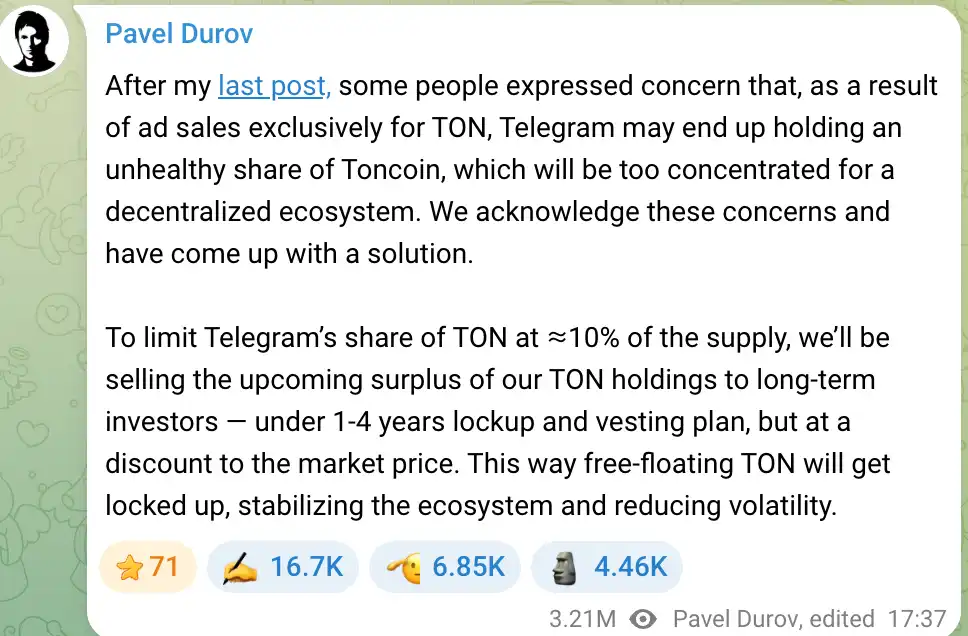
Durov emphasized that these sales would be conducted at a slight discount to the market price and would be subject to lock-up and vesting periods to avoid short-term selling pressure and ensure the stability of the TON ecosystem. This plan aims to prevent TON from being concentrated in Telegram's hands, which could raise concerns about price manipulation, and to维护 the project's decentralization宗旨. Therefore, Telegram's token selling行为 is more like a part of asset structure adjustment and liquidity management, rather than simply cashing out at high prices for arbitrage.

It is worth noting that while the持续走低 of TON's price in 2025 certainly brought impairment pressure on Telegram's financial reports, in the long run, Telegram's deep binding with TON has also created a situation of shared prosperity and loss.

Telegram has gained new revenue sources and product highlights through deep participation in the TON ecosystem, but it must also bear the financial impact of crypto market volatility. This "double-edged sword" effect is also a factor that investors must consider when evaluating its value as Telegram contemplates an IPO.

Telegram's IPO Prospects

With improving financial performance and business diversification, Telegram's上市前景 has become a focus of market attention. The company has raised over $1 billion since 2021 through multiple rounds of bond issuance; in 2025, it issued another $1.7 billion in convertible bonds, attracting participation from internationally renowned institutions like BlackRock and Abu Dhabi's Mubadala.

These financing measures not only provide Telegram with capital but are also seen as preparations for an IPO. However, Telegram's path to listing is not smooth; its debt arrangements, regulatory environment, and founder factors will all influence the IPO process.

Telegram currently has two main bonds outstanding: one is a bond with a coupon of 7% maturing in March 2026, and the other is a convertible bond with a coupon of 9% maturing in 2030. In the second $1.7 billion bond, approximately $955 million was used to replace old bonds, and $745 million was new capital for the company.

The special feature of the convertible bond is that it has an IPO conversion clause: if the company goes public before 2030, investors can redeem/convert the bonds at approximately 80% of the IPO price, equivalent to a 20% discount. In other words, these investors are betting that Telegram can successfully IPO and achieve a considerable valuation premium.

Currently, through the 2025 debt restructuring, Telegram has提前 redeemed or repaid the vast majority of the bonds maturing in 2026. Durov publicly stated that the old debt from 2021 has been largely settled and does not constitute a current risk. Addressing the impact of the frozen $500 million Russian bonds on Telegram, he responded that Telegram does not rely on Russian capital, and there were no Russian investors in the recently issued $1.7 billion bond.

Therefore, Telegram's main debt now is the convertible bond maturing in 2030, leaving a relatively宽裕的上市窗口. However, many investors still expect Telegram to seek an上市 around 2026-2027,实现债转股 and open up new financing channels. If this window is missed, the company may face long-term debt interest pressure in the future and may lose a good opportunity to transition to equity financing.

When investors measure Telegram's上市价值, they also focus on its profit prospects and抽成模式. Telegram currently has about 1 billion monthly active users and an estimated 450 million daily active users. This huge user base gives it commercial imagination space. Although its growth has been迅猛 in recent years, Telegram still needs to prove that its business model can achieve sustainable profitability.

The good news is that Telegram currently has absolute control over its own ecosystem. Durov recently emphasized that he remains the company's sole shareholder, and creditors are not involved in corporate governance.

Therefore, Telegram has the potential to sacrifice some short-term profits for long-term user stickiness and ecological prosperity without being constrained by short-sighted shareholders. This "delayed gratification" strategy is in line with Durov's consistent product philosophy and will also be the core of the growth story told to investors during the IPO path.

However, it must be emphasized that an IPO does not depend solely on financial and debt structure. FT pointed out that Telegram's potential上市计划 is currently still affected by judicial proceedings in France against Durov, and the related uncertainty makes it difficult to clarify the上市时间表. Telegram has also acknowledged in its communication with investors that this investigation may pose an obstacle.

Recommended Reading:

RootData 2025 Web3 Industry Annual Report

Xiao Hong: From Small-Town Youth to Manus CEO, The Long-Termism of a Bitcoin Believer

Binance's Power Shift: The Dilemma of a 300 Million User Empire

Has the Project Buyback红利 Really Come to an End?

Crypto di tendenza

Domande pertinenti

QWhy did Telegram report a net loss of $222 million in the first half of 2025 despite strong revenue growth?

ATelegram reported a net loss primarily because it had to revalue its holdings of TON tokens due to a significant price decline. The value of TON tokens fell by over 73% at their lowest point in 2025, leading to substantial impairment losses on its financial statements.

QHow much TON tokens did Telegram sell, and what was the purpose behind this sale?

ATelegram sold over $450 million worth of TON tokens. The sales were part of a strategy to prevent over-concentration of tokens, adhering to founder Pavel Durov's commitment to keep Telegram's holdings below 10% of the total supply to maintain decentralization. The tokens were sold at a discount with a four-year vesting period to long-term investors to avoid immediate market pressure.

QWhat are the main revenue sources for Telegram as highlighted in the article?

ATelegram's main revenue sources include advertising, premium subscriptions, and partnerships with the TON blockchain. In the first half of 2025, advertising contributed $125 million, premium subscriptions brought in $223 million, and the TON partnership generated nearly $300 million.

QWhat is the significance of Telegram's convertible bonds and their IPO conversion terms?

ATelegram issued $1.7 billion in convertible bonds with a 9% coupon maturing in 2030. These bonds include an IPO conversion clause that allows investors to redeem or convert their bonds at approximately 80% of the IPO price if Telegram goes public before 2030, effectively giving them a 20% discount. This structure incentivizes investors to support Telegram's IPO plans.

QWhat potential obstacles does Telegram face regarding its planned public listing?

ATelegram's IPO plans face obstacles primarily from ongoing legal proceedings in France involving founder Pavel Durov. The company has acknowledged that this investigation could pose a significant challenge to its上市 timeline, adding uncertainty to its public listing efforts.

Letture associate

DRAM ETF Issuer: Samsung, SK Hynix, Micron All Surpass $1 Trillion, the AI Era of Memory Chips Has Only Just Begun

Authors: Dave Mazza, Thomas DiFazio | Source: Deep Tide TechFlow The article, written by Roundhill Investments (issuer of the DRAM ETF), responds to Morningstar's caution about investing in memory chip stocks. Morningstar warns of the sector's history of boom-bust cycles, a lack of economic moats, and potential momentum-driven overvaluation. Roundhill argues the current situation is structurally different due to AI. Key points in Roundhill's rebuttal include: * **Changed Demand & Supply Dynamics:** AI infrastructure, not consumer electronics, is now the primary growth driver for memory demand. New, strict long-term supply agreements with hyperscalers reflect the high capital intensity of advanced manufacturing. * **Existence of a Moat:** High-Bandwidth Memory (HBM), essential for AI, has extremely high manufacturing barriers. The market is dominated by Samsung, SK Hynix, and Micron, with new entrants blocked by technological complexity and long lead times for equipment like ASML's EUV machines. * **Strong Fundamental Outlook:** Analyst consensus projects the three companies will rank among the world's most profitable by 2027, with combined profits of $704 billion on over $1 trillion in revenue. Their operating margins have already reached record highs. * **Valuation Re-rating:** Despite significant stock price gains, memory stocks trade at attractive valuations (e.g., a median NTM P/E of 8.37x for the DRAM ETF) relative to projected explosive EPS growth. Roundhill suggests historical valuation frameworks may no longer apply given the new profitability paradigm. Conclusion: Roundhill contends the rally is justified by fundamentals, marking a structural shift for the memory industry into a new era of sustained, AI-driven demand against constrained supply, rather than a repeat of past cycles.

marsbit13 min fa

DRAM ETF Issuer: Samsung, SK Hynix, Micron All Surpass $1 Trillion, the AI Era of Memory Chips Has Only Just Begun

marsbit13 min fa

EF's Epic Reorganization: 20% Layoffs, Budget Halved, Is Ethereum Gearing Up for a Leaner Future?

The Ethereum Foundation (EF) has announced a major organizational restructuring, involving a 20% staff reduction (approx. 54 employees) and a division into functional clusters like Protocol, Access, User, Community, and Institutional layers. Co-founder Vitalik Buterin further revealed plans to cut the EF's budget by around 40% over the coming years, aiming to reduce its annual spending rate from about 15% to roughly 5% by 2030, transitioning to an endowment-driven model. This overhaul is seen as a long-overdue correction to the EF's ambiguous role. As Ethereum grew, the foundation faced persistent criticism over ETH sales, perceived lack of execution, and unclear strategy, often becoming a focal point for community frustration amid ETH's price stagnation. The reform aims to redefine the EF's boundaries, narrowing its focus to core protocol research, public goods funding, and ecosystem coordination, while offloading more applied development work to the broader market. Concurrently, ecosystem forces like the newly formed Ethlabs (founded by ex-EF researchers) and other independent groups are stepping in to fill the space, signaling a shift from a centralized model to a more distributed, collaborative ecosystem structure. The move was notably praised by Solana co-founder toly, who viewed a "leaner" EF as potentially more decisive and agile.

Odaily星球日报54 min fa

EF's Epic Reorganization: 20% Layoffs, Budget Halved, Is Ethereum Gearing Up for a Leaner Future?

Odaily星球日报54 min fa

Dragonfly Partner Haseeb: The Fastest-Growing Companies of the Future May All Get Stuck at 149 Employees

Dragonfly partner Haseeb explores the distorted economics of AI model pricing, drawing parallels to tax policy. He notes that startups and small teams (under 150 users) enjoy heavily subsidized, fixed-price AI subscriptions (like Claude Code), where the marginal cost of an additional token is effectively zero. This creates a powerful incentive for them to maximize token usage ("token-maxxing") and innovate aggressively with AI automation. In contrast, large enterprises (over 150 users) are forced onto "Enterprise" plans, paying per-token API fees with high (~75%) markups. This acts like a steep "tax" on AI-powered labor, disincentivizing marginal automation and experimental use, and encouraging them to retain more human workers. Haseeb argues this pricing creates a "150-person cliff," a regulatory notch similar to labor laws in France that discourage firms from growing past 50 employees. He predicts the fastest-growing future companies may deliberately cap their headcount at 149 to avoid the punitive enterprise pricing. This would foster an "AI-first" management philosophy obsessed with automation and outsourcing to stay lean. While not intentionally designed, this bifurcated pricing could become one of the most influential de facto tax policies, shaping how AI replaces labor—not through mass layoffs at big firms, but through agile, AI-native startups outcompeting them.

marsbit1 h fa

Dragonfly Partner Haseeb: The Fastest-Growing Companies of the Future May All Get Stuck at 149 Employees

marsbit1 h fa

How xBubble Breaks Through in the VC-Heavily-Backed OPC Economy

xBubble: Addressing the Structural Gap in the VC-Backed OPC Economy The concept of OPC (One Person Company) is evolving from a buzzword to a significant AI-driven market. While AI coding tools like Replit and Lovable have validated demand from non-technical users wanting to build applications, a key gap remains: the leap from creating a demo to running a stable, evolving business. These tools still require users to manage the development process, including technical judgments for integrations, modifications, and deployments—a major hurdle for OPCs. xBubble, by DAPPOS, tackles this by shifting from "Prompt-to-Code" to "SOP-to-Business." Instead of generating code from instructions, its core is a system of pre-organized SOPs (Standard Operating Procedures) that translate business goals—like "sell World Cup merchandise"—into complete, executable workflows. This includes generating cohesive assets, pages, payment systems, and backend logic. The platform is augmented by a network of third-party service providers who handle infrastructure (hosting, domains, payment setup), acting like "on-site service engineers." Users can pay for these services directly with xBubble credits, simplifying onboarding. This ecosystem aims to deliver not just an app, but a complete, modifiable business launch path. xBubble targets a clear OPC segment: small commercial nodes (e.g., creators, merchants) with existing products, customers, or channels, but for whom a full tech team is unjustifiable. Its potential lies in SOPs accumulating expertise from real cases, improving reliability and reducing delivery costs over time. Additionally, its native support for crypto payments caters to global or digital-native OPCs. In summary, as AI democratizes software creation, xBubble's opportunity is to prove that "SOP-to-Business" provides more immediate value for launching a real, operational business than a powerful but unstructured AI coding tool.

链捕手1 h fa

How xBubble Breaks Through in the VC-Heavily-Backed OPC Economy

链捕手1 h fa

Trading

Spot
Futures

Articoli Popolari

Cosa è $S$

Comprendere SPERO: Una Panoramica Completa Introduzione a SPERO Mentre il panorama dell'innovazione continua a evolversi, l'emergere delle tecnologie web3 e dei progetti di criptovaluta gioca un ruolo fondamentale nel plasmare il futuro digitale. Un progetto che ha attirato l'attenzione in questo campo dinamico è SPERO, denotato come SPERO,$$s$. Questo articolo mira a raccogliere e presentare informazioni dettagliate su SPERO, per aiutare gli appassionati e gli investitori a comprendere le sue basi, obiettivi e innovazioni nei domini web3 e crypto. Che cos'è SPERO,$$s$? SPERO,$$s$ è un progetto unico all'interno dello spazio crypto che cerca di sfruttare i principi della decentralizzazione e della tecnologia blockchain per creare un ecosistema che promuove l'impegno, l'utilità e l'inclusione finanziaria. Il progetto è progettato per facilitare interazioni peer-to-peer in modi nuovi, fornendo agli utenti soluzioni e servizi finanziari innovativi. Al suo interno, SPERO,$$s$ mira a responsabilizzare gli individui fornendo strumenti e piattaforme che migliorano l'esperienza dell'utente nello spazio delle criptovalute. Questo include la possibilità di metodi di transazione più flessibili, la promozione di iniziative guidate dalla comunità e la creazione di percorsi per opportunità finanziarie attraverso applicazioni decentralizzate (dApps). La visione sottostante di SPERO,$$s$ ruota attorno all'inclusività, cercando di colmare le lacune all'interno della finanza tradizionale mentre sfrutta i vantaggi della tecnologia blockchain. Chi è il Creatore di SPERO,$$s$? L'identità del creatore di SPERO,$$s$ rimane piuttosto oscura, poiché ci sono risorse pubblicamente disponibili limitate che forniscono informazioni dettagliate sul suo fondatore o fondatori. Questa mancanza di trasparenza può derivare dall'impegno del progetto per la decentralizzazione—un ethos che molti progetti web3 condividono, dando priorità ai contributi collettivi rispetto al riconoscimento individuale. Centrando le discussioni attorno alla comunità e ai suoi obiettivi collettivi, SPERO,$$s$ incarna l'essenza dell'empowerment senza mettere in evidenza individui specifici. Pertanto, comprendere l'etica e la missione di SPERO rimane più importante che identificare un creatore singolo. Chi sono gli Investitori di SPERO,$$s$? SPERO,$$s$ è supportato da una varietà di investitori che vanno dai capitalisti di rischio agli investitori angelici dedicati a promuovere l'innovazione nel settore crypto. Il focus di questi investitori generalmente si allinea con la missione di SPERO—dando priorità a progetti che promettono avanzamenti tecnologici sociali, inclusività finanziaria e governance decentralizzata. Queste fondazioni di investitori sono tipicamente interessate a progetti che non solo offrono prodotti innovativi, ma contribuiscono anche positivamente alla comunità blockchain e ai suoi ecosistemi. Il supporto di questi investitori rafforza SPERO,$$s$ come un concorrente degno di nota nel dominio in rapida evoluzione dei progetti crypto. Come Funziona SPERO,$$s$? SPERO,$$s$ impiega un framework multifunzionale che lo distingue dai progetti di criptovaluta convenzionali. Ecco alcune delle caratteristiche chiave che sottolineano la sua unicità e innovazione: Governance Decentralizzata: SPERO,$$s$ integra modelli di governance decentralizzati, responsabilizzando gli utenti a partecipare attivamente ai processi decisionali riguardanti il futuro del progetto. Questo approccio favorisce un senso di proprietà e responsabilità tra i membri della comunità. Utilità del Token: SPERO,$$s$ utilizza il proprio token di criptovaluta, progettato per servire varie funzioni all'interno dell'ecosistema. Questi token abilitano transazioni, premi e la facilitazione dei servizi offerti sulla piattaforma, migliorando l'impegno e l'utilità complessivi. Architettura Stratificata: L'architettura tecnica di SPERO,$$s$ supporta la modularità e la scalabilità, consentendo un'integrazione fluida di funzionalità e applicazioni aggiuntive man mano che il progetto evolve. Questa adattabilità è fondamentale per mantenere la rilevanza nel panorama crypto in continua evoluzione. Coinvolgimento della Comunità: Il progetto enfatizza iniziative guidate dalla comunità, impiegando meccanismi che incentivano la collaborazione e il feedback. Nutrendo una comunità forte, SPERO,$$s$ può affrontare meglio le esigenze degli utenti e adattarsi alle tendenze di mercato. Focus sull'Inclusione: Offrendo basse commissioni di transazione e interfacce user-friendly, SPERO,$$s$ mira ad attrarre una base utenti diversificata, inclusi individui che potrebbero non aver precedentemente interagito nello spazio crypto. Questo impegno per l'inclusione si allinea con la sua missione generale di empowerment attraverso l'accessibilità. Cronologia di SPERO,$$s$ Comprendere la storia di un progetto fornisce preziose intuizioni sulla sua traiettoria di sviluppo e sui traguardi. Di seguito è riportata una cronologia suggerita che mappa eventi significativi nell'evoluzione di SPERO,$$s$: Fase di Concettualizzazione e Ideazione: Le idee iniziali che formano la base di SPERO,$$s$ sono state concepite, allineandosi strettamente con i principi di decentralizzazione e focus sulla comunità all'interno dell'industria blockchain. Lancio del Whitepaper del Progetto: Dopo la fase concettuale, è stato rilasciato un whitepaper completo che dettaglia la visione, gli obiettivi e l'infrastruttura tecnologica di SPERO,$$s$ per suscitare interesse e feedback dalla comunità. Costruzione della Comunità e Prime Interazioni: Sono stati effettuati sforzi attivi di outreach per costruire una comunità di early adopters e potenziali investitori, facilitando discussioni attorno agli obiettivi del progetto e ottenendo supporto. Evento di Generazione del Token: SPERO,$$s$ ha condotto un evento di generazione del token (TGE) per distribuire i propri token nativi ai primi sostenitori e stabilire una liquidità iniziale all'interno dell'ecosistema. Lancio della Prima dApp: La prima applicazione decentralizzata (dApp) associata a SPERO,$$s$ è stata attivata, consentendo agli utenti di interagire con le funzionalità principali della piattaforma. Sviluppo Continuo e Partnership: Aggiornamenti e miglioramenti continui alle offerte del progetto, inclusi partnership strategiche con altri attori nello spazio blockchain, hanno plasmato SPERO,$$s$ in un concorrente competitivo e in evoluzione nel mercato crypto. Conclusione SPERO,$$s$ rappresenta una testimonianza del potenziale del web3 e delle criptovalute di rivoluzionare i sistemi finanziari e responsabilizzare gli individui. Con un impegno per la governance decentralizzata, il coinvolgimento della comunità e funzionalità progettate in modo innovativo, apre la strada verso un panorama finanziario più inclusivo. Come per qualsiasi investimento nello spazio crypto in rapida evoluzione, si incoraggiano potenziali investitori e utenti a ricercare approfonditamente e a impegnarsi in modo riflessivo con gli sviluppi in corso all'interno di SPERO,$$s$. Il progetto mostra lo spirito innovativo dell'industria crypto, invitando a ulteriori esplorazioni delle sue innumerevoli possibilità. Mentre il percorso di SPERO,$$s$ è ancora in fase di sviluppo, i suoi principi fondamentali potrebbero effettivamente influenzare il futuro di come interagiamo con la tecnologia, la finanza e tra di noi in ecosistemi digitali interconnessi.

87 Totale visualizzazioniPubblicato il 2024.12.17Aggiornato il 2024.12.17

Cosa è $S$

Cosa è AGENT S

Agent S: Il Futuro dell'Interazione Autonoma in Web3 Introduzione Nel panorama in continua evoluzione di Web3 e criptovalute, le innovazioni stanno costantemente ridefinendo il modo in cui gli individui interagiscono con le piattaforme digitali. Uno di questi progetti pionieristici, Agent S, promette di rivoluzionare l'interazione uomo-computer attraverso il suo framework agentico aperto. Aprendo la strada a interazioni autonome, Agent S mira a semplificare compiti complessi, offrendo applicazioni trasformative nell'intelligenza artificiale (AI). Questa esplorazione dettagliata approfondirà le complessità del progetto, le sue caratteristiche uniche e le implicazioni per il dominio delle criptovalute. Cos'è Agent S? Agent S si presenta come un innovativo framework agentico aperto, progettato specificamente per affrontare tre sfide fondamentali nell'automazione dei compiti informatici: Acquisizione di Conoscenze Specifiche del Dominio: Il framework apprende in modo intelligente da varie fonti di conoscenza esterne ed esperienze interne. Questo approccio duale gli consente di costruire un ricco repository di conoscenze specifiche del dominio, migliorando le sue prestazioni nell'esecuzione dei compiti. Pianificazione su Lungo Orizzonte di Compiti: Agent S impiega una pianificazione gerarchica potenziata dall'esperienza, un approccio strategico che facilita la suddivisione e l'esecuzione efficiente di compiti complessi. Questa caratteristica migliora significativamente la sua capacità di gestire più sottocompiti in modo efficiente ed efficace. Gestione di Interfacce Dinamiche e Non Uniformi: Il progetto introduce l'Interfaccia Agente-Computer (ACI), una soluzione innovativa che migliora l'interazione tra agenti e utenti. Utilizzando Modelli Linguistici Multimodali di Grandi Dimensioni (MLLM), Agent S può navigare e manipolare senza sforzo diverse interfacce grafiche utente. Attraverso queste caratteristiche pionieristiche, Agent S fornisce un framework robusto che affronta le complessità coinvolte nell'automazione dell'interazione umana con le macchine, preparando il terreno per innumerevoli applicazioni nell'AI e oltre. Chi è il Creatore di Agent S? Sebbene il concetto di Agent S sia fondamentalmente innovativo, informazioni specifiche sul suo creatore rimangono elusive. Il creatore è attualmente sconosciuto, il che evidenzia sia la fase embrionale del progetto sia la scelta strategica di mantenere i membri fondatori sotto anonimato. Indipendentemente dall'anonimato, l'attenzione rimane sulle capacità e sul potenziale del framework. Chi sono gli Investitori di Agent S? Poiché Agent S è relativamente nuovo nell'ecosistema crittografico, informazioni dettagliate riguardanti i suoi investitori e sostenitori finanziari non sono documentate esplicitamente. La mancanza di approfondimenti pubblicamente disponibili sulle fondazioni di investimento o sulle organizzazioni che supportano il progetto solleva interrogativi sulla sua struttura di finanziamento e sulla roadmap di sviluppo. Comprendere il supporto è cruciale per valutare la sostenibilità del progetto e il suo potenziale impatto sul mercato. Come Funziona Agent S? Al centro di Agent S si trova una tecnologia all'avanguardia che gli consente di funzionare efficacemente in contesti diversi. Il suo modello operativo è costruito attorno a diverse caratteristiche chiave: Interazione Uomo-Computer Simile a Quella Umana: Il framework offre una pianificazione AI avanzata, cercando di rendere le interazioni con i computer più intuitive. Mimando il comportamento umano nell'esecuzione dei compiti, promette di elevare le esperienze degli utenti. Memoria Narrativa: Utilizzata per sfruttare esperienze di alto livello, Agent S utilizza la memoria narrativa per tenere traccia delle storie dei compiti, migliorando così i suoi processi decisionali. Memoria Episodica: Questa caratteristica fornisce agli utenti una guida passo-passo, consentendo al framework di offrire supporto contestuale mentre i compiti si sviluppano. Supporto per OpenACI: Con la capacità di funzionare localmente, Agent S consente agli utenti di mantenere il controllo sulle proprie interazioni e flussi di lavoro, allineandosi con l'etica decentralizzata di Web3. Facile Integrazione con API Esterne: La sua versatilità e compatibilità con varie piattaforme AI garantiscono che Agent S possa adattarsi senza problemi agli ecosistemi tecnologici esistenti, rendendolo una scelta attraente per sviluppatori e organizzazioni. Queste funzionalità contribuiscono collettivamente alla posizione unica di Agent S all'interno dello spazio crittografico, poiché automatizza compiti complessi e multi-fase con un intervento umano minimo. Man mano che il progetto evolve, le sue potenziali applicazioni in Web3 potrebbero ridefinire il modo in cui si svolgono le interazioni digitali. Cronologia di Agent S Lo sviluppo e le tappe di Agent S possono essere riassunti in una cronologia che evidenzia i suoi eventi significativi: 27 Settembre 2024: Il concetto di Agent S è stato lanciato in un documento di ricerca completo intitolato “Un Framework Agentico Aperto che Usa i Computer Come un Umano”, mostrando le basi per il progetto. 10 Ottobre 2024: Il documento di ricerca è stato reso pubblicamente disponibile su arXiv, offrendo un'esplorazione approfondita del framework e della sua valutazione delle prestazioni basata sul benchmark OSWorld. 12 Ottobre 2024: È stata rilasciata una presentazione video, fornendo un'idea visiva delle capacità e delle caratteristiche di Agent S, coinvolgendo ulteriormente potenziali utenti e investitori. Questi indicatori nella cronologia non solo illustrano i progressi di Agent S, ma indicano anche il suo impegno per la trasparenza e il coinvolgimento della comunità. Punti Chiave su Agent S Man mano che il framework Agent S continua a evolversi, diversi attributi chiave si distinguono, sottolineando la sua natura innovativa e il potenziale: Framework Innovativo: Progettato per fornire un uso intuitivo dei computer simile all'interazione umana, Agent S porta un approccio nuovo all'automazione dei compiti. Interazione Autonoma: La capacità di interagire autonomamente con i computer attraverso GUI segna un passo avanti verso soluzioni informatiche più intelligenti ed efficienti. Automazione di Compiti Complessi: Con la sua metodologia robusta, può automatizzare compiti complessi e multi-fase, rendendo i processi più veloci e meno soggetti a errori. Miglioramento Continuo: I meccanismi di apprendimento consentono ad Agent S di migliorare dalle esperienze passate, migliorando continuamente le sue prestazioni e la sua efficacia. Versatilità: La sua adattabilità attraverso diversi ambienti operativi come OSWorld e WindowsAgentArena garantisce che possa servire un'ampia gamma di applicazioni. Man mano che Agent S si posiziona nel panorama di Web3 e delle criptovalute, il suo potenziale per migliorare le capacità di interazione e automatizzare i processi segna un significativo avanzamento nelle tecnologie AI. Attraverso il suo framework innovativo, Agent S esemplifica il futuro delle interazioni digitali, promettendo un'esperienza più fluida ed efficiente per gli utenti in vari settori. Conclusione Agent S rappresenta un audace passo avanti nell'unione tra AI e Web3, con la capacità di ridefinire il modo in cui interagiamo con la tecnologia. Sebbene sia ancora nelle sue fasi iniziali, le possibilità per la sua applicazione sono vaste e coinvolgenti. Attraverso il suo framework completo che affronta sfide critiche, Agent S mira a portare le interazioni autonome al centro dell'esperienza digitale. Man mano che ci addentriamo nei regni delle criptovalute e della decentralizzazione, progetti come Agent S giocheranno senza dubbio un ruolo cruciale nel plasmare il futuro della tecnologia e della collaborazione uomo-computer.

554 Totale visualizzazioniPubblicato il 2025.01.14Aggiornato il 2025.01.14

Cosa è AGENT S

Come comprare S

Benvenuto in HTX.com! Abbiamo reso l'acquisto di Sonic (S) semplice e conveniente. Segui la nostra guida passo passo per intraprendere il tuo viaggio nel mondo delle criptovalute.Step 1: Crea il tuo Account HTXUsa la tua email o numero di telefono per registrarti il tuo account gratuito su HTX. Vivi un'esperienza facile e sblocca tutte le funzionalità,Crea il mio accountStep 2: Vai in Acquista crypto e seleziona il tuo metodo di pagamentoCarta di credito/debito: utilizza la tua Visa o Mastercard per acquistare immediatamente SonicS.Bilancio: Usa i fondi dal bilancio del tuo account HTX per fare trading senza problemi.Terze parti: abbiamo aggiunto metodi di pagamento molto utilizzati come Google Pay e Apple Pay per maggiore comodità.P2P: Fai trading direttamente con altri utenti HTX.Over-the-Counter (OTC): Offriamo servizi su misura e tassi di cambio competitivi per i trader.Step 3: Conserva Sonic (S)Dopo aver acquistato Sonic (S), conserva nel tuo account HTX. In alternativa, puoi inviare tramite trasferimento blockchain o scambiare per altre criptovalute.Step 4: Scambia Sonic (S)Scambia facilmente Sonic (S) nel mercato spot di HTX. Accedi al tuo account, seleziona la tua coppia di trading, esegui le tue operazioni e monitora in tempo reale. Offriamo un'esperienza user-friendly sia per chi ha appena iniziato che per i trader più esperti.

1.1k Totale visualizzazioniPubblicato il 2025.01.15Aggiornato il 2026.06.02

Come comprare S

Discussioni

Benvenuto nella Community HTX. Qui puoi rimanere informato sugli ultimi sviluppi della piattaforma e accedere ad approfondimenti esperti sul mercato. Le opinioni degli utenti sul prezzo di S S sono presentate come di seguito.

活动图片