Telegram taps Lighter for 50x perps trading across crypto, stocks, and commodities: Details

ambcryptoPubblicato 2026-04-04Pubblicato ultima volta 2026-04-04

Introduzione

Telegram has integrated Lighter, a decentralized exchange (DEX) specializing in perpetual trading, to power its native leveraged trading feature. Through the Wallet in Telegram, users can now trade cryptocurrencies, stocks, metals, and oil with up to 50x leverage. This integration, Telegram's largest with Lighter to date, could significantly boost trading volumes for the DEX by tapping into Telegram’s vast user base of over 150 million registered and 25 million active wallet users. The partnership arrives as Lighter faces a substantial decline in activity and revenue—weekly trading volumes dropped 89% from its November peak to $8B in April, while revenue fell 91% to $325K weekly. This downturn followed the end of LIT token farming after its December debut. The Telegram deal has already spurred a 30% price recovery for LIT in early April. If the integration drives renewed user activity, it may reverse Lighter’s declining metrics and support further token buybacks; otherwise, LIT could face renewed downward pressure.

Lighter, a DEX focused on perpetual (perps) trading, has been tapped to power Telegram’s native leveraged trading.

In a statement on the 2nd of April, Wallet in Telegram said that users on the privacy-focused messenger can now trade crypto, stocks, metals, and oil with up to 50x leverage.

The wallet has seen strong adoption with over 150 million registered users.

About 25 million of these users are considered active, especially in P2P transfers and fiat on-ramps, making Telegram a key crypto trading terminal. The messenger itself has over 1 billion users.

As such, the integration of Lighter could boost trading volumes on the DEX too. As it stands, this is the primary and largest Lighter integration to date.

For comparison, its rival Hyperliquid runs perps trading for Phantom, Rabby, MetaMask, and others. This fueled Hyperliquid’s initial adoption by sharing fees from trades routed by the apps.

Could Lighter benefit from a similar traction?

Will the deal boost Lighter’s trading activity?

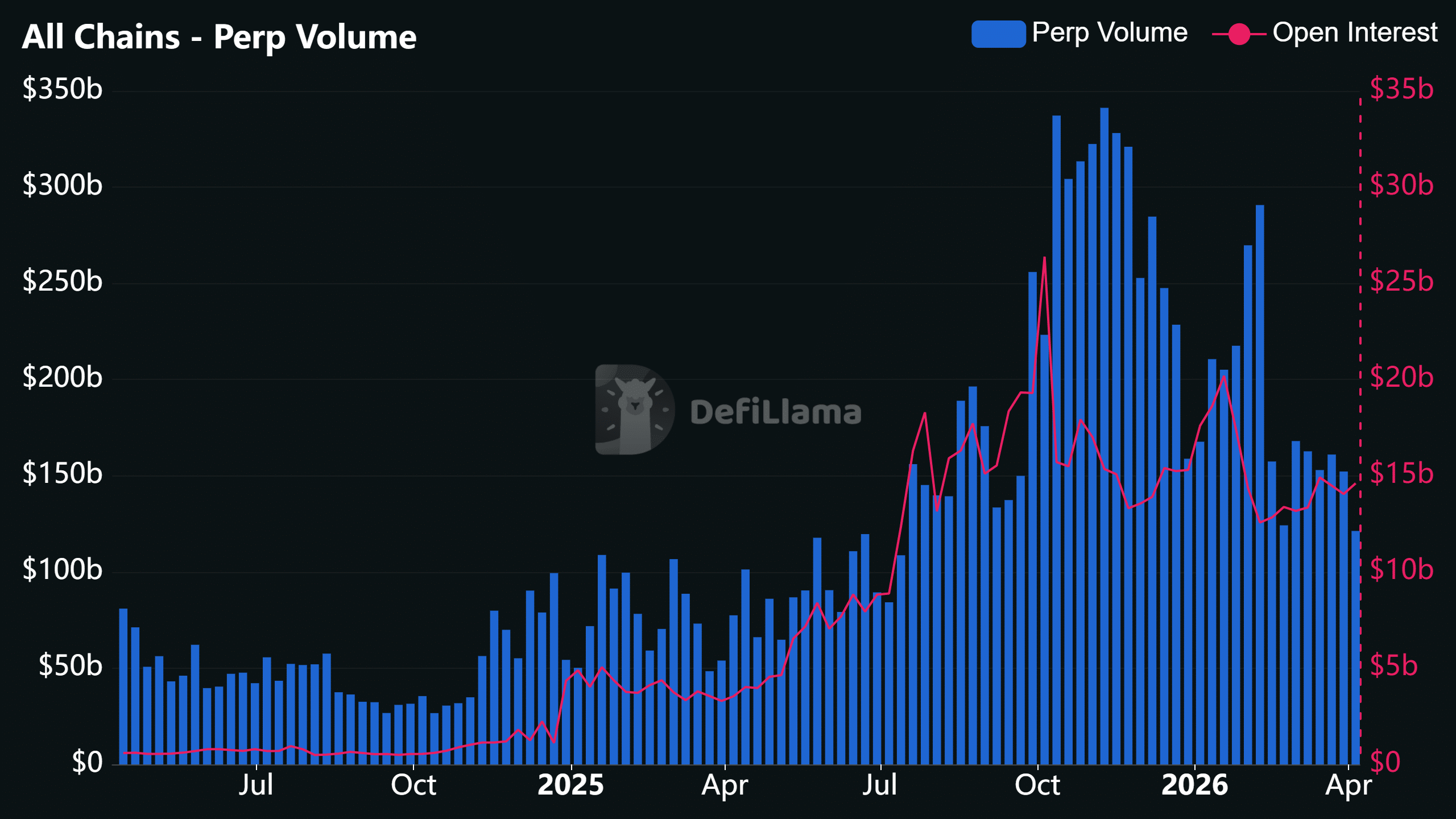
The collaboration comes at a time when the demand for perpetual trading has exploded. At the market peak last October, the overall perp volume reached $350 billion and $25 billion in Open Interest (OI).
Source: DeFiLlama

Despite the broader crypto rout in the past few months, perp volume still hovered around $150 billion.

However, Lighter’s trading activity has declined significantly. Especially after the LIT’s token debut at the end of last December, which ended the farming period. As a result, traders who were hunting for an airdrop migrated elsewhere to search for new opportunities.

Consequently, Lighter’s trading activity fell sharply after December. This decline has extended into Q1 2026, and there hasn’t been any meaningful recovery in Q2 as the broader crypto market remains subdued.

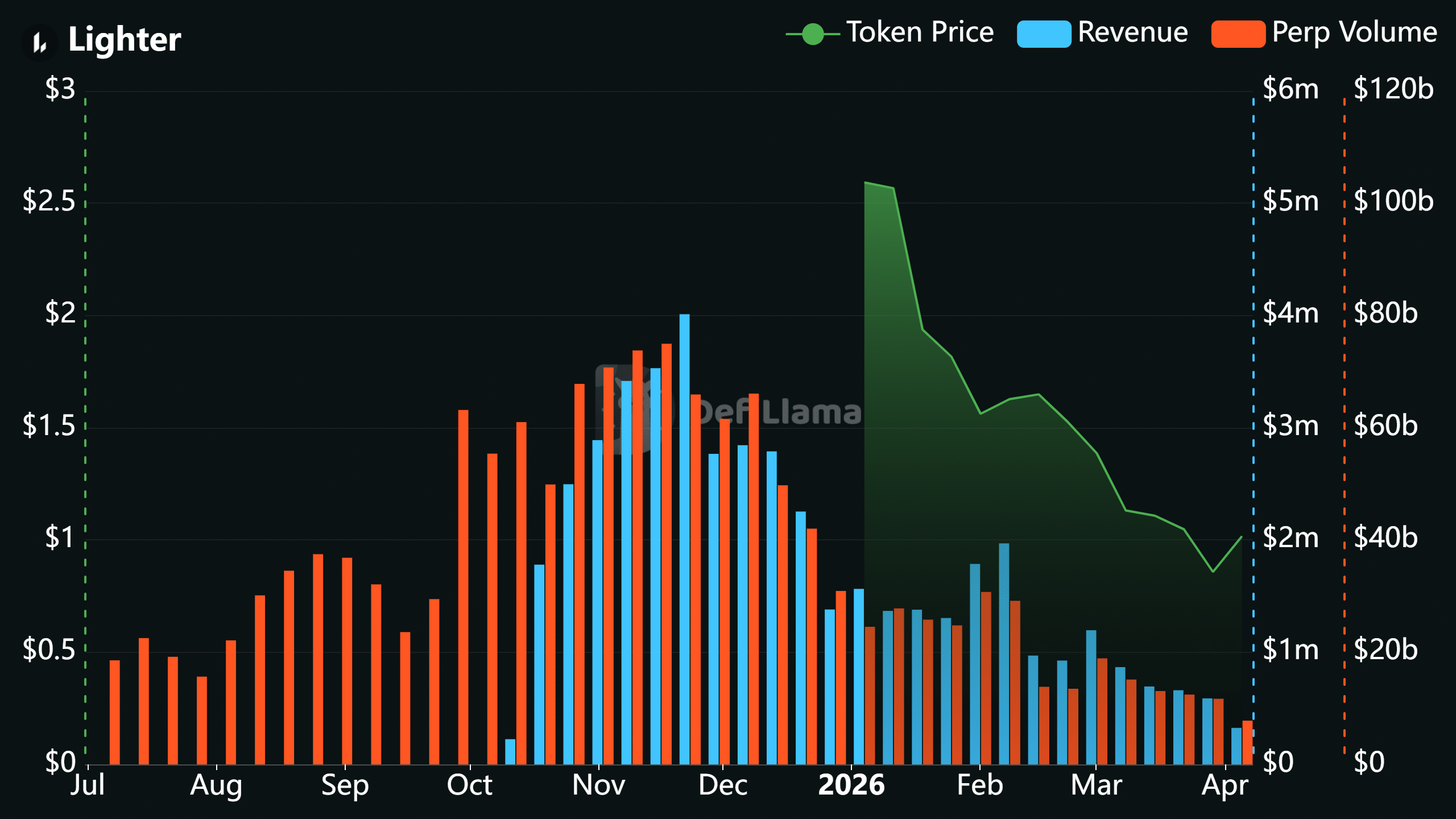
So far, the weekly perps volumes have fallen from a record $75B in November to about $8B in April—an 89% decline in trading activity.
Source: DeFiLlama

The protocol’s revenue also went downwards. It dropped from a weekly average of $4M to $325K, translating to a 91% revenue crash.

It’s worth pointing out that the brief relief in February boosted activity and revenue. Ultimately, this fueled the buyback of LIT, the protocol’s native token.

If Telegram integration improves activity and revenue improve in April, then the recent 30% recovery rally could extend. Otherwise, a rejection at $1 and low activity could drag LIT back to $0.78 or below.
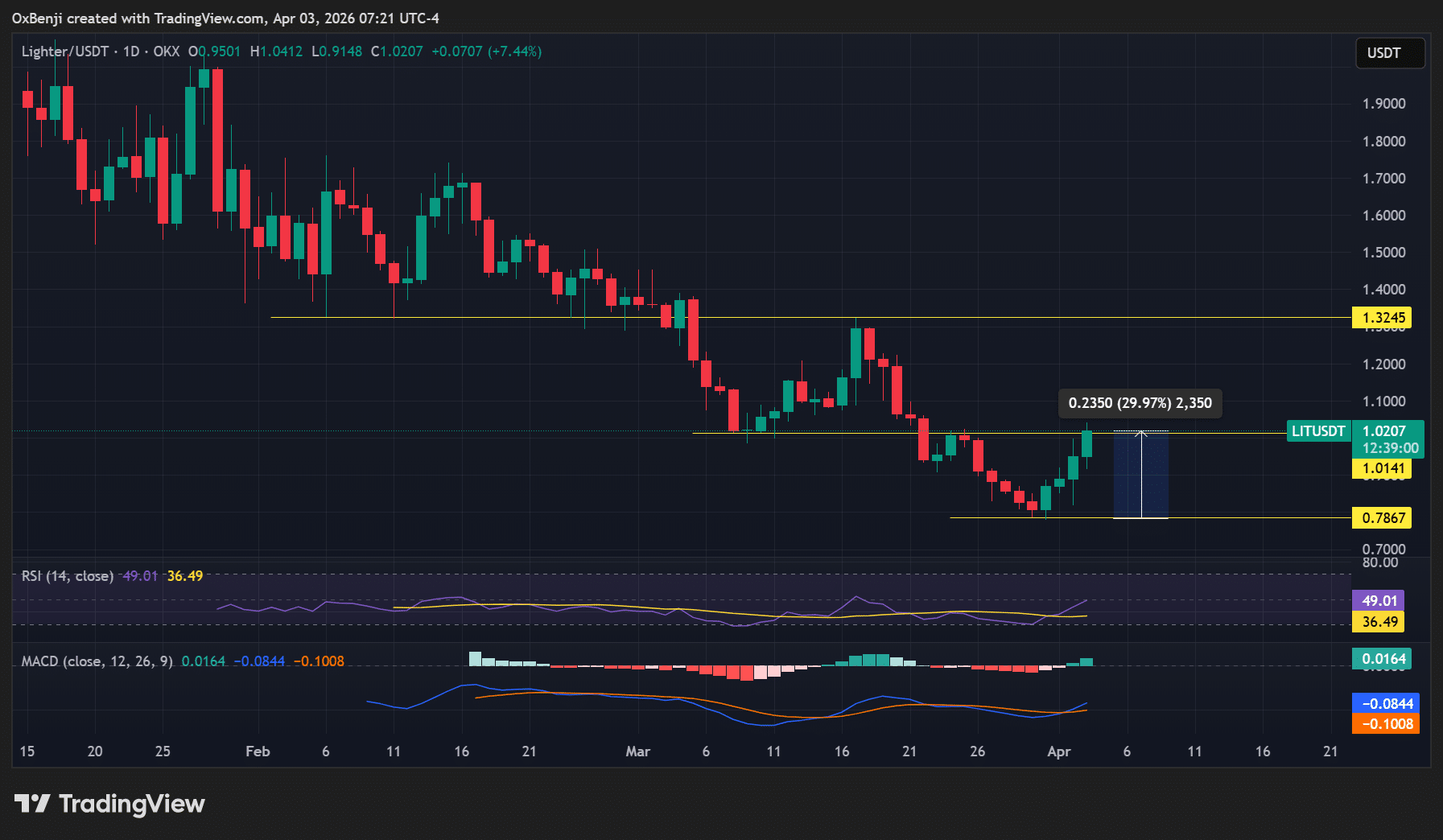
Source: LIT/USDT, TradingView

Final Summary

  • Telegram integration has fueled LIT’s recovery by 30% in early April.
  • Lighter DEX’s revenue crashed 91%, but renewed trading activity from Telegram could help reverse it and boost LIT buyback.


Domande pertinenti

QWhat is the main partnership announced between Telegram and Lighter?

ATelegram has partnered with Lighter, a decentralized exchange (DEX), to power its native leveraged trading feature, allowing users to trade crypto, stocks, metals, and oil with up to 50x leverage.

QHow many active users does Wallet in Telegram have, and why is this significant?

AWallet in Telegram has about 25 million active users, which is significant because their activity in P2P transfers and fiat on-ramps makes Telegram a key crypto trading terminal, potentially boosting Lighter's trading volumes.

QWhat happened to Lighter's trading activity and revenue after its token debut in December?

ALighter's trading activity fell sharply after its LIT token debut in December, with weekly perps volumes declining by 89% from $75B in November to about $8B in April, and revenue crashing by 91% from a weekly average of $4M to $325K.

QHow did the Telegram integration affect LIT's token price in early April?

AThe Telegram integration fueled a 30% recovery rally for LIT's token price in early April.

QWhat is the potential future price movement for LIT depending on the success of the Telegram integration?

AIf the Telegram integration improves trading activity and revenue, the recent 30% recovery rally for LIT could extend. Otherwise, a rejection at $1 and low activity could drag LIT back to $0.78 or below.

Letture associate

L2 'Recalibration': When L1 Becomes Its Own Rollup, What Is Ethereum's Endgame?

The article discusses the evolving relationship between Ethereum's Layer 1 (L1) and Layer 2 (L2) solutions, moving beyond the initial "L2 for scaling" model. As Ethereum L1 itself scales (increasing Gas Limit, statelessness, zkEVM), the unique value proposition of L2s shifts from merely providing cheap execution to offering differentiated features like application-specific optimization, privacy, and flexible governance. The piece explores three key themes: 1. **L2's New Role:** L2s are transitioning from a pure scaling technology to a spectrum of execution environments with varying degrees of security inheritance from Ethereum L1. 2. **Interoperability as State Trust:** Solving L2 fragmentation is less about cross-chain bridges and more about enabling faster, trust-minimized state verification between environments. This involves initiatives like faster L1 finality, intent-based architectures (Open Intents Framework), and native account abstraction. 3. **Blurring Layers:** With the potential integration of zk-proofs into L1 validation (making L1 akin to its own "Rollup") and the concept of "Native Rollups," the rigid boundary between L1 and L2 may fade. The future could be a unified system with multiple execution domains (for DeFi, gaming, privacy, etc.) sharing a common security, settlement, and state framework. In conclusion, Ethereum's goal is not to abandon L2s or re-centralize everything on L1, but to re-integrate the fragmented user experience—liquidity, accounts, applications—while preserving the scaling benefits of a multi-environment ecosystem. The endgame is a cohesive "one chain" feeling for users, powered by diverse but securely interconnected execution layers.

marsbit16 min fa

L2 'Recalibration': When L1 Becomes Its Own Rollup, What Is Ethereum's Endgame?

marsbit16 min fa

The Encryption Bill Clarity's Challenge: A Thorny Path of Bipartisan Compromise in the U.S.

U.S. lawmakers are attempting to advance the Clarity Act, a significant crypto market structure bill, but its path is fraught with partisan hurdles. The process has been rocky since January, when a prior bipartisan deal in the Senate Banking Committee was upended. A key compromise in May on "yield" issues allowed the bill to move forward in committee, but only with the conditional support of two Democratic senators, Angela Alsobrooks and Ruben Gallego. They emphasized that their final vote depends on reaching an agreement on ethics provisions for elected officials. Ultimately, the Senate Agriculture Committee passed its version along party lines without Democratic support. As Republicans push for a full Senate vote in July, the demand for strong ethics language has expanded beyond Democrats. Additional controversies surround provisions related to yields (aligning some Republicans with large banks) and developer protections (opposed by enforcement agencies). Core concerns about illicit finance and consumer protection remain central to the debate. Despite consensus on the need for legislation, achieving the necessary bipartisan compromise is proving difficult. While momentum exists—including recent meetings between senators and White House officials—a reconciled bill text faces skepticism. Senator Gallego has stated that without ethics terms acceptable to Democrats, they will not provide the needed votes. The immediate goals for the crypto community in Congress are unclear: a symbolic Senate vote before the August recess, eventual passage into law by 2026, or forging a final compromise framework. The arduous, vote-by-vote effort to build bipartisan support continues, mirroring the traditional legislative grind the industry must now navigate.

Foresight News1 h fa

The Encryption Bill Clarity's Challenge: A Thorny Path of Bipartisan Compromise in the U.S.

Foresight News1 h fa

Trading

Spot
活动图片