Telegram taps Lighter for 50x perps trading across crypto, stocks, and commodities: Details

ambcryptoPubblicato 2026-04-04Pubblicato ultima volta 2026-04-04

Introduzione

Telegram has integrated Lighter, a decentralized exchange (DEX) specializing in perpetual trading, to power its native leveraged trading feature. Through the Wallet in Telegram, users can now trade cryptocurrencies, stocks, metals, and oil with up to 50x leverage. This integration, Telegram's largest with Lighter to date, could significantly boost trading volumes for the DEX by tapping into Telegram’s vast user base of over 150 million registered and 25 million active wallet users. The partnership arrives as Lighter faces a substantial decline in activity and revenue—weekly trading volumes dropped 89% from its November peak to $8B in April, while revenue fell 91% to $325K weekly. This downturn followed the end of LIT token farming after its December debut. The Telegram deal has already spurred a 30% price recovery for LIT in early April. If the integration drives renewed user activity, it may reverse Lighter’s declining metrics and support further token buybacks; otherwise, LIT could face renewed downward pressure.

Lighter, a DEX focused on perpetual (perps) trading, has been tapped to power Telegram’s native leveraged trading.

In a statement on the 2nd of April, Wallet in Telegram said that users on the privacy-focused messenger can now trade crypto, stocks, metals, and oil with up to 50x leverage.

The wallet has seen strong adoption with over 150 million registered users.

About 25 million of these users are considered active, especially in P2P transfers and fiat on-ramps, making Telegram a key crypto trading terminal. The messenger itself has over 1 billion users.

As such, the integration of Lighter could boost trading volumes on the DEX too. As it stands, this is the primary and largest Lighter integration to date.

For comparison, its rival Hyperliquid runs perps trading for Phantom, Rabby, MetaMask, and others. This fueled Hyperliquid’s initial adoption by sharing fees from trades routed by the apps.

Could Lighter benefit from a similar traction?

Will the deal boost Lighter’s trading activity?

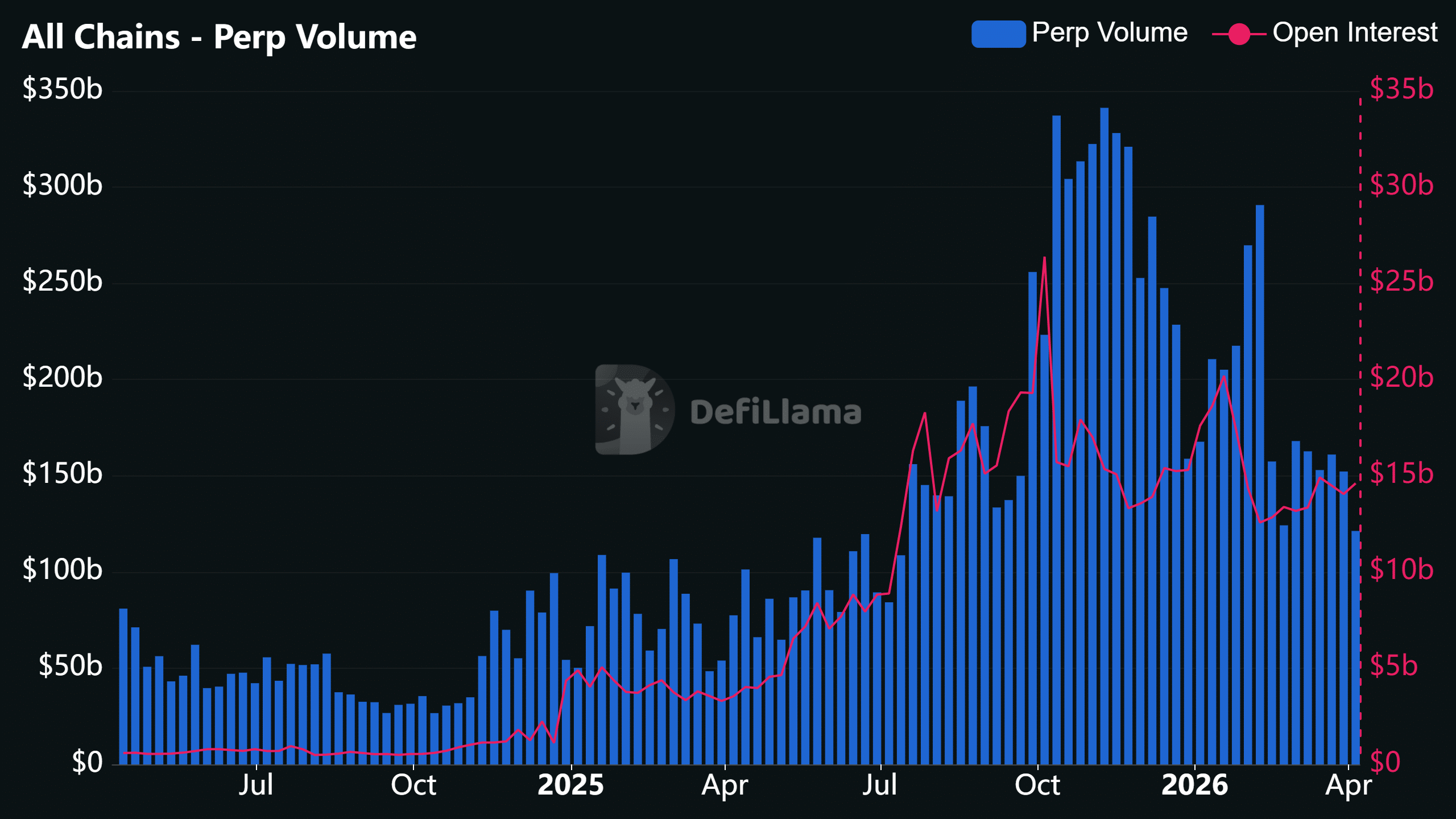
The collaboration comes at a time when the demand for perpetual trading has exploded. At the market peak last October, the overall perp volume reached $350 billion and $25 billion in Open Interest (OI).
Source: DeFiLlama

Despite the broader crypto rout in the past few months, perp volume still hovered around $150 billion.

However, Lighter’s trading activity has declined significantly. Especially after the LIT’s token debut at the end of last December, which ended the farming period. As a result, traders who were hunting for an airdrop migrated elsewhere to search for new opportunities.

Consequently, Lighter’s trading activity fell sharply after December. This decline has extended into Q1 2026, and there hasn’t been any meaningful recovery in Q2 as the broader crypto market remains subdued.

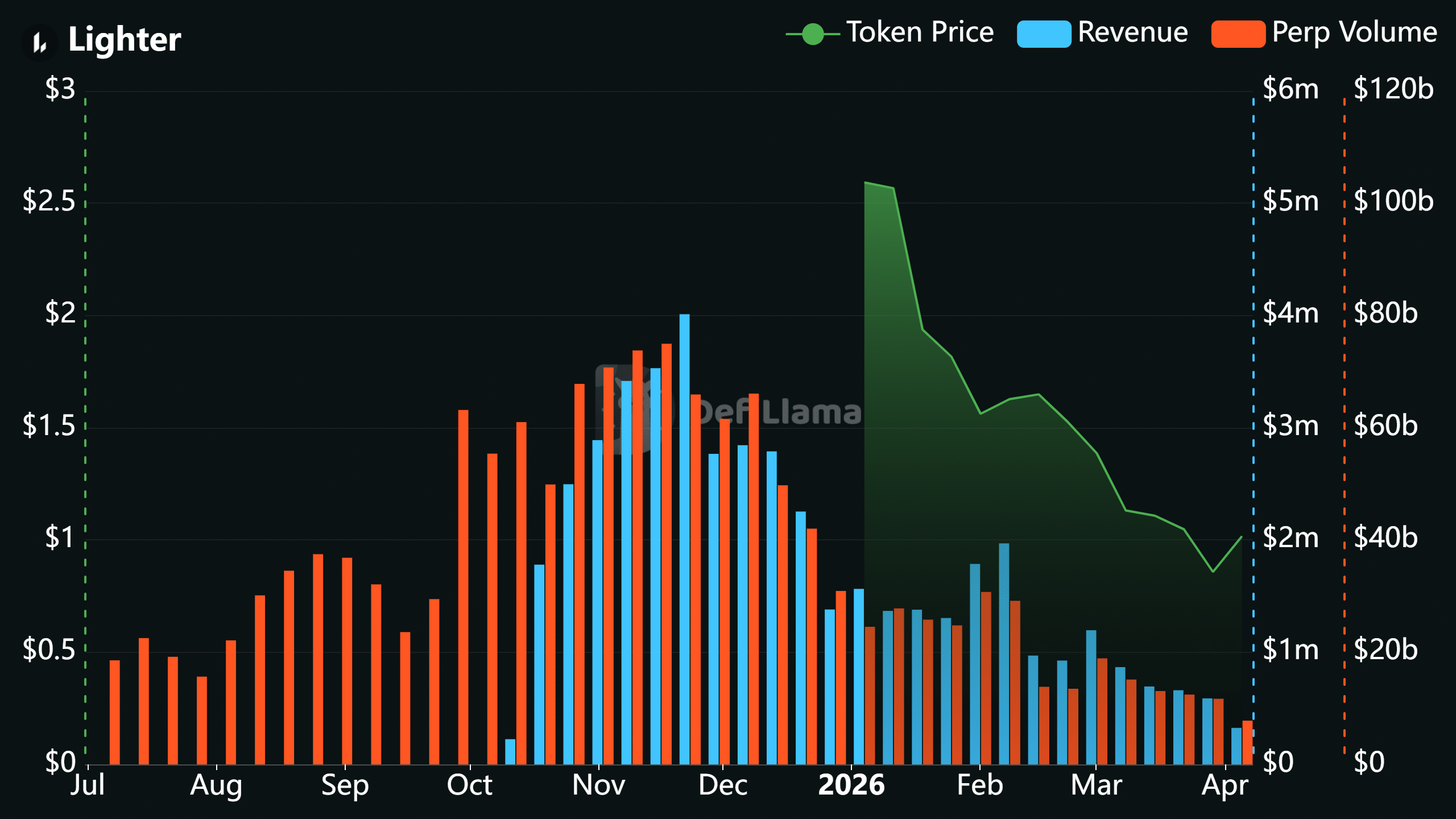
So far, the weekly perps volumes have fallen from a record $75B in November to about $8B in April—an 89% decline in trading activity.
Source: DeFiLlama

The protocol’s revenue also went downwards. It dropped from a weekly average of $4M to $325K, translating to a 91% revenue crash.

It’s worth pointing out that the brief relief in February boosted activity and revenue. Ultimately, this fueled the buyback of LIT, the protocol’s native token.

If Telegram integration improves activity and revenue improve in April, then the recent 30% recovery rally could extend. Otherwise, a rejection at $1 and low activity could drag LIT back to $0.78 or below.
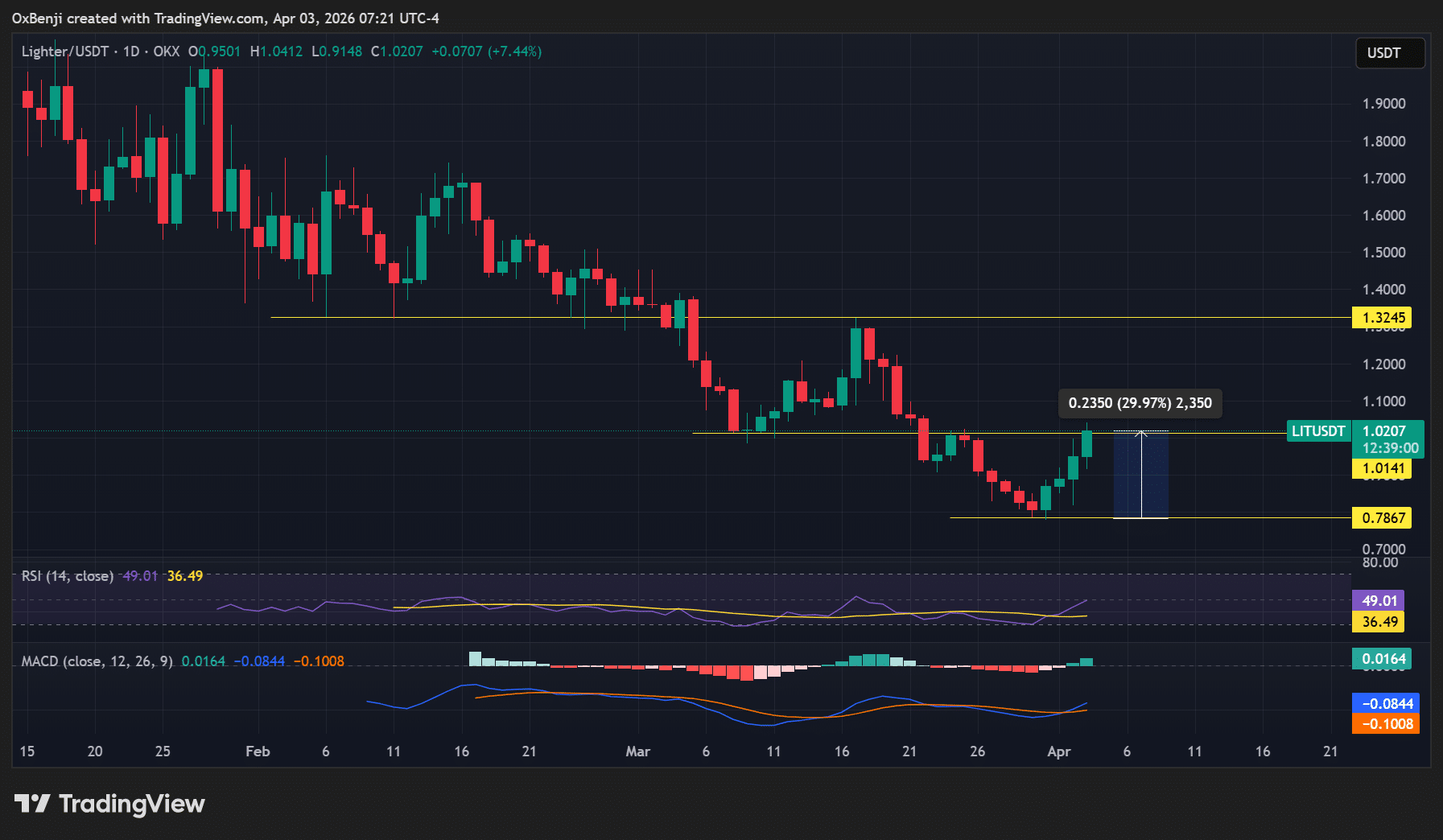
Source: LIT/USDT, TradingView

Final Summary

  • Telegram integration has fueled LIT’s recovery by 30% in early April.
  • Lighter DEX’s revenue crashed 91%, but renewed trading activity from Telegram could help reverse it and boost LIT buyback.

Domande pertinenti

QWhat is the main partnership announced between Telegram and Lighter?

ATelegram has partnered with Lighter, a decentralized exchange (DEX), to power its native leveraged trading feature, allowing users to trade crypto, stocks, metals, and oil with up to 50x leverage.

QHow many active users does Wallet in Telegram have, and why is this significant?

AWallet in Telegram has about 25 million active users, which is significant because their activity in P2P transfers and fiat on-ramps makes Telegram a key crypto trading terminal, potentially boosting Lighter's trading volumes.

QWhat happened to Lighter's trading activity and revenue after its token debut in December?

ALighter's trading activity fell sharply after its LIT token debut in December, with weekly perps volumes declining by 89% from $75B in November to about $8B in April, and revenue crashing by 91% from a weekly average of $4M to $325K.

QHow did the Telegram integration affect LIT's token price in early April?

AThe Telegram integration fueled a 30% recovery rally for LIT's token price in early April.

QWhat is the potential future price movement for LIT depending on the success of the Telegram integration?

AIf the Telegram integration improves trading activity and revenue, the recent 30% recovery rally for LIT could extend. Otherwise, a rejection at $1 and low activity could drag LIT back to $0.78 or below.

Letture associate

Base Claims Its Distribution Advantage Can Outlast Robinhood Chain's Initial Surge

Base, a layer-2 blockchain, argues that its established distribution network will outlast Robinhood Chain's initial popularity surge. While Robinhood Chain quickly attracted 230,000 daily active users and over $9 billion in DEX volume (primarily from meme coins) shortly after launch, its core feature of tokenized stocks saw minimal use. Base acknowledged shortcomings in focusing on social blockchain products and lagging in areas like perpetual contracts, predictions markets, and on-chain tokenized stocks—a move Robinhood got right. In response, Base highlights its nearly three-year head start in building infrastructure. It emphasizes its x402 payment protocol, which has processed 187.8 million agent payments, its $3.9 billion in stablecoin deposits (mostly USDC), and its integration with partners like Visa, Shopify, and JPMorgan for institutional and merchant settlements. Base contends these capabilities for corporate payments and stablecoin liquidity represent a more durable and defensible ecosystem than Robinhood's retail trading metrics. Coinbase plans to launch its own on-chain, share-backed tokenized stocks on Base, which would directly challenge Robinhood's key differentiating feature. Base's strategy bets that its deep-rooted distribution and institutional partnerships will prove harder to overcome than Robinhood's early, meme-driven volume, which may fade after the initial launch hype.

cryptonews.ru4 min fa

Base Claims Its Distribution Advantage Can Outlast Robinhood Chain's Initial Surge

cryptonews.ru4 min fa

The Turning Point of the AI Bull Market: Leverage Blow-ups, Overcapacity in Compute, Why This Macro Analyst is Fully Bearish

AI Bull Market Reaches Inflection Point: Analyst Turns Bearish Due to Leverage, Chinese Competition, and Overcapacity Fidenza Macro analyst Geo Chen explains his decision to sell all AI semiconductor and infrastructure holdings in June, offering a comprehensive bearish thesis. He argues the AI-driven bull market has peaked, citing several key factors. First, unsustainable buying pressure: a massive influx of "low-quality" capital from Korean retail investors using highly leveraged ETFs on stocks like SK Hynix created a parabolic, fragile rally. Recent liquidations have wiped out billions and impacted over a million accounts, removing a key market driver. Second, a competitive threat: the rapid rise of powerful, cost-effective open-source AI models from China, such as MoonShot AI's Kimi K3 and Alibaba's Qwen 3.8, is commoditizing intelligence. This undermines the pricing power and high-valuation financing prospects of closed-source leaders like OpenAI and Anthropic, potentially creating a "single point of failure" for the ecosystem. Third, an impending capacity glut: while AI compute and components are currently in shortage, Chen warns this is typical of a cycle top. Massive, committed capex from cloud providers will likely lead to a supply overhang within 1-2 years. Data shows token spending has already peaked and declined since June, while bond spreads for data center companies are widening, signaling rising credit risk. Chen also highlights broader macro headwinds: the protracted Iran conflict acts as a persistent stagflationary force, and the Federal Reserve under Chair Kevin Warsh is losing credibility in its inflation fight. Long-term Treasury yields breaking above 5.2% present a new challenge for equities. In summary, Chen believes the convergence of speculative excesses, competitive disruption, looming overcapacity, and adverse macroeconomic conditions marks a significant turning point for the AI investment theme.

marsbit20 min fa

The Turning Point of the AI Bull Market: Leverage Blow-ups, Overcapacity in Compute, Why This Macro Analyst is Fully Bearish

marsbit20 min fa

Trading

Spot
活动图片