Telegram Financial Report Revealed: Main Revenue Actually Comes from Selling Coins!

marsbitPubblicato 2026-01-07Pubblicato ultima volta 2026-01-07

Introduzione

Telegram's unaudited financial report for the first half of 2025 reveals a 65% year-on-year revenue increase to $870 million, up from $525 million in the same period of 2024. However, the company reported a net loss of over $220 million, compared to a net profit of $334 million a year earlier. This loss is attributed to a significant decline in the value of its Toncoin (TON) holdings, leading to asset write-downs. Despite its growth in users—now exceeding 900 million monthly active users—Telegram's financial performance is heavily tied to TON. Approximately one-third of its revenue, around $300 million, comes from TON-related exclusive agreements, including wallet integration and payment services. Moreover, Telegram has sold over $450 million worth of TON in 2025 alone, accounting for about 10% of TON's market capitalization, making cryptocurrency sales a major revenue stream. Telegram's planned IPO has been delayed due to ongoing legal investigations involving its founder, Pavel Durov, in France. The company secured $1.7 billion in convertible bonds from institutions like BlackRock and Mubadala in May 2025. Originally launched in 2017, TON faced regulatory challenges from the SEC but was revived as a community-led blockchain. Despite initial growth, TON's ecosystem has struggled recently, with many projects declining significantly in value.

Author: C Labs Crypto Watch

According to unaudited financial reports disclosed by the Financial Times, Telegram, known as the "dark version of WeChat," achieved revenue of $870 million in the first half of 2025, a 65% year-over-year increase, showing a significant leap compared to $525 million in the same period of 2024.

From a "revenue growth" perspective, this is a quite impressive growth curve.

However, the problem lies in the profit side. Telegram recorded a net loss of over $220 million in the first half of 2025, compared to a net profit of $334 million in the same period last year.
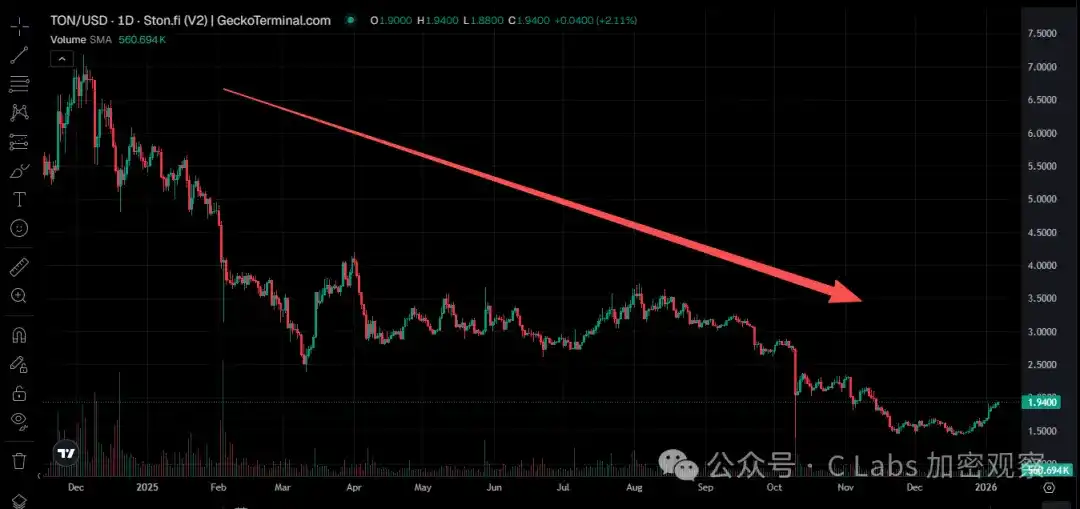
The loss did not stem from a collapse in the main business but was due to a significant decline in the value of Toncoin (TON) held by the company in 2025, leading to a write-down of related assets.

PART 01: Telegram's Development History

Telegram was founded in 2013 and is one of the world's most important instant messaging platforms.

As of 2025, Telegram's monthly active users have exceeded 900 million, covering Europe, the Middle East, South America, and emerging markets, making it one of the fastest-growing social applications globally.
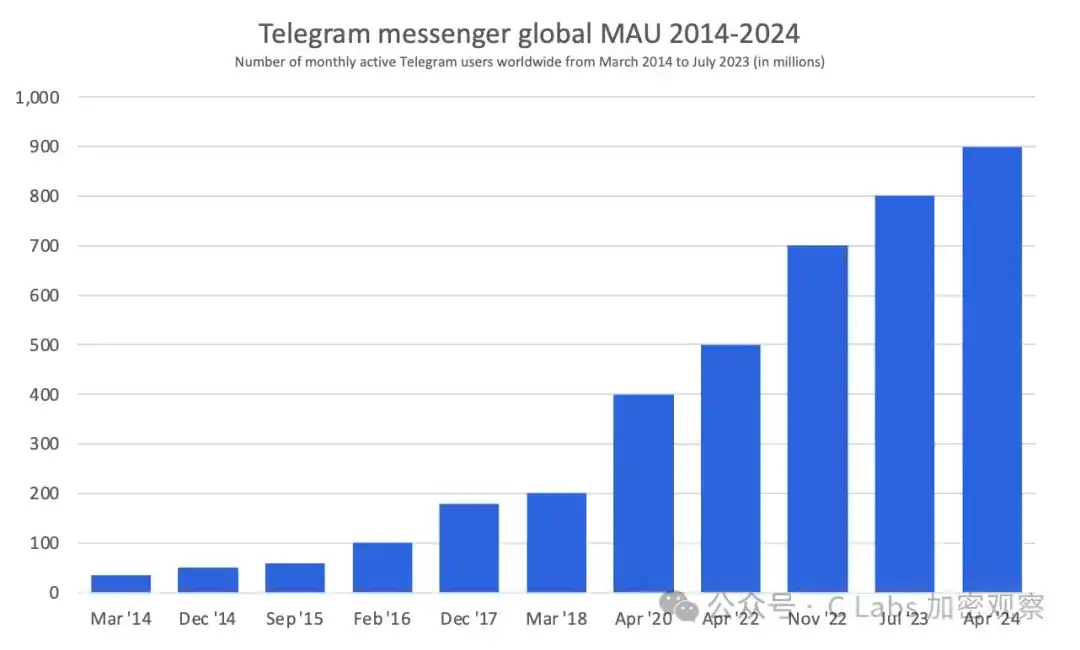
For crypto users, Telegram has become the de facto "public discussion layer" of the crypto industry: a large number of exchange announcements, project governance, airdrop information, OTC trading, and on-chain communities use Telegram as their core platform.

This gives it the dual attributes of a social platform and financial information infrastructure.

PART 02: IPO Plans Shelved

Although Telegram announced preparations for an IPO, the practical obstacle is that its founder, Pavel Durov, is still under investigation in France (Breaking! TG Founder Arrested, TON Price Plummets).

Telegram has clearly stated that it will not proceed with the listing until related compliance issues are clearer.

Fortunately, Telegram is not short of capital support. In May 2025, the company completed a $1.7 billion convertible bond financing, backed by top institutions including BlackRock and Mubadala.

PART 03: Telegram's Relationship with TON

The relationship between Telegram and TON is also complex.

In 2017, Telegram launched the blockchain project TON (Telegram Open Network), aiming to embed a payment system into the messaging app, and raised approximately $1.7 billion in 2018. However, in 2019, it was forced to halt the project after the SEC deemed it an unregistered securities offering. Telegram settled with regulators and exited the project in 2020.

Subsequently, TON was reborn as a community public chain, and Telegram re-engaged with it in a "non-official but deeply integrated" manner, which saw significant growth in 2024.
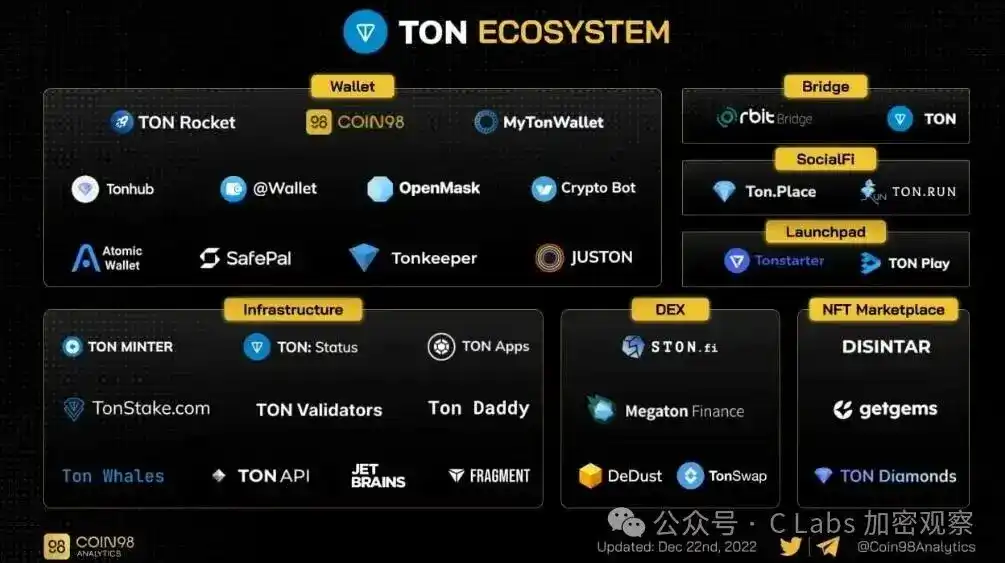
Unfortunately, in 2024, after founder Durov was arrested, the rapid progress came to an abrupt halt (TON Chain Crashed? No New Blocks for a Long Time).

Most of the once-popular TON ecosystem projects have now faded, with token prices generally down over 70%:
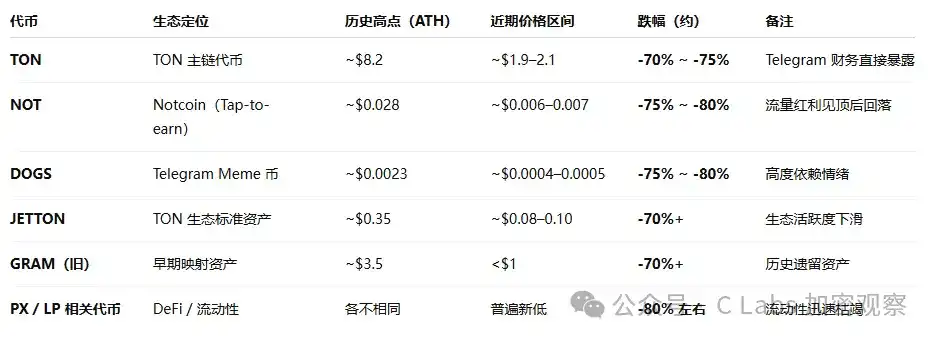
However, according to the latest financial report, the relationship between Telegram and TON has already gone beyond "official support for a public chain."

Significant Proportion of TON-Related Revenue

The financials show that about one-third of Telegram's revenue (approximately $300 million) comes from exclusive agreements related to TON, including wallet integration, payment functions, and ecosystem collaboration.

At the same time, Telegram is also one of the most significant sources of TON circulation, having sold over $450 million worth of TON since 2025, accounting for about 10% of TON's current market value.

This means that selling coins is Telegram's main business, and simultaneously, Telegram is the biggest whale dumping TON!

Domande pertinenti

QWhat was Telegram's revenue in the first half of 2025 and what was the year-over-year growth rate?

ATelegram's revenue in the first half of 2025 was $870 million, representing a 65% year-over-year growth compared to the same period in 2024.

QWhy did Telegram report a net loss in the first half of 2025 despite significant revenue growth?

ATelegram reported a net loss of over $220 million in the first half of 2025 due to a significant decline in the value of the Toncoin (TON) it held, which led to an accounting write-down of these assets.

QWhat is the relationship between Telegram and the TON blockchain project?

ATelegram initially launched the TON blockchain project in 2017 but was forced to abandon it in 2020 after a settlement with the SEC. The project was later revived by the community, and Telegram has since re-engaged with it in a 'non-official but deeply integrated' manner, with TON-related services now contributing significantly to its revenue.

QHow much of Telegram's revenue came from TON-related exclusive agreements in the first half of 2025?

AApproximately one-third of Telegram's revenue, about $300 million, came from TON-related exclusive agreements in the first half of 2025.

QWhat major financing did Telegram secure in May 2025 and which institutions were involved?

AIn May 2025, Telegram completed a $1.7 billion convertible bond financing round with backing from top-tier institutions including BlackRock and Mubadala.

Letture associate

Understanding Hash in One Article: The "Browser Miner" on Ethereum

Hash is an Ethereum-based ERC-20 token described as a "browser-minable post-quantum token." Its key features include enabling browser-based GPU mining without specialized hardware, a fixed supply cap of 21 million tokens, immutable and permissionless smart contracts with no team allocation or pre-mining, and an emphasis on post-quantum security using Keccak256 hashing. The mining mechanism is a simplified on-chain proof-of-work where miners solve unique challenges tied to their wallet address. Key design elements prevent answer theft, with epochs resetting every 100 blocks (~20 minutes) and a per-block minting limit. Emission follows a Bitcoin-like halving schedule every 100,000 mints, starting at 100 tokens per mint. Projections suggest all tokens could be mined within approximately 294 days if a target rate of one mint per minute is sustained. Hash emphasizes "post-quantum" security by leveraging hash-based primitives like Keccak256, which are considered more resistant to quantum attacks compared to elliptic-curve cryptography. While not a fully post-quantum asset, it aligns with Ethereum's broader post-quantum research narrative. The project completed its Genesis sale at $0.03 and began trading on Uniswap, with its price reaching around $0.19. The initial circulating supply is small, with 5% sold in Genesis and 5% allocated to liquidity. The majority (47.6% of total supply) is allocated to early-stage mining, leading to a front-loaded emission schedule. This structure, combined with low initial liquidity, makes Hash a high-volatility, high-risk project dependent on sustained miner participation and market demand to absorb new supply.

marsbit13 min fa

Understanding Hash in One Article: The "Browser Miner" on Ethereum

marsbit13 min fa

OpenAI's Largest Internal Wealth Creation: 600 People Cash Out a Total of $6.6 Billion, 75 Take Home the Maximum $30 Million Each

A Wall Street Journal report reveals OpenAI's unprecedented pre-IPO wealth creation. In a single employee stock sale last October, over 600 current and former employees sold shares, collectively cashing out approximately $6.6 billion. Due to high investor demand, the company tripled the individual sale cap to $30 million, with about 75 employees selling the maximum amount. This event represents the largest such transaction in tech industry history for a private company. OpenAI's valuation was $500 billion for this tender offer. Employees with over two years of tenure were eligible, allowing many post-ChatGPT hires their first liquidity event. The company's stock has reportedly grown over 100-fold in seven years. Following a restructuring, employees collectively hold about 26% of OpenAI. The scale of executive wealth is also staggering. In court testimony related to Elon Musk's lawsuit, President and co-founder Greg Brockman confirmed his OpenAI stake is worth around $30 billion. Analysis indicates about 165 current and former employees hold a combined ~$164.9 billion in equity, averaging nearly $1 billion per person in paper wealth. OpenAI's per-employee stock-based compensation is estimated to be 34 times the average of major tech firms before their IPOs. OpenAI continues its rapid ascent, closing a $122 billion funding round at an $852 billion valuation in March. With monthly revenue hitting $2 billion, over 900 million weekly ChatGPT users, and plans for a potential trillion-dollar IPO in late 2026, this wealth-creation engine shows no signs of stopping.

链捕手36 min fa

OpenAI's Largest Internal Wealth Creation: 600 People Cash Out a Total of $6.6 Billion, 75 Take Home the Maximum $30 Million Each

链捕手36 min fa

Trading

Spot
Futures
活动图片