‘Technologically impossible’: Could Kentucky bill threaten crypto self-custody?

ambcryptoPubblicato 2026-03-20Pubblicato ultima volta 2026-03-20

Introduzione

Kentucky's proposed HB 380 amendment aims to regulate cryptocurrency kiosks but includes a controversial provision requiring hardware wallet providers to reset users' seed phrases upon request. The Bitcoin Policy Institute warns this measure would effectively outlaw self-custody, calling it "technologically impossible" and a violation of Bitcoin’s core security principles. They argue it would push users toward centralized custodians, increasing vulnerability to hacks. The amendment, added last minute, has drawn criticism for potentially infringing on residents' rights to secure their digital assets. Meanwhile, only seven U.S. states have established strategic Bitcoin reserves, with the federal government holding the largest share globally.

Kentucky is under scrutiny ahead of its planned passage of a key crypto legislation that would ban self-custody wallets.

According to the Bitcoin Policy Institute, a research and advocacy group, Kentucky’s HB 380 amendment would harm residents. The firm noted,

BPI has just learned of an amendment buried in Kentucky HB 380 that would require hardware wallet providers to reset users’ seed phrases on request. This would effectively outlaw self-custody in Kentucky.
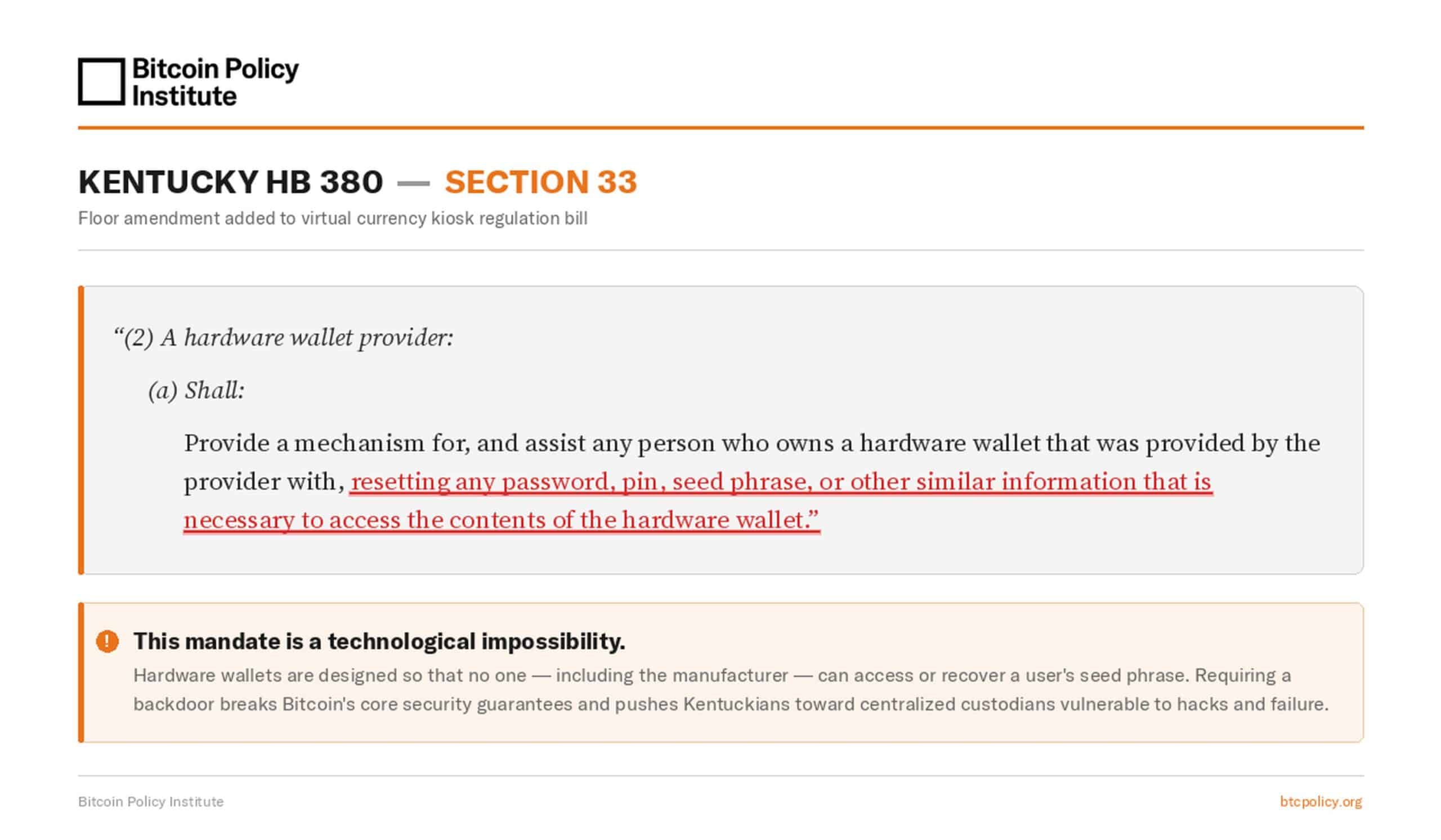
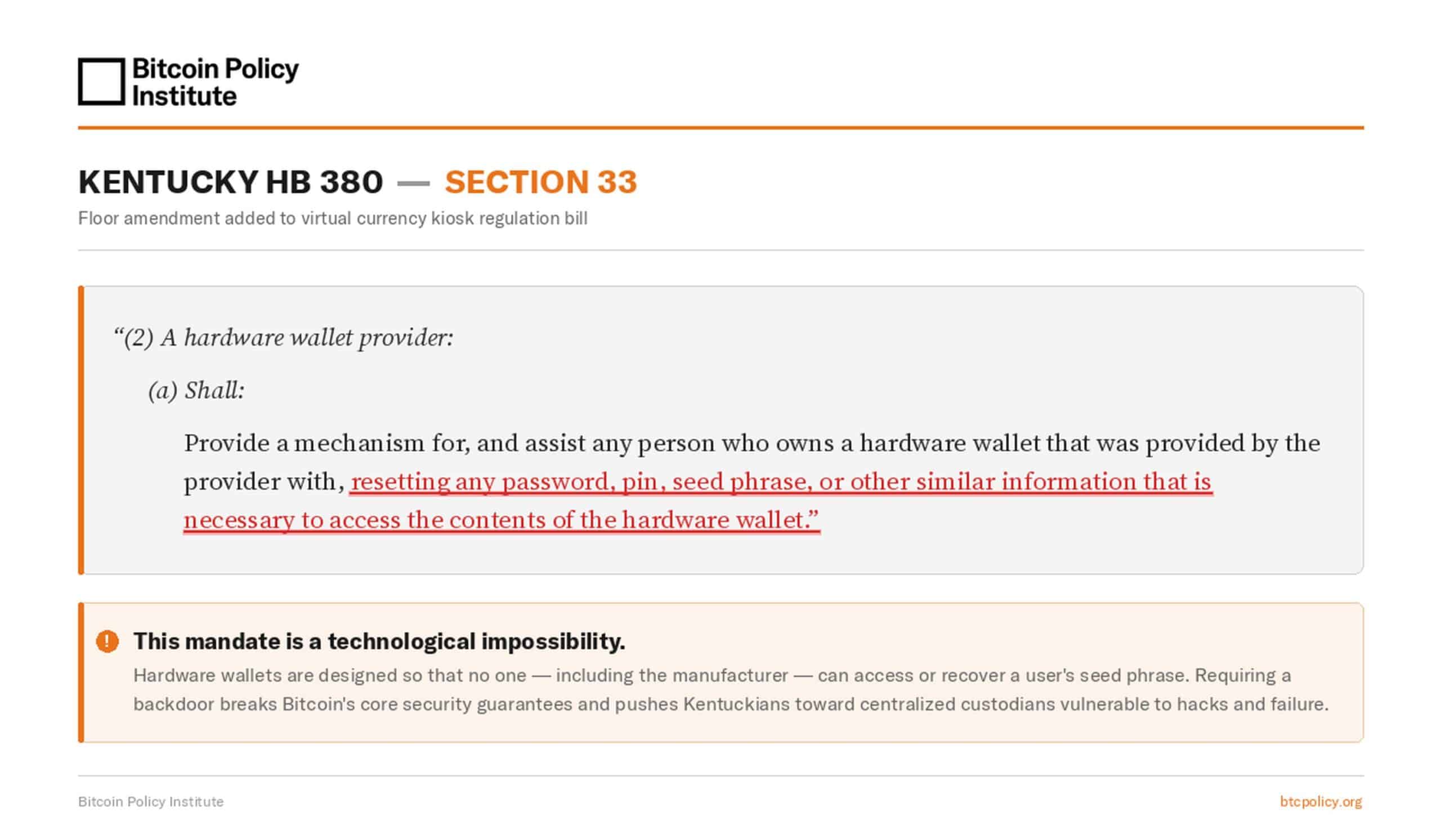
Source: BPI

Kentucky crypto plans

The HB 380 is an amendment to the 77-page virtual currency kiosk legislation, part of a broader effort to regulate crypto ATMs, especially those that facilitate BTC transfers.

It was a last-minute amendment added in January. It requires hardware providers to be able to reset and recover users’ hardware wallet passwords and seed phrases, something BPI called ‘technologically impossible.’

The mandate is technologically impossible for non-custodial wallets. Requiring a backdoor for seed phrase recovery breaks Bitcoin’s fundamental security guarantees and pushes users toward centralized custodians that are vulnerable to hacks and failures.

The advocacy group wrote to the Kentucky Senate, informing it of the harmful nature of the amendment’s language. It added that the legislators should “protect Kentucky constituents’ right to secure their property.”

However, one analyst noted that ‘commercial hardware wallets’ are vulnerable to government overreach because their parent firms are legal entities operating in different jurisdictions.

Race for strategic Bitcoin reserve

Last year, at the state level, the race for the strategic Bitcoin reserve (SBR) became hot. But, as of 2026, only a handful of states in the U.S. have managed to codify the plans into law. Currently, only seven states have approved an SBR, including Arizona, Texas, and New Mexico.

At the federal level, however, there’s been little commitment or update on whether the U.S. SBR will be established. Even so, the U.S. now holds 328,272 BTC, about 1.5% of the total supply.

This was nearly half of the total 650,296 BTC held by governments, making the U.S. the top holder, followed by China at 190,000 BTC and the UK at 61,245 BTC.


Final Summary

  • The Bitcoin Policy Institute pressed the Kentucky Senate to reconsider its recent amendment on crypto ATM rules to safeguard self-custody.
  • There are about 7 U.S. states with approved strategic BTC reserve frameworks.

Domande pertinenti

QWhat is the main concern raised by the Bitcoin Policy Institute regarding Kentucky's HB 380 amendment?

AThe Bitcoin Policy Institute is concerned that the amendment would require hardware wallet providers to reset users' seed phrases on request, which they call 'technologically impossible' and argue it would effectively outlaw self-custody in Kentucky.

QWhy does the Bitcoin Policy Institute claim the mandate in HB 380 is 'technologically impossible'?

AThey state it is technologically impossible for non-custodial wallets because requiring a backdoor for seed phrase recovery breaks Bitcoin's fundamental security guarantees.

QWhat is the primary purpose of the broader HB 380 legislation that this amendment is a part of?

AHB 380 is an amendment to virtual currency kiosk legislation, which is part of a broader effort to regulate crypto ATMs, especially those that facilitate BTC transfers.

QHow many U.S. states have approved a strategic Bitcoin reserve (SBR) framework as of 2026, according to the article?

AAs of 2026, seven U.S. states have approved a strategic Bitcoin reserve framework.

QWhich country is the largest government holder of Bitcoin, and how much does it hold?

AThe United States is the largest government holder of Bitcoin, with 328,272 BTC, which is about 1.5% of the total supply.

Letture associate

Yao Shunyu's 88 Days

Yao Shunyu, a 27-year-old AI expert with a background from Princeton and OpenAI, joined Tencent in September 2025. Within 88 days, he led a major overhaul of Tencent’s AI strategy and organization, resulting in the release of Hunyuan Hy3 preview—a MoE model with 295B total parameters and 21B active parameters, supporting up to 256K context length. The launch came after Tencent leadership, including CEO Ma Huateng and President Martin Lau, openly criticized Hunyuan's earlier underperformance—citing slow development, over-reliance on superficial benchmark optimization, and poor generalization in real-world applications. Internal adoption was low, with key business units like WeChat and gaming seeking external AI solutions. Yao reshaped Tencent’s AI approach by integrating previously siloed teams, dissolving the ten-year-old Tencent AI Lab, and establishing new units focused on AI infrastructure and data. Hy3 preview was developed using co-design principles, closely aligned with product teams to ensure practical usability from the start. It has already been integrated into core products like Yuanbao, QQ, and enterprise tools. The release signals a shift from chasing rankings to building usable, scalable AI grounded in Tencent’s ecosystem. While external partnerships (like with DeepSeek and OpenClaw) helped retain users temporarily, the focus is now on making Hunyuan a reliable internal foundation. The real test lies in sustaining this new organizational momentum amid fierce competition from Alibaba, DeepSeek, and others.

marsbit52 min fa

Yao Shunyu's 88 Days

marsbit52 min fa

Trading

Spot
Futures
活动图片





