TechFlow Intelligence Bureau: Spot Gold Falls Below $4,400, Cryptocurrency Market Plunges Across the Board

marsbitPubblicato 2026-05-28Pubblicato ultima volta 2026-05-28

Introduzione

The market experienced volatility with spot gold dropping below $4400/oz, while the crypto market saw broad declines. In AI developments, VLLM and other mainstream LLM tools were found to have critical vulnerabilities, risking millions of AI agents. Gemini Omni Flash faced criticism for excessive content filtering, while Ali's Qwen3.6-35B showed significant coding improvement with higher-bit quantization. Nvidia introduced LocateAnything, a visual language model with faster object localization. In crypto, a Google employee was charged for insider trading using search data on Polymarket, where suspicious accounts with near-perfect win rates were also discovered. A Trump-linked crypto company neared bankruptcy after losing $1.5B. Hardware and chip stocks, particularly Korean AI memory makers, drove market gains. Meta's stock rose on news of paid subscriptions for Facebook and Instagram, while Micron delivered massive returns for some investors. Broader trends included DuckDuckGo's traffic surging as users reacted against Google's push for AI search, and Microsoft data suggesting AI tools can be more expensive than human labor. The day's theme highlighted the redefinition of insider information boundaries in the age of AI data advantages and a growing scrutiny of AI's real-world costs and user acceptance.

A senior Hacker News user and co-founder of Django wrote an article arguing that the two companies have finally found PMF, with the post receiving 875 upvotes and over a thousand comments. The core viewpoint is that Claude and ChatGPT have evolved from "expensive toys" into developers' daily tools, with subscription retention rates and enterprise adoption data supporting this judgment.

Heated discussion: The community is fiercely debating whether this is real PMF or an illusion propped up by money-burning subsidies, with some questioning whether AI programming assistants are lowering code quality.

Simon Willison | HN Discussion

Mainstream LLM Tools Like VLLM Exposed to Severe Vulnerabilities, Millions of AI Agents at Risk

Critical vulnerabilities in open-source frameworks could allow attackers to hijack AI agents and MCP servers, affecting widely used tools like VLLM and several MCP implementations. Ars Technica reports that the vulnerabilities have existed for months, and some projects remain unpatched.

Ars Technica | r/LocalLLaMA

Gemini Omni Flash Accused of Exceeding Chinese Models in Censorship Level

Reddit user testing found Google's multimodal video model exhibits "unprecedented" levels of censorship, frequently refusing to generate even routine scenes, making it more conservative than domestic Chinese models like Minimax and Zhipu AI.

Heated discussion: Developers complain "Google has killed innovation with censorship," some suggest directly using open-source alternatives.

Reddit Video | r/singularity

Qwen3.6-35B's Programming Capability Soars with Quantization Upgrade from Q4 to Q6

Developer tests show that Tongyi Qianwen 3.6's performance on code agent tasks significantly improves, with error rates notably dropping, after upgrading quantization from 4-bit to 6-bit. Discussion sparks debate on whether "spending 2GB more VRAM for quality" is worth it.

r/LocalLLaMA

Crypto / Web3

Google Employee Sued for Polymarket Insider Trading, Made Millions Using Search Data

The U.S. Department of Justice charges a Google employee with using internal search trend data to place bets on specific keyword popularity on Polymarket, earning over $1 million. The case sparks discussion on whether prediction markets constitute a national security risk, with Congress considering legislation to ban such platforms.

> Spicy Comment: A search engine employee playing prediction markets is like a casino dealer joining the game—not explicitly forbidden by the rules, but you still go to jail if you win.

CNBC | ABC News

Bubblemaps Discovers Anomalous Polymarket Accounts: 98% Win Rate Across 80 Bets

Nicolas Vaiman, head of blockchain analysis team Bubblemaps, discloses several linked accounts achieved a "statistically impossible" 98% win rate on Polymarket. The investigation points to possible manipulation or information advantage, with Coindesk reporting such cases are driving tighter regulation.

Coindesk | r/CryptoCurrency

Trump-Linked Crypto Company Nears Bankruptcy After Burning Through $1.5 Billion

A crypto company associated with Donald Trump faces bankruptcy liquidation after losing $1.5 billion in a failed token project. The report does not disclose the specific project name, but the community speculates it's related to previously high-profile NFT or DeFi initiatives.

Disruption Banking | r/CryptoCurrency

Chips / Hardware

South Korea's KOSPI Index Soars 100% by 2026, AI Chip Stocks Lead Biggest Gains in Decades

AI memory chip makers like SK Hynix drive a record rebound in the South Korean stock market, with KOSPI becoming one of the world's best-performing major markets this year. Analysis suggests the explosion in HBM (High Bandwidth Memory) demand is the core driver.

BlockNow | r/artificial

Nvidia Releases LocateAnything: Visual Localization 10x Faster Than Qwen3-VL

Nvidia Research introduces a new vision-language localization model, achieving high-quality object localization through parallel box decoding technology, with inference speed significantly leading existing open-source solutions. The paper is public, code will be open-sourced soon.

Nvidia Research | r/LocalLLaMA

Tech Companies

Alibaba's Tongyi Qianwen 3.7 Ranks Second Globally in Programming Ability, Hotly Discussed by Millions on Zhihu

A global authoritative programming leaderboard shows Alibaba's Qwen 3.7 programming capability ranks second, just behind a leading model. A Zhihu question garnered over 1.2 million views, with discussions focusing on "whether domestic models have truly caught up to GPT-4" and the impact of open-source strategies.

> Spicy Comment: Alibaba's move is like announcing college entrance exam results—"My son is second in the world!" shouted louder than the first place.

Zhihu

DuckDuckGo Traffic Surges 28% Within a Week of Google Aggressively Pushing AI Search

PC Gamer reports that within a week of Google publicly claiming "users love the AI mode," traffic to the non-AI-focused DuckDuckGo surged nearly 28%. Data suggests some users' aversion to forced AI search results is translating into migration behavior.

PC Gamer | r/technology

Microsoft Data Shows: Using AI is More Expensive Than Hiring People

Yahoo Finance cites internal Microsoft data stating that the actual cost of AI tools (including infrastructure, subscriptions, training) exceeds the equivalent labor cost in most scenarios. The report does not provide specific figures but notes "efficiency gains" do not necessarily equal "cost reductions."

Yahoo Finance | r/technology

U.S. Stocks

Meta Launches Paid Subscriptions for Facebook and Instagram, Stock Price Jumps

Meta announces premium subscription services offering ad-free experiences and exclusive features. Forbes reports the stock price rose accordingly, but analysts question user willingness to pay—it's hard to transition free, habitual social networks to a subscription model.

Forbes Australia | r/wallstreetbets

Micron Becomes AI Memory Play, Some Holders See 1058% Return in One Year

An r/wallstreetbets user shares a $160,000 position in Micron held from $110, achieving over 10x annual return. The community discusses who the "next Micron" will be—which chip peripheral area (storage, packaging, cooling) is still undervalued.

Heated discussion: Someone reflects, "Back then everyone said memory was a sunset industry."

r/wallstreetbets Image | r/stocks Discussion

Finance / Macro

Spot Gold Dives Below $4,400 per Ounce

On May 28th, gold plummeted below $4,400 intraday, with a Zhihu question receiving over 1.07 million views. Analysis attributes the drop to hawkish Fed signals and a temporary easing of Middle East tensions leading to a withdrawal of safe-haven funds, with silver also falling nearly 3% to $72.40.

Zhihu

U.S. Attack on Iran Pushes Oil Prices Higher, Brent Crude Rises to $97

After U.S. forces shot down four Iranian drones and conducted an airstrike on a Bandar Abbas control center on Wednesday, Brent crude futures rose $3.01 to $97.30 per barrel in a single day. Iran stated the U.S. attack caused no casualties, but tensions in the Strait of Hormuz have intensified.

BBC | Barron's | NYT

New Products / Trends

YouTube to Automatically Label AI-Generated Videos

YouTube announces an AI content auto-labeling system to help viewers identify synthetic videos. The Hacker News post garnered nearly 900 upvotes and 550+ comments, with the main controversy being "who defines AI-generated"—does using AI for editing count? Using it for background music?

YouTube Blog | HN Discussion

Today's Underlying Theme

The boundaries of insider information are being redefined. A Google employee is sued for betting with search trend data, "statistically impossible" win rates appear on Polymarket—behind it all lies the same question: when AI turns information asymmetry from "industry secrets" into "data advantages," are traditional insider trading laws still sufficient? Meanwhile, Microsoft data shows AI is more expensive than hiring people, and DuckDuckGo's user base surges for rejecting AI—the narrative of technological dividends is beginning to face dual challenges of cost and genuine user preferences. The speed at which the market votes with its feet may outpace regulatory legislation.


Domande pertinenti

QWhat critical vulnerability was recently exposed in mainstream LLM tools, and which major framework is affected?

AA critical vulnerability allowing attackers to hijack AI agents and MCP servers was exposed in major LLM tools. The open-source framework vLLM, among several MCP implementations, is affected. According to Ars Technica, the vulnerability had existed for months with some projects still unpatched.

QWhat significant financial misconduct involving Google and a prediction market platform is described in the article?

AA Google employee was sued by the U.S. Department of Justice for allegedly using internal search trend data to place bets on the prediction market platform Polymarket, profiting over $1 million. This case sparked debate about whether such platforms pose national security risks and is driving legislative consideration to ban them.

QWhat is the main finding regarding the cost of AI tools compared to human labor, according to data cited from Microsoft?

AAccording to Microsoft internal data reported by Yahoo Finance, in most scenarios, the actual cost of using AI tools—including infrastructure, subscriptions, and training—is higher than the cost of equivalent human labor. The report suggests that 'efficiency gains' do not necessarily equate to 'cost reductions'.

QWhat event triggered a sharp increase in the price of Brent crude oil, and what was the price mentioned?

AThe price of Brent crude oil surged to $97.30 per barrel after U.S. forces shot down four Iranian drones and conducted an airstrike on a control center in Bandar Abbas. This escalation of tensions in the Strait of Hormuz caused a single-day increase of $3.01 in the oil price.

QWhat notable market movement occurred for the Korean KOSPI index, and what is cited as the primary driver?

AThe article states that the Korean KOSPI index is projected to surge 100% by 2026, marking one of its largest gains in decades. This record rebound is primarily driven by AI memory chip makers like SK Hynix, fueled by explosive demand for HBM (High Bandwidth Memory).

Letture associate

Blocked Its Own Treasure, WeChat AI Steps Up

Tencent's stock surged over 10% on June 2nd amid reports that WeChat, with 1.43 billion monthly users, is finalizing tests for a native AI Agent. The reported feature, accessible by swiping right from the main interface, allows users to issue commands in natural language. The AI then decomposes tasks and automatically calls upon relevant Mini Programs within WeChat to complete actions like ordering food, booking tickets, or making payments, creating a closed-loop service execution system. This strategic shift follows the internal conflict and subsequent "blocking" of Tencent's standalone AI app, Yuanbao, by WeChat for violating sharing rules during a 2026 Spring Festival promotion. The incident highlighted a lack of internal consensus and exposed the weakness of competing in the standalone AI assistant arena against rivals like ByteDance's Doubao (345M MAU) and Alibaba's Qianwen. The new WeChat AI Agent aims to leverage WeChat's unique assets—its massive user base, standardized Mini Program APIs, WeChat Pay, and identity system—to move from simple content generation to actual task execution. Analysts note this changes the competitive landscape from model benchmarks to which AI can connect to more real-world services. However, success depends on key variables: the capability of Tencent's underlying Hunyuan model, managing massive inference costs, and redesigning incentives for Mini Program developers whose traffic might be bypassed. The move is seen as an attempt to keep user service intent within WeChat's ecosystem as AI begins to redefine how users access services.

marsbit32 min fa

Blocked Its Own Treasure, WeChat AI Steps Up

marsbit32 min fa

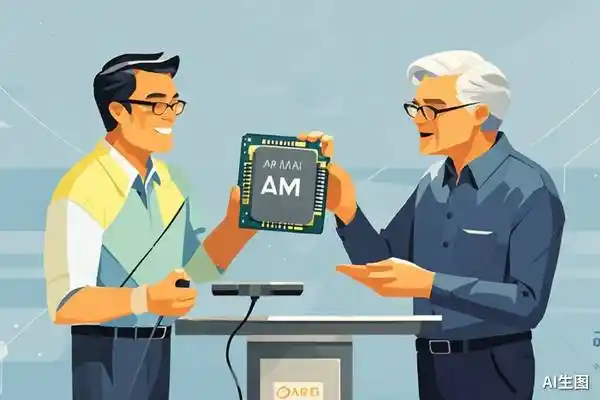
ByteDance Adopts Arm CPUs, Jensen Huang: So Sad I Didn't Buy Arm

**Summary:** At Computex 2026, Arm CEO Rene Haas announced that ByteDance and Oracle have adopted Arm's self-designed Arm AGI data center CPU. The company expects significant revenue growth from this product, projecting $20 billion in demand for the 2027/2028 fiscal years. Haas noted that restricting AI-capable CPUs from the US to China is nearly impossible due to their widespread applications. Arm's stock has surged dramatically this year, notably rising 16% after NVIDIA's Arm-based Vera CPU and RTX Spark announcements. A highlight was the informal, humorous on-stage conversation between Haas and NVIDIA CEO Jensen Huang. Huang joked about NVIDIA's failed attempt to acquire Arm and playfully lamented selling his Arm shares. Both executives showed a clear sense of camaraderie and shared regret over the missed merger. Key technical topics were discussed: 1. **AI PC Design:** Huang explained NVIDIA's RTX Spark superchip (with a 20-core Arm CPU) is designed for future AI agents that will autonomously run and use tools on PCs, blending local and cloud processing. 2. **Agent vs. OS:** Huang emphasized the operating system remains crucial, as AI agents rely on its APIs and tools to function. 3. **Growth Constraints:** He identified the shift to "useful AI" that generates profitable tokens as a primary driver for immense, almost limitless, computational demand. Haas outlined Arm's strategy across PC and data centers. For PCs, Arm collaborates with partners like NVIDIA and MediaTek, offering its compute subsystem (CSS) for custom SoCs. In data centers, its Arm AGI CPU (built on TSMC's 3nm process) has gained major partners including OpenAI, Meta, and now ByteDance and Oracle. Arm presented a multi-year roadmap for its in-house CPU line. The article concludes that while GPUs dominated the AI training race, the explosion of AI agents is shifting significant focus to CPUs for inference, state management, and tool orchestration. The industry is trending towards vertical integration, with companies like cloud providers designing chips and chip/IP firms offering full solutions, all competing to deliver more efficient computing per watt.

marsbit52 min fa

ByteDance Adopts Arm CPUs, Jensen Huang: So Sad I Didn't Buy Arm

marsbit52 min fa

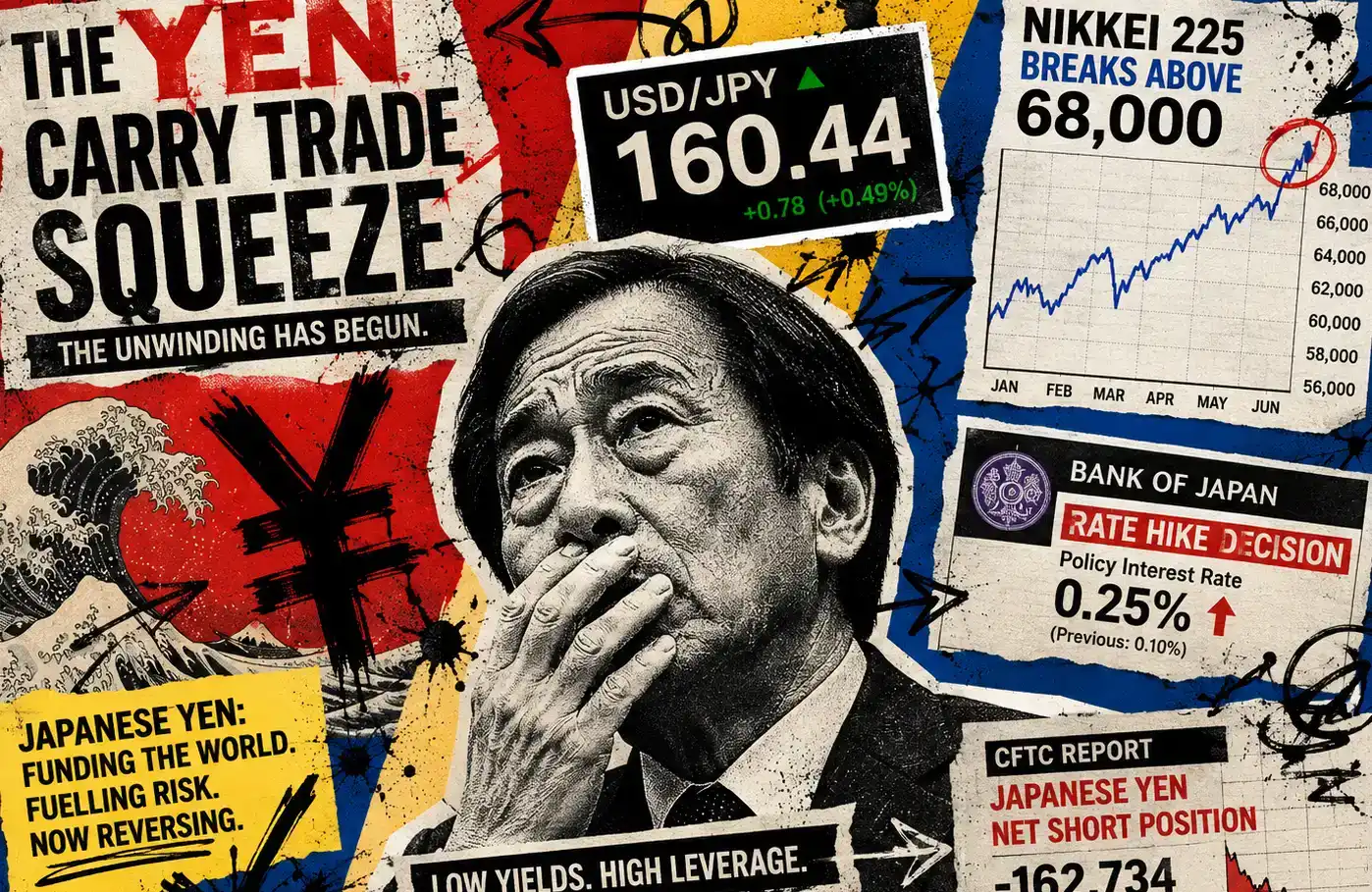
New Wall Street Play: Yen Shorts Still Adding, But Japan Stocks Don't Rely on Carry Trade Unwinding

On June 3rd, USD/JPY hit 160.44, its highest level since July 2024, while the Nikkei 225 surged past 68,000 points. Contrary to popular narratives of an imminent "carry trade unwind" akin to August 2024, data reveals a more complex picture. Speculative net short positions in yen futures have actually increased, reaching -114,667 contracts by late May, suggesting traders are doubling down rather than retreating. Meanwhile, Japan's Finance Ministry conducted its largest-ever single-round FX intervention (11.73 trillion yen) in April-May but failed to hold the 160 yen line. The Nikkei's rally is not driven by carry trade dynamics. Foreign investors are aggressively buying Japanese stocks, with net purchases in 2026 running nearly 16 times higher than 2025 levels. This inflow is concentrated in AI and semiconductor-related stocks like SoftBank and Socionext, fueled by positive sector outlooks, rather than being a flight from unwinding yen shorts. Furthermore, the Nikkei has continued climbing despite the Bank of Japan's (BOJ) rate hikes to 0.75%. This disconnect exists because the current equity boom is fueled by AI-driven foreign investment, not reliant on cheap yen funding. However, this relationship remains fragile. Should the BOJ hike rates further (e.g., to 1.0%) while dollar weakness increases carry trade costs, the trajectories of the yen and Japanese stocks could reconverge, potentially triggering volatility.

marsbit56 min fa

New Wall Street Play: Yen Shorts Still Adding, But Japan Stocks Don't Rely on Carry Trade Unwinding

marsbit56 min fa

Broadcom's Q3 Guidance Misses Expectations by $12 Billion, After-Hours Trading Plummets Over 13%, AI Narrative "Cooling"?

On June 3, Broadcom released record Q2 FY26 results with revenue of $22.19B, up 48% YoY, and AI chip sales of $10.8B, up 143%. Adjusted EPS of $2.44 beat estimates. However, its Q3 AI semiconductor revenue guidance of $16B, while up over 200% YoY, fell roughly $1.2B (7%) short of analyst consensus expectations of $17.2B. This miss, coupled with slightly weaker-than-expected software revenue, triggered a severe market reaction. CEO Hock Tan maintained the FY26 AI revenue outlook of over $100B but did not raise it, disappointing investors who had priced in more robust growth. The stock plummeted over 13% in after-hours trading, erasing roughly $270B in market cap. The sell-off extended to peers like Marvell. A key concern for markets, particularly for Chinese optical module suppliers, was Tan's comment that the contribution of AI networking (e.g., Ethernet switches, optical interconnect chips) to AI revenue, currently near 40%, is expected to normalize to around 30% over time, signaling a potential peak in growth for that segment. Despite the guidance shortfall, Tan reiterated that AI demand remains "insatiable" and reaffirmed the long-term target of exceeding $100B in AI revenue by FY27. The reaction highlights the heightened sensitivity and premium valuation placed on AI-exposed stocks, where anything less than stellar guidance can prompt significant profit-taking. The broader question is whether this represents a cooling AI narrative or a correction in overstretched valuations.

marsbit57 min fa

Broadcom's Q3 Guidance Misses Expectations by $12 Billion, After-Hours Trading Plummets Over 13%, AI Narrative "Cooling"?

marsbit57 min fa

Trading

Spot
Futures
活动图片