Tech Giants' Earnings Report "Face Change", Why Did Bitcoin Fall Deeper Than the Nasdaq?

比推Pubblicato 2026-01-30Pubblicato ultima volta 2026-01-30

Introduzione

Bitcoin experienced a sharp decline, dropping around 7-8% to near $82,000, its lowest point since last November. The downturn was triggered by a sell-off in tech stocks, particularly after Microsoft’s earnings report raised concerns over AI investment returns despite revenue growth. This sparked a downturn in the Nasdaq and S&P 500, which spilled over into crypto markets. Additional factors included heightened geopolitical tensions between the U.S. and Iran, fears of a U.S. government shutdown, and internal market vulnerabilities. Large-scale liquidations exceeded $800 million, exacerbating the sell-off. Moreover, Bitcoin ETFs saw net outflows, and retail participation dwindled, reducing market support. While most holders remain profitable, the market's structure remains fragile, and further declines may occur if negative macro conditions persist or worsen.

Author: Chloe

Original Title: Following the Decline but Not the Rise, Why Did Bitcoin Plummet Again?


After a period of sideways consolidation, the cryptocurrency market experienced a price drop from last night to this morning. Bitcoin fluctuated and declined sharply within just a few hours, quickly falling below the $85,000 mark, dropping from around $89,000 on the 28th to near $82,000 on the 30th, with an overall decline of about 7-8%, hitting the lowest point since last November.

This sudden and severe pullback that caught investors off guard is the result of a combination of factors: a collapse in tech stock sentiment, rising geopolitical risks, and internal liquidity drying up in the crypto market.

Microsoft's Earnings Report Sparks Investor Concerns Over AI Benefits

The starting point of this crypto market decline is largely related to the opening of the U.S. stock market. According to foreign media reports, after the U.S. stock market opened on Thursday, global markets immediately entered a downward trend. The core momentum came from the earnings report released by tech giant Microsoft after the U.S. market closed the previous day.

Although the software giant's revenue actually grew by 17% in the fourth quarter, the slowdown in its cloud division's growth and the massive spending in the artificial intelligence field raised investors' concerns about over-investment in AI in the tech industry. Microsoft's stock price plummeted by 12% after the earnings report, dragging down the entire tech sector.

After the U.S. stock market opened on Thursday morning, the Nasdaq Composite Index fell by about 2.3%, and the S&P 500 Index dropped by about 1.5%. The comprehensive rout of tech stocks quickly spread to the cryptocurrency market. Bitcoin's price rapidly declined in a short period, hitting a low of $81,000. According to CoinGecko data, Bitcoin's recent trading price has accumulated a 6% drop compared to a week ago.

Cryptocurrencies as the First Risk Assets Sold Off by the Market

Timot Lamarre, Research Director at Unchained, pointed out that although many people view Bitcoin as the world's hardest currency, the vast majority of market participants still regard Bitcoin as a tech stock trading target. This perception makes it difficult for Bitcoin to remain unaffected when traditional tech stocks suffer heavy losses. Historical data also confirms this; there is a significant correlation between Bitcoin and the U.S. stock market, especially tech stocks. When investors become skeptical about the prospects of the tech industry, cryptocurrencies are often among the first risk assets to be sold off.

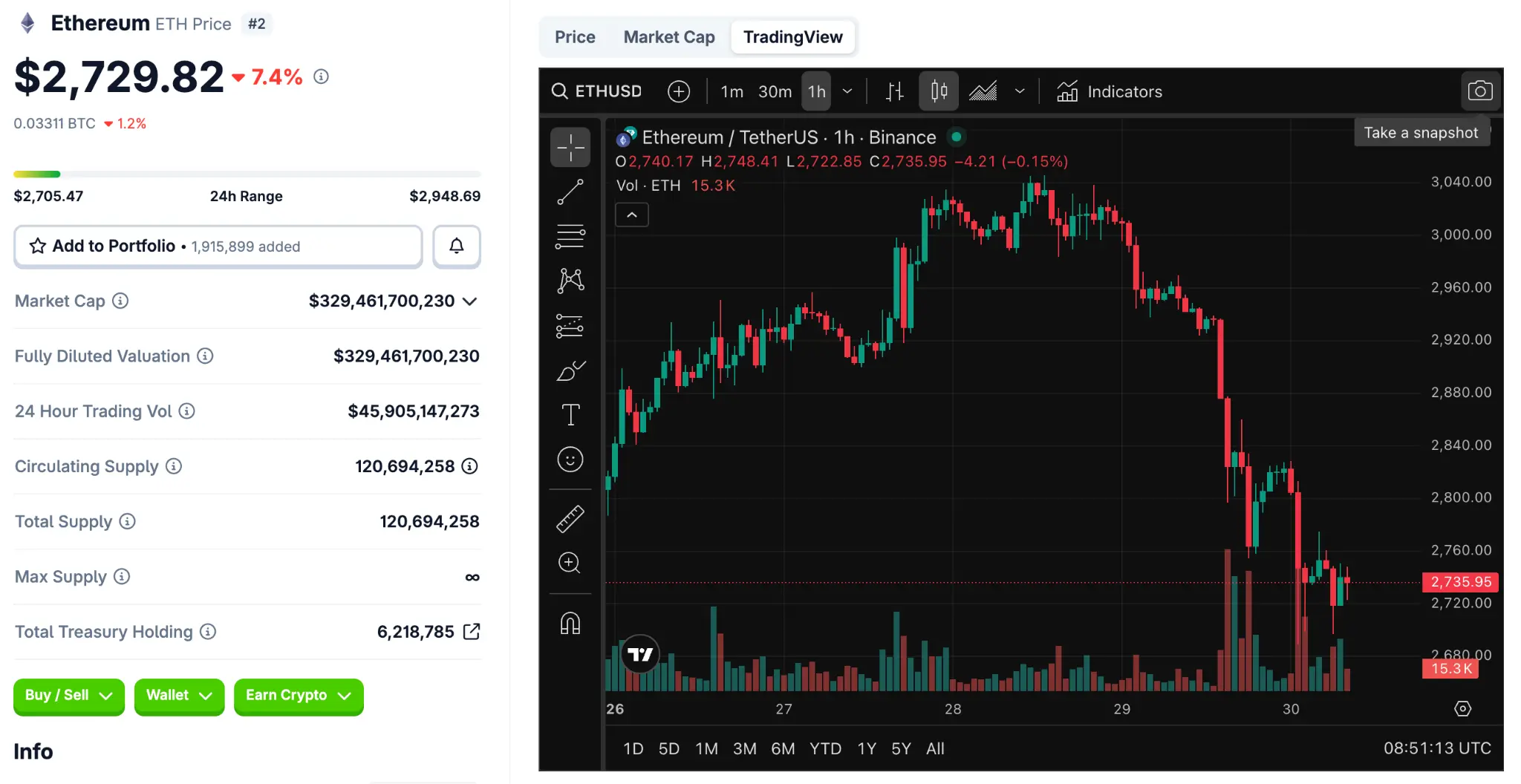
Meanwhile, Ethereum fell by over 7% in a single day, with its trading price dropping to around $2,729. Besides these two major cryptocurrencies, other top-ten crypto assets by market cap also generally experienced declines of 4% to 6%.
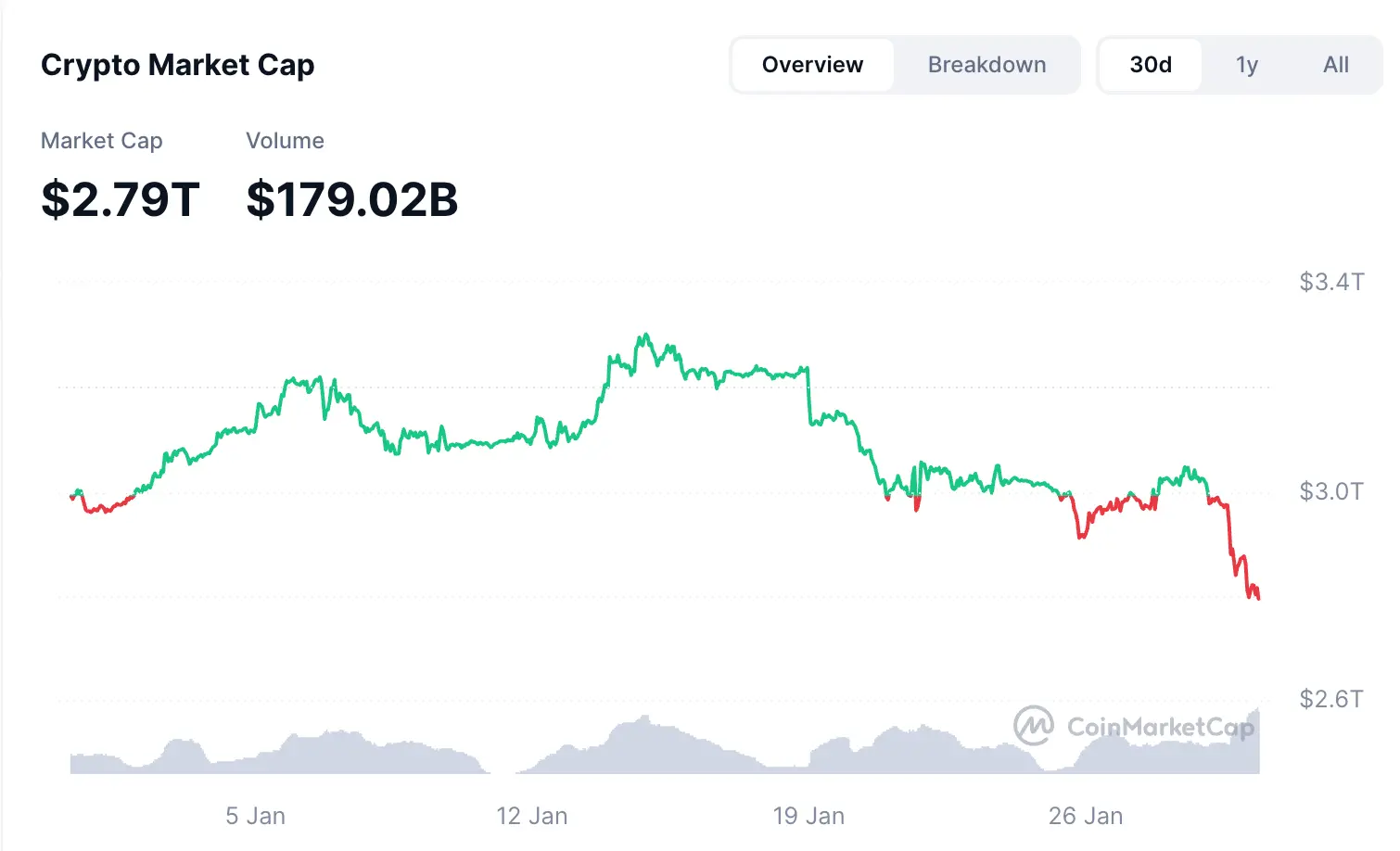
Among mainstream coins, popular tokens like XRP and Solana also saw similar single-day declines. Overall, the total market capitalization of the cryptocurrency market fell by about 5%, now reduced to $2.79 trillion.
Large-Scale Liquidation Events Create a Vicious Cycle

In addition, this sharp decline also caused large-scale leveraged liquidation events. According to CoinGlass data, in the past 24 hours, over 200,000 traders had their positions liquidated, with a total liquidation amount exceeding $813 million. Among them, long positions accounted for the vast majority of the liquidations, reaching nearly $700 million, indicating that there were a large number of bullish bets in the market before the price plummeted.

DLNews data shows that just the positions betting on Bitcoin's price rise had $313.7 million liquidated that day, with another $327 million in Bitcoin-related positions wiped out in the past 24 hours. Ethereum followed closely, with liquidation amounts reaching $134 million.

Such large-scale liquidation events often create a vicious cycle.

When prices start to fall, the forced liquidation of leveraged positions further exacerbates selling pressure, pushing prices down further and triggering more liquidations. This avalanche effect is particularly evident in environments with insufficient liquidity, causing prices to fall much faster than market expectations.

Unstable Middle East Situation, Multiple Macro Risk Factors Erupt

Besides the drag from tech stocks, multiple macro risk factors are also putting pressure on the market simultaneously. Tensions between the U.S. and Iran have reheated. According to a Reuters report, U.S. War Secretary Pete Hegseth said today that regardless of what decision President Trump makes regarding Iran, the U.S. military will be ready to carry out its mission to ensure that the Tehran regime does not develop nuclear capabilities, "They should not seek nuclear capabilities, and whatever the President expects from the War Department, we will be ready to accomplish the mission."

Some U.S. officials also revealed that Trump is evaluating various options but has not yet decided whether to use military force against Iran. However, Trump has repeatedly warned that if the Iranian regime resumes its nuclear program, the U.S. will take action.

At the same time, the risk of a U.S. government shutdown is also being priced into the market. As negotiations remain deadlocked before the critical deadline, without a last-minute agreement, multiple federal agencies could face operational disruptions, delayed payments, and reduced recent fiscal clarity. Historical data shows that during the past three government shutdowns, Bitcoin prices experienced significant declines, with the highest drop reaching 16%.

Fragile Crypto Market Structure, Deeper Declines, Difficult Rebound

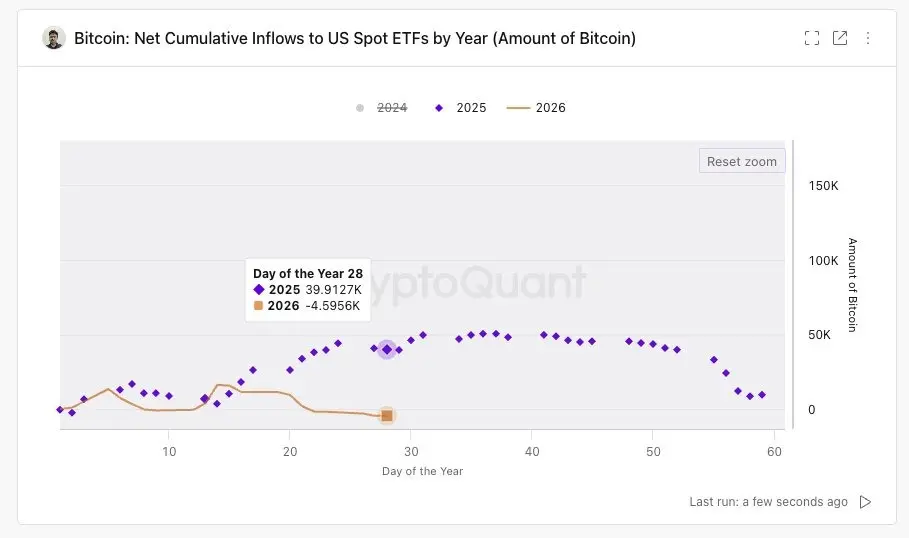
Finally, the inherent fragility of the crypto market structure should be the most important attribution in this downward trend. U.S. spot Bitcoin ETFs have net sold about 4,600 Bitcoins year-to-date, compared to a net inflow of nearly 40,000 Bitcoins during the same period last year. ETFs were supposed to be the most stable source of buying power in this cycle. Now that this support has disappeared, the rebound has lost momentum, and the decline has become more severe due to a lack of承接 (buying support).
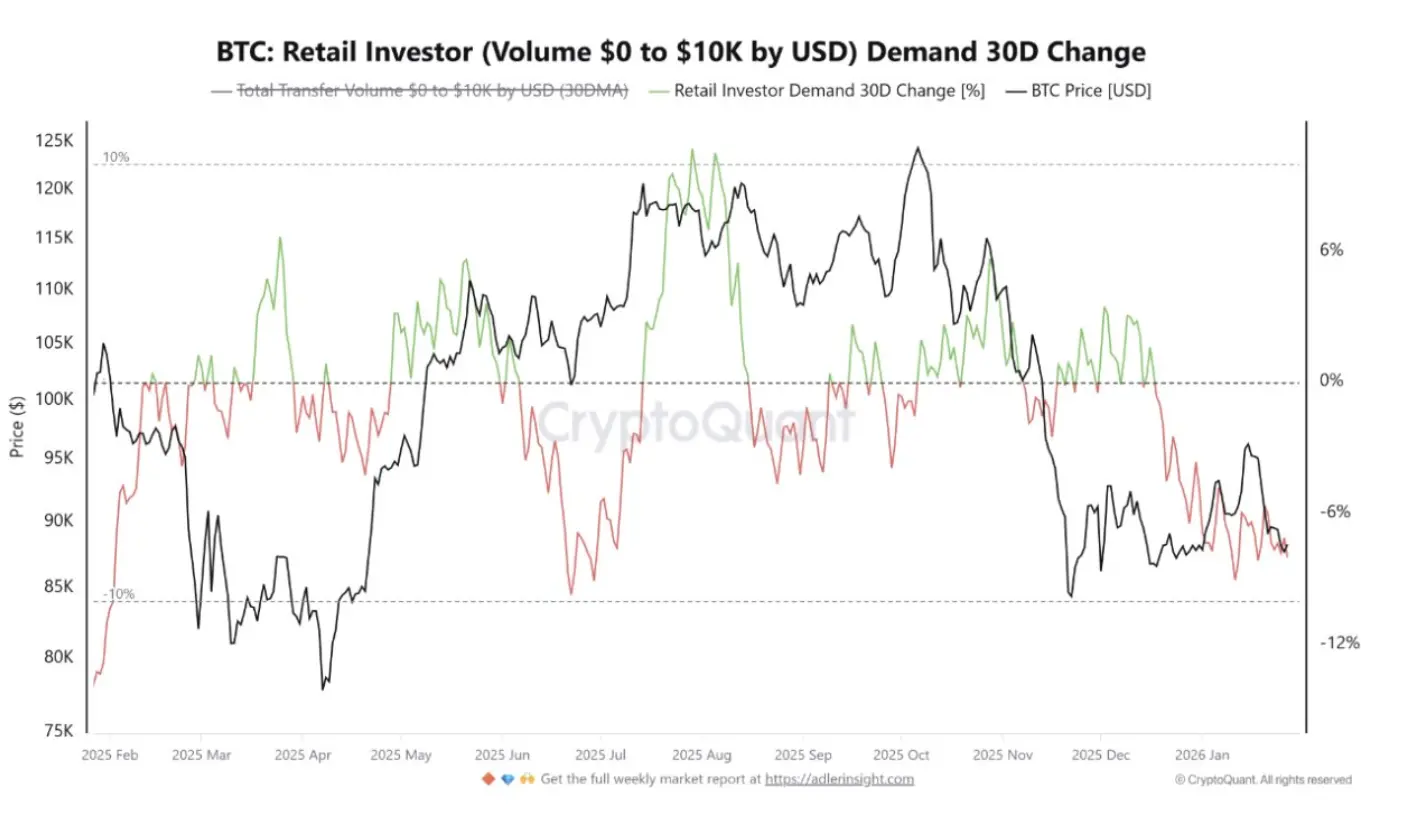
Meanwhile, retail investors are also withdrawing. On-chain data shows that small transactions between $0 and $10,000 have shrunk sharply in the past month, not only buying slowing down but also a substantial decrease in the number of participants. And when ETF buying disappears and retail investors exit, the market is left only with short-term traders and leveraged speculators, inevitably amplifying volatility.

Crypto Market Maturing, But Market Structure Remains Fragile
Additionally, according to Beincrypto, most coin holders are still in a profitable state. The Bitcoin Loss Supply indicator is low by historical standards, meaning a large number of筹码 (chips/holdings) have not yet experienced real pain. This often indicates that Bitcoin will fall further rather than having bottomed out. "Only when prices continue to探 (probe/decline), and more holders turn to losses, will the real panic selling begin."

However, according to Pantera Capital's outlook for this year's行情 (market trend), judging from historical cycles, the current duration of the decline for non-Bitcoin tokens has been on par with the bear markets of 2018 and 2022 (about 12-14 months), and market sentiment has also been compressed to near capitulation levels, which may mean it is接近 (approaching) a cyclical bottom.

Although the cryptocurrency market has become increasingly, it still cannot withstand the叠加 (overlay/combination) of multiple negative factors. It can be said that the U.S. stock sell-off, U.S.-Iran tensions, and the potential government shutdown acted as catalysts for this sharp decline, but the liquidity drought caused by ETF outflows and reduced retail demand points to an inherently fragile market structure.

If subsequent tech earnings reports fail to convey strong confidence, or if geopolitical conditions worsen further, Bitcoin and the crypto market may need to undergo deeper adjustments to regroup.


Twitter:https://twitter.com/BitpushNewsCN

Bitpush TG Discussion Group:https://t.me/BitPushCommunity

Bitpush TG Subscription: https://t.me/bitpush

Original link:https://www.bitpush.news/articles/7607400

Domande pertinenti

QWhat was the main trigger for the recent sharp decline in Bitcoin's price according to the article?

AThe decline was largely triggered by Microsoft's quarterly earnings report, which showed slowing growth in its cloud division and massive AI spending, causing a 12% drop in Microsoft's stock and dragging down the entire tech sector.

QHow much did Bitcoin's price drop during the recent sell-off, and what was its lowest point?

ABitcoin's price dropped approximately 7-8%, falling from around $89,000 to near $82,000, reaching its lowest point since November of the previous year.

QWhat role did leverage and liquidations play in exacerbating the cryptocurrency market downturn?

AThe sharp price decline triggered massive liquidations of leveraged positions, with over $813 million liquidated in 24 hours, predominantly long positions. This created a vicious cycle where forced selling intensified downward pressure, leading to further price drops and more liquidations.

QBesides tech stock weakness, what other macroeconomic factors contributed to the market decline?

AOther contributing factors included escalating tensions between the U.S. and Iran regarding nuclear capabilities, and the risk of a U.S. government shutdown due to stalled negotiations, both of which added to market uncertainty.

QWhy is the cryptocurrency market structure described as fragile in the context of this downturn?

AThe market structure is fragile because U.S. spot Bitcoin ETFs have become net sellers (selling 4,600 BTC year-to-date compared to net inflows last year), retail investor participation has significantly declined, and the market is now dominated by short-term traders and leveraged speculation, amplifying volatility.

Letture associate

In-Depth Report on the On-Chain Lending Market: When Off-Chain Credit Meets On-Chain Liquidation

The on-chain lending market has evolved from a peripheral DeFi niche into core financial infrastructure. As of early 2026, total value locked (TVL) in on-chain lending protocols has reached $64.3 billion, accounting for 53.54% of total DeFi TVL, making it the largest and most mature vertical within decentralized finance. Aave dominates the sector with approximately $32.9 billion in TVL, commanding nearly half of the market—a leadership position that is unlikely to be challenged in the foreseeable future. However, the path of on-chain lending forward is not without risk. Liquidation cascades, credit defaults, and cross-chain vulnerabilities remain systemic threats hanging over the industry. At the same time, a deeper structural transformation is underway: on-chain lending is shifting from a “leverage tool for crypto-native users” to a “compliant gateway for institutional capital”. The scale of RWA (Real World Asset) lending has surpassed $18.5 billion, with U.S. Treasuries and government securities increasingly serving as core collateral. Institutional capital inflows are reshaping both the user base and risk appetite of the sector. This report systematically analyzes the evolution of on-chain lending definitions, competitive dynamics, core risks, and future trends, providing a comprehensive industry outlook for investors and trade practitioners. Key findings suggest that the “one dominant player with several strong challengers” structure will persist in the short term, while fixed-rate lending, compliant collateral, and institutional credit underwriting will define the next phase of competition. For investors focused on DeFi infrastructure, three key opportunity tracks stand out, namely, the Aave ecosystem (Morpho, Spark), RWA lending protocols (Ondo, Maple) and fixed-rate innovation (Notional, Pendle).

HTX Learn24 min fa

In-Depth Report on the On-Chain Lending Market: When Off-Chain Credit Meets On-Chain Liquidation

HTX Learn24 min fa

Fu Peng's First Public Speech in 2026: What Exactly Are Crypto Assets? Why Did I Join the Crypto Asset Industry?

Fu Peng, a renowned macroeconomist and now Chief Economist at New火 Group, delivered his first public speech of 2026 at the Hong Kong Web3 Festival. He explained his perspective on crypto assets and why he joined the industry, framing it within the context of macroeconomic trends and financial evolution. Fu emphasized that crypto assets are transitioning from an early, belief-driven phase to a mature, institutionally integrated asset class. He drew parallels to the 1970s-80s, when technological advances (like computing) revolutionized traditional finance, leading to the rise of FICC (Fixed Income, Currencies, and Commodities). Similarly, current advancements in AI, data, and blockchain are reshaping finance, with crypto assets becoming part of a new "FICC + C" (C for Crypto) framework. He noted that institutional capital, including traditional hedge funds, avoided early crypto due to its speculative nature but are now engaging as regulatory clarity emerges (e.g., stablecoin laws, CFTC classifying crypto as a commodity). Fu predicted that 2025-2026 marks a turning point where crypto becomes a standardized, financially viable asset for diversified portfolios, akin to commodities or derivatives in traditional finance. Fu defined Bitcoin not as "digital gold" in a simplistic sense but as a value-preserving, financially tradable asset. He highlighted that crypto's future lies in regulated, institutional adoption, moving away from retail-dominated trading. His entry into crypto signals this maturation, where traditional finance integrates crypto into mainstream asset management.

marsbit1 h fa

Fu Peng's First Public Speech in 2026: What Exactly Are Crypto Assets? Why Did I Join the Crypto Asset Industry?

marsbit1 h fa

Justin Sun Sues Trump Family: What $75 Million Bought Was Only a Blacklist

Justin Sun, founder of Tron, has filed a lawsuit in federal court against World Liberty Financial (WLF), alleging he was made the "primary target of a fraudulent scheme" after investing $75 million. Sun claims the investment secured him an advisor title and WLFI tokens, which were later frozen by WLF, causing "hundreds of millions in losses." The dispute began in late 2024 when Sun's investment helped revive WLF's struggling token sale, which ultimately raised $550 million. Shortly after, the SEC dropped its lawsuit against Sun following Donald Trump's inauguration. However, relations soured when Sun refused WLF's demands for additional funding. In August 2025, WLF added a "blacklist" function to its smart contract, allowing it to unilaterally freeze tokens. Sun's holdings, worth approximately $107 million, were frozen, and he was threatened with token destruction. The lawsuit highlights WLF's structure, which directs 75% of token sale profits to the Trump family, who had earned $1 billion by December 2025. WLF's CEO is Zach Witkoff, son of U.S. Middle East envoy Steve Witkoff. The project faces scrutiny for opaque operations, including a controversial loan arrangement on the Dolomite platform, co-founded by a WLF advisor. Despite Sun's history with the SEC, the case underscores centralization risks within DeFi, as WLF controls governance and holds powers to freeze assets arbitrarily. Sun's tokens remain frozen as legal proceedings begin.

marsbit1 h fa

Justin Sun Sues Trump Family: What $75 Million Bought Was Only a Blacklist

marsbit1 h fa

Trading

Spot
Futures
活动图片