Tariff Threat Shocks Market: Trump's Post Triggers Bitcoin Safe-Haven Sell-off

比推Pubblicato 2026-01-19Pubblicato ultima volta 2026-01-19

Introduzione

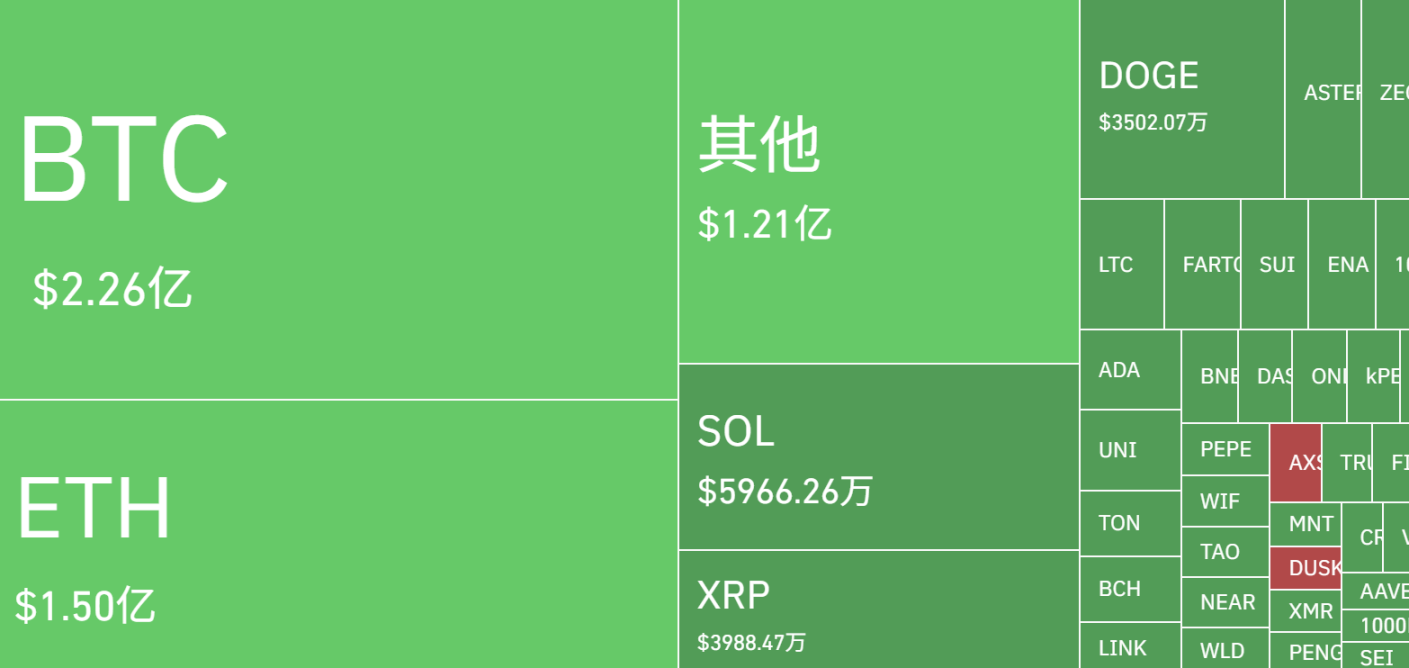
Cryptocurrency markets experienced a sharp sell-off on the morning of January 19, with Bitcoin dropping from $95,531 to a low of $91,910. Ethereum and Solana also saw significant declines, along with several altcoins falling over 10%. The sell-off resulted in $830 million in liquidations over 12 hours, predominantly long positions. The downturn was triggered by former U.S. President Donald Trump’s announcement on Truth Social that the U.S. would impose tariffs—starting at 10% on February 1 and rising to 25% by June—on imports from eight European countries, including Denmark, Germany, and the UK. The move is tied to Trump’s demand for a “complete and total purchase of Greenland,” citing unspecified security concerns. European leaders strongly opposed the tariffs, warning of strained transatlantic relations and potential benefits to geopolitical rivals like China and Russia. Meanwhile, traditional safe-haven assets like gold and silver surged to record highs amid the geopolitical tension and market uncertainty. With a 96% probability that the Federal Reserve will hold interest rates steady, risk assets faced additional pressure. Market analysts suggested that investors take profits and await clearer signals, though some remain optimistic about Bitcoin’s long-term potential, citing macroeconomic trends and increasing demand.

Author: Ma He, Foresight News

Original Title: Trump Stirs Trouble Again: An Island Causes Bitcoin to Plunge by $3,000


At around 7:00 AM on January 19, the cryptocurrency market experienced a sudden flash crash. The price of BTC plummeted sharply in a short period, dropping from $95,531 to a low of $91,910. ETH fell from $3,350 to a low of $3,177, and SOL dropped from $143 to a low of $130. Some altcoins like SUI, XPL, and ASTER saw declines of over 10% in 24-hour period.

According to Coinglass data, over the past 12 hours, $830 million was liquidated across the network, with long positions accounting for $764 million of that. In the past 24 hours, the largest single liquidation order occurred on Hyperliquid for a BTC-USDT perpetual contract worth $25.8337 million.
Meanwhile, traditional safe-haven assets like gold and silver bucked the trend and surged to record highs. Spot gold broke through the $4,690 per ounce mark,刷新历史高点, with a daily increase of over 2%. Spot silver broke through the $94 per ounce mark, hitting a record high, with a daily gain of over 4%.

U.S. stock markets are closed today. The U.S. Dollar Index fell 0.26% to 99.14. U.S. stock futures opened lower, with S&P 500 futures down 0.71% and Nasdaq futures down as much as 1.1% at one point. U.S. 10-year Treasury futures rose 5 ticks, and 30-year Treasury futures also rose 5 ticks.

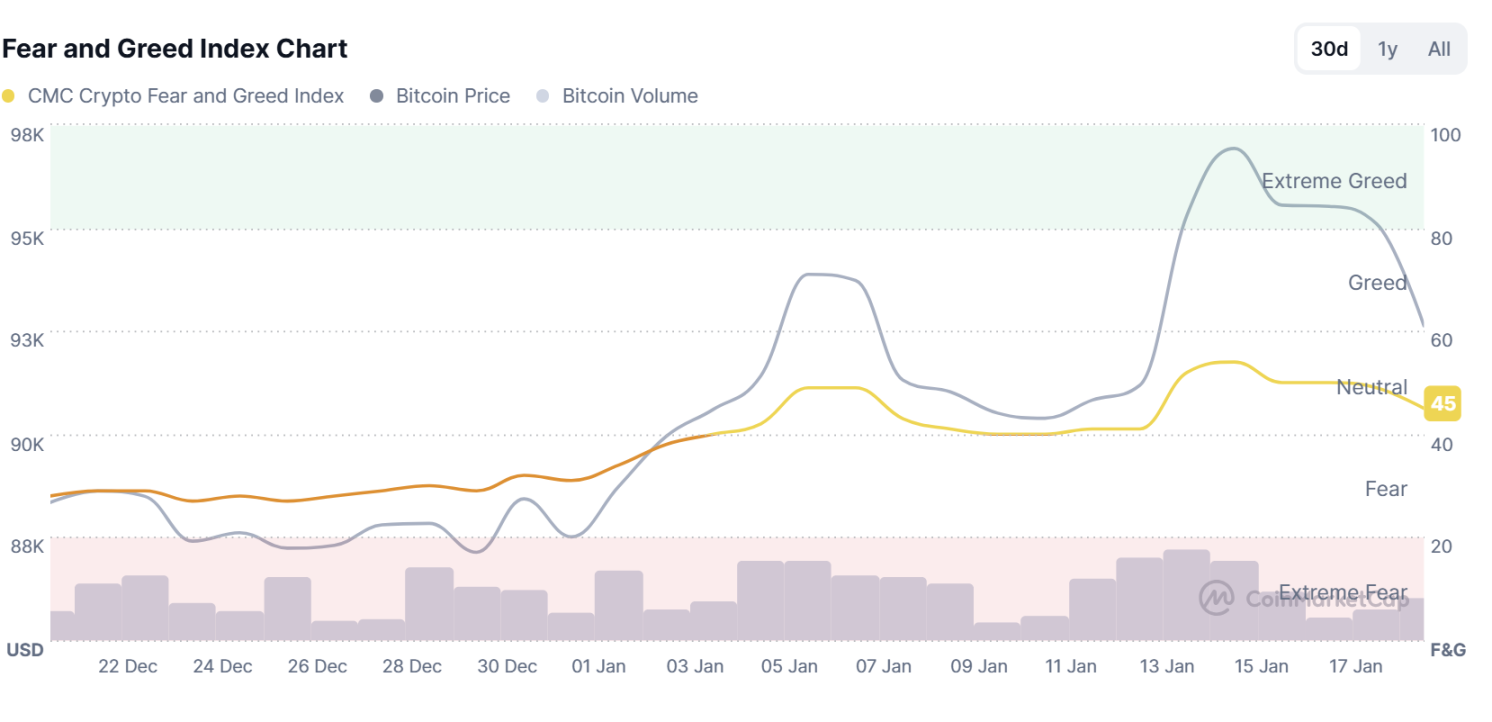
The Crypto Fear & Greed Index has currently retreated to 45.
This event is not isolated but the result of intertwined macroeconomic factors and geopolitical tensions.

Trump Wields Tariff Stick Again, Imposing Tariffs on 8 European Countries Starting February 1st

Last year, the trigger for the crypto market's "1011暴跌" (October 11th crash) was Trump wielding tariff threats against China. Now, this scene is repeating itself.

On January 18, Trump posted on Truth Social, stating that due to the Greenland issue, starting February 1st of this year, all goods exported to the U.S. from Denmark, Norway, Sweden, France, Germany, the UK, the Netherlands, and Finland will be subject to an additional 10% tariff. By June 1st of this year, the tariff will increase to 25%. These tariffs are to be paid continuously until an agreement on the "comprehensive and thorough purchase of Greenland" is reached.

In his post, Trump stated, "These countries—Denmark, Norway, Sweden, France, Germany, the UK, the Netherlands, and Finland—have all gone to Greenland for unknown purposes. This poses a very dangerous situation for the safety, security, and survival of our planet. These countries are playing an extremely dangerous game, and the level of risk they bring is intolerable and unsustainable. Therefore, to protect global peace and security, strong measures must be taken to bring this potential dangerous situation to a swift and indisputable end."

Furthermore, according to CNBC, after Trump issued tariff threats against European allies over the "Greenland issue," several European leaders responded强硬ly, emphasizing that Greenland's sovereignty is non-negotiable and warning that this move would further撕裂 transatlantic relations.

European Commission President Ursula von der Leyen and European Council President António Costa stated that pressuring allies with tariffs would damage EU-US relations and could trigger a "dangerous vicious cycle"; EU High Representative for Foreign Affairs and Security Policy Kaja Kallas said that tariffs would only harm shared prosperity, divert Europe's priorities on Ukraine, and allow rivals like Russia and China to "reap the benefits." Additionally, Spanish Prime Minister Pedro Sánchez warned that more激进 U.S. actions on Greenland would have a major impact on NATO. EU ambassadors from 27 countries plan to hold an emergency meeting to coordinate their response.

That day, according to Bloomberg, Senate Democrats plan to introduce legislation to阻止 Trump from imposing tariffs on European countries that oppose the U.S. annexation of Greenland. Previously, Senate Minority Leader Chuck Schumer criticized the move for harming the U.S. economy and relations with allies.

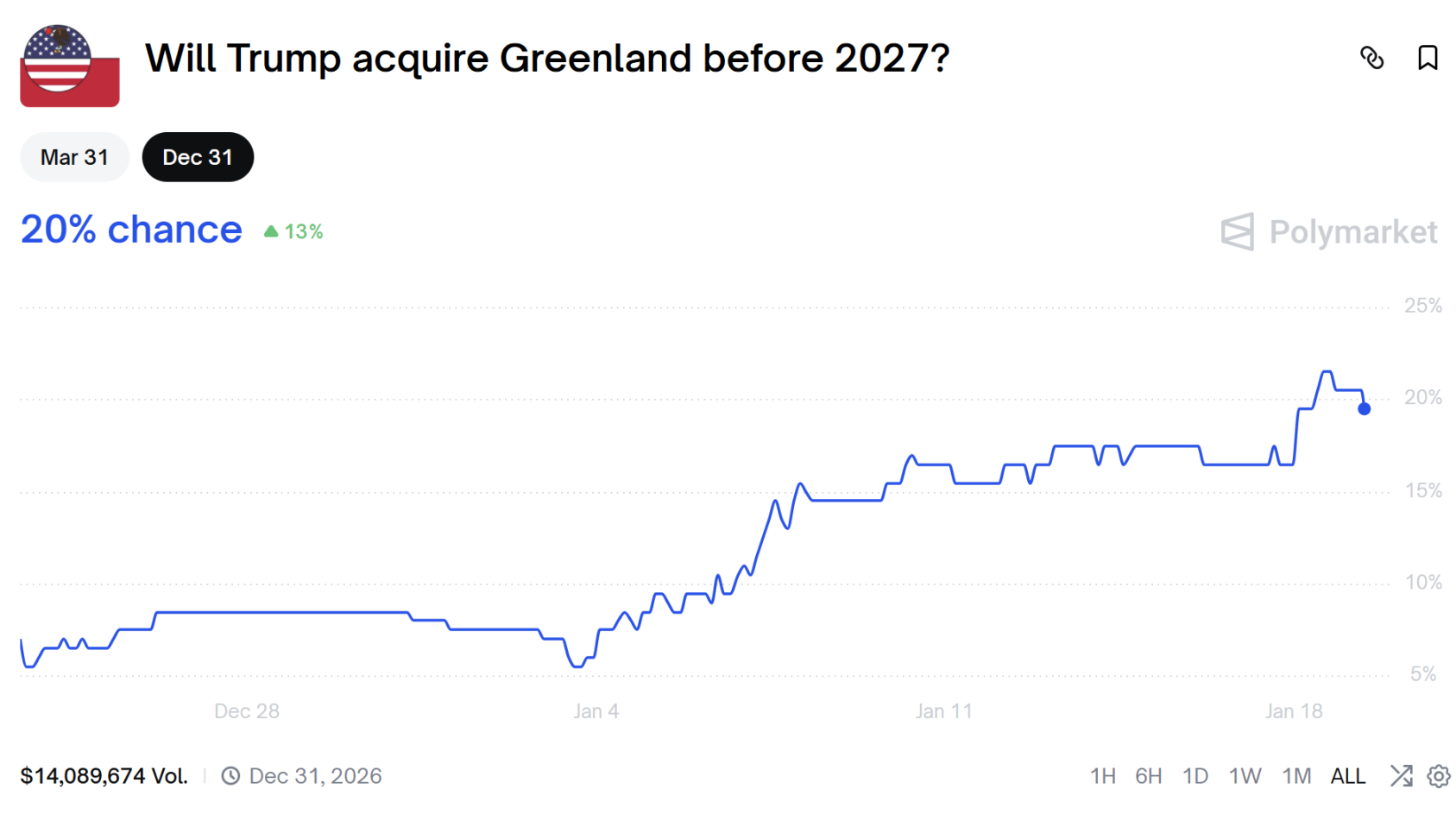
Latest data from Polymarket shows the market is betting a 20% probability that Trump will acquire Greenland by 2027.

Tariffs and geopolitical concerns have caused investors to turn to gold and silver for safety, leading to an outflow of funds from crypto.

Additionally, the probability of the Federal Reserve holding rates steady this January is extremely high. According to Polymarket data, the market's bet on no rate cut has now risen to 96%, putting pressure on risk assets.

On the evening of January 18, crypto trading indicator analysis platform CoinKarma posted, stating, "BTC rose to nearly $98,000 this week, but when it reached that price level, the market saw the most significant selling pressure in recent weeks, causing a slight pullback. However, the overall liquidity between buyers and sellers has not shown a significant imbalance and remains relatively balanced. Other key market indicators have not yet given clear signals. Based on the current situation, long position holders who entered at the relatively low points at the beginning of the year may consider taking profits, either fully or partially closing their positions, and waiting for clearer signals before re-entering the market."

Seasoned crypto investor Dan Tapiero stated: "If investing $10,000 in crypto assets in 2026, I think you can directly allocate funds to Bitcoin, Ethereum, and Solana. As for the specific allocation, it depends on your preference."

Dan Tapiero believes that the biggest opportunities in the cryptocurrency space in 2026 lie in infrastructure and the adoption of stablecoins. Tapiero stated that he expects Bitcoin to rise to $180,000 in this cycle, citing the combined effect of growing demand and a shift in global monetary policy. Falling interest rates and massive government investment in AI infrastructure will bring strong positive factors. This global push is leading to the devaluation of all fiat currencies, including the U.S. dollar. This is very favorable for Bitcoin.


Twitter:https://twitter.com/BitpushNewsCN

Bitpush TG Discussion Group:https://t.me/BitPushCommunity

Bitpush TG Subscription: https://t.me/bitpush

Original article link:https://www.bitpush.news/articles/7604166

Domande pertinenti

QWhat was the immediate impact of Trump's tariff threat on cryptocurrency markets?

ACryptocurrency markets experienced a sharp flash crash, with Bitcoin dropping from $95,531 to a low of $91,910, Ethereum falling from $3,350 to $3,177, and Solana declining from $143 to $130 within a short period.

QWhich traditional safe-haven assets saw price increases following the geopolitical tension?

ATraditional safe-haven assets like gold and silver surged to record highs, with spot gold rising over 2% to above $4,690 per ounce and spot silver increasing over 4% to above $94 per ounce.

QWhich European countries did Trump threaten with tariffs starting February 1st, and why?

ATrump threatened to impose tariffs on Denmark, Norway, Sweden, France, Germany, the UK, the Netherlands, and Finland, citing their activities in Greenland as a 'very dangerous situation' for global security and demanding a agreement for the 'complete and total purchase of Greenland'.

QHow did European leaders respond to Trump's tariff threat over Greenland?

AEuropean leaders strongly opposed the move, emphasizing Greenland's sovereignty is non-negotiable. EU officials warned it would damage transatlantic relations and could create a 'vicious cycle,' while some leaders cautioned it would benefit rivals like Russia and China and impact NATO.

QWhat was the market's probability assessment of Trump acquiring Greenland by 2027 according to Polymarket?

APolymarket data showed a 20% probability that Trump would acquire Greenland by 2027.

Letture associate

Misjudged A-Shares: Resilience, Expectations, and Confidence

China's A-share market recently faced selling pressure, especially in tech sectors, initially triggered by a global tech sell-off that began in South Korea. However, the article argues this is a case of "mistaken injury" and highlights the market's underlying resilience. This resilience stems from three main pillars: **1) Tech Sector Fundamentals:** Unlike Korea's market dominated by a few memory chip stocks, China's tech sector is diversified across computing, communications, electronics, and semiconductors, supported by dual narratives of global AI supply chains and domestic substitution. Core areas like optical modules and fiber optics continue to show strong earnings growth. **2) "National Team" Support:** State-backed institutions and large corporations have made significant market purchases and announced buybacks, providing liquidity and signaling confidence. This is seen as a stabilizing policy signal, often associated with market bottoms. **3) Broader Market Pillars:** Other major sectors are showing endogenous recovery momentum. Consumer stocks benefit from stabilizing CPI and signs of sector recovery (e.g., liquor price hikes). Cyclical sectors like aluminum have high earnings, potential price increases due to tight supply, and low valuations. The financial sector offers stable dividends and low valuations. The conclusion is that the sell-off was driven by external contagion, not a collapse in fundamentals. With strong policy support and recovering momentum across key sectors, the A-share market possesses the toughness to regain stability.

marsbit33 min fa

Misjudged A-Shares: Resilience, Expectations, and Confidence

marsbit33 min fa

The Clarity Act's Journey Through Congress: The Thorny Path of Bipartisan Compromise in the U.S.

The U.S. Congress is struggling to advance the crypto market structure bill known as the Clarity Act, with bipartisan compromise proving difficult. Key hurdles include unresolved disputes over "yield" products and, more critically, the inclusion of strong ethics provisions for elected officials—a non-negotiable demand for many Democrats. While a compromise on yield was reached in May, securing only limited Democratic support in committee, the separate Senate Agriculture Committee version later passed with no Democratic votes due to the ethics impasse. As Republicans push for a full Senate vote in July, demands for ethics rules have expanded, and other contentious issues like developer protections and concerns from law enforcement and large banks further complicate negotiations. Despite consensus on the need for legislation, the path forward is unclear. Recent discussions between senators and White House officials aim to find acceptable ethics language. Some lawmakers question whether a compromise text can garner enough bipartisan support, with one Democrat stating the current proposal lacks the strong ethics provisions required for their vote. Potential short-term goals for the crypto community include symbolic Senate action before the August recess, a longer-term aim for passage by 2026, or establishing a detailed framework that addresses ethics and other compromises. The process remains arduous, relying on the traditional, vote-by-vote effort to build bipartisan support.

marsbit53 min fa

The Clarity Act's Journey Through Congress: The Thorny Path of Bipartisan Compromise in the U.S.

marsbit53 min fa

Are Kalshi and Polymarket Founders at Odds? This Business Rivalry Is More Brutal Than You Think

"The Rivalry Between Kalshi and Polymarket Founders Turns Bitter and Litigious" The intense feud between Tarek Mansour, CEO of Kalshi, and Shayne Coplan, founder of Polymarket, has escalated far beyond typical business competition into personal animosity and regulatory battles. Both lead billion-dollar prediction market platforms, but their approaches differ sharply. Kalshi positions itself as the compliant operator, securing U.S. regulatory approval before launching. In contrast, Polymarket initially operated offshore, allowing U.S. users to access its platform via VPN, which drew regulatory scrutiny. The conflict reached a peak in November 2024 when FBI agents raided Coplan's New York apartment. While Coplan publicly blamed political motives, his team privately suspected Kalshi was involved. According to sources, Kalshi's lawyers had previously reported Polymarket's operations to federal prosecutors, highlighting its accessibility to U.S. users despite a ban. This incident fueled mutual accusations and underhanded tactics, including social media smear campaigns and attempts to sabotage each other's major business deals. Their rivalry also played out in Washington, influencing regulatory debates. Kalshi actively lobbied against Polymarket's practices, framing them as illegal and unethical. Polymarket, after facing a CFTC fine and investigation, later acquired a licensed U.S. firm to launch a domestic app, regaining a foothold. Despite the hostility, both companies have seen massive growth, with combined trading volumes soaring. However, increased regulatory scrutiny, particularly around insider trading on Polymarket's platform, continues to pose challenges. The founders' deep-seated mutual disdain ensures their battle for market dominance remains as much a personal vendetta as a commercial one.

marsbit1 h fa

Are Kalshi and Polymarket Founders at Odds? This Business Rivalry Is More Brutal Than You Think

marsbit1 h fa

Trading

Spot
活动图片





