# Shutdown Articoli collegati

Il Centro Notizie HTX fornisce gli articoli più recenti e le analisi più approfondite su "Shutdown", coprendo tendenze di mercato, aggiornamenti sui progetti, sviluppi tecnologici e politiche normative nel settore crypto.

Meta Spent $90 Billion to Close the Metaverse, $2 Billion to Let AI Live in Your Computer

Meta spent $90 billion to build the metaverse, only to shut down its flagship VR platform, Horizon Worlds, on June 15. The virtual world, launched in 2021 with great fanfare, failed to attract a meaningful user base despite massive investment. Its closure marks a symbolic end to Meta’s ambitious—and costly—bet on the metaverse, which accumulated nearly $90 billion in losses over seven years. Simultaneously, Meta is aggressively pivoting to AI. It acquired AI startup Manus for $2 billion, which recently launched a desktop version allowing AI to operate directly on users' local machines—reading files, running apps, and executing commands. In contrast to the metaverse’s weak adoption, Manus reached one million paid users within eight months. The shift is stark: Meta is cutting 20% of its workforce—around 15,000 jobs—and reallocating nearly its entire $115–135 billion capital expenditure budget toward AI infrastructure. This abrupt turn reflects industry-wide FOMO (fear of missing out) on AI, similar to the metaverse hype half a decade ago. Companies like Block, Shopify, and Amazon are also slashing jobs to fund AI investments. While Meta faces internal challenges—including delayed AI models and executive departures—its drastic realignment underscores a broader trend: the consensus has shifted from virtual worlds to ambient AI. The question remains whether this new bet will prove more sustainable than the last.

marsbit03/19 04:53

Meta Spent $90 Billion to Close the Metaverse, $2 Billion to Let AI Live in Your Computer

marsbit03/19 04:53

2026 Death List: Games Are Dead, DeFi Is Dead, Tools Are Dead, Who's Next?

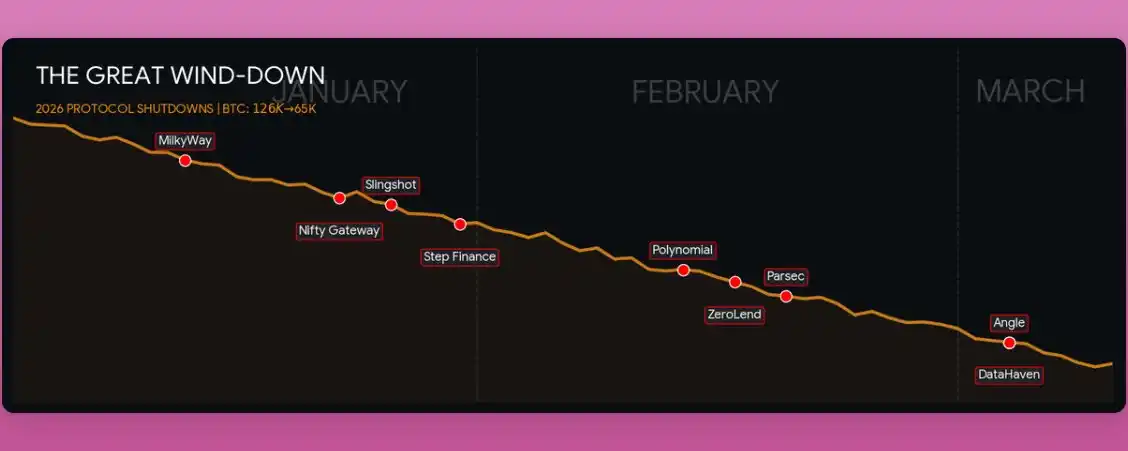
"Death List 2026: A Quiet Mass Extinction in Crypto" The crypto market is experiencing a wave of silent shutdowns in early 2026, with over 10 Web3 projects ceasing operations within 90 days. Unlike dramatic collapses of the past, these projects are dying quietly, often with a simple announcement before servers go dark. Key failures span major sectors: - **Play-to-Earn Games**: GENSO Online is closing with monthly costs 5x its revenue. Pixiland abandoned its Web3 plans and token generation event (TGE), and Forgotten Runiverse went offline indefinitely due to broken funding. - **DeFi Protocols**: ZeroLend, once a leading L2 lender with $250M TVL, is honorably shutting down after suffering from fragmented liquidity across multiple chains and the withdrawal of oracle support. Polynomial canceled its TGE, admitting its product was in a "decaying state." Step Finance collapsed after a $40M hack originating from a compromised executive's device. - **Infrastructure & Tools**: Parsec, a well-funded on-chain analytics tool, failed to compete against giants like Dune and Nansen and shut down after 5 years. ENS scrapped its Layer 2 Namechain because Ethereum's Fusaka upgrade slashed mainnet gas fees by 99%, making the L2 unnecessary. Common themes behind the failures include a fundamental lack of sustainable revenue, the trap of unsustainable multi-chain expansion, and security failures that are often human, not technical. The industry is seeing a brutal consolidation of capital towards projects with real demand, like stablecoins and RWA, while regulatory clarity pushes out non-compliant players. Despite the carnage, some projects, like Polynomial and ZeroLend, are choosing responsible shutdowns over harming their communities, setting a new standard for accountability.

Odaily星球日报03/04 08:35
2026 Death List: Games Are Dead, DeFi Is Dead, Tools Are Dead, Who's Next?

Odaily星球日报03/04 08:35

Claiming 'KYC-Free Global Payments', Inevitable Shutdown Within 6 Months

Cryptocurrency cards marketed as "No-KYC global payment" solutions are fundamentally unsustainable and inevitably face shutdown within 6 months due to structural and regulatory realities. These cards rely on exploiting corporate card programs, where a company undergoes business verification (KYB) to issue cards to "employees" without individual KYC. However, Visa and Mastercard's strictly regulated networks mandate that all end-users must be identifiable. When these projects gain traction and transaction volume increases, they attract scrutiny from card networks or issuing banks. Compliance reviews quickly identify the misuse of the corporate card model, leading to account freezes, project termination, and often frozen user funds. Users are attracted to these cards due to privacy concerns or lack of access, but they bear significant risks. Legally, users are not bank customers; their funds are controlled by the company holding the master account, offering no deposit insurance or consumer protection. When projects collapse, users face frozen balances and difficult refund processes. Legitimate alternatives exist, such as low-limit prepaid cards or gift cards purchased with crypto, but they operate within strict boundaries. The only structurally honest path to sustainable no-KYC payments lies outside the Visa/Mastercard duopoly, by building crypto-native networks that integrate directly with payment acquirers, though this approach is more complex and less common. Ultimately, any card bearing a Visa or Mastercard logo that promises high limits without KYC is built on a temporary and fragile foundation destined to fail.

比推02/10 12:11

Claiming 'KYC-Free Global Payments', Inevitable Shutdown Within 6 Months

比推02/10 12:11

活动图片