# Digital Assets Articoli collegati

Il Centro Notizie HTX fornisce gli articoli più recenti e le analisi più approfondite su "Digital Assets", coprendo tendenze di mercato, aggiornamenti sui progetti, sviluppi tecnologici e politiche normative nel settore crypto.

Blockchain Capital Partner: Most People Have a Narrow Understanding of the On-Chain Economy

Author Spencer Bogart, a partner at Blockchain Capital, argues that most people have a narrow view of the on-chain economy, seeing it primarily as a faster, cheaper version of existing financial systems. While this represents a significant opportunity, he believes it's only a small part of the story. Bogart compares the current state of crypto to the early internet, where email was the obvious "faster mail" application. The truly transformative categories—like search, social media, and cloud computing—were entirely new and unimaginable beforehand. Similarly, the most profound innovations in crypto will not be incremental improvements but entirely new categories enabled by the core properties of public blockchains: atomic execution, shared global state, programmable custody, and composability. He cites the "flash loan" as a prime example of a "new verb"—a financial action structurally impossible before programmable assets and atomic settlement. It allows for uncollateralized, trustless borrowing of any size, provided repayment occurs within the same transaction, enabling novel strategies like arbitrage and collateral swaps. Bogart admits the difficulty in precisely predicting these future innovations, as human imagination tends to extrapolate from the past. He posits that the most exciting applications in ten years will be things that don't exist today and have no precedent—products only possible in a global, composable, always-on environment with programmable assets. While the exploration of this vast design space will involve many failures, the potential for transformative, category-defining breakthroughs is what makes the next decade so promising.

链捕手8 h fa

Blockchain Capital Partner: Most People Have a Narrow Understanding of the On-Chain Economy

链捕手8 h fa

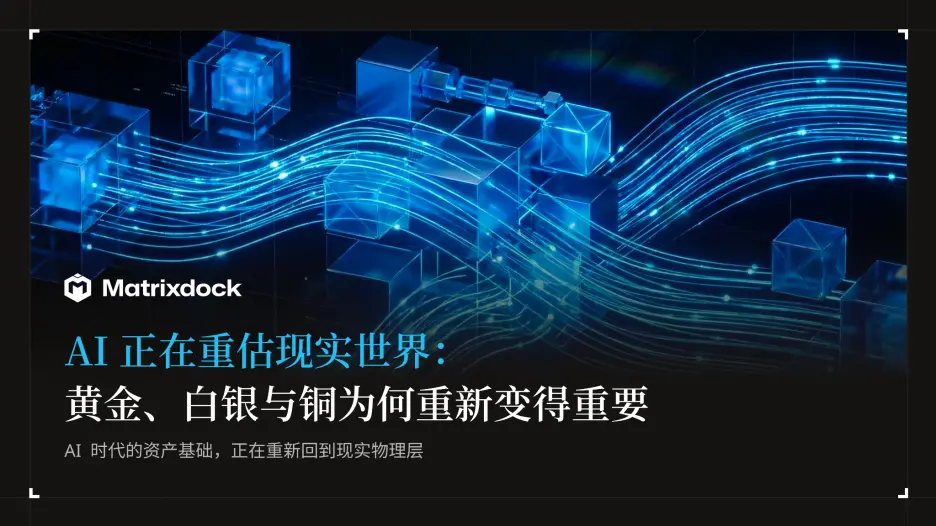
AI is Revaluing the Real World: Why Gold, Silver, and Copper are Becoming Important Again

AI is reassessing the value of the real world: why gold, silver, and copper are regaining importance. For over a decade, financial innovation centered on digitalization, from internet platforms to RWA tokenization. However, AI's rapid development highlights a deeper dependency: the physical infrastructure underpinning the AI era, not just code. Contrary to being "dematerialized," AI strengthens reliance on the real world. Every model training and deployment requires vast resources—data centers, energy grids, cooling systems, and critical industrial materials like copper, silver, and gold, which provide irreplaceable conductivity and durability. This shift is redefining the asset layer structure. A new "Asset Stack" is emerging: - Physical Layer: Metals, energy, and raw materials. - Financial Layer: Government bonds, ETFs, structured products. - Digital Layer: Tokenization infrastructure and programmable assets. The digital layer relies on the financial layer, which ultimately depends on the physical layer. While markets previously rewarded upper-layer assets like stocks and digital platforms, AI is redirecting attention to foundational real-world resources. S&P Global forecasts data center copper demand will surge from 1.1 million tons in 2025 to 2.5 million tons by 2040, amid a growing global supply deficit. This signals a long-term structural shift where energy, metals, and infrastructure form a critical "Physical Layer" that could limit AI's expansion. Tokenization alone doesn't create value; it connects markets to already-trusted assets. Successful tokenization requires mature demand, deep liquidity, and institutional consensus. Thus, the logical progression begins with sovereign debt (highest liquidity and trust), followed by gold (centuries of global consensus), then silver (blending reserve and industrial utility). Future expansion may include industrially critical materials like copper. Within gold, a key divergence is appearing. Gold ETFs solved "investability" but keep gold within traditional financial systems. Gold tokens, like Matrixdock's XAUm, explore making gold a functional part of the digital financial system—enabling instant settlement, cross-border collateral, and programmable utility without intermediaries. Looking ahead, industrial metals are evolving from commodities to strategic "functional assets." Silver faces a structural supply deficit, driven by demand from solar, EVs, and AI infrastructure. While gold represents a "Store of Value," metals like silver and copper are becoming "Stores of Function." Tokenizing them, as with Matrixdock's XAGm for silver, focuses not just on reserve value but on bridging physical commodity systems with digital infrastructure for efficient circulation. Ultimately, the asset layer is evolving to be more grounded in the strategic, physical realities of the economy. The most valuable assets for tokenization may not be the easiest to digitize, but those most essential for long-term economic and technological foundations.

链捕手05/13 11:00

AI is Revaluing the Real World: Why Gold, Silver, and Copper are Becoming Important Again

链捕手05/13 11:00

Wall Street's 'Compliance Hunt': The Great Stablecoin Reserve Migration

In a concentrated move over the past week, several Wall Street giants have advanced their tokenized money market fund initiatives, signaling a strategic shift driven by impending U.S. stablecoin regulations. JPMorgan Chase launched its second such fund, JLTXX, on Ethereum, explicitly targeting future stablecoin issuer reserve needs. Concurrently, Franklin Templeton partnered with Kraken to integrate its BENJI tokenized funds onto the exchange platform for use as collateral and cash management tools. BlackRock further solidified its position by filing for two new tokenized funds with the SEC, aiming to convert its massive traditional stablecoin custody business into a tokenized model. These parallel developments represent a multi-pronged institutional "compliance hunt" to capture future crypto liquidity. BlackRock and JPMorgan are focusing on the backend, preparing to serve as the core reserve and settlement infrastructure for compliant stablecoins as outlined by the GENIUS Act. This act defines strict "qualified reserve asset" requirements for stablecoin backing while prohibiting interest payments to holders. Franklin Templeton and Kraken, however, are exploiting a potential regulatory gap. By offering a tokenized fund (BENJI) that is not a stablecoin, they aim to provide yield-bearing, collateralizable digital cash instruments, circumventing GENIUS Act's ban on stablecoin yield. The impending CLARITY Act, which will delineate digital asset market structure, is seen as a complementary piece to GENIUS. Its treatment of passive income could solidify the niche for instruments like BENJI. With conservative market size estimates for tokenized money market funds reaching hundreds of billions by 2030, Wall Street institutions are positioning themselves early, using on-chain settlement as a key competitive differentiator to offer superior liquidity and composability for the next generation of dollar reserves.

marsbit05/13 05:15

Wall Street's 'Compliance Hunt': The Great Stablecoin Reserve Migration

marsbit05/13 05:15

How Significant a Variable Will the CLARITY Act Be for the 2026 Midterm Elections?

Title: "The CLARITY Act" as a New Variable in the 2026 Midterm Elections Encryption regulation is emerging as a new variable in the 2026 U.S. midterm elections. According to a HarrisX survey, a bipartisan majority of registered voters supports the U.S. maintaining leadership in digital finance and the passage of the CLARITY Act. This legislation aims to define regulatory boundaries between the SEC and CFTC for digital assets, establish registration rules for exchanges and custodians, and enhance consumer protection. Political impact is significant: 37% of voters said they would be more inclined to support a senator who votes for the bill, resulting in a net electoral gain of +20 percentage points. Notably, 47% of voters indicated they would consider voting for a candidate outside their preferred party if that candidate supports the CLARITY Act while their own party does not. This cross-party appeal is even stronger among cryptocurrency holders and voters familiar with digital assets. The survey found that while general awareness of digital assets is limited, there is strong, bipartisan voter demand for clear federal rules. 70% of voters believe the U.S. should have passed clear crypto legislation already, and 62% deem it important for the U.S. to set global digital finance rules. Concerns about national security and the offshore concentration of crypto exchanges (8 of the top 10 are headquartered outside the U.S.) further drive support for federal action. Currently, 52% of voters support the CLARITY Act after hearing a neutral description, versus 11% opposed. Support is bipartisan, with net approval rates of +48 among Republicans, +43 among Democrats, and +32 among independents. The findings suggest that for candidates, supporting the CLARITY Act is a net political positive, offering a pathway to engage young voters, crypto holders, and swing voters. The core question in crypto regulation for U.S. politics is shifting from "whether to regulate" to "who can mobilize votes with it."

marsbit05/10 01:08

How Significant a Variable Will the CLARITY Act Be for the 2026 Midterm Elections?

marsbit05/10 01:08

a16z Crypto Partner: Crypto is Being Repackaged by Financial Institutions, Potential Far Exceeds Imagination

In this article, Guy Wuollet of a16z Crypto explores why traditional financial institutions are increasingly adopting blockchain technology. He questions the term "digital assets," pointing out that most modern assets are already digital. However, he argues that the core infrastructure of finance remains surprisingly undigitized, relying on fragmented systems and manual reconciliation. The key driver for Wall Street's adoption, according to Wuollet, is not the ideological principles of decentralization but a pragmatic need to solve complex coordination problems among multiple, often distrustful, parties. Blockchain offers a neutral, shared system where asset ownership is embedded directly in the software, eliminating the need for separate ledgers and reducing settlement times and costs. As crypto technology is integrated into traditional finance, it loses some of its countercultural edge but gains mainstream legitimacy. More importantly, it brings the powerful software concept of *composability* to finance. When financial assets exist on a shared, programmable infrastructure, they can be easily combined, extended, and integrated, enabling faster innovation and new applications. In essence, crypto is being "repackaged" as critical infrastructure by large institutions. While this integration involves compromises, the underlying transformative potential—inheriting capabilities like composability—may ultimately be far greater than these institutions initially anticipated.

marsbit05/08 16:28

a16z Crypto Partner: Crypto is Being Repackaged by Financial Institutions, Potential Far Exceeds Imagination

marsbit05/08 16:28

a16z Crypto Partner: Cryptocurrency is Being Repackaged by Financial Institutions, Its Potential Far Exceeds Imagination

"Digital Assets" and the Real Digital Transformation of Finance The term "digital assets" puzzles many in crypto, as most assets today are already digital. Yet, the financial industry's core infrastructure has largely escaped the profound digital transformation seen in other sectors like media and retail. Beneath modern interfaces, finance still relies on fragmented systems, manual reconciliation, and paper-based processes. The true driver for blockchain adoption by large financial institutions is not ideology but a practical need to solve coordination problems. It provides a neutral system for multiple parties to collaborate without ceding control to a single entity. Asset ownership is encoded directly into the software, eliminating separate ledgers and disputes over records. The asset *is* the record. While crypto's adoption by Wall Street involves compromises and compliance, it inherits a key capability: *composability*. When financial assets exist on shared, programmable infrastructure, they can be combined, extended, and integrated seamlessly. The immediate benefits are faster settlement and lower costs, but the deeper, structural change is the newfound ease of building applications on top of this system. In essence, crypto technology is not disappearing into financial institutions but being repackaged as foundational infrastructure. As Wall Street adopts it, the industry may ultimately inherit more of crypto's transformative potential than it initially anticipated.

链捕手05/08 06:42

a16z Crypto Partner: Cryptocurrency is Being Repackaged by Financial Institutions, Its Potential Far Exceeds Imagination

链捕手05/08 06:42

活动图片